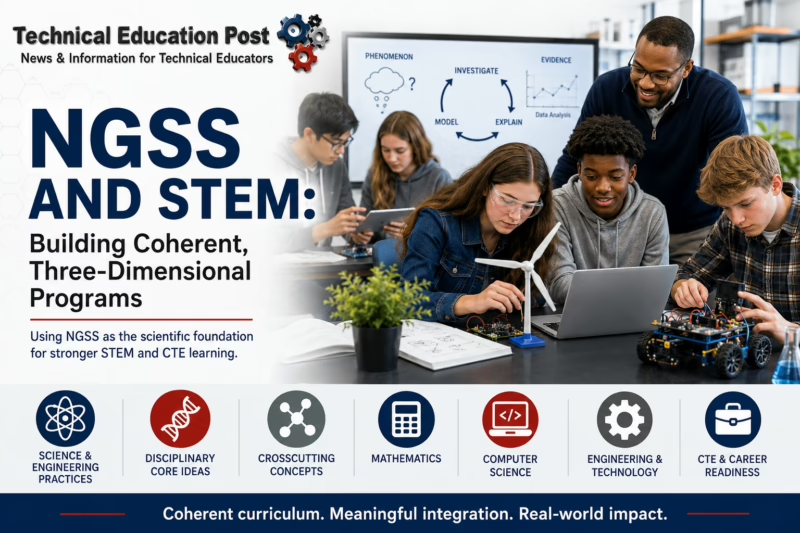
NGSS and STEM are frequently discussed as though they are interchangeable. They are not.
The Next Generation Science Standards define what students should know and be able to demonstrate in K–12 science. They organize science learning around the integration of disciplinary knowledge, scientific and engineering practices, and concepts that connect ideas across fields.
STEM education is broader. Depending on the school or program, it may include science, mathematics, engineering, technology, computer science, data science, career and technical education, work-based learning, advanced manufacturing, biotechnology, agriculture, energy, health science, or interdisciplinary capstones.
NGSS therefore does not define an entire STEM program.
It can, however, provide the scientific and engineering backbone that many STEM programs lack.
That role is important because hands-on activity alone does not ensure academic depth. Students can build bridges, code robots, fabricate products, test water, or design energy systems without developing a coherent understanding of forces, matter, ecosystems, energy, heredity, Earth systems, or engineering trade-offs.
The strongest programs use NGSS to answer a central question:
What scientific understanding and evidence must students use to explain the phenomenon or justify the solution?
They then use mathematics, computer science, technology-and-engineering standards, CTE competencies, and workforce expectations to complete the program.
Key Takeaways
- NGSS is a set of science standards, not a complete STEM curriculum or instructional program.
- Its central innovation is three-dimensional learning: students use scientific and engineering practices, disciplinary core ideas, and crosscutting concepts together.
- NGSS performance expectations describe end-of-instruction performances; they should not be reduced to daily objectives or disconnected checklist items.
- A project is not NGSS-aligned merely because students build, code, measure, or collaborate.
- Engineering design is part of science education under NGSS, but it must involve scientific reasoning, criteria, constraints, testing, evidence, and optimization.
- STEM programs still need separate mathematics, computer science, technology-and-engineering, CTE, safety, and career-readiness standards.
- Three-dimensional assessment must examine reasoning, models, data, explanations, arguments, and design decisions—not only the final product.
- Curriculum quality depends on coherence, teacher capacity, equitable access, assessment, and sustained implementation—not equipment purchases alone.
What the Next Generation Science Standards Actually Are
The NGSS emerged from a state-led standards-development process based on the National Research Council’s 2012 report, A Framework for K–12 Science Education.
The Framework called for science education to move away from teaching long lists of disconnected facts and toward coherent learning organized through three dimensions:
- Science and Engineering Practices
- Disciplinary Core Ideas
- Crosscutting Concepts
The NGSS combines these dimensions in performance expectations describing what students should be able to demonstrate after instruction.
This represents more than an update to science content.
Students are expected to:
- Ask questions and define problems
- Develop and use models
- Plan and conduct investigations
- Analyze and interpret data
- Use mathematics and computational thinking
- Construct explanations and design solutions
- Engage in argument from evidence
- Obtain, evaluate, and communicate information
The complete Framework can be explored through the National Academies’ interactive version.
NGSS Is Not a Curriculum
The NGSS specifies learning expectations. It does not prescribe:
- A textbook
- A required unit sequence
- A single teaching method
- A particular engineering kit
- A mandatory STEM program model
- Daily lesson objectives
- A specific technology platform
- A local grading policy
States and districts remain responsible for curriculum, instructional materials, professional learning, assessment systems, course design, graduation requirements, and implementation.
This distinction matters because publishers, programs, and individual activities often describe themselves as “NGSS-aligned” after attaching standards codes to existing materials.
A standards code does not establish meaningful alignment.
A genuinely aligned unit must provide students with sustained opportunities to use the three dimensions together while explaining phenomena or solving problems.
STEM Does Not Have One Nationally Binding Definition
STEM education can take many forms:
- Integrated science and mathematics
- Engineering design
- Computer science
- Robotics
- Makerspaces
- Project-based learning
- Career academies
- CTE pathways
- Interdisciplinary capstones
- Informal or after-school programs
- Industry-connected technical education
The National Academies’ report STEM Integration in K–12 Education found substantial variation in how integrated STEM is defined and implemented.
That flexibility can support innovation, but it also creates a quality-control problem.
Two schools may both describe a course as STEM even when one offers a coherent sequence of standards-aligned investigations and the other offers unrelated technology activities.
District leaders should therefore define what STEM means locally.
A useful definition should identify:
- Included disciplines
- Required standards
- Grade-level progression
- Intended student outcomes
- Role of engineering design
- Role of technology
- Role of computer science
- Assessment expectations
- Career and postsecondary connections
- Access and equity expectations
NGSS as the Scientific Backbone of STEM
NGSS can strengthen STEM education in four important ways.
1. It Requires Scientific Understanding
Students cannot demonstrate an NGSS performance expectation through construction alone.
They must use scientific ideas.
For example, building a wind turbine does not automatically demonstrate understanding of:
- Energy transfer
- Forces
- Electrical systems
- Material properties
- Efficiency
- System constraints
An aligned task requires students to use relevant science to explain performance and make design decisions.
2. It Makes Practices Part of the Learning
NGSS does not treat investigation, modeling, data analysis, argumentation, and engineering as optional enrichment.
Students must use those practices to develop and demonstrate understanding.
3. It Supports Coherence Across Grades
The Framework organizes disciplinary core ideas as learning progressions. Students encounter increasingly sophisticated versions of important ideas over time.
A coherent energy sequence might include:
- Elementary observations of heating, light, motion, and sound
- Middle school modeling of energy transfer and transformation
- High school quantitative analysis of energy systems, efficiency, storage, and environmental effects
A STEM program should make that development visible.
4. It Prevents Technology From Becoming the Curriculum
Robotics kits, sensors, fabrication tools, simulations, AI systems, and coding platforms can support excellent learning.
They can also become ends in themselves.
NGSS requires educators to ask what students are learning about the natural or designed world through the technology.
The Three Dimensions of NGSS
Science and Engineering Practices
The practices describe what students do while developing and using scientific knowledge.
They are not a generic list of skills taught separately from content.
A student does not master “analyzing data” in the abstract. The student analyzes particular data to understand a system, evaluate a claim, or improve a design.
The Eight Practices
- Asking questions and defining problems
- Developing and using models
- Planning and carrying out investigations
- Analyzing and interpreting data
- Using mathematics and computational thinking
- Constructing explanations and designing solutions
- Engaging in argument from evidence
- Obtaining, evaluating, and communicating information
The practices should develop progressively across grade bands. Elementary students may compare observations and explain simple patterns, while high school students may evaluate competing models, analyze uncertainty, defend methodological choices, and revise claims in response to evidence. The official NGSS appendices provide grade-band progressions for each practice.
Disciplinary Core Ideas
Disciplinary core ideas identify the science and engineering knowledge that warrants sustained attention across multiple grades.
They are organized into four areas:
- Physical sciences
- Life sciences
- Earth and space sciences
- Engineering, technology, and applications of science
A core idea is not simply an important fact. The Framework selected ideas that have broad importance, provide a foundation for more advanced learning, connect with students’ interests or experiences, and can be taught at increasing levels of sophistication. The aim is depth and progression rather than superficial coverage of many unrelated topics.
For STEM leaders, the implication is significant. A one-time robotics activity, bridge challenge, or environmental project should not stand alone. It should contribute to a longer progression in which students revisit ideas such as systems, energy, force, matter, heredity, ecosystems, Earth processes, or engineering design with increasing explanatory power.
Crosscutting Concepts
Crosscutting concepts help students recognize patterns of reasoning that apply across scientific disciplines and engineering contexts.
The seven crosscutting concepts are:
- Patterns
- Cause and effect
- Scale, proportion, and quantity
- Systems and system models
- Energy and matter
- Structure and function
- Stability and change
Crosscutting concepts are frequently the least visible part of NGSS implementation. A teacher may clearly identify the science content and the student activity but never require students to use a crosscutting concept as a reasoning tool.
For example:
- Students use cause and effect to distinguish a correlation from a supported causal explanation.
- Students use systems and system models to identify components, boundaries, inputs, outputs, and interactions.
- Students use structure and function to explain why a material, organism, or engineered component behaves as it does.
- Students use stability and change to analyze ecosystem balance, climate patterns, manufacturing processes, or feedback systems.
- Students use scale, proportion, and quantity when comparing a classroom model with a full-sized technical system.
The NGSS appendices provide grade-band progressions for the crosscutting concepts, helping curriculum teams avoid teaching them as vocabulary labels disconnected from scientific reasoning. (NGSS Appendices)
Why NGSS-Aligned STEM Matters Now
The latest national science results reinforce the importance of deeper science learning.
The 2024 National Assessment of Educational Progress science assessment found that the average eighth-grade science score was four points lower than in 2019. Scores declined across all five reported performance percentiles. Thirty-one percent of eighth-graders performed at or above NAEP Proficient, four percentage points lower than in 2019.
NAEP Proficient is a performance standard specific to NAEP and should not be interpreted as the same thing as grade-level proficiency on a state test. The trend nevertheless provides a national warning: many students are not demonstrating the science knowledge and practices needed to investigate questions and reason in real-world contexts. (2024 NAEP Science Results)
The NAEP assessment is not itself an NGSS assessment. Its current science framework predates the NGSS. However, it measures both content and practices, including scientific inquiry and technological design. Its findings strengthen the case for science programs that move beyond recall and provide repeated opportunities to use knowledge.
What NGSS Does—and Does Not—Cover
NGSS can anchor the science and engineering dimension of STEM, but it should not be asked to define every program outcome.
A complete STEM or CTE pathway may need several standards frameworks.
| Program Component | Appropriate Standards or Framework | What It Contributes |
|---|---|---|
| Science | NGSS, the National Academies Framework, and applicable state science standards | Science content, science and engineering practices, crosscutting concepts, and performance expectations |
| Mathematics | State mathematics standards and applicable mathematical-practice standards | Modeling, statistics, functions, measurement, proportional reasoning, precision, and quantitative justification |
| Computer science | 2026 CSTA PK–12 Computer Science Standards and state computer science standards | Algorithms, programming, data, systems, security, computing and society, AI, and human-centered design |
| Technology and engineering | ITEEA Standards for Technological and Engineering Literacy and state engineering standards | Technological systems, design, impacts, optimization, engineering practices, and technological literacy |
| CTE | State program standards, industry competencies, safety requirements, credentials, and approved programs of study | Occupational competence, technical performance, equipment use, safety, and career readiness |
| Employability and work-based learning | State career-readiness standards and local employer expectations | Communication, teamwork, documentation, professionalism, and workplace performance |
The newly published 2026 CSTA standards reinforce that computer science is not simply technology use or coding. They address algorithms and design, programming, data and analysis, systems and security, computing and society, ethics, collaboration, computational thinking, and human-centered design. NGSS may connect naturally with these areas, but it does not replace computer science standards.
Similarly, ITEEA’s Standards for Technological and Engineering Literacy provide a broader framework for technological systems, engineering practices, and the social and environmental effects of technology. Those expectations extend beyond the engineering design components of NGSS.
Engineering Design Under NGSS
Engineering design is one of the most important bridges between NGSS and STEM.
It is also one of the most frequently misunderstood.
Engineering under NGSS is not defined by the presence of building materials. It is defined by a process of:
- Defining a problem
- Establishing criteria
- Identifying constraints
- Generating possible solutions
- Comparing alternatives
- Testing designs
- Analyzing evidence
- Improving or optimizing the solution
For example, middle school students may be expected to define criteria and constraints precisely, evaluate competing solutions systematically, and analyze test data to identify features that could improve a new design. (MS-ETS1-1) (MS-ETS1-2) (MS-ETS1-3)
A student who creates the most successful prototype has not necessarily demonstrated the deepest understanding.
A failed prototype may provide stronger evidence when the student can:
- Explain the scientific reason for the failure
- Analyze the quality of the test
- Identify a relevant constraint
- Compare competing approaches
- Use data to recommend a redesign
- Discuss uncertainty and trade-offs
Activity Versus NGSS-Aligned Engineering
| Activity-Based Project | NGSS-Aligned Engineering Task |
| Build the tallest tower | Design a structure that maximizes height while meeting stability and material constraints |
| Build a wind turbine | Use evidence about energy transfer and blade performance to optimize electrical output |
| Make a water filter | Analyze matter, particle properties, flow, and test data to improve filtration performance |
| Program a robot | Use sensor evidence, force, motion, energy, or system models to improve robotic performance |
| Build a greenhouse | Model energy and matter flows and evaluate conditions affecting plant growth |
| Create a bridge | Compare structural designs using load data, material properties, geometry, cost, and failure analysis |
The second column is not stronger merely because it includes more steps. It is stronger because students must use scientific ideas and evidence to make engineering decisions.
Start With a Phenomenon or a Problem
NGSS-aligned units are often organized around a phenomenon students seek to explain or a problem they seek to solve.
A phenomenon is an observable event, process, or pattern that gives students a reason to develop scientific understanding.
A problem creates a need for engineering design.
Strong anchors might include:
- Why are some areas of the school grounds consistently warmer?
- Why did dissolved oxygen decline in a local stream?
- Why does one classroom require more energy for heating and cooling?
- Why did a particular component fail under repeated loads?
- How can a greenhouse maintain a more stable growing environment?
- How can a community reduce stormwater runoff?
- Why do two materials with similar appearances perform differently?
- How can an assistive device be optimized for a specific user?
The phenomenon or problem should be consequential enough to sustain investigation, but bounded enough to support the intended grade-level learning.
A dramatic video or teacher demonstration is not automatically a strong phenomenon. It must create a genuine need for the knowledge students are expected to develop.
Student Sensemaking Is the Instructional Center
NGSS-aligned instruction is often described as sensemaking.
Students are not simply receiving explanations from the teacher and then confirming them through a laboratory activity. They are developing, testing, discussing, and revising explanations or solutions.
A sensemaking sequence may include:
- Encountering a phenomenon or problem
- Recording observations and initial questions
- Developing an initial model
- Identifying information needed
- Conducting investigations or analyzing data
- Learning relevant scientific ideas
- Revising the model or explanation
- Evaluating evidence
- Applying understanding to a related context
- Communicating the final explanation or solution
Direct instruction remains important. Students cannot be expected to discover every scientific idea independently.
The distinction is that instruction is used to advance students’ explanatory work rather than becoming a disconnected presentation of information.
Designing an NGSS-Aligned STEM Unit
Step 1: Select the Intended Performance
Begin with the performance expectations and applicable state standards.
Determine:
- What should students explain or design?
- Which science ideas are essential?
- Which practices must students use?
- Which crosscutting concepts should guide their reasoning?
- What would count as convincing evidence of learning?
Performance expectations describe end-of-instruction expectations. They should not be copied directly into daily lesson plans as though each could be completed in a single class period.
Step 2: Unpack the Three Dimensions
Identify the specific elements of:
- Science and engineering practices
- Disciplinary core ideas
- Crosscutting concepts
The official NGSS Evidence Statements provide additional detail about observable components that can satisfy performance expectations.
Step 3: Choose a Phenomenon or Problem
The anchor should require the intended science.
Ask:
- Can students explain it using prior knowledge alone?
- Will it sustain questions across the unit?
- Does it connect with student or community experience?
- Can it generate relevant data, models, investigations, or designs?
- Is it accessible within available time and resources?
- Does it avoid sensationalizing trauma or community problems?
Step 4: Build the Learning Progression
Map how student thinking should develop.
A progression may move from:
- Observable patterns
- To identification of variables
- To a mechanism or system model
- To quantitative analysis
- To an evidence-based explanation
- To transfer in a new situation
This is more useful than planning a sequence based only on activities.
Step 5: Identify the STEM Contributions
Determine what the other disciplines genuinely contribute.
Mathematics may support:
- Measurement
- Proportional reasoning
- Statistics
- Functions
- Modeling
- Optimization
- Uncertainty
Computer science may support:
- Data collection
- Coding
- Simulation
- Algorithms
- Automation
- Data visualization
- Sensor systems
Engineering may support:
- Criteria
- Constraints
- Prototyping
- Testing
- Failure analysis
- Optimization
CTE may support:
- Industry tools
- Safety procedures
- Technical documentation
- Quality requirements
- Career context
- Authentic performance standards
Do not add every discipline simply to justify the STEM label. Integration should deepen the intended learning.
Step 6: Plan the Evidence
Decide what students will produce.
Possible evidence includes:
- Initial and revised models
- Data tables
- Investigation plans
- Graphs
- Engineering notebooks
- Technical drawings
- Code
- Design-test records
- Scientific explanations
- Arguments from evidence
- Oral defenses
- Individual reflections
Step 7: Design Supports
Plan for:
- Prerequisite knowledge
- Reading and vocabulary demands
- Multilingual learners
- Students with disabilities
- Safety
- Equipment access
- Varied prior STEM experiences
- Extension and remediation
- Multiple methods of communication
Step 8: Review the Unit as a Coherent Whole
Ask whether the unit:
- Advances toward the performance expectations
- Uses all three dimensions
- Supports student sensemaking
- Builds across lessons
- Includes formative assessment
- Requires individual evidence
- Uses technology and engineering purposefully
- Ends with a performance that matches the intended learning
NGSS-Aligned STEM by Grade Band
Elementary School
Elementary science should not be reduced to occasional demonstrations or holiday activities.
Students can engage in:
- Observation
- Measurement
- Pattern identification
- Simple modeling
- Investigation
- Evidence-based explanation
- Age-appropriate engineering design
Examples include:
- Comparing how different surfaces heat in sunlight
- Investigating plant needs
- Modeling animal habitats
- Testing erosion-control materials
- Designing a device that changes the direction or speed of motion
- Comparing materials for a specific use
Elementary students may represent understanding through drawings, physical models, oral explanations, simple graphs, and guided written responses.
The National Academies has emphasized that strong science and engineering learning should begin in the early grades and build on children’s existing curiosity, ideas, language, and capabilities—not wait until secondary school. (National Academies STEM Education Collection)
Middle School
Middle school students can engage in more explicit systems thinking, proportional reasoning, controlled testing, computational modeling, and evaluation of trade-offs.
Appropriate work includes:
- Analyzing sensor data
- Comparing material performance
- Modeling energy transfer
- Investigating ecosystem change
- Testing water-treatment designs
- Programming physical systems
- Comparing competing engineering solutions
- Evaluating evidence for scientific claims
Students need support in distinguishing:
- Observation from inference
- Correlation from causation
- A variable from a control
- Repeated tinkering from systematic testing
- A claim from supporting evidence
- A physical model from the system it represents
High School
High school NGSS-aligned STEM should require deeper disciplinary knowledge and more sophisticated evidence.
Students may:
- Analyze large datasets
- Evaluate scientific literature
- Develop computational models
- Conduct multi-week investigations
- Apply statistical analysis
- Examine uncertainty
- Create and test engineering systems
- Use CAD or simulation
- Present technical arguments
- Complete capstones
The task should remain anchored in science learning even when it includes advanced tools or industry contexts.
Connecting NGSS With CTE Pathways
NGSS can strengthen the scientific reasoning behind technical performance.
It should not replace pathway-specific standards or occupational competence.
| CTE Pathway | Relevant Science Foundation | Possible NGSS-Aligned Performance |
| Advanced manufacturing | Material properties, force, energy, structure and function | Test competing materials and justify selection using performance, cost, and failure data |
| Construction and HVAC | Heat transfer, energy, matter, systems | Compare wall assemblies or HVAC strategies using thermal data and system constraints |
| Agriculture | Ecosystems, heredity, matter cycling, water systems | Use soil, weather, and sensor data to improve irrigation or crop-system decisions |
| Health science | Body systems, microorganisms, heredity, matter and energy | Analyze disease transmission or physiological data and justify an intervention |
| Biotechnology | Cellular systems, genetics, chemical processes | Evaluate experimental data and explain biological mechanisms |
| Energy | Energy transfer, Earth systems, environmental impacts | Compare energy-generation and storage options using scientific and economic evidence |
| Transportation | Force, motion, energy, materials | Analyze braking, efficiency, stability, or structural safety under constraints |
| Robotics and automation | Force, energy, waves, feedback, systems | Use sensor and performance data to optimize a robotic system |
| Environmental and natural resources | Ecosystems, Earth systems, human impacts | Investigate water, soil, air, habitat, or climate patterns and recommend action |
Perkins V supports nearly $1.4 billion annually for CTE programs and career pathways, but proposed expenditures must align with approved programs, local needs, state plans, and allowable uses. NGSS-related equipment should not be treated as automatically eligible simply because it supports STEM. (Perkins V)
Assessing NGSS-Aligned STEM
Three-dimensional learning requires three-dimensional evidence.
The National Academies concluded that NGSS assessment should involve tasks or task components that allow students to use practices while reasoning with core ideas and crosscutting concepts. Assessments also need to reflect learning progressions and support interpretation of varied student products. (Developing Assessments for the Next Generation Science Standards)
A vocabulary quiz may provide useful evidence about prerequisite knowledge. It cannot, by itself, show whether a student can explain a phenomenon, analyze data, revise a model, or design a solution.
Use Multiple Forms of Evidence
A balanced unit may include:
- Selected-response checks
- Short constructed responses
- Student models
- Data interpretation
- Investigation plans
- Engineering tasks
- Claims supported by evidence
- Oral questioning
- Portfolios
- Technical presentations
- Individual reflections
Reason From Evidence
Assessment design should begin with the conclusion educators want to make about student learning.
Ask:
- What claim do we want to make about the student?
- What evidence would support that claim?
- What task could produce that evidence?
- How will the evidence be evaluated?
The National Academies identifies evidence-centered design as an especially useful approach for assessments intended to measure integrated NGSS performance.
Assess Models, Not Just Model Appearance
A strong model should help explain or predict a system.
Students should be able to explain:
- What each component represents
- Which relationships matter
- What is inside or outside the system
- Which evidence supports the model
- What the model cannot represent
- Why the model changed
A polished diagram without explanatory value is not strong evidence.
Assess Engineering Reasoning
A design rubric may address:
- Problem definition
- Scientific basis
- Criteria and constraints
- Test quality
- Data interpretation
- Trade-offs
- Redesign
- Communication
- Safety
Avoid grading only whether the prototype functions.
Combine Team and Individual Evidence
Team projects may produce authentic collaboration, but a shared product does not establish individual mastery.
Use:
- Individual explanations
- Engineering notebooks
- Oral defenses
- Personal data analysis
- Role-specific artifacts
- Short transfer tasks
- Reflection tied to evidence
Use Formative Assessment Throughout
The National Academies describes classroom assessment as including teacher-student interactions, observations, student products, and assessments closely connected to instruction. These methods allow teachers to respond while learning is still developing.
Useful checkpoints include:
- Initial model
- Question board
- Investigation plan
- Data-quality conference
- Draft explanation
- Prototype review
- Peer critique
- Revised model
- Final performance
Equity Is an Implementation Requirement
NGSS was designed for all students, not only those pursuing science careers.
That aspiration does not guarantee equitable implementation.
The National Academies’ 2025 report on equity in K–12 STEM emphasizes that learning opportunities remain unevenly distributed and that equity requires ongoing, context-specific decisions rather than a one-time program initiative. (Equity in K–12 STEM Education)
Program leaders should examine:
- Time allocated to science
- Quality of instructional materials
- Access to laboratories and equipment
- Availability of advanced courses
- Representation in engineering and CTE pathways
- Experienced teacher distribution
- Participation in technical roles
- Access to informal STEM opportunities
- Course prerequisites
- Transportation and scheduling
- Outcome patterns by student group
Multilingual Learners
Science learning is language-rich.
Students must describe observations, ask questions, interpret representations, evaluate claims, participate in argument, and communicate explanations.
Language development and science learning should therefore occur together.
The National Academies recommends that English learners receive access to rigorous, grade-appropriate STEM learning and that curriculum, instruction, assessment, and teacher development be designed with their needs in mind from the beginning. (English Learners in STEM Subjects)
Useful supports include:
- Visual models
- Structured discussion
- Multiple representations
- Word banks
- Sentence frames
- Bilingual resources
- Annotated diagrams
- Opportunities to rehearse explanations
- Strategic use of home language
- Multiple methods of demonstrating reasoning
Language supports should not remove the scientific reasoning required by the task.
Students With Disabilities
Accessible NGSS implementation may require:
- Adapted laboratory tools
- Accessible digital materials
- Captioning
- Screen-reader-compatible resources
- Alternative input devices
- Flexible workspace
- Tactile or enlarged models
- Multiple communication methods
- Additional processing time when speed is not the target
- Explicit safety planning
Students with disabilities should participate as investigators, modelers, designers, analysts, and decision-makers—not be assigned only observational roles.
Place and Community Matter
Local phenomena can increase relevance when educators use them responsibly.
Possible contexts include:
- Water quality
- Building energy use
- Agriculture
- Local manufacturing
- Urban heat
- Habitat change
- Transportation
- Air quality
- Weather hazards
- Community health
Educators should avoid using a community merely as a source of problems. Students should learn about local expertise, existing assets, historical context, and the people already working on the issue.
Reviewing Curriculum and Instructional Materials
Claims of NGSS alignment should be evaluated systematically.
Use the EQuIP Rubric for Lessons and Units
The current EQuIP Rubric for Science is designed to evaluate how well lessons and units reflect NGSS design.
Its uses include:
- Identifying needed revisions
- Providing criterion-based feedback
- Reviewing potential model materials
- Supporting development of new units
- Building shared understanding among educators
The current page identifies Version 3.1 as the applicable rubric.
Use the Lesson Screener for an Initial Review
The NGSS Lesson Screener provides a quicker, informal review before a full EQuIP analysis.
It is intended for coherent learning sequences extending over several class periods or days—not a single isolated activity.
Use NextGen TIME for Full Programs
The NGSS resource center recommends NextGen TIME when districts are evaluating year-long instructional programs. The older PEEC tool remains available but is identified as archived. (PEEC and NextGen TIME)
Warning Signs in “NGSS-Aligned” Materials
Be cautious when materials:
- Add standards codes without changing instruction
- Present the science explanation before students investigate
- Use hands-on activities without student reasoning
- Include only one dimension of a performance expectation
- Treat crosscutting concepts as vocabulary
- Use an engineering challenge unrelated to the science
- Lack opportunities to revise models
- Assess recall after project-based instruction
- Provide no individual evidence of learning
- Assume expensive equipment without alternatives
- Ignore language, accessibility, or cultural context
Professional Learning and Teacher Capacity
NGSS implementation is not a matter of distributing new standards documents.
Teachers need support in:
- Reading performance expectations
- Understanding the three dimensions
- Selecting phenomena
- Facilitating student discussion
- Supporting modeling
- Integrating engineering
- Interpreting student thinking
- Designing assessments
- Supporting multilingual learners
- Using technical tools
- Managing investigations safely
- Reviewing curriculum materials
Professional learning should be sustained and connected with actual curriculum.
Useful structures include:
- Unit-design teams
- Lesson study
- Student-work analysis
- Instructional coaching
- Co-teaching
- Peer observation
- EQuIP review sessions
- Grade-band planning
- Science and CTE collaboration
- Mathematics and data-analysis support
The EQuIP professional-learning materials provide a ten-module structure for building educator and leadership capacity to use the rubric and understand NGSS-aligned instructional design. (EQuIP Professional Learning Facilitator’s Guide)
Federal Title II-A funds may support professional learning, recruitment, retention, and educator capacity when activities comply with program requirements and approved state or local plans. The Department of Education updated its Title II-A resource page and guidance materials in 2025 and 2026. (Title II-A Supporting Effective Instruction)
Leadership and Scheduling
Interdisciplinary STEM does not emerge from enthusiasm alone.
Schools may need:
- Common planning periods
- Summer curriculum institutes
- Shared project calendars
- Protected professional-learning time
- STEM or science coaches
- Laboratory support
- CTE-science co-planning
- Data and assessment review
- Equipment-management systems
- Safety oversight
- Community-partnership coordination
Leaders should also protect dedicated science instructional time, particularly in elementary schools.
The National Academies’ Call to Action for Science Education identifies time, instructional resources, a strong teaching workforce, student pathways, assessment, and evidence-based improvement as national priorities.
Costs and Funding
NGSS-aligned STEM can be implemented at several cost levels.
Local phenomena, public datasets, simple materials, and existing tools can support strong learning. Advanced manufacturing, biotechnology, robotics, energy, environmental monitoring, and engineering pathways may require sustained investments.
Common Cost Categories
- Curriculum materials
- Laboratory consumables
- Safety equipment
- Sensors and probes
- Data systems
- Fabrication equipment
- Maintenance
- Software
- Teacher professional learning
- Curriculum-development time
- Substitute coverage
- Accessibility
- Assessment development
- Partnership coordination
- Equipment storage
- Replacement cycles
The largest cost is not always equipment. Curriculum development, teacher collaboration, and professional learning can determine whether equipment produces meaningful instruction.
Title IV-A
The Student Support and Academic Enrichment program supports well-rounded education, improved learning conditions, and effective technology use. The Department of Education currently lists estimated total grant funding of $1.38 billion and published a Title IV-A public-reporting update in May 2026. Local uses must remain consistent with program requirements and approved plans. (Title IV-A Student Support and Academic Enrichment)
Title II-A
Title II-A may support educator professional learning and capacity building. Proposed uses should address identified educator and student needs and comply with current federal, state, and local requirements.
Perkins V
Perkins V may support science-and-engineering integration inside approved CTE programs of study when expenditures align with the comprehensive local needs assessment, pathway goals, and allowable uses.
It should not be treated as a general-purpose source for science equipment outside eligible CTE programming.
State, Local, and Partnership Funding
Other possible support includes:
- State STEM grants
- Science instructional-materials funds
- Workforce-development grants
- Local education foundations
- Community college partnerships
- University research-practice partnerships
- NSF-funded education projects
- Industry contributions
- Regional STEM ecosystems
- Capital or technology funds
Partnerships should serve curriculum goals. A donated technology should not dictate what students learn merely because it is available.
A One-Year NGSS and STEM Implementation Roadmap
Months 1–3: Establish the Baseline
- Define the district’s meaning of STEM.
- Inventory existing units and projects.
- Map current science standards.
- Review instructional materials.
- Identify access and equipment differences.
- Examine current assessment practices.
- Survey teacher professional-learning needs.
- Identify promising existing units.
Months 4–6: Build Shared Capacity
- Train a representative leadership and teacher team.
- Study the three dimensions.
- Review student work.
- Practice using the EQuIP Rubric.
- Establish curriculum-review criteria.
- Identify priority grade bands or pathways.
- Protect collaboration time.
Months 7–9: Redesign and Pilot
Select a limited number of units.
For each unit:
- Identify performance expectations.
- Select a phenomenon or problem.
- Build the learning progression.
- Clarify mathematics, technology, engineering, and CTE connections.
- Develop formative assessments.
- Build accessibility and language supports.
- Pilot with a manageable student group.
Months 10–12: Review Evidence
- Analyze student work.
- Compare intended and actual learning.
- Review teacher implementation.
- Examine participation by student group.
- Document equipment and scheduling problems.
- Revise the unit.
- Determine whether it is ready to scale.
- Develop the next cycle of professional learning.
Scaling should follow evidence from implementation—not the visual appeal of the project.
Common Mistakes
Mistake 1: Treating Hands-On as Minds-On
Students may be physically active without developing a scientific explanation.
Correction: Require models, evidence, analysis, explanation, and revision.
Mistake 2: Beginning With the Product
“Students will build a rocket” does not define the science learning.
Correction: Begin with what students will explain about force, motion, energy, stability, or system performance.
Mistake 3: Using Only One Dimension
A unit may contain the correct science topic but provide no meaningful practice or crosscutting concept.
Correction: Unpack and assess all three dimensions.
Mistake 4: Labeling Generic Skills as Practices
“Students collaborated” is not equivalent to using a science and engineering practice.
Correction: Identify the specific practice and the disciplinary evidence students will produce.
Mistake 5: Ignoring Crosscutting Concepts
Students complete investigations but do not develop transferable ways of reasoning.
Correction: Make the crosscutting concept explicit in questions, modeling, discussion, and assessment.
Mistake 6: Adding Engineering Without Science
Students build and test but cannot explain performance.
Correction: Require scientific principles to influence design decisions.
Mistake 7: Buying Equipment Before Designing Curriculum
Tools remain underused or support isolated activities.
Correction: Establish the standards, unit, teacher capacity, assessment, access plan, and recurring budget first.
Mistake 8: Assessing Recall After Three-Dimensional Instruction
Students spend weeks modeling and designing but receive a vocabulary test.
Correction: Use assessments matching the learning experience and intended performance.
Mistake 9: Assuming Equity From Enrollment
All students may be present while only some use the equipment, lead the investigation, or explain the results.
Correction: Monitor roles, participation, access, outcomes, and instructional opportunity.
Mistake 10: Expecting Teachers to Integrate Without Time
Integration remains superficial when teachers must develop it individually outside paid planning time.
Correction: Create a sustainable collaboration structure.
NGSS-Aligned STEM Unit Review Checklist
| Review Question | Evidence to Seek |
| Is the unit anchored in a meaningful phenomenon or problem? | Students have a sustained reason to develop the intended science |
| Are the performance expectations clearly identified? | Standards are unpacked into the three dimensions |
| Do students use science and engineering practices? | Students investigate, model, analyze, explain, argue, design, or communicate |
| Are disciplinary core ideas necessary? | Students cannot complete the performance through construction or opinion alone |
| Are crosscutting concepts used as reasoning tools? | Student questions, models, explanations, and assessments use the concepts |
| Does learning build across the unit? | Lessons contribute to a coherent progression |
| Is mathematics authentic? | Quantitative reasoning influences an explanation or decision |
| Is technology purposeful? | Technology supports data, modeling, design, communication, or investigation |
| Is engineering evidence-based? | Criteria, constraints, tests, trade-offs, and redesign are documented |
| Is the assessment three-dimensional? | Students apply knowledge and practices together |
| Is individual understanding visible? | Individual models, explanations, analysis, or oral defenses are included |
| Are language and accessibility supports built in? | Diverse learners can participate in the intended reasoning |
| Are safety and equipment needs realistic? | Procedures, supervision, storage, maintenance, and access are addressed |
| Does the unit support transfer? | Students use their understanding in a related but unfamiliar context |
Questions to Ask Your Program
Standards and Curriculum
- Which NGSS or state science performance expectations are central to each STEM unit?
- Are students using all three dimensions?
- Where do crosscutting concepts develop across grade levels?
- How are engineering-design expectations taught progressively?
- Which units are coherent learning sequences, and which are isolated activities?
- What evidence supports claims that purchased materials are NGSS-aligned?
Instruction and Assessment
- Do units begin with a phenomenon, problem, or teacher explanation?
- When do students revise models or explanations?
- Do assessments match the intended performance?
- How is individual understanding measured in team projects?
- Are students expected to communicate limitations and uncertainty?
- Which results lead to instructional changes?
Equity and Access
- How much science instructional time does each student receive?
- Which students access advanced STEM, engineering, computer science, and CTE pathways?
- Are laboratory, technology, and equipment opportunities comparable across schools?
- Do multilingual learners receive access to rigorous science reasoning?
- Do students with disabilities participate fully in investigations and design?
- Who performs the most technical roles during team projects?
Leadership and Sustainability
- Is teacher collaboration protected and compensated?
- What professional learning is required?
- What are the recurring equipment and consumable costs?
- How will units remain current?
- Are partnerships supporting rather than directing curriculum?
- What happens after grant funding ends?
What to Watch Next
State Science Assessments
States continue to develop and revise science assessments intended to capture more complex performance.
Curriculum leaders should review:
- State test blueprints
- Released items
- Performance-task examples
- Accessibility policies
- Scoring guidance
- Achievement-level descriptions
Local instruction should not be narrowed to test preparation. However, students should not encounter evidence-based modeling, data analysis, or multicomponent science tasks for the first time during a state assessment.
Better Curriculum-Quality Signals
Expect continued development of stronger review processes for comprehensive science programs.
The EQuIP Rubric remains useful for lessons and units, while program-level reviews increasingly require attention to:
- Coherence across the year
- Teacher supports
- Assessment systems
- Accessibility
- Professional learning
- Materials and equipment
- Implementation planning
Artificial Intelligence and Data Science
NGSS already includes mathematics, computational thinking, modeling, data analysis, evidence evaluation, and communication.
Those expectations provide a foundation for:
- Environmental-data analysis
- Computational modeling
- Machine-learning demonstrations
- Sensor systems
- Image classification
- Simulation
- Evaluation of AI-generated claims
However, computer science and AI learning should also be aligned with the 2026 CSTA standards, particularly when students design algorithms, analyze computing systems, address data bias, or evaluate social impacts.
Students should be expected to verify AI-generated scientific information, examine source quality, disclose AI assistance, and retain ownership of their reasoning.
Climate, Energy, and Sustainability
NGSS provides a strong base for learning about:
- Earth systems
- Climate
- Human impacts
- Energy transfer
- Ecosystems
- Resources
- Engineering solutions
CTE pathways can add authentic contexts involving:
- Building performance
- Renewable energy
- Transportation
- Agriculture
- Water systems
- Grid technology
- Environmental monitoring
- Green manufacturing
The rigor should come from evidence, systems reasoning, quantitative analysis, and evaluation of trade-offs—not from attaching a sustainability label to a project.
Stronger Science and CTE Integration
Modern technical work increasingly requires:
- Scientific reasoning
- Data literacy
- Troubleshooting
- Systems thinking
- Modeling
- Technical communication
- Engineering judgment
The boundary between academic science and technical education should therefore become more permeable.
The standards should remain distinct, but the learning can be intentionally connected.
Frequently Asked Questions
Is NGSS the same as STEM?
No. NGSS defines K–12 science learning expectations. STEM is a broader approach or program structure that may include mathematics, engineering, technology, computer science, CTE, and career-connected experiences.
Is every hands-on STEM project NGSS-aligned?
No. Students must use relevant science and engineering practices, disciplinary core ideas, and crosscutting concepts together. Building or using technology does not establish alignment.
Does NGSS require teachers to use project-based learning?
NGSS does not mandate one instructional model. Coherent projects, investigations, storylines, and problem-based units can support the standards, but only when they advance the intended three-dimensional learning.
Are NGSS performance expectations lesson objectives?
Generally, no. Performance expectations describe what students should be able to demonstrate after instruction. They frequently require a sequence of lessons and several forms of evidence.
How much engineering is included in NGSS?
Engineering design appears across grade levels and includes defining problems, establishing criteria and constraints, generating solutions, testing, evaluating, and optimizing. It is part of science education for all students, not only specialized engineering electives.
Does NGSS replace engineering or technology standards?
No. NGSS includes engineering design and connections among science, technology, society, and the environment. Broader technology-and-engineering programs should also use standards such as ITEEA’s STEL and applicable state requirements.
Does NGSS cover computer science?
NGSS includes computational thinking and the use of computing tools in science. It does not provide a complete computer science curriculum. Schools should use CSTA and state computer science standards for algorithms, programming, data, systems, cybersecurity, AI, and computing’s social effects.
What is the best way to assess NGSS-aligned STEM?
Use multiple measures that require students to apply scientific knowledge and practices. Models, data analysis, investigations, explanations, arguments, design tasks, notebooks, and oral defenses should complement quizzes and selected-response assessments.
Do schools need expensive equipment?
No. High-quality units can use local phenomena, simple materials, public datasets, and existing technology. Specialized pathways may require equipment, but curriculum goals, teacher capacity, safety, access, maintenance, and assessment should be established before purchasing.
How should leaders evaluate curriculum materials?
Use a structured process. The NGSS Lesson Screener can support an initial review, the EQuIP Rubric can evaluate lessons and units, and NextGen TIME can support the selection of comprehensive instructional programs.
TechEd Magazine Perspective
NGSS and STEM serve different purposes.
NGSS establishes an ambitious vision for science education in which every student develops knowledge by investigating, modeling, analyzing, explaining, arguing, designing, and communicating.
STEM provides broader contexts in which that learning can become tangible and consequential.
The danger comes when schools use the STEM label to avoid defining what students are expected to learn.
A busy makerspace is not a curriculum. A functioning robot is not evidence of scientific understanding. A school garden is not automatically an ecosystem investigation. An industry partnership is not a standards map. A collection of impressive projects is not necessarily a coherent program.
NGSS can provide the discipline that STEM needs.
It asks educators to identify the science, examine the evidence, make the reasoning visible, and build understanding over time.
Mathematics, computer science, engineering, CTE, and workplace standards must then complete the picture.
The strongest program is not the one with the most equipment or the most elaborate showcase.
It is the one in which students can explain what happened, demonstrate why it happened, use evidence to improve what they designed, and transfer that understanding to the next problem they encounter.
Related TechEd Magazine Resources
- K–12 STEM Education Resources
- Free STEM Curriculum
- Integrating Math Into STEM
- Assessing STEM Learning
- Coding Projects
- Free STEM Lessons and Activities to Explore Robotics
- Future of STEM Education
- Technical and STEM Education 2026
- Clean Energy STEM Education
- Rethinking Maker Education
Authoritative Sources
NGSS and the National Academies
- Next Generation Science Standards
- NGSS Standards Search
- NGSS Appendices
- A Framework for K–12 Science Education
- Interactive Framework for K–12 Science Education
- Next Generation Science Standards: For States, By States
- Developing Assessments for the Next Generation Science Standards
- Guide to Implementing the Next Generation Science Standards
- Science and Engineering for Grades 6–12
- Call to Action for Science Education
- Equity in K–12 STEM Education
- English Learners in STEM Subjects
Curriculum and Assessment Tools
- EQuIP Rubric for Science
- NGSS Lesson Screener
- EQuIP Detailed Guidance
- EQuIP Professional Learning Facilitator’s Guide
- NGSS Resource Library
- NextGen TIME Information
Complementary Standards
- 2026 CSTA PK–12 Computer Science Standards
- ITEEA Standards for Technological and Engineering Literacy