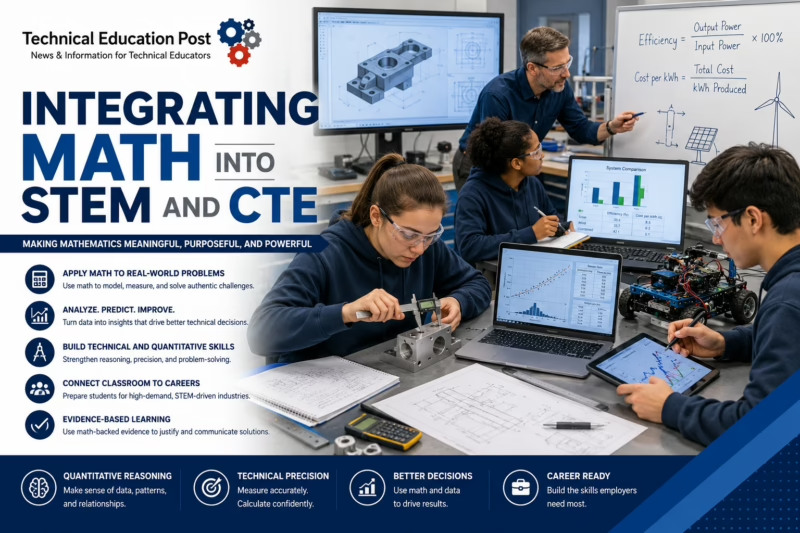
Integrating math into STEM is not a matter of adding equations to a science activity or requiring engineering students to complete calculations after a prototype is finished. Strong integration makes quantitative reasoning central to how students define problems, investigate phenomena, predict performance, compare options, evaluate uncertainty, control quality, and justify decisions.
That distinction matters as schools confront persistent mathematics achievement challenges and rapidly changing workforce expectations.
The latest national results show that the average grade 12 mathematics score in 2024 was three points lower than in 2019. Only 22% of students performed at or above NAEP Proficient, while 45% performed below NAEP Basic. NAEP Proficient is not the same as grade-level proficiency on a state assessment, but the results remain a significant national indicator of students’ ability to use mathematical knowledge and solve problems. (2024 NAEP Mathematics Results)
At the same time, mathematics is becoming more—not less—important in technical work. The Bureau of Labor Statistics projects employment in STEM occupations to grow 8.1% from 2024 to 2034, compared with 2.7% for non-STEM occupations. The agency also expects artificial intelligence adoption to contribute to demand for computer and mathematical occupations, including data scientists and operations research analysts. (BLS STEM Employment Projections) (AI, Information Technology and Employment)
For STEM and CTE leaders, the practical challenge is clear:
Mathematics must become visible, purposeful, assessable, and transferable without turning every technical project into a disconnected math worksheet.
Key Takeaways
- Integrated STEM experiences can improve achievement, but mathematical learning does not emerge automatically from hands-on activity.
- Mathematics should influence decisions before, during, and after an investigation or design process.
- Strong integration emphasizes modeling, measurement, proportional reasoning, statistics, data analysis, units, precision, and financial reasoning—not algebra alone.
- Students need explicit instruction and opportunities to explain the mathematics embedded in technical work.
- Teacher collaboration, common planning time, professional learning, and curriculum alignment are more important than purchasing additional technology.
- Assessments should evaluate both technical performance and mathematical reasoning.
- AI and automated analytical tools make estimation, verification, model evaluation, and quantitative skepticism increasingly important.
Why Math Integration Matters in 2026
Mathematics Performance Remains Uneven
The 2024 NAEP results show that mathematics recovery following the pandemic has not been uniform. Grade 4 performance improved compared with 2022 but remained below 2019. Grade 12 results declined compared with both 2019 and 2005, with lower scores across nearly the entire performance distribution. (NAEP Mathematics, Grades 4 and 8) (NAEP Mathematics, Grade 12)
These results should not lead schools to replace STEM projects with additional test preparation. They should prompt a more important question:
Where do students regularly use mathematics to solve unfamiliar, consequential problems?
Students may perform procedures successfully in mathematics class but struggle to recognize the same relationship in an electrical circuit, manufacturing process, biological dataset, construction plan, or robotics system. That transfer problem is one of the strongest arguments for deliberately integrating mathematics into STEM and CTE.
Emerging Technology Increases the Need for Quantitative Judgment
Artificial intelligence, simulation, automated data analysis, CAD, digital twins, robotics, and advanced manufacturing can perform calculations that previously required substantial manual work.
That does not eliminate the need for mathematics. It changes the mathematical demand.
Students increasingly need to determine:
- Whether an output is reasonable
- Whether a model uses appropriate assumptions
- Whether the units are consistent
- Whether data are representative
- Whether uncertainty has been communicated
- Whether a correlation supports the stated conclusion
- Whether an algorithm performs differently across groups
- Whether optimization has ignored safety or cost
- Whether an AI-generated calculation can be independently verified
The National Science Foundation’s FY 2026–2030 Strategic Plan emphasizes talent development in areas including artificial intelligence, advanced manufacturing, biotechnology, quantum information science, and other critical and emerging technologies. It also calls for stronger connections among formal education, experiential learning, industry, two-year institutions, and four-year colleges. (NSF FY 2026–2030 Strategic Plan)
Mathematical reasoning is the connective tissue across those fields.
Federal STEM Strategy Emphasizes Workforce Preparation
The 2024 federal STEM strategic plan focuses on meeting national workforce needs, expanding access and opportunity, strengthening partnerships, and improving transparency and accountability. It specifically recognizes rapidly evolving fields such as artificial intelligence as priorities for talent development. (Federal Strategic Plan for Advancing STEM Education and Cultivating STEM Talent)
Math integration should therefore be treated as a readiness strategy, not an enrichment strategy.
What Does Integrating Math Into STEM Mean?
Math integration in STEM is the deliberate use of mathematical concepts, practices, tools, and representations to improve an investigation, technical process, design, or decision.
It is different from three common alternatives.
Math Review
Students practice a previously taught procedure before beginning a project.
This may be useful, but it is not complete integration.
Math Added After the Project
Students build a prototype and then calculate its dimensions, cost, or efficiency because the teacher requires a mathematics component.
The calculation documents the project but may not influence it.
STEM as a Context for a Math Lesson
A mathematics teacher uses a bridge, robot, or renewable-energy system as the setting for teaching a mathematical concept.
This is a valuable instructional approach, but it usually begins with the mathematics objective.
Reciprocal STEM Integration
A meaningful problem creates a need for mathematics, and the mathematics improves the quality of the solution.
For example, students designing a robotic vehicle might:
- Measure wheel diameter.
- Calculate circumference.
- Relate motor rotation to travel distance.
- Collect speed and power data.
- Develop a predictive model.
- Test the model under different loads.
- Use the results to revise gearing or control settings.
The mathematics is not decoration. It changes the design.
From Embedded Math to Explicit Math
Most STEM and CTE pathways already contain mathematics.
Students may:
- Measure voltage
- Calculate gear ratios
- Estimate material quantities
- Interpret slope
- Apply dimensional tolerances
- Convert units
- Analyze growth rates
- Read CNC coordinates
- Determine flow rates
- Compare energy efficiency
- Calculate defect rates
- Estimate labor and material costs
The difficulty is that this mathematics often remains embedded but invisible.
Students may follow a procedure without recognizing:
- The quantities being compared
- The relationship among variables
- The assumptions behind the formula
- The reason a unit conversion is required
- The effect of measurement error
- How the same mathematics applies elsewhere
A robotics team, for example, might tune motor power through trial and error. A stronger approach asks students to collect motor-input and speed data, graph the relationship, decide whether it is proportional or nonlinear, use the model to predict performance, and explain where the prediction fails.
The technical task creates the need for mathematics. Explicit instruction gives students the ability to transfer it.
What Research Says—and What It Does Not
Research generally supports integrated STEM instruction, but the evidence contains an important warning: simply combining subjects or assigning a hands-on project does not guarantee mathematical learning.
A recent meta-analysis examined 79 effect sizes from 40 studies involving 15,577 students. It found a positive overall effect of integrated STEM education on achievement, with substantial variation based on the type of integration, instructional approach, and assessment. The effect reported specifically for mathematics achievement was considerably smaller than the effect for science achievement or overall STEM learning. (Effects of Integrated STEM Education on Student Achievement)
That result is not an argument against integration. It is evidence that the mathematical learning goals must be made explicit.
The National Academies reached a similar conclusion in its foundational review of integrated STEM education. Integrated approaches can support learning, interest, persistence, and transfer, but outcomes depend heavily on program design, teacher capacity, instructional conditions, and how the disciplines are connected. (STEM Integration in K–12 Education)
A more recent systematic review found continued growth in student-centered, problem-based, design-based, and project-based STEM approaches, but also noted variation in research quality and no single consensus model for effective integration. (Integrated STEM Education: A Systematic Review)
Recent case-study research on “incidental mathematics” provides a useful implementation lesson. Teachers working with professional learning and mentoring became better able to identify mathematical opportunities within integrated STEM and digital-technology activities. The study was exploratory rather than a large causal trial, but it illustrates how teacher knowledge and planning can turn hidden mathematics into explicit learning. (Teaching the Incidental Mathematics in Integrated STEM)
Research Snapshot
The evidence supports three conclusions:
- Authentic context can strengthen mathematical meaning.
- Hands-on activity alone is insufficient.
- Teachers must deliberately identify, teach, assess, and revisit the mathematics.
Standards Alignment
Standards for Mathematical Practice
The Common Core Standards for Mathematical Practice offer a useful framework even in states that use differently named mathematics standards.
The practices expect students to:
- Make sense of problems and persevere
- Reason abstractly and quantitatively
- Construct arguments and critique reasoning
- Model with mathematics
- Use tools strategically
- Attend to precision
- Look for structure
- Recognize repeated reasoning
Several are especially important in STEM.
Model With Mathematics
Mathematical modeling requires students to identify important quantities, represent relationships, analyze results, validate conclusions, and revise the model when necessary. The Common Core modeling standards explicitly connect mathematics to everyday life, society, and the workplace. (High School Modeling Standards)
Use Tools Strategically
Students should decide when to use:
- A ruler or caliper
- A spreadsheet
- Graphing software
- A statistical package
- CAD
- A simulation
- A calculator
- A programming environment
- A physical model
The tool should extend reasoning, not conceal it. (Standards for Mathematical Practice)
Attend to Precision
Precision includes:
- Correct units
- Appropriate labels
- Definitions
- Measurement limits
- Significant digits
- Tolerances
- Clear communication
In technical education, lack of precision can make a result unusable or unsafe. (Standards for Mathematical Practice)
Science and Engineering Practices
The Framework for K–12 Science Education and the Next Generation Science Standards identify mathematics and computational thinking as a core science and engineering practice.
Students use mathematics to:
- Represent variables
- Analyze relationships
- Develop models
- Process data
- Make predictions
- Express uncertainty
- Evaluate engineering performance
- Compare competing solutions
Math integration is therefore not an optional addition to standards-based science instruction. It is part of how students engage in scientific and engineering practice.
CTE and Perkins V
Perkins V supports programs of study that develop academic, technical, and employability skills and connect secondary education with postsecondary education and high-skill, high-wage, or in-demand careers. Federal CTE formula grants provide roughly $1.4 billion annually, with at least 85% of state allocations distributed to eligible local recipients. Local priorities are shaped through the comprehensive local needs assessment and approved plans. (Perkins V) (Perkins V Basic State Grants)
Academic and technical integration is therefore both an instructional priority and a potential program-improvement strategy.
The Quantitative Decision Cycle
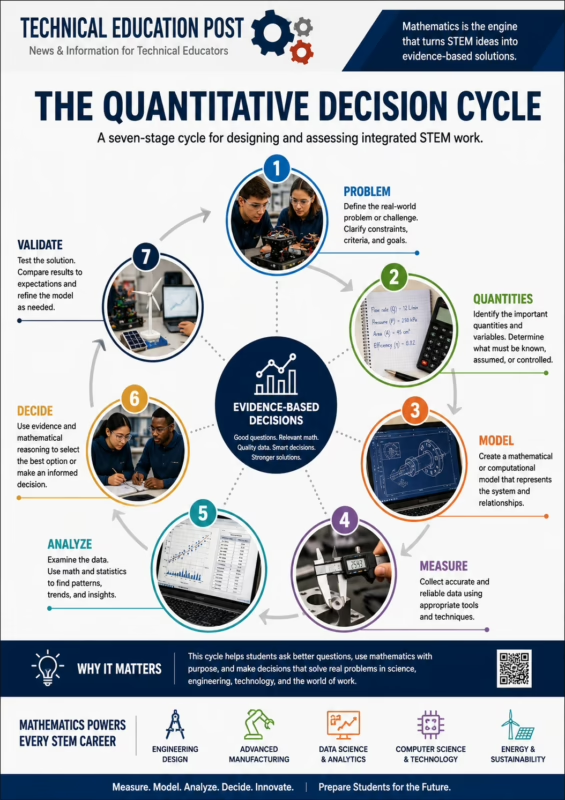
TechEd Magazine recommends using a seven-stage cycle when designing integrated STEM work:
Problem → Quantities → Model → Measure → Analyze → Decide → Validate
1. Define the Problem or Decision
Students begin with a meaningful question.
Examples:
- Which insulation should be used?
- How should a robot be geared?
- What irrigation schedule conserves the most water?
- Which manufacturing process produces the least variation?
- What battery size is required?
- Which design provides the best performance per dollar?
2. Identify the Quantities
Students determine what can be measured or calculated.
Possible quantities include:
- Length
- Mass
- Time
- Temperature
- Voltage
- Current
- Force
- Cost
- Energy
- Flow
- Error
- Probability
- Defect rate
3. Select a Representation or Model
Students may use:
- Equation
- Scale drawing
- Table
- Graph
- Diagram
- Statistical model
- Simulation
- Code
- CAD model
- Physical prototype
4. Measure or Gather Data
Students establish:
- Tools
- Units
- Sampling method
- Number of trials
- Measurement precision
- Data-recording process
- Quality-control procedures
5. Analyze
Students calculate, compare, graph, model, estimate, or test.
6. Make a Decision
The mathematics should affect:
- Material selection
- Design revision
- Process settings
- Cost recommendation
- Safety choice
- Resource allocation
- Technical conclusion
7. Validate
Students ask:
- Is the result reasonable?
- Does it match the physical evidence?
- What uncertainty remains?
- Which assumption is weakest?
- Would the model work under different conditions?
- Can another method confirm the answer?
Recommended Infographic Placement
Place “The Quantitative Decision Cycle” infographic here, immediately after the cycle and before the pathway table.
Where Mathematics Fits Across STEM and CTE
| STEM or CTE Context | High-Value Mathematics | Authentic Application | Evidence Students Could Produce |
|---|---|---|---|
| Engineering design | Geometry, functions, ratios, optimization, uncertainty | Compare bridge designs using load-to-mass ratio | Calculations, test data, graph and redesign |
| Robotics and automation | Rates, ratios, coordinates, trigonometry, logic | Predict travel distance from wheel and motor rotation | Model, code, trial data and error analysis |
| Manufacturing | Measurement, tolerances, statistics, process control | Determine whether a production process remains within specifications | Inspection data, control chart and corrective action |
| Construction | Geometry, slope, scale, area, volume, estimating | Calculate roof pitch and material quantities | Scale drawing, quantity takeoff and cost estimate |
| Health science | Ratios, rates, unit conversion, probability, statistics | Interpret patient trends or prepare a simulated dosage calculation | Calculation record, safety check and explanation |
| Agriculture | Area, volume, rates, probability, financial math | Estimate irrigation needs using soil and weather data | Water-use model, cost comparison and recommendation |
| Environmental science | Statistics, GIS, modeling, rates of change | Analyze heat, water-quality or air-quality patterns | Map, graph, uncertainty statement and policy recommendation |
| Energy systems | Algebra, unit analysis, efficiency, financial modeling | Compare energy output, storage and payback periods | Energy model, cost projection and trade-off analysis |
| Computer science | Logic, functions, discrete math, probability, data analysis | Compare algorithm performance or evaluate dataset bias | Code, runtime data, visualization and interpretation |
| Transportation | Rates, vectors, geometry, optimization | Analyze stopping distance, route efficiency or fuel use | Mathematical model, simulation and safety recommendation |
| Business and logistics | Percentages, forecasting, optimization, financial math | Compare inventory, production or transportation scenarios | Spreadsheet model, assumptions and recommendation |
Do Not Reduce STEM Mathematics to Algebra
Algebra is important, but authentic technical work also depends on:
- Measurement
- Geometry
- Proportional reasoning
- Statistics
- Probability
- Financial mathematics
- Discrete mathematics
- Logic
- Unit analysis
- Estimation
- Computational modeling
- Spatial reasoning
For many technical pathways, measurement, ratio, units, tolerances, and data interpretation are the most frequently used mathematical skills. Advanced engineering and science pathways may place greater emphasis on functions, trigonometry, probability, vectors, calculus, or differential modeling.
Curriculum leaders should identify the actual quantitative demands within each pathway rather than assume a generic algebra sequence will address every need.
Practical Strategies for Teachers
Start With a Need-to-Know Math Brief
Before beginning a project, ask students:
- What are we trying to predict, compare, control, or optimize?
- Which quantities affect the outcome?
- What can we measure directly?
- What must be calculated?
- Which units are required?
- What assumptions are we making?
- What level of precision is appropriate?
- How will we know whether the answer is reasonable?
This short routine positions mathematics as part of problem definition.
Conduct a Mathematical Demand Analysis
Before teaching the unit, educators should identify:
- Concepts students need
- Representations students will encounter
- Required prerequisite knowledge
- Essential calculations
- Tool requirements
- Likely misconceptions
- Vocabulary demands
- Appropriate precision
- Assessment evidence
- Possible accessibility barriers
A mathematical demand analysis prevents teachers from discovering midway through a project that students lack an essential skill.
Add Math Checkpoints
Do not wait until the final report.
Useful checkpoints include:
- Initial estimate
- Quantity and unit list
- Measurement plan
- Data-table review
- Graph selection
- Model proposal
- Calculation verification
- Error analysis
- Cost-performance comparison
- Quantitative redesign decision
A water-filtration challenge, for example, might require students to measure flow, calculate percentage change in turbidity, compare material costs, and evaluate performance per dollar before revising the filter.
Use Just-in-Time Instruction Carefully
Teaching mathematics at the point of need can increase relevance, but “just in time” should not mean “students must discover everything without instruction.”
A focused mini-lesson might include:
- The mathematical concept
- Why it is needed
- A worked example
- A visual or physical representation
- A common error
- Guided practice
- Application to project data
- Independent verification
Explicit instruction and authentic application should support one another.
Require Estimates Before Technology
Before using a calculator, spreadsheet, AI system, CAD package, or simulation, students should estimate:
- Expected range
- Direction of change
- Approximate magnitude
- Likely graph shape
- Reasonable number of decimal places
After using the tool, they should compare the output with the estimate.
This creates a basic defense against incorrect formulas, unit errors, faulty data, and uncritical acceptance of AI-generated results.
Make Units Visible
Students should label units throughout the process—not only in the final answer.
Require units in:
- Data tables
- Graph axes
- Equations
- Spreadsheet headings
- Code variables where appropriate
- CAD drawings
- Technical reports
- Cost models
Unit analysis should be treated as reasoning, not formatting.
Use Multiple Representations
Students should move among:
- Physical systems
- Diagrams
- Tables
- Graphs
- Equations
- Written explanations
- Code
- Simulations
- Verbal presentations
A motion investigation might begin with a physical cart, produce position-time data, move to a graph, generate a linear model, connect slope with velocity, and finish with a prediction that is tested physically.
Require Quantitative Claims
Replace:
Our second design worked better.
With:
The second design increased load capacity from 18.4 newtons to 26.7 newtons—a 45.1% improvement—while its mass increased by 8.3%.
Students should explain whether the improvement is meaningful and what trade-off was accepted.
Use Error Analysis
Give students flawed technical work and ask them to diagnose it.
Possible errors include:
- Mixing inches and feet
- Omitting a unit conversion
- Selecting the wrong graph
- Extrapolating beyond the data
- Reporting unjustified precision
- Ignoring an outlier
- Using the wrong baseline for percent change
- Confusing average speed with acceleration
- Treating correlation as causation
- Accepting an AI-generated formula without verification
Error analysis develops habits that matter in science, engineering, healthcare, manufacturing, and skilled trades.
Grade-Level Progression
Elementary School
Elementary integration should emphasize:
- Counting
- Comparison
- Measurement
- Shapes
- Patterns
- Estimation
- Simple data displays
- Early proportional reasoning
Students might:
- Measure plant growth
- Graph daily weather
- Compare the strength of materials
- Test paper gliders
- Build structures under material limits
- Estimate and measure distance
- Use grids for coding or mapping
- Compare container capacity
The emphasis should be on mathematical sense-making and explanation rather than formal symbolism.
Ask:
- How do you know?
- Which is greater?
- What changed?
- What did you measure?
- How close was your estimate?
- What pattern do you notice?
Middle School
Middle school is a critical period for:
- Ratios
- Rates
- Variables
- Linear relationships
- Geometry
- Scale
- Statistics
- Probability
- Unit analysis
Students might:
- Calculate speed from distance and time
- Model sensor data
- Create scale drawings
- Compare experimental distributions
- Analyze energy use
- Calculate mixture ratios
- Evaluate design efficiency
- Model ecosystem change
Students should begin choosing mathematical methods rather than always being told which formula to use.
High School
High school integration can include:
- Functions
- Regression
- Trigonometry
- Probability
- Statistical inference
- Financial modeling
- Optimization
- Vectors
- Matrices
- Computational analysis
Students might:
- Model experimental data
- Use trigonometry in robotics or surveying
- Analyze process variation
- Compare energy investments
- Evaluate model limitations
- Estimate uncertainty
- Analyze algorithm performance
- Use spreadsheets to test scenarios
High school students should justify assumptions and explain where a model is likely to fail.
Postsecondary and Advanced CTE
Advanced programs should reflect disciplinary and workplace expectations.
Students may work with:
- Geometric dimensioning and tolerancing
- Statistical process control
- Electrical load calculations
- Construction estimating
- Medical mathematics
- Surveying
- Financial forecasting
- Process capability
- Data analytics
- Technical simulation
Assessment should address accuracy, documentation, safety, compliance, interpretation, and decision-making.
Assessment Methods
A successful technical product does not prove that a student understands the mathematics.
The product may have worked through:
- Trial and error
- Peer assistance
- Copied code
- Teacher correction
- A template
- Luck
Assessment should make mathematical reasoning visible.
Separate the Mathematical and Technical Criteria
A strong rubric may include:
- Problem definition
- Mathematical model
- Measurement and data quality
- Accuracy, units, and precision
- Technical performance
- Evidence-based decision
- Communication
- Revision
Do not bury mathematics inside a broad category such as “project quality.”
Assess the Process
Look for evidence that students can:
- Define variables
- Identify quantities
- Select a method
- Use units
- Calculate accurately
- Represent data
- Interpret results
- Check reasonableness
- Identify uncertainty
- Revise a technical decision
Include Individual Evidence
In team projects, use:
- Individual notebook entries
- Personal calculations
- Oral questioning
- Role-specific deliverables
- Short transfer problems
- Individual data interpretation
- Technical reflection
A team’s successful prototype should not automatically give every member the same evidence of mathematical proficiency.
Use Performance Tasks
A strong integrated task might provide students with:
- Local rainfall data
- Roof measurements
- Tank capacities
- Material costs
- Irrigation demand
- Installation constraints
Students must design a rainwater-collection system, calculate potential collection, evaluate storage, compare cost, and justify a recommendation.
This assesses:
- Area
- Volume
- Unit conversion
- Data interpretation
- Financial reasoning
- Modeling
- Engineering constraints
Math Integration and Equity
Mathematics can either expand STEM participation or become a gatekeeping mechanism.
Students should not be removed from authentic technical experiences simply because they have not yet mastered every prerequisite procedure. At the same time, access should not be created by eliminating the mathematical demand.
The National Council of Teachers of Mathematics argues that access and equity require responsive instruction, appropriate supports, high expectations, and the removal of barriers that prevent students from engaging in meaningful mathematics. (Access and Equity in Mathematics Education)
Useful supports include:
- Visual models
- Worked examples
- Vocabulary support
- Accessible technology
- Multiple representations
- Structured peer discussion
- Partially completed data displays
- Strategic calculators or spreadsheets
- Additional practice
- Alternative ways to explain reasoning
The learning target should remain rigorous.
Rural and Small-School Considerations
A 2025 National Academies report found that rural communities have significant STEM assets, including local industries, natural environments, community relationships, and place-based problems. It also documented barriers involving staffing, professional learning, broadband, funding, and access to advanced coursework. (K–12 STEM Education and Workforce Development in Rural Areas)
Integrated mathematics can be particularly effective when built around local contexts such as:
- Agriculture
- Water systems
- Energy
- Forestry
- Transportation
- Healthcare access
- Manufacturing
- Broadband infrastructure
Technology should support the learning, but schools should not design projects that depend on equipment or connectivity students cannot reliably access.
Supporting Teachers
Integrated instruction depends heavily on teacher knowledge and collaboration.
An influential randomized Math-in-CTE study paired CTE instructors with mathematics teachers to identify and teach the mathematics embedded in technical curricula. Participating fields included agriculture, automotive technology, business and marketing, health, and information technology. The study reported mathematics gains without reducing students’ technical achievement, but the model required intensive professional development and sustained collaboration. (Rigor and Relevance: Enhancing High School Students’ Math Skills Through CTE) (Math-in-CTE Final Study Report)
The implementation lesson remains relevant:
Teachers cannot be expected to build strong academic-technical integration through goodwill alone.
They need:
- Common planning time
- Curriculum-writing support
- Discipline-specific professional learning
- Access to one another’s classrooms
- Shared student-work review
- Instructional coaching
- Administrative protection of collaboration time
A Co-Planning Protocol
A mathematics teacher and STEM or CTE instructor can use this process:
1. Select an Existing Technical Task
Start with a real unit already taught.
2. Identify the Embedded Mathematics
Where do students measure, calculate, model, estimate, graph, compare, or optimize?
3. Identify the Mathematical Standard
Which concept or mathematical practice is involved?
4. Examine Student Errors
Where do students guess, misuse units, select an incorrect formula, or misinterpret data?
5. Redesign the Task
Make the mathematics necessary to a technical decision.
6. Add Instructional Support
Decide what should be explicitly taught and by whom.
7. Develop Common Evidence
Determine what students will calculate, represent, explain, and submit.
8. Review Student Work Together
Examine whether students understood and transferred the mathematics.
A recent National Academies report on scaling and sustaining STEM education innovations emphasizes that promising practices often fail to spread when local capacity, leadership, infrastructure, professional learning, and system conditions are not addressed. (Scaling and Sustaining Pre-K–12 STEM Education Innovations)
Math integration must therefore become a program structure rather than an isolated teacher experiment.
Practical Examples
Manufacturing: Statistical Quality Control
Students produce or measure a series of components.
They calculate:
- Mean
- Range
- Standard deviation where appropriate
- Percentage within tolerance
- Defect rate
- Scrap or rework cost
- Process capability at an introductory level
They then decide whether the process is stable and recommend an adjustment.
The task connects statistics with quality, cost, productivity, and customer requirements.
Robotics: Calibration and Motion
Students program a robot to travel a defined distance.
They:
- Measure wheel diameter.
- Calculate circumference.
- Predict motor rotations.
- Conduct repeated trials.
- Calculate average error.
- Graph programmed versus actual distance.
- Revise the calibration factor.
- Test under a different load.
This changes a coding activity into a quantitative systems investigation.
For additional context on robotics learning and workforce preparation, see TechEd Magazine’s Future With K–12 Robotics.
Energy: Solar System Design
Students use:
- Energy-demand data
- Solar-resource data
- Panel specifications
- Battery capacity
- Efficiency estimates
- Installation cost
- Maintenance assumptions
They compare designs and calculate:
- Daily output
- Storage requirements
- Efficiency
- Cost per unit of energy
- Payback period
- Sensitivity to changing assumptions
Students should identify what the model excludes and explain why a lower-cost system may not be the most reliable.
Construction: Roof Design and Estimating
Students receive a building footprint and design requirements.
They calculate:
- Rise and run
- Pitch
- Rafter length
- Roof area
- Waste factor
- Material quantities
- Labor estimate
- Total cost
They create a scale drawing and explain how measurement error would affect ordering or installation.
Environmental Science: Campus Heat Analysis
Students measure surface temperature across campus.
They:
- Develop a sampling plan
- Record location and surface type
- Calculate summary statistics
- Visualize spatial patterns
- Compare shaded and unshaded areas
- Evaluate uncertainty
- Propose a mitigation strategy
- Estimate implementation cost
The mathematics supports a local planning decision.
Computer Science: Algorithm Performance
Students implement two approaches to the same problem.
They compare:
- Runtime
- Dataset size
- Memory use
- Operation count
- Error rate
- Scalability
They graph performance and explain why the relationship changes as the input grows.
Costs and Funding
Math integration does not always require expensive equipment. The largest costs are often:
- Teacher planning time
- Curriculum writing
- Professional development
- Substitute coverage
- Common assessment development
- Instructional coaching
- Data and measurement tools
- Software
- Equipment maintenance
- Partnership coordination
Many integrations can begin with:
- Spreadsheets
- Rulers
- Scales
- Stopwatches
- Public datasets
- Free simulations
- Classroom materials
- Existing laboratory tools
Perkins V funding may support academic and technical integration when the activity aligns with the approved local plan, comprehensive local needs assessment, program of study, and applicable state and federal rules. Funding eligibility should be confirmed locally rather than assumed based on the STEM or CTE label alone. (Perkins V Basic State Grants)
Math Integration Review Checklist
| Review Question | Evidence to Look For |
| Is mathematics necessary to solve the STEM problem? | Students use quantitative evidence to make a decision |
| Are both mathematics and STEM or CTE standards identified? | Standards appear in the unit plan and assessment |
| Are the important quantities defined? | Variables, units and relationships are documented |
| Do students choose or justify a method? | The task requires reasoning rather than formula substitution |
| Are measurement and precision addressed? | Tools, tolerances and uncertainty are discussed |
| Do students work with data? | Students collect, clean, graph, model or interpret evidence |
| Does mathematics influence the solution? | Calculations lead to a revision or recommendation |
| Are multiple representations used? | Students connect physical, numerical, graphical and symbolic forms |
| Are technology outputs verified? | Students estimate and independently check results |
| Is mathematical reasoning assessed separately? | The rubric includes explicit quantitative criteria |
| Is individual evidence collected? | Each student explains or demonstrates the mathematics |
| Are supports provided without reducing rigor? | Students receive accessible entry points and targeted scaffolds |
| Do teachers collaborate? | Mathematics and technical educators plan or review work together |
| Does the unit build transfer? | Students apply the mathematics in a new context |
Questions to Ask Your Program
- Where do students already use mathematics in our STEM and CTE pathways?
- Which mathematical concepts are essential for success in each pathway?
- Which concepts are assumed but never explicitly taught?
- Do projects require mathematics before, during, and after the build?
- Can students complete major projects through trial and error without quantitative reasoning?
- Do students explain why they selected a mathematical method?
- Are units, precision, tolerances, and uncertainty consistently addressed?
- Do rubrics separately assess mathematical reasoning?
- Where do students work with authentic data?
- Do students verify spreadsheet, simulation, calculator, and AI output?
- How often do mathematics and STEM or CTE teachers plan together?
- Are teachers given paid time for integration work?
- What mathematical errors appear repeatedly in technical courses?
- Are supports expanding access without removing the quantitative demand?
- What evidence shows that students can transfer mathematics to an unfamiliar problem?
- Are local employers and postsecondary partners helping identify priority mathematics?
- How do assessment results affect curriculum and professional learning?
What to Watch Next
AI Verification as a Mathematical Practice
As generative AI and automated analytical tools become more common, students will need explicit routines for:
- Estimation
- Unit checking
- Independent calculation
- Assumption review
- Model comparison
- Data-source evaluation
- Bias detection
- Sensitivity analysis
The instructional question will increasingly be not “Can the tool calculate this?” but “Can the student determine whether the answer should be trusted?”
Data Science Across Pathways
Data science is becoming a natural bridge among mathematics, science, engineering, business, agriculture, healthcare, and technical education.
Students need experience with:
- Data collection
- Cleaning
- Visualization
- Statistical reasoning
- Missing information
- Bias
- Variation
- Uncertainty
- Ethical interpretation
The Bureau of Labor Statistics projects especially rapid growth in data science and related analytical occupations, reinforcing the value of data literacy beyond traditional computer science programs. (Occupational Outlook: Math Occupations)
Advanced Manufacturing and Digital Models
Modern manufacturing increasingly connects physical measurement with:
- CAD
- Simulation
- Machine data
- Quality analytics
- Digital twins
- Automated inspection
- Predictive maintenance
Students must be able to connect a virtual model with the physical result and explain why discrepancies occur.
TechEd Magazine’s CNC Education in America and Free CNC Training provide further context for technical skill development in modern manufacturing.
Performance-Based and Competency-Based Assessment
Integrated STEM tasks can provide evidence for competency-based pathways because they require students to apply multiple forms of knowledge.
However, these systems will need:
- Clear competencies
- Common performance tasks
- Reliable rubrics
- Teacher calibration
- Portfolios
- Consistent records
- External validation where appropriate
Stronger Academic–Technical Partnerships
Programs that can clearly document how students use mathematics within technical work will be better positioned to:
- Strengthen pathways
- Improve advisory-board conversations
- Align with dual enrollment
- Pursue funding
- Communicate program quality
- Demonstrate student readiness
Frequently Asked Questions
How is math integration different from using a STEM example in math class?
A STEM example in math class usually begins with a mathematical objective and applies it in context. Math integration in STEM begins with a scientific, engineering, computing, or technical problem and uses mathematics as a necessary tool for investigation or decision-making. Both approaches are valuable.
Should STEM and CTE teachers teach mathematics directly?
Yes, when the mathematics is essential to the task. They should not be expected to replace mathematics teachers, but they should name, model, reinforce, and assess the quantitative reasoning embedded in their discipline.
What should teachers do when students lack prerequisite skills?
Provide targeted, just-in-time support through visual models, worked examples, vocabulary, guided practice, and appropriate tools. Preserve the mathematical demand while helping students access it. Coordinate with mathematics teachers when gaps are widespread.
How much mathematics should a STEM project include?
Enough that students must measure, model, analyze, predict, compare, optimize, or justify. Not every project needs advanced mathematics, but an integrated project should require meaningful quantitative reasoning.
Which tools are most useful?
Spreadsheets are especially versatile because they support formulas, tables, graphs, scenario analysis, and statistics. Other tools include sensors, CAD, graphing software, simulations, GIS, coding environments, multimeters, calipers, and pathway-specific equipment.
How should integrated mathematics be graded?
Use explicit criteria for mathematical modeling, measurement, accuracy, units, data representation, interpretation, reasonableness, and the use of mathematics in a decision. Do not award full credit based only on the finished product.
Can elementary students engage in meaningful math integration?
Yes. Elementary projects can incorporate counting, measurement, shapes, comparison, estimation, patterns, and data displays. Students should explain how quantities relate to what they observe or design.
Does project-based learning automatically improve mathematics achievement?
No. Research shows positive overall effects for integrated STEM, but mathematics gains vary and can be modest. Projects need explicit mathematical goals, instruction, assessment, and teacher support.
What is the greatest implementation barrier?
Planning capacity is often the central barrier. Teachers need time to identify embedded mathematics, align standards, redesign tasks, develop assessments, and examine student work together.
TechEd Magazine Perspective
The strongest argument for integrating math into STEM is not that mathematics becomes more entertaining when attached to a robot, bridge, solar panel, or manufacturing process.
It is that the mathematics becomes consequential.
In authentic STEM and technical work, an incorrect unit can invalidate a result. A weak model can produce an unsafe recommendation. An unexamined average can conceal process variation. A calculation without a realistic assumption can lead to the wrong investment, design, treatment, or operating decision.
That is the kind of mathematical responsibility students need to experience.
The goal is not to make every CTE instructor a mathematics teacher or every mathematics teacher an engineer. It is to build enough shared understanding that students encounter a coherent message across disciplines:
- Quantities have meaning.
- Units matter.
- Models have limits.
- Data require interpretation.
- Tools require verification.
- Decisions require evidence.
The most practical place to begin is with one existing unit.
Identify the hidden mathematics. Determine which decision it should influence. Teach the reasoning explicitly. Require students to show the evidence. Then examine whether they can use the same mathematics somewhere new.
That is where integration becomes transfer—and where STEM education begins to resemble the work students are preparing to do.
Related TechEd Magazine Resources
- Federal STEM Strategic Plan — Coverage of the national strategy for STEM access, workforce development, partnerships, and emerging technology.
- America’s Strategy for STEM Education — Broader analysis of national STEM education goals and talent development.
- Technical and STEM Education 2026 — Current trends affecting technical education, workforce readiness, technology, and student preparation.
- Future of STEM Education: Trends Shaping CTE Programs — Analysis of artificial intelligence, automation, interdisciplinary learning, and future career pathways.
- Future With K–12 Robotics — Robotics education, experiential learning, mathematics, and workforce development.
- CNC Education in America — Technical education, precision manufacturing, CNC skills, and the workforce pipeline.
- Free CNC Training — Training resources supporting CNC programming, machining, measurement, and technical skill development.
- Siemens Launches Digitalization Academy — Digital manufacturing, industrial technology, and workforce education.
- Siemens Partners With Educators to Fill Industry Skill Gaps — Industry–education partnerships supporting technical preparation.
- Technical Education Resources — TechEd Magazine’s collection of teaching resources, projects, funding, events, and technical education tools.
Authoritative Sources
- 2024 NAEP Mathematics Results: Grade 12
- 2024 NAEP Mathematics Results: Grades 4 and 8
- Standards for Mathematical Practice
- High School Mathematical Modeling Standards
- A Framework for K–12 Science Education
- Next Generation Science Standards
- STEM Integration in K–12 Education
- Effects of Integrated STEM Education on Student Achievement
- Integrated STEM Education: A Systematic Review
- Teaching the Incidental Mathematics in Integrated STEM
- NCTM Principles to Actions
- NCTM Access and Equity in Mathematics Education
- Rigor and Relevance: Enhancing Math Skills Through CTE
- Perkins V
- Perkins V Basic State Grants
- NSF FY 2026–2030 Strategic Plan
- 2024 Federal STEM Strategic Plan
- BLS STEM Employment Projections
- BLS Mathematics Occupations
- Scaling and Sustaining Pre-K–12 STEM Education Innovations
- K–12 STEM Education and Workforce Development in Rural Areas