
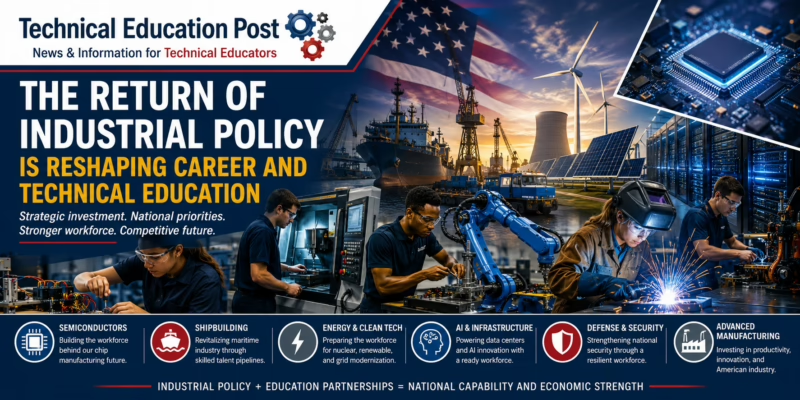
Industrial policy and CTE are becoming increasingly connected as government investment helps determine which industries, technologies, and workforce capabilities the United States intends to develop.
During a single three-week period in July 2026, the federal government awarded nearly $162 million to expand apprenticeships in shipbuilding, defense, semiconductor, nuclear-energy, AI-infrastructure, telecommunications, information-technology, and transportation occupations; opened a second $40 million industry-driven training competition; issued a new order to strengthen domestic defense-material supply chains; launched Workforce Pell; and advanced a proposal for a maritime-focused Job Corps center tied directly to a major shipbuilder.
These actions are not isolated workforce announcements. Together, they reveal a larger structural change.
For decades, career and technical education was generally expected to follow the labor market: study existing vacancies, ask local employers what they need, update programs, and prepare students for available jobs. Industrial policy reverses part of that sequence. Government investment, procurement, trade policy, research funding, infrastructure development, and supply-chain requirements are now helping determine where production will expand and which capabilities the country intends to possess.
That means CTE is increasingly being asked to prepare workers for industries before their full labor demand is visible in conventional job-posting data.
Technical Education Post calls the resulting challenge the Industrial Policy Translation Gap: the distance between a national investment decision and a local education system capable of converting that decision into instructors, curriculum, laboratories, apprenticeships, credentials, and qualified workers.
The opportunity is substantial. Technical schools and colleges can become active partners in rebuilding semiconductor production, maritime manufacturing, energy systems, critical-material supply chains, advanced manufacturing, and AI infrastructure.
The risk is equally real. Schools can chase announcements that never become sustained hiring, build narrow programs around one employer, purchase specialized equipment before demand is verified, or train students for jobs that appear in another region.
The central question is no longer simply, “What jobs are available?” It is, “Which national and regional capabilities are being built—and what evidence tells us that our institution should help build them?”
Key Takeaways
- Industrial policy uses public investment, procurement, regulation, trade policy, research support, and workforce programs to shape domestic productive capacity.
- Recent federal actions are explicitly directing education and training toward shipbuilding, defense, semiconductors, nuclear energy, AI infrastructure, advanced manufacturing, telecommunications, and critical minerals.
- Traditional labor-market data often arrive after a major facility, supply chain, or production program is already underway; CTE leaders now need earlier demand signals without treating every announcement as guaranteed employment.
- Technical Education Post’s proposed National Capability Pipeline connects policy objectives to industrial capacity, occupations, education, work-based learning, production readiness, and long-term workforce retention.
- Programs should combine portable technical foundations with sector-specific overlays rather than create narrow credentials tied to one company, grant, or political cycle.
- Industrial alignment must serve students as well as national strategy by protecting career mobility, educational progression, safety, and the long-term value of credentials.
What Is Industrial Policy?
Industrial policy refers to deliberate government action intended to develop, expand, protect, or redirect economically or strategically important industries.
Its tools can include:
- Direct grants and loans
- Tax incentives
- Federal procurement
- Research and development funding
- Trade measures and domestic-content requirements
- Infrastructure investment
- Supply-chain rules
- Workforce grants and apprenticeships
- Education and training priorities
Industrial policy does not replace private industry. It changes the conditions under which private investment, production, hiring, and innovation occur.
The current resurgence did not begin with one administration or one law. The CHIPS and Science Act created a major federal role in semiconductor manufacturing, research, and workforce development. Manufacturing USA has operated through public-private institutes supported by the Departments of Commerce, Defense, and Energy. More recent policy has placed additional emphasis on shipbuilding, defense production, nuclear energy, AI infrastructure, domestic minerals, skilled trades, apprenticeship, and short-term workforce education.
The priorities and implementation methods differ across administrations. The common structural development is that economic development and workforce development are being designed together more intentionally.
That shift matters for education because talent is no longer treated merely as a consequence of industrial growth. It is increasingly treated as a precondition for industrial growth.
Technical Education Post Definition
Industrial Policy Translation Gap: The distance between a public decision to build strategic industrial capacity and the local education-and-workforce capability required to produce qualified instructors, programs, apprentices, technicians, and long-term workers.
July 2026 Made the Shift Visible
The clearest evidence is the way recent policy actions connect industrial priorities directly to education and training.
Performance-Based Apprenticeship Funding
On July 7, the Department of Labor awarded nearly $162 million through five cooperative agreements. The targeted sectors included shipbuilding and the defense industrial base; AI, semiconductor, and nuclear-energy infrastructure; telecommunications; information technology; and automotive and truck service.
The funding does more than support training. It pays for verified apprentice retention and progression, aligning workforce finance with the sectors the government has identified as important to reindustrialization.
The awards included $40 million for a Florida-led shipbuilding and defense consortium and $40 million for apprenticeship roles connected to AI infrastructure, semiconductors, and nuclear energy. At least 85% of award funds are intended to flow to eligible apprenticeship sponsors.
Technical Education Post previously examined the accountability implications in Apprenticeship Funding Is Shifting to Results. The broader implication is that apprenticeship is becoming an implementation instrument for industrial policy.
A New Industry-Driven Training Round
Also in July, the Department of Labor announced approximately $40 million for a second round of the Industry-Driven Skills Training Fund, with at least $5 million designated for shipbuilding.
The fund reimburses employers for training workers in targeted sectors such as skilled trades, AI infrastructure, advanced manufacturing, nuclear energy, domestic mineral production, and information technology. More than $86 million had already been awarded to 14 states in the first round.
This model shifts part of the training decision toward employers while asking states and workforce agencies to organize public resources around national economic priorities.
Critical Materials Became a Workforce Signal
A July 20 executive order directed stronger domestic and allied sourcing of critical materials and components used in defense systems. The order focuses on supply-chain mapping, source qualification, and reduced dependence on covered foreign nations.
The immediate policy language concerns procurement and supply security. The education implications are broader. Domestic sourcing requires people who can mine, process, refine, test, fabricate, inspect, qualify, document, maintain, and secure materials and components.
That creates potential demand across mining technology, metallurgy, chemical processing, machining, welding, nondestructive testing, quality assurance, logistics, industrial maintenance, cybersecurity, and environmental compliance.
Job Corps May Become a Shipbuilding Pipeline
On July 27, the Department of Labor announced progress on a partnership with Huntington Ingalls Industries that could create a maritime-focused Job Corps center in San Diego. The proposal would connect pre-apprenticeship, advanced training, relocation assistance, and direct entry into regional shipbuilding careers.
“Strengthening our maritime talent pipeline has a two-fold benefit.”
— Acting Secretary of Labor Keith Sonderling
The proposal reflects a deeper change in federal workforce design. A general youth-training institution could be reorganized around a strategic industrial mission, a specific employer ecosystem, and national maritime goals.
Workforce Pell Changed Education Finance
Workforce Pell became effective July 1, 2026, allowing eligible students to use Pell Grants for approved short-term programs lasting as little as eight weeks.
Governors and state workforce boards identify priority industries and career fields. Eligible programs must meet completion, employment, and value requirements. Federal student aid is therefore becoming more directly connected to state workforce strategy and measurable labor-market outcomes.
As Technical Education Post noted in Workforce Pell and CTE Incentives, funding rules influence which programs institutions build, how they select students, and what outcomes they prioritize.
CTE Is Moving From Labor-Market Responder to Capability Builder
Traditional CTE planning usually begins with observed demand:
- Current job postings
- Employer vacancies
- Occupational projections
- Wage data
- Advisory-board requests
This approach remains necessary. Schools should not build programs without evidence of opportunity.
Industrial policy introduces a different kind of demand: policy-created demand.
Policy-created demand begins when government decides that the country needs greater capacity in a strategic sector. Public funding and regulatory action may precede facility construction, employer expansion, job descriptions, and local hiring by several years.
| Market-observed demand | Policy-created demand |
|---|---|
| Appears in current vacancies and wage data | Begins with a strategic objective, appropriation, award, procurement plan, or regulation |
| Usually local or regional | May be national, supply-chain-based, or geographically concentrated elsewhere |
| Often supports an existing occupation | May alter the scale, technology, security requirements, or specialization of occupations |
| Can justify immediate program adjustment | Requires staged validation before major institutional commitment |
| Risk is reacting too slowly | Risk is scaling too early or too narrowly |
The difference changes institutional leadership.
A superintendent, college president, or CTE director can no longer wait until hundreds of local positions are posted if instructor preparation, laboratory development, accreditation, and program approval require several years.
But leaders also cannot treat every federal announcement, corporate memorandum, or proposed facility as guaranteed demand.
The planning problem is timing: act early enough to be useful, but late enough to have credible evidence.
The Demand Signal Ladder
Technical Education Post proposes a six-stage Demand Signal Ladder to help institutions distinguish strategic direction from verified hiring.
| Stage | Signal | Appropriate education response |
|---|---|---|
| 1 | Policy priority or executive action | Monitor, research occupations, convene partners, and identify transferable competencies |
| 2 | Authorized funding, tax incentive, procurement target, or grant competition | Conduct regional scenario planning and faculty-development exploration |
| 3 | Company award, site commitment, consortium, or signed agreement | Validate occupational demand, pilot curriculum, and negotiate employer commitments |
| 4 | Construction, equipment installation, supplier expansion, or apprenticeship registration | Scale instructor preparation, laboratories, work-based learning, and recruitment |
| 5 | Active hiring and production ramp | Expand enrollment carefully, place students, and measure employer satisfaction |
| 6 | Sustained production, retention, advancement, and replacement demand | Institutionalize, update, and diversify the pathway |
The ladder prevents two opposite errors.
The first is the wait-and-miss error: institutions delay until employers are hiring and discover they cannot create instructors, labs, and graduates quickly enough.
The second is the announce-and-build error: institutions commit major resources at the policy-announcement stage before a project, employer, or durable workforce market exists.
The National Capability Pipeline
Jobs are the final visible expression of a much longer system.
Technical Education Post proposes the National Capability Pipeline as a way to understand how industrial policy becomes productive capacity.
1. Strategic Objective
The country identifies a capability it wants to expand or secure: semiconductor production, maritime capacity, nuclear power, AI infrastructure, domestic minerals, telecommunications, or defense manufacturing.
2. Industrial Capacity
Companies, laboratories, shipyards, suppliers, utilities, and infrastructure projects receive incentives, contracts, financing, or regulatory support.
3. Occupational Architecture
The strategy is translated into actual work: occupations, tasks, knowledge, skills, safety requirements, security requirements, and career progression.
NIST’s 2026 Manufacturing USA Occupation and Competency Framework demonstrates the scale of this translation challenge. Researchers identified 132 entry-level occupations connected to 235 knowledge, skill, and ability statements and organized them into 13 competencies and 68 subcompetencies across advanced-manufacturing technologies.
4. Education and Training Capacity
Schools need instructors, curriculum, equipment, facilities, approvals, credentials, student recruitment, support services, and enough operating capacity to deliver the competencies.
This is where the instructor multiplier and the Great Equipment Gap become industrial-policy problems. Factories and infrastructure can be financed faster than technical teaching capacity can be developed.
5. Work-Based Learning
Students need apprenticeships, internships, cooperative education, clinical experience, laboratory access, employer mentors, and opportunities to apply skills under real operating conditions.
6. Production Readiness
Graduates must be able to enter work safely, perform to standard, learn proprietary systems, and contribute to quality, uptime, throughput, and continuous improvement.
7. Retention and Advancement
National capability depends not only on hiring workers but retaining them, developing supervisors, transferring knowledge, and creating pathways into higher technical and leadership roles.
Why This Matters
Industrial policy fails when capital reaches the facility but talent does not reach production. The education system is not adjacent to the strategy; it is one of the systems through which the strategy becomes real.
Strategic Industries Need Capability Clusters, Not Single Programs
One of the easiest mistakes is to translate an industrial priority into a program title.
A semiconductor announcement produces a semiconductor certificate. A data-center announcement produces a data-center pathway. A shipbuilding initiative produces a maritime program.
But strategic industries usually require clusters of occupations rather than one pipeline.
| Strategic sector | Representative capability cluster |
|---|---|
| Semiconductors | Electronics, process technology, vacuum systems, automation, facilities, metrology, chemical safety, maintenance, cybersecurity, and quality |
| Shipbuilding | Welding, machining, pipefitting, electrical, coatings, design, logistics, nondestructive testing, quality, and marine systems |
| Nuclear energy | Electrical, instrumentation and controls, radiation protection, welding, operations, maintenance, chemistry, cybersecurity, quality, and construction |
| AI and data-center infrastructure | Electrical power, HVACR, controls, networking, fiber, cybersecurity, construction, generators, batteries, and critical-facilities operations |
| Critical minerals | Mining technology, geology, chemical processing, environmental systems, industrial maintenance, materials testing, logistics, and safety |
| Defense manufacturing | Machining, welding, electronics, composites, additive manufacturing, metrology, supply-chain security, cybersecurity, and quality assurance |
This reinforces the argument in Semiconductor Education Is Becoming National Infrastructure and The Data Center Boom Is Becoming a CTE Capacity Test: strategic sectors depend on coordinated education systems, not isolated specialty courses.
Build Portable Foundations and Strategic Overlays
Industrial policy can change with technology, markets, elections, security conditions, and public priorities. Students need skills that remain valuable even when a specific project is delayed or redirected.
The strongest curriculum architecture combines:
Portable Technical Foundations
- Applied mathematics and measurement
- Electrical and mechanical fundamentals
- Blueprints, schematics, and technical documentation
- Machining, fabrication, or process fundamentals
- Automation and controls
- Quality systems and metrology
- Data literacy and AI-assisted work
- Cybersecurity and digital safety
- Troubleshooting and root-cause analysis
- Professional communication and teamwork
Strategic Sector Overlays
- Maritime standards and shipboard systems
- Nuclear quality and radiation-related practices
- Semiconductor process and cleanroom protocols
- Critical-mineral processing and environmental requirements
- Defense traceability and supply-chain requirements
- Data-center reliability and critical-facilities operations
This model protects career mobility. A student can enter a strategic sector without being trapped by a credential that has little value outside one employer or funding cycle.
Workforce Pell Will Intensify State-Level Industrial Alignment
Workforce Pell changes more than student financial aid.
Governors, state workforce boards, and institutions now have a stronger incentive to identify short-term programs aligned with high-skill, high-wage, or in-demand fields. Programs must demonstrate completion, employment, and financial value.
Industrial policy will influence which sectors states designate as priorities. States with semiconductor investment may favor electronics and process programs. Maritime states may prioritize shipbuilding. Regions with nuclear development may approve nuclear-related technicians. States pursuing mining and processing may elevate critical-mineral occupations.
This creates several opportunities:
- Faster financing for short-term technical pathways
- Stronger state coordination
- More direct connection between training and employment
- Stackable entry points into longer credentials
It also creates risks:
- Overemphasis on immediate placement
- Programs designed too narrowly around current employers
- Reduced support for longer foundational education
- Pressure to select students most likely to complete quickly
- Credentials optimized for reporting rather than advancement
Workforce Pell should be used as an entry ramp, not an educational ceiling. Short-term programs should articulate into certificates, apprenticeships, associate degrees, and continued technical advancement.
Perkins and WIOA Are Moving Closer Together
Industrial policy is also changing how education and workforce systems plan.
In May 2026, the Departments of Education and Labor reported that 21 states had submitted combined WIOA state plans, compared with nine in 2024. Federal guidance has encouraged states to include Perkins-funded CTE in broader workforce planning and create a unified talent-development system.
This alignment can reduce duplication and connect secondary CTE, adult education, community colleges, workforce boards, apprenticeships, and employers.
But integration should not turn education into a short-term staffing service.
Perkins serves students whose careers may unfold over decades. WIOA often responds to immediate labor-market needs. Industrial policy may prioritize sectors because of national security or supply-chain concerns. These purposes overlap, but they are not identical.
Strong state plans should reconcile four interests:
- Student development and mobility
- Regional employer demand
- State economic strategy
- National capability priorities
The Strategic Sector Readiness Test
Before launching or expanding a program in response to industrial policy, Technical Education Post recommends evaluating seven questions.
| Readiness factor | Key question |
|---|---|
| Demand maturity | Where is the sector on the Demand Signal Ladder? |
| Geographic fit | Will the jobs exist within the students’ realistic commuting or relocation range? |
| Employer commitment | Have employers committed instructors, equipment access, work-based learning, interviews, or hiring—not merely endorsed the concept? |
| Instructional lead time | Can qualified instructors and laboratories be ready before hiring demand peaks? |
| Credential portability | Will the credential retain value across employers, sectors, and economic cycles? |
| Student value | Does the pathway provide wages, advancement, further education, and safe working conditions? |
| Exit resilience | What happens if the project is delayed, reduced, automated, relocated, or canceled? |
What CTE and College Leaders Should Do Now
1. Create a Strategic Sector Map
Identify the industrial priorities affecting your region: federal awards, state incentives, defense contracts, utility projects, supply-chain requirements, major construction, and employer expansion.
Separate national announcements from regionally actionable developments.
2. Use the Demand Signal Ladder
Assign each opportunity a maturity stage. Match the size and permanence of the institutional response to the strength of the evidence.
3. Translate Industries Into Occupations and Competencies
Do not stop at labels such as “advanced manufacturing” or “clean energy.” Identify actual tasks, occupational pathways, standards, security requirements, and technical competencies.
NIST’s Manufacturing USA framework provides a model for creating a shared language among employers and educators.
4. Build Cross-Program Capability Clusters
Bring faculty from electrical, machining, welding, HVACR, automation, IT, cybersecurity, engineering technology, logistics, and quality together. Strategic industries often depend on all of them.
5. Require Employer Commitments
Ask employers to provide faculty externships, equipment access, apprenticeships, internships, mentors, assessment validation, and hiring pathways.
The deeper partnership described in Industry’s Role in Technical Education is essential when public policy is accelerating industrial demand.
6. Forecast Instructor and Equipment Lead Times
Work backward from the projected production or hiring date. Instructor recruitment, certification, facilities, procurement, curriculum approval, and student completion may require several years.
7. Build Stackable Programs
Combine career exploration, secondary CTE, dual credit, short-term Workforce Pell, apprenticeship, certificates, and degrees into pathways that allow entry and advancement at multiple points.
8. Measure Throughput, Not Announcements
Track qualified instructors, student seats, completion, credentials, apprenticeship entry, placement, retention, wage progression, and employer satisfaction.
A grant or facility announcement is not workforce capacity.
9. Protect Students From Concentration Risk
Avoid dependence on one employer. Build transferable skills, multiple employer partnerships, and articulation options.
10. Establish a Policy-to-Curriculum Review
At least twice each year, review major federal, state, and regional industrial actions and determine whether they require monitoring, curriculum updates, pilot programs, or full-scale investment.
Administrator Takeaway
Industrial policy creates earlier and stronger demand signals, but it does not eliminate uncertainty. Build programs in stages, require employer evidence, preserve portable skills, and match institutional commitment to the maturity of the industrial opportunity.
Common Mistakes
- Chasing the headline. A national announcement may not create local jobs.
- Using job titles instead of competencies. Titles vary; underlying work is more durable.
- Building a program around one employer. A hiring slowdown can strand students and equipment.
- Waiting for job postings. By then, instructor and facility lead times may be too long.
- Confusing public investment with guaranteed employment. Awards, construction, production, and sustained hiring are different stages.
- Creating narrow credentials. Strategic overlays should rest on portable technical foundations.
- Ignoring supplier networks. Many opportunities appear in smaller firms rather than the headline facility.
- Underestimating security and eligibility requirements. Defense, nuclear, cyber, and infrastructure work may require additional screening or compliance.
- Measuring enrollment instead of capability. National capacity depends on completion, performance, retention, and advancement.
- Allowing strategy to eclipse student value. Programs must serve learners, not merely policy targets.
Questions to Ask Your Program
- Which national or state industrial priorities are likely to affect our region?
- Where does each opportunity fall on the Demand Signal Ladder?
- Which projects are funded, contracted, under construction, hiring, or fully operating?
- Which occupations and competencies—not just industries—will be required?
- How many local employers share the need?
- What commitments have employers made to training and hiring?
- How long will instructor preparation, equipment procurement, and program approval take?
- Which competencies are portable across employers and sectors?
- Which sector-specific overlays should be added to existing programs?
- Can short-term programs stack into apprenticeships and degrees?
- Will students have access to paid work-based learning?
- Are wages, advancement, safety, and working conditions strong enough to justify the pathway?
- What happens if the flagship project is delayed or canceled?
- How will we measure workforce conversion and retention?
- Are we building a durable capability or responding to a temporary announcement?
What to Watch Next
Maritime-Focused Education Infrastructure
The proposed San Diego Job Corps model could become a template for reorganizing federal training sites around strategic sectors and employer ecosystems.
Implementation of the Critical-Materials Order
Supply-chain mapping and domestic-source qualification may reveal new occupations and regional bottlenecks in materials processing, testing, quality, logistics, and manufacturing.
Workforce Pell Approval Patterns
The first waves of approved programs will show how states define high-value short-term education and which strategic industries receive priority.
Performance-Based Apprenticeship Results
The $162 million apprenticeship initiative will test whether outcome-linked incentives can rapidly expand capacity in shipbuilding, defense, semiconductor, nuclear, AI infrastructure, telecommunications, IT, and transportation.
Combined Perkins and WIOA Planning
The growth from nine to 21 combined state plans suggests that CTE will become more integrated into statewide talent and economic-development strategy.
Manufacturing Competency Frameworks
NIST’s 132-occupation framework may help schools move from broad industry labels to more precise curriculum and credential decisions.
Continued CHIPS Implementation
Recent Commerce agreements—including a July 2026 award supporting Bosch’s $2 billion silicon-carbide facility investment—show that semiconductor industrial policy remains active and increasingly connected to automotive, energy, industrial, defense, and AI applications.
Nuclear and Energy Workforce Development
Federal policy has directed Labor and Education to increase nuclear-related apprenticeships and CTE participation, while DOE’s PACT initiative is funding regional academic-industry consortia across energy, construction, AI, and data-center power systems.
Frequently Asked Questions
What does industrial policy mean for CTE?
It means public policy is increasingly helping determine which industries, supply chains, technologies, and occupations will receive investment. CTE leaders must interpret those signals and decide when to monitor, pilot, expand, or decline a program opportunity.
Is industrial policy only about manufacturing?
No. It can affect energy, transportation, telecommunications, construction, mining, healthcare supply chains, digital infrastructure, research, and defense as well as manufacturing.
How is policy-created demand different from ordinary labor demand?
Ordinary demand is visible in current hiring and wage data. Policy-created demand may begin years earlier through legislation, procurement, incentives, grants, or regulation intended to create future capacity.
Should schools create programs as soon as a major project is announced?
Usually not. Institutions should determine whether funding is authorized, a site is committed, construction has begun, employers have defined occupations, and hiring is likely within the program’s completion timeline.
What is the Industrial Policy Translation Gap?
It is Technical Education Post’s term for the distance between a national investment decision and a local education system capable of producing the instructors, programs, apprentices, and workers required to implement it.
What is the safest curriculum strategy?
Build portable foundations in electrical, mechanical, digital, quality, safety, automation, and problem-solving skills, then add sector-specific overlays for strategic industries.
How should small or rural institutions respond?
They can participate through shared regional labs, mobile training, employer-hosted learning, dual enrollment, remote experts, faculty consortia, supplier-focused programs, and articulation with larger technical colleges.
How should success be measured?
Measure instructor capacity, student seats, competencies, completion, credentials, apprenticeship entry, placement, retention, wage growth, advancement, and employer performance—not only grants and enrollment.
Technical Education Post Perspective
The return of industrial policy changes the status of career and technical education.
CTE is no longer only a service that responds after employers report shortages. In strategic industries, it is becoming part of the mechanism through which the United States attempts to create production capacity, secure supply chains, build infrastructure, and maintain technological leadership.
That elevation brings influence, resources, and opportunity. It also brings responsibility.
Education leaders must learn to interpret policy without becoming captive to it. A federal priority can identify a real national need while still producing uncertain local demand. A major award can create opportunity while concentrating risk around one firm. A short-term credential can provide rapid entry while limiting advancement if it does not stack into deeper education.
The most durable response is not to create a separate program for every strategic initiative. It is to build flexible technical institutions capable of translating national priorities into portable competencies, sector-specific preparation, work-based learning, and long-term career mobility.
Industrial policy asks the country what it must be able to make, build, power, repair, and secure.
Technical education must answer a related question: what learning system will produce the people capable of doing it?
That is the National Capability Pipeline. And increasingly, the success of national economic strategy will depend on whether schools, colleges, employers, workforce agencies, and governments can build every link before the demand arrives.
Continue Reading
- Technical and STEM Education 2026
- America’s Advanced Manufacturing Workforce
- Semiconductor Education Is Becoming National Infrastructure
- The Data Center Boom Is Becoming a CTE Capacity Test
- Apprenticeship Funding Is Shifting to Results
- Workforce Pell and CTE Incentives
- America’s Skills Gap Has a Multiplier
- The Great Equipment Gap
- Industry’s Role in Technical Education
Sources and Further Reading
- Department of Labor: Huntington Ingalls Maritime Workforce Partnership
- Department of Labor: $162 Million Pay-for-Performance Apprenticeship Awards
- Department of Labor: Industry-Driven Skills Training Fund, Round Two
- Department of Labor: Industry-Driven Skills Training Fund
- Executive Order: Securing Defense Supply Chains and Critical Materials
- Executive Order: Restoring America’s Maritime Dominance
- Executive Order: Reinvigorating the Nuclear Industrial Base
- Department of Education: Workforce Pell Final Rule
- Education and Labor: Expansion of Combined WIOA State Plans
- NIST: Manufacturing USA Program Strategic Plan
- NIST: Manufacturing USA Occupation and Competency Framework
- Commerce Department: Bosch CHIPS Award
- Department of Labor: AI Skills in Registered Apprenticeship
- Department of Energy: PACT Energy Workforce Initiative