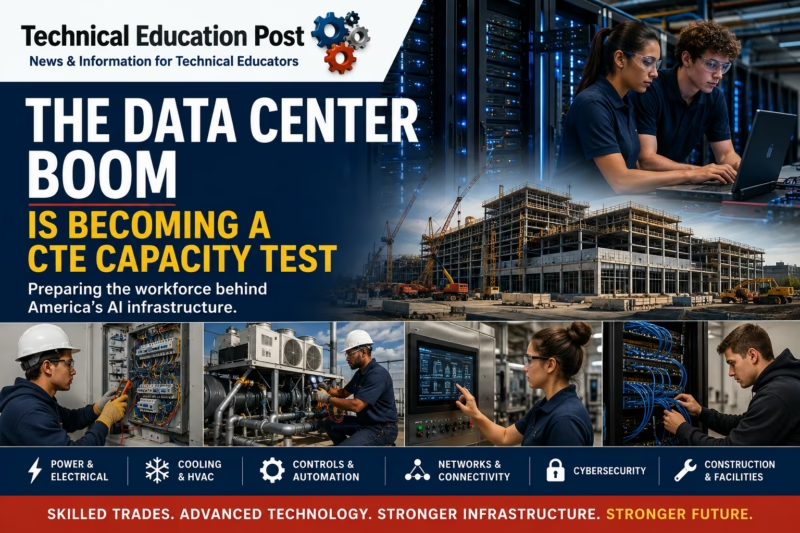
America’s data-center expansion is usually described through investment totals, computing capacity, artificial intelligence, electricity demand, and the race to build new infrastructure. For technical educators, the more urgent question is whether the workforce-development system can prepare enough people to construct, commission, secure, operate, and maintain that infrastructure.
A June 2026 update from Lawrence Berkeley National Laboratory estimates that data centers could consume 11.8% of all U.S. electricity by 2030 under its reference case. The report’s full range extends from 9.5% to 15.3%, depending on equipment shipments, AI-server utilization, chip operating life, cooling performance, and other variables. That scale of growth will affect far more than information-technology programs.
Data centers depend on electricians, HVACR technicians, pipefitters, sheet-metal workers, controls specialists, industrial-maintenance technicians, stationary engineers, power-system workers, network professionals, cybersecurity personnel, and construction managers. Many of these occupations already face significant replacement and growth demand across the broader economy.
The implication for career and technical education is clear: schools should not respond by simply adding a “data-center” label to an existing program. They should examine whether their electrical, HVACR, energy, construction, automation, networking, and cybersecurity pathways can work together to prepare students for critical-facilities environments.
The data-center boom is therefore becoming a test of CTE capacity—not only the number of students enrolled, but the ability of institutions to coordinate programs, modernize laboratories, prepare instructors, create work-based learning, and teach the systems-level thinking required in facilities where electrical, mechanical, digital, and security failures are tightly connected.
Key Takeaways
- Berkeley Lab’s 2026 update estimates that U.S. data centers could consume 11.8% of national electricity by 2030, with a modeled range of 9.5% to 15.3%.
- The data-center workforce extends far beyond software and computer science into electrical, HVACR, construction, controls, maintenance, networking, energy, and cybersecurity occupations.
- National BLS projections show approximately 81,000 electrician openings and 40,100 HVACR openings per year across the economy; these figures are not data-center-specific but illustrate competition for the same talent.
- Programs should build cross-disciplinary critical-facilities competencies rather than creating narrow pathways tied to one employer or project.
- Federal workforce initiatives are beginning to connect data-center power, energy training, AI skills, and Registered Apprenticeship.
- Schools should teach transferable foundations while employers provide site-specific procedures, proprietary systems, and operational protocols.
What Happened?
Lawrence Berkeley National Laboratory published the United States Data Center Energy Usage Report: 2025 Update in June 2026. Although the title refers to the 2025 update, the report was released in 2026 and extends national estimates through 2030.
The reference case projects 649 terawatt-hours of U.S. data-center electricity use in 2030, representing approximately 11.8% of total national electricity consumption. The researchers also modeled sensitivity and uncertainty scenarios that produce a range of 521 to 843 terawatt-hours, or approximately 9.5% to 15.3% of U.S. electricity use.
The estimates were produced through a bottom-up model using real-world and projected data on information-technology equipment shipments, per-device electricity consumption, AI-chip utilization, equipment operating life, cooling performance, facility types, and geographic distribution.
This methodology matters because the report is not simply extrapolating from past electricity use. It attempts to model what companies are expected to install and how those systems are likely to operate. The uncertainty remains substantial, but every major scenario points toward enormous growth in power and cooling requirements.
“There’s so much difference in the industry between when we looked at it in 2016 and when we look at it now.”
— Arman Shehabi, Berkeley Lab staff scientist and data-center energy researcher
The report updates a 2024 Berkeley Lab analysis that estimated data centers consumed about 4.4% of U.S. electricity in 2023 and could account for 6.7% to 12% by 2028. The new update pushes the planning horizon to 2030 and raises the central estimate.
Statistics Callout
649 TWh: Berkeley Lab’s reference-case estimate for U.S. data-center electricity consumption in 2030.
11.8%: Reference-case share of total U.S. electricity use.
521–843 TWh: Modeled uncertainty range for 2030.
9.5%–15.3%: Estimated range of total U.S. electricity that data centers could consume in 2030.
81,000: Average annual electrician openings projected across the U.S. economy.
40,100: Average annual HVACR mechanic and installer openings projected across the U.S. economy.
Why an Energy Report Is Also an Education Report
Electricity consumption is a proxy for physical systems. Computing equipment cannot operate without power distribution, backup systems, cooling, controls, networking, fire protection, water management, physical security, and continuous maintenance.
Every expansion in computing capacity creates work across several stages:
| Project stage | Representative occupations and functions |
|---|---|
| Site preparation and construction | Construction managers, equipment operators, electricians, plumbers, pipefitters, sheet-metal workers, welders, and safety professionals |
| Power and mechanical installation | Electrical contractors, HVACR technicians, controls technicians, generator specialists, stationary engineers, and commissioning personnel |
| Network and computing deployment | Fiber and telecommunications technicians, network specialists, server technicians, systems analysts, and vendor technicians |
| Commissioning and validation | Testing, balancing, controls integration, electrical verification, thermal validation, documentation, and failure-mode testing |
| Continuous operations | Critical-facilities technicians, electrical and mechanical maintenance, cybersecurity, network operations, monitoring, security, and emergency response |
The workforce problem is therefore distributed across programs that schools often manage separately. Electrical students may never work with HVACR students. Networking students may not understand building controls. Cybersecurity students may focus on enterprise IT without studying operational technology. Construction students may have little exposure to commissioning or critical-facilities documentation.
Data centers expose the limits of that separation. A cooling failure can become a computing failure. A control-system vulnerability can become a physical-operational risk. A power-quality event can damage equipment. A maintenance mistake can reduce redundancy and create an outage.
The education challenge is not to make every student an expert in every discipline. It is to ensure that graduates understand how their work affects the larger system and how to communicate across trades and technical teams.
Demand Is Arriving in Trades That Are Already Stretched
Data-center growth is entering a labor market where many infrastructure occupations already face strong demand from housing, manufacturing, hospitals, schools, energy projects, commercial construction, and the replacement of retiring workers.
The Bureau of Labor Statistics projects electrician employment to grow 9% from 2024 through 2034, much faster than the average for all occupations. BLS estimates approximately 81,000 electrician openings each year across the economy. Most electricians learn through apprenticeships, although technical-school programs can provide foundational instruction and credit toward apprenticeship.
For HVACR mechanics and installers, BLS projects 8% growth and approximately 40,100 annual openings. The agency specifically notes growing demand associated with sophisticated climate-control systems and energy-efficiency upgrades.
Industrial machinery mechanics, maintenance workers, and millwrights are projected to grow 13%, while computer network architects are projected to grow 12%. Electrical power-line installers and repairers are projected to grow 7%.
These national projections should not be interpreted as data-center job forecasts. BLS does not isolate data-center demand across all relevant occupations. The figures instead show that data-center developers will be competing with other industries for many of the same workers.
Technical Education Post has already documented the rise in data-center construction demand and the growing need for qualified electricians and mechanical trades. The new Berkeley Lab report suggests that this pressure is not a short construction cycle. It is part of a longer infrastructure transformation.
AI Jobs Include the People Who Build and Maintain AI Infrastructure
Public discussion of AI careers often centers on software developers, data scientists, and machine-learning engineers. Those roles matter, but they represent only one part of the AI economy.
The U.S. Department of Labor’s 2026 initiative to integrate AI skills into Registered Apprenticeship specifically identified data centers, telecommunications, and advanced manufacturing as workforce priorities. The initiative is designed both to create pathways for AI-focused occupations and to integrate AI competencies into traditional trades and infrastructure jobs.
That distinction should influence curriculum planning. An electrician may use AI-supported diagnostics. An HVACR technician may work with predictive maintenance and intelligent controls. A critical-facilities technician may interpret automated alerts and equipment-health data. A cybersecurity worker may protect systems whose physical and digital functions cannot be separated.
The relevant question is not whether these workers will become AI developers. It is whether they can use, verify, troubleshoot, and safely act on AI-assisted information within their occupation.
This connects directly to Technical Education Post’s analysis of applied co-intelligence in CTE. Students need enough occupational knowledge to evaluate technology-assisted recommendations rather than accept them without verification.
Cooling Is Becoming a Core Digital-Infrastructure Skill
AI servers produce high heat loads, and the Berkeley Lab model identifies cooling-system performance as one of the variables that significantly affects national electricity consumption.
That makes HVACR education central to the data-center workforce. However, conventional residential and light-commercial instruction is not sufficient by itself. Critical-facilities environments may require knowledge of:
- High-capacity and mission-critical cooling systems
- Airflow management and containment
- Liquid cooling and heat-transfer principles
- Pumps, valves, piping, and hydronic systems
- Variable-speed drives and digital controls
- Testing, adjusting, and balancing
- Temperature, humidity, and pressure monitoring
- Redundancy and failure response
- Energy-performance measurement
- Refrigerant safety and regulatory requirements
Technical Education Post’s earlier coverage of AI-driven demand for HVACR infrastructure and data-center cooling careers highlighted this emerging specialization. The new energy forecast strengthens the case for treating data-center cooling as a durable instructional opportunity rather than a temporary trend.
Electrical Programs Need More Than Basic Wiring
Data centers require extensive electrical systems, including utility interconnections, switchgear, transformers, uninterruptible power supplies, generators, batteries, distribution equipment, grounding, monitoring, controls, and emergency systems.
Students do not need access to a hyperscale facility to begin learning relevant principles. Electrical programs can strengthen preparation through:
- One-line diagrams and electrical schematics
- Power-quality fundamentals
- Three-phase systems
- Transformers, switchgear, and protective devices
- Backup power and transfer systems
- Grounding and bonding
- Controls and building-automation interfaces
- Thermal imaging and condition monitoring
- Lockout/tagout and arc-flash awareness
- Redundancy concepts and maintenance procedures
Advanced laboratories can simulate a critical load, backup source, transfer sequence, cooling response, and alarm condition at safe training voltages. The objective is not to reproduce an entire data center. It is to teach how electrical decisions affect continuity, safety, and system reliability.
Cybersecurity Cannot Be Separated From Facilities Operations
Modern data centers are cyber-physical environments. Building-management systems, electrical monitoring, cooling controls, access systems, network infrastructure, remote support tools, and operational dashboards all create security dependencies.
A March 2026 NIST guide connects cybersecurity risk management with workforce management and argues for continuous workforce adaptation as threats and technologies evolve. That approach is relevant to data-center education because technical risk is distributed across many job roles—not confined to a security operations center.
Cybersecurity programs should understand operational technology, facilities networks, access control, asset inventories, vendor access, incident response, and business continuity. Electrical, HVACR, controls, and maintenance students should learn cyber hygiene, authentication, change control, secure remote access, and escalation procedures appropriate to their roles.
This does not mean turning every trades program into a cybersecurity degree. It means treating secure operation as part of technical competence.
Federal Policy Is Beginning to Connect Energy and Data-Center Workforce Development
The Department of Energy’s 2026 Partnerships for Academic-Industry Career Training initiative provides up to $11.3 million for regional consortia led by institutions of higher education, including community colleges, technical colleges, trade schools, and Tribal Colleges and Universities.
The eligible technology areas include power generation for data centers or remote operations, construction of related facilities and infrastructure, AI and machine learning, energy technologies, and geographic information systems.
The program is important not only because of its funding. It demonstrates how policymakers are beginning to frame data-center workforce preparation: as a regional academic-industry challenge involving power, construction, technology, and hands-on credentials.
Institutions should watch whether similar initiatives emerge through the Department of Labor, state economic-development agencies, utilities, data-center developers, and apprenticeship intermediaries.
Programs should also review Technical Education Post’s coverage of regional energy-workforce partnerships, which shows how sector partnerships can align employers, colleges, workforce agencies, and community organizations around common training needs.
Do Not Build a Narrow “Data Center Program” Too Quickly
The visibility of data-center investment may tempt institutions to create new program titles before determining what employers actually need.
A narrow pathway can create several risks:
- Dependence on one developer or construction project
- Curriculum built around proprietary equipment
- Equipment purchases that become obsolete quickly
- Duplication of existing electrical, HVACR, or networking content
- Insufficient enrollment after the initial hiring surge
- Credentials that lack value outside one facility type
A stronger model is usually a data-center specialization, certificate, capstone, or shared critical-facilities sequence built across existing programs.
| School responsibility | Employer responsibility |
|---|---|
| Electrical, mechanical, controls, networking, and safety foundations | Proprietary equipment and site architecture |
| Reading diagrams, documentation, and operating procedures | Facility-specific standard operating procedures |
| Troubleshooting methods and measurement skills | Authorized diagnostic and escalation processes |
| Cybersecurity and change-control fundamentals | Company security tools, access policies, and incident workflows |
| Redundancy, reliability, and systems thinking | Site-specific redundancy design and operational thresholds |
| Professional communication and teamwork | Organizational roles, shift practices, and performance expectations |
This approach preserves portability. Graduates can pursue data-center work while remaining qualified for advanced manufacturing, hospitals, utilities, commercial facilities, telecommunications, and other infrastructure sectors.
What CTE and College Leaders Should Do Now
1. Map the Regional Infrastructure Pipeline
Identify announced data centers, utility upgrades, construction contractors, mechanical contractors, electrical contractors, controls firms, equipment suppliers, telecommunications companies, and operations employers. Separate confirmed projects from proposed developments.
2. Identify Shared Occupations, Not Just Data-Center Job Titles
Employers may use titles such as critical-facilities technician, building-automation technician, electrical technician, operations technician, controls specialist, or commissioning technician. Map the underlying competencies to existing programs.
3. Conduct a Cross-Program Curriculum Audit
Bring electrical, HVACR, construction, automation, IT, networking, and cybersecurity faculty together. Determine where competencies overlap, where gaps exist, and which learning experiences should be shared.
4. Build a Critical-Facilities Fundamentals Module
Create a common module covering uptime, redundancy, power, cooling, controls, cybersecurity, documentation, emergency procedures, and the relationship among physical systems.
5. Use Simulation Before Purchasing Expensive Equipment
Tabletop exercises, digital twins, control-system trainers, low-voltage electrical simulations, airflow demonstrations, and fault-insertion labs can teach system behavior without attempting to replicate a full data center.
6. Establish Employer-Validated Work-Based Learning
Use job shadows, facility tours, internships, apprenticeships, faculty externships, commissioning observations, and employer-designed capstones. Students need exposure to operational discipline, not just equipment.
7. Prepare Faculty Across Disciplines
Faculty development should include data-center architecture, critical-facilities operations, safety, cybersecurity, modern cooling, controls, and emerging AI-assisted maintenance.
8. Align With Apprenticeship and Academic Credit
Many relevant trades rely on apprenticeship. Colleges should determine how related technical instruction, employer training, and work-based competencies can stack into certificates and degrees.
9. Track Regional Competition for Talent
Data centers may compete with manufacturers, utilities, hospitals, schools, and contractors for the same graduates. Advisory committees should discuss wages, schedules, travel, working conditions, advancement, and retention—not only projected openings.
10. Preserve Broad Career Mobility
Teach data-center applications through transferable competencies. Avoid designing graduates for one building, one vendor, or one construction cycle.
Administrator Takeaway
Before approving a new data-center pathway, require evidence of confirmed employer demand, faculty capacity, laboratory access, apprenticeship or work-based learning, cross-program coordination, portable credentials, and a sustainability plan. A specialization added to strong electrical, HVACR, automation, or networking programs may create more value than a separate degree.
Common Mistakes
- Treating data centers as an IT-only sector. The physical infrastructure workforce is essential.
- Building curriculum around one project announcement. Proposed facilities may change schedule, scale, or location.
- Ignoring commissioning and operations. Construction is only one stage of the facility lifecycle.
- Separating cybersecurity from trades instruction. Connected facilities require secure behavior across roles.
- Buying equipment before defining competencies. Systems should support learning outcomes, not determine them.
- Assuming all data-center jobs require a bachelor’s degree. Many critical roles are reached through CTE, apprenticeships, certificates, and associate degrees.
- Training only for proprietary systems. Employer-specific preparation should build on portable foundations.
- Underestimating faculty development. Cross-disciplinary instruction requires instructors to understand the larger facility system.
Questions to Ask Your Program
- Which data-center projects in our region are confirmed, under construction, proposed, or speculative?
- Which employers will construct, commission, operate, and maintain those facilities?
- Which relevant competencies already exist in our electrical, HVACR, automation, construction, IT, networking, and cybersecurity programs?
- Where do students currently learn about critical loads, redundancy, controls, commissioning, and emergency response?
- Can faculty and students access facility tours, internships, apprenticeships, or employer-supported labs?
- Are employers asking for new credentials or stronger mastery of existing fundamentals?
- Do our programs teach cyber-physical security and change-control practices?
- Can students interpret one-line diagrams, mechanical schematics, controls data, alarms, and technical procedures?
- How will we prepare instructors for modern cooling, electrical, and controls technologies?
- Can the same curriculum support careers in manufacturing, healthcare facilities, utilities, and commercial buildings?
- What equipment can be simulated before we invest in full-scale trainers?
- How will we measure placement, retention, wage progression, employer satisfaction, and advancement?
- Could data-center hiring weaken other regional employers by drawing from the same limited graduate pool?
- What happens to the pathway if a major project is delayed or canceled?
What to Watch Next
Electricity and Grid Constraints
Data-center development will increasingly depend on generation, transmission, interconnection timelines, and local power availability. Workforce planning must include utilities and power-system occupations, not only facility employers.
Liquid Cooling and Thermal Management
Higher-density AI computing will accelerate changes in cooling design. HVACR and mechanical programs will need to monitor liquid cooling, heat exchangers, pumping systems, controls, water treatment, and thermal-performance measurement.
Regional Training Consortia
Expensive laboratories, faculty shortages, and overlapping employer needs favor shared training centers and multi-institution partnerships. The DOE PACT model may be an early example of a broader regional approach.
AI-Assisted Maintenance
Predictive diagnostics, automated monitoring, and AI-supported troubleshooting will become more common. Programs must teach students how to validate recommendations and recognize when automated systems are incomplete or wrong.
Cybersecurity Workforce Integration
Facilities, networking, and operational-technology security will become more closely connected. NIST’s risk-based workforce approach suggests that organizations will need continuous skill adaptation rather than static job descriptions.
Community Scrutiny
Communities will continue asking questions about electricity, water, land use, tax incentives, construction impacts, and long-term employment. Technical educators should distinguish independently verified workforce demand from promotional projections.
The broader lesson aligns with Technical Education Post’s analysis of the technical and STEM education landscape in 2026: education systems increasingly function as economic infrastructure for industries whose growth depends on specialized technical talent.
Frequently Asked Questions
Why are data centers important to CTE programs?
Data centers require workers in electrical, HVACR, construction, automation, maintenance, networking, cybersecurity, and energy systems. Many of these occupations are served directly by CTE, apprenticeships, technical colleges, and community colleges.
How much U.S. electricity could data centers use by 2030?
Berkeley Lab’s 2026 update estimates a reference case of 11.8% of U.S. electricity, with a modeled range of approximately 9.5% to 15.3%.
Should colleges create separate data-center degrees?
Not automatically. Many institutions may create stronger outcomes through specializations, certificates, shared modules, and employer-supported capstones added to established electrical, HVACR, automation, networking, or cybersecurity programs.
Which trades are most relevant?
Relevant occupations include electricians, HVACR technicians, pipefitters, plumbers, sheet-metal workers, controls technicians, industrial-maintenance workers, stationary engineers, telecommunications technicians, and power-system workers.
Are data-center careers only available during construction?
No. Construction creates substantial demand, but facilities also require commissioning, operations, preventive maintenance, monitoring, networking, cybersecurity, security, and emergency-response personnel.
What can high schools teach without expensive data-center equipment?
High schools can teach electrical fundamentals, electronics, controls, networking, cybersecurity, HVAC principles, technical documentation, troubleshooting, safety, energy efficiency, and systems thinking through simulations and scaled trainers.
How should employers participate?
Employers should validate competencies, provide instructors with current technical knowledge, support work-based learning, explain site-specific hiring requirements, and supply proprietary training after students master transferable foundations.
What is the biggest planning risk?
The biggest risk is building a narrow program around one announced project without confirmed employer demand, portable competencies, faculty capacity, work-based learning, or a plan for project delays.
Technical Education Post Perspective
The data-center boom is often presented as proof that the economy needs more advanced computing talent. That is true, but incomplete.
The same growth also requires a much larger and more coordinated infrastructure workforce. Servers depend on power. Power depends on electrical systems and utilities. Computing depends on cooling. Connected controls require cybersecurity. Continuous operation depends on technicians who can diagnose problems across systems without creating new failures.
This is where technical education becomes a limiting factor. Capital can finance buildings and equipment, but it cannot instantly produce experienced electricians, HVACR technicians, controls specialists, instructors, mentors, or critical-facilities operators.
The strongest institutional response will not be a rush to create narrowly branded programs. It will be disciplined capacity building: stronger foundational pathways, cross-program instruction, employer-validated specialization, modern laboratories, faculty externships, apprenticeship alignment, and evidence-based workforce planning.
If data centers are becoming national digital infrastructure, then the programs preparing the people who keep them operating are workforce infrastructure. The success of one increasingly depends on the capacity of the other.
Continue Reading
- Data Center Construction Growth
- Artificial Intelligence Drives HVACR
- Demand for HVACR Technicians
- Construction Trades Education Matters
- America’s Advanced Manufacturing Workforce
- Skills Shortage or Exposure Shortage?
- AI Literacy Is Not Enough
- Technical and STEM Education 2026
Sources and Further Reading
- Lawrence Berkeley National Laboratory: United States Data Center Energy Usage Report, 2025 Update
- Lawrence Berkeley National Laboratory: 2024 United States Data Center Energy Usage Report
- Berkeley Lab: Data Center Electricity Demand Analysis
- Department of Energy: Partnerships for Academic-Industry Career Training
- Department of Labor: AI Skills in Registered Apprenticeship
- Bureau of Labor Statistics: Electricians
- Bureau of Labor Statistics: HVACR Mechanics and Installers
- Bureau of Labor Statistics: Industrial Machinery Mechanics and Millwrights
- Bureau of Labor Statistics: Computer Network Architects
- NIST Cybersecurity Framework 2.0 Workforce Management Guide