
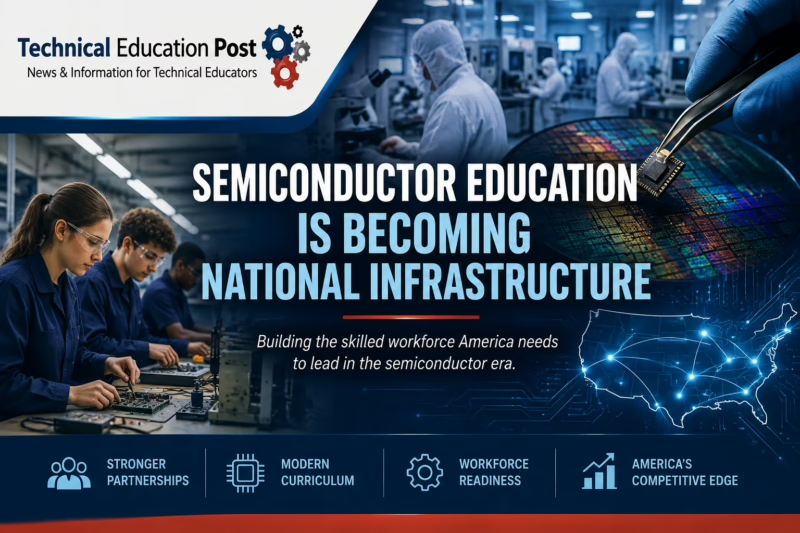
The United States has spent the past several years announcing semiconductor fabs, research centers, supply-chain investments, tax incentives, and new training programs. The next challenge is more difficult: turning hundreds of separate education and workforce initiatives into a system capable of preparing technicians, engineers, equipment specialists, and other workers at the speed new facilities will require them.
That transition began taking clearer shape in 2026 with the launch of the first four Regional Nodes of the National Network for Microelectronics Education, or NNME. Supported by the National Science Foundation in partnership with the U.S. Department of Commerce and operated by the SEMI Foundation, the network is designed to connect employers, K–12 schools, colleges, universities, workforce organizations, economic-development agencies, and community partners through shared regional and national infrastructure.
The timing is consequential. A new national workforce analysis published in July projects that the semiconductor industry will need approximately 189,000 additional workers between 2026 and 2030, including about 104,000 engineers, 73,000 technicians, and 12,000 computer scientists. Even under optimistic assumptions, the analysis estimates a workforce shortfall of 127,000 to 157,000 people by 2030.
For technical educators, the central message is not simply that semiconductor careers are growing. It is that isolated programs, one-time equipment grants, and individual employer partnerships will not be enough. The emerging model is a coordinated talent system in which curriculum, facilities, faculty development, work-based learning, career awareness, placement, and outcome measurement are shared across institutions and regions.
Schools should not wait until a semiconductor fab opens nearby to begin planning. They should determine how their existing programs in electronics, mechatronics, automation, machining, industrial maintenance, chemistry, engineering technology, cybersecurity, and advanced manufacturing can connect to this national workforce infrastructure.
Key Takeaways
- The first four NNME Regional Nodes activate a network of more than 325 organizations and may receive up to $20 million per node over five years.
- A new analysis projects approximately 189,000 incremental semiconductor workers will be needed between 2026 and 2030.
- Nearly three-quarters of projected demand is tied to manufacturing-related occupations.
- The largest problem is not the complete absence of training programs; it is limited scale, fragmented coordination, low career awareness, faculty constraints, and uneven access to facilities.
- Schools should teach transferable technical foundations while employers provide proprietary, equipment-specific training.
- Programs should track placement, retention, cost per graduate, employer engagement, and replication readiness—not just enrollment and completion.
What Happened?
The National Science Foundation announced in May that the SEMI Foundation and NSF had launched the first four Regional Nodes of the National Network for Microelectronics Education. Collectively, the nodes connect more than 325 organizations, including school districts, postsecondary institutions, employers, workforce agencies, economic-development organizations, and community partners.
Under the current structure:
- NNME Southwest is led by the Arizona Commerce Authority and serves Arizona, Southern California, Colorado, New Mexico, and Utah.
- NNME Northeast is led by NY CREATES and serves Connecticut, Delaware, Maine, Maryland, Massachusetts, New Hampshire, New Jersey, New York, Pennsylvania, Rhode Island, Vermont, and Virginia.
- NNME South is led by the University of Texas at Austin and serves Arkansas, Georgia, Mississippi, Florida, Texas, New Mexico, Louisiana, Oklahoma, Utah, and Alabama.
- NNME Pacific-Intermountain is led by Boise State University and serves Idaho, Washington, Oregon, Montana, Utah, Colorado, Nevada, Northern California, and Hawaii.
The published footprints overlap in several states, reflecting the reality that semiconductor supply chains and talent markets do not follow clean administrative boundaries. The initial network also does not yet list every state within a Regional Node service area, making future expansion and national access to shared resources important issues to watch.
Each node is expected to translate national strategy into regional execution. Participating organizations are not meant to function as unrelated grant recipients. They are expected to coordinate employer demand, curriculum, workforce pathways, facilities, professional development, career navigation, and performance measures.
This moves semiconductor education beyond the individual-program approach described in earlier Technical Education Post coverage of STEM education for the chip sector and toward a national system for sharing and scaling what works.
Statistics Callout
189,000: Estimated incremental semiconductor workers needed from 2026 through 2030.
104,000: Projected engineering demand.
73,000: Projected technician demand.
127,000–157,000: Estimated workforce shortfall by 2030.
74%: Share of projected demand tied to manufacturing-related occupations.
325-plus: Organizations activated through the first four NNME Regional Nodes.
The Workforce Problem Is Larger Than Recruiting
The new National Landscape Analysis, developed by McKinsey & Company and published in collaboration with the SEMI Foundation and NNME, argues that workforce pressure will intensify as announced semiconductor investments begin ramping between 2026 and 2030.
The report identifies more than $390 billion in announced U.S. investments across manufacturing, design, materials, and advanced packaging. It warns that talent shortages could delay facility start-ups, constrain production ramps, slow research and design work, and reduce the economic and strategic value of public and private investment.
The report’s most important contribution is its diagnosis. The national gap stems less from a complete lack of programs than from insufficient scale, weak coordination, late career exposure, limited faculty capacity, uneven access to cleanrooms and equipment, and pathways that depend too heavily on a single employer or short-term grant.
That finding should change how schools respond. The answer is not for every community college to build an independent semiconductor program or for every high school to purchase expensive fabrication equipment. The stronger approach is to identify the role each institution can play within a connected regional system.
“Every region brings unique strengths, but lasting impact comes from connecting those efforts through shared goals, industry engagement, and collaboration.”
— Dr. Jennifer Ellis, Director, National Network for Microelectronics Education
Why Technicians Matter as Much as Engineers
Semiconductor workforce discussions often emphasize engineering degrees, but nearly three-quarters of projected demand is connected to manufacturing. The new analysis estimates demand for roughly 73,000 technicians through 2030, alongside approximately 104,000 engineers.
The Bureau of Labor Statistics projects employment for semiconductor processing technicians to grow 11% from 2024 to 2034, much faster than the average for all occupations. These technicians operate and monitor equipment used in photolithography, etching, polishing, deposition, inspection, and other highly controlled production processes.
Other occupations are equally important to fab operations: industrial maintenance technicians, electrical and electronic engineering technicians, mechatronics technicians, quality specialists, equipment installers, facilities technicians, automation specialists, and workers supporting ultrapure water, vacuum, gases, chemicals, and environmental controls.
This is why the semiconductor workforce opportunity extends beyond programs carrying the word semiconductor in their title. Schools with strong electrical, electronics, robotics, automation, industrial maintenance, or advanced-manufacturing programs may already teach much of the foundation employers need.
Technical Education Post has previously documented how a short, employer-connected model can introduce cleanroom practices, electrical theory, circuits, schematics, tools, safety, lean manufacturing, and vacuum technology through semiconductor industry training in Phoenix. The national challenge is to determine which elements of successful local models can be standardized and replicated without losing employer relevance.
What Schools Should Teach—and What Employers Must Teach
The National Landscape Analysis draws a useful boundary between education and employer training.
Education programs are expected to develop durable foundations: electrical principles, process awareness, applied mathematics, measurement, data interpretation, automation, quality, safety, documentation, teamwork, and structured problem-solving. Employers then complete the preparation with proprietary tools, equipment-specific procedures, fab protocols, and production systems that schools often cannot reproduce.
This is a more realistic standard than expecting graduates to arrive fully trained on equipment that may cost millions of dollars, operate under restricted access, or differ from one facility to another.
| Education-provider responsibility | Employer responsibility |
|---|---|
| Electrical, electronic, mechanical, and process fundamentals | Proprietary equipment and production procedures |
| Safety culture and cleanroom readiness | Site-specific environmental, chemical, and emergency protocols |
| Measurement, metrology, and quality principles | Company-specific quality systems and process controls |
| Automation, sensors, data, and troubleshooting methods | Tool-specific diagnostics and restricted technical systems |
| Technical documentation and communication | Internal documentation, escalation, and reporting workflows |
| Work habits, collaboration, and problem-solving | Production expectations, team roles, and performance standards |
This division of responsibility also supports broader preparation. A student grounded in electronics, controls, metrology, troubleshooting, and industrial safety can move among semiconductor manufacturing, equipment suppliers, aerospace, medical devices, automotive electronics, and other advanced-manufacturing sectors.
That portability is essential because hiring cycles change. A program designed around one employer’s immediate ramp may struggle if construction is delayed, production schedules shift, or hiring slows. The strongest programs prepare students for a semiconductor ecosystem while preserving value in adjacent industries.
Short-Term Training Works Best When Hiring Is Real
The report finds that employer-linked quick-start programs and apprenticeships can achieve placement rates of roughly 70% to 90%, with some models exceeding 90%. Their effectiveness comes from direct alignment with real hiring demand, employer participation in curriculum, hands-on experience, and a clear transition into work.
But those programs also have limitations. Their benefits tend to be concentrated near fabs, tied to specific hiring windows, and vulnerable to changes in employer demand. A two- to eight-week program cannot create a durable workforce system by itself.
Short-term training should therefore function as one layer within a larger pathway:
- K–12 career awareness and technical foundations
- High school CTE, dual enrollment, and pre-apprenticeship
- Quick-start or bridge training for immediate hiring needs
- Industry-recognized credentials and registered apprenticeships
- Associate degrees in electronics, automation, mechatronics, or semiconductor technology
- Bachelor’s and graduate engineering pathways
- Employer-supported upskilling and advancement
This stackable approach is consistent with Technical Education Post’s coverage of semiconductor supply-chain careers and the need to connect early exposure, credentials, technical education, and long-term advancement.
The Talent Gap Begins Before Enrollment
One of the report’s most useful findings is that semiconductor programs may have an awareness problem before they have a curriculum problem.
In a small supply survey of 25 engineering and technician graduates, 83% reported little or no familiarity with semiconductor careers before entering their programs. Interest in STEM was common, but knowledge of semiconductor occupations, employers, tools, and pathways was limited.
The sample is too small to treat the percentages as national estimates. However, the findings align with a recurring problem across technical education: students cannot choose careers they have never seen.
Effective awareness efforts should go beyond showing students a finished microchip. Students need to see the occupations and production systems behind it:
- How technicians keep automated tools operating
- How metrology teams identify defects measured at microscopic scales
- How facilities workers maintain vacuum, water, gases, temperature, and contamination controls
- How engineers improve yield and process stability
- How cybersecurity protects connected production systems and intellectual property
- How equipment, materials, packaging, logistics, and maintenance companies support the industry
Schools can begin with low-cost electronics, sensors, automation, inspection, coding, contamination-control demonstrations, and process-improvement projects. Cleanroom tours, industry speakers, paid internships, and teacher externships can add context that a classroom alone cannot provide.
The same principle appears in Technical Education Post’s examination of robots and the modern shop class: students need both technical fundamentals and visible connections to the industries using them.
Faculty and Facilities Are the Scaling Constraint
Semiconductor education is expensive to scale if every institution attempts to duplicate specialized facilities. The report identifies cleanroom access, equipment time, faculty capacity, and instructional staffing as major constraints.
A national network creates alternatives to duplication:
- Shared cleanroom and laboratory access across institutions
- Mobile or remote laboratory experiences
- Common curriculum modules and virtual simulations
- Regional faculty professional development
- Employer-donated or decommissioned equipment
- Cross-institution teaching agreements
- Summer institutes and short-term immersion programs
- Transfer and articulation agreements between high schools, community colleges, and universities
The NNME’s national platforms are intended to support this work. SemiSphere is described as a curriculum and learning platform for industry-aligned instructional resources, while ChipPath connects learners to training, career-navigation tools, and live employment opportunities.
Educators should evaluate these resources as infrastructure—not simply as websites. Their value will depend on whether curricula remain current, credentials are recognized, employers participate, faculty can use the materials effectively, and students can move from exploration to training to employment.
A Networked Program Is Different From a Stand-Alone Program
| Stand-alone approach | Networked approach |
|---|---|
| One institution designs curriculum independently | Employers and institutions co-develop shared competencies |
| Equipment is purchased for one campus | Facilities and equipment are shared regionally where possible |
| One employer drives program design | Multiple employers validate transferable and company-specific skills |
| Success is measured by enrollment and completion | Success includes placement, retention, cost, employer engagement, and advancement |
| Funding ends when a grant ends | Partners develop a multi-year sustainability model |
| Students discover careers late | K–12 exposure and career navigation begin early |
| Faculty update skills individually | Regional professional development and externships are coordinated |
| Programs compete for limited resources | Institutions specialize and connect pathways across the region |
This networked model parallels the broader argument in America’s Advanced Manufacturing Workforce: no single school, employer, or workforce agency can independently solve a regional talent problem.
What CTE and College Leaders Should Do Now
1. Map Existing Assets Before Creating a New Program
Inventory courses, faculty expertise, laboratories, equipment, credentials, dual-enrollment agreements, and employer relationships across electronics, automation, maintenance, engineering technology, chemistry, machining, cybersecurity, and quality.
The first question is not, “Should we launch a semiconductor program?” It is, “Which semiconductor-relevant capabilities do we already teach, and where are the actual gaps?”
2. Identify the Regional Semiconductor Ecosystem
Map fabs, equipment manufacturers, materials suppliers, packaging operations, utilities, construction firms, maintenance contractors, research institutions, and adjacent industries. Schools far from a fab may still serve the supply chain or prepare workers who can relocate.
3. Engage More Than One Employer
A single anchor employer can accelerate program development, but overdependence creates risk. Seek input from manufacturers, suppliers, contractors, and adjacent industries so the curriculum remains portable when hiring cycles change.
4. Define the Education-to-Employer Boundary
Agree on which skills schools can reasonably teach and which proprietary capabilities employers will develop after hire. This prevents unrealistic equipment purchases and keeps programs focused on foundations that transfer.
5. Create an Early-Awareness Strategy
Integrate semiconductor applications into middle school STEM, high school electronics, robotics, chemistry, physics, computer science, and manufacturing courses. Career awareness should precede the point when students select a college major or technical program.
6. Build Work-Based Learning Into the Program
Internships, apprenticeships, faculty externships, job shadows, capstone projects, and employer-supported labs connect classroom fundamentals to proprietary production environments.
7. Track Outcomes That Matter
The National Landscape Analysis recommends tracking semiconductor-aligned placement, time to placement, cost per placed graduate, employer engagement, retention, capacity utilization, funding durability, and replication readiness.
Those metrics are more demanding than enrollment counts, but they tell leaders whether a program is producing workforce value.
Administrator Takeaway
Do not approve a semiconductor program solely because the industry is receiving major investment. Require evidence of regional demand, employer participation, faculty capacity, laboratory access, work-based learning, student awareness, placement opportunities, and a sustainability plan that does not depend on one grant or one company.
Questions to Ask Your Program
- Which semiconductor-related competencies do we already teach?
- Which local or regional employers validate those competencies?
- Are we preparing students for one company or for a broader technical ecosystem?
- Can students access cleanroom, metrology, automation, or process-control experiences without duplicating expensive facilities?
- Do faculty members have current industry exposure?
- Where does semiconductor career awareness begin in our K–12 pipeline?
- Can students stack short-term training into certificates and degrees?
- What proprietary skills will employers teach after hire?
- How will we track placement, retention, advancement, and employer satisfaction?
- What happens to the program if an employer delays hiring?
- Are there Regional Node, NNME, NSF, NIST, or industry resources we are not yet using?
- Could our existing electronics, mechatronics, maintenance, robotics, or engineering programs connect to semiconductor pathways without being renamed?
What to Watch Next
Regional Node Expansion
The first four public node footprints do not cover every state. Future expansion will determine how institutions in the Midwest and other uncovered regions connect to the network, receive technical assistance, and access shared infrastructure.
Curriculum Standardization Without Overstandardization
Shared curriculum can reduce duplication and improve portability, but it must remain responsive to regional equipment, materials, packaging, design, and manufacturing needs.
Faculty Development
Programs cannot scale faster than instructors can be prepared. Employer externships, regional academies, shared faculty, and train-the-trainer models will be central.
Hiring-Cycle Volatility
Fab construction and production ramps do not always occur on the original schedule. Programs will need diversified employer partnerships and pathways into adjacent industries.
National Outcome Measures
NNME intends to create shared performance tracking. The credibility of the network will depend on whether partners report placement, retention, cost, employer engagement, and workforce outcomes consistently.
Automation and AI
The workforce analysis found that automation and AI are changing demand for digital, analytical, systems, and problem-solving skills. Programs should prepare students to work with increasingly automated production systems while preserving hands-on diagnostic expertise.
This reinforces Technical Education Post’s broader coverage of the technical and STEM education landscape in 2026, where semiconductor manufacturing, AI, national security, and workforce readiness are increasingly interconnected.
Frequently Asked Questions
What is the National Network for Microelectronics Education?
NNME is a national workforce-development network supported by NSF in partnership with the U.S. Department of Commerce and operated by the SEMI Foundation. It coordinates regional employers, education providers, workforce organizations, and community partners around semiconductor career pathways.
How many NNME Regional Nodes exist?
The first four Regional Nodes are Southwest, Northeast, South, and Pacific-Intermountain. Their public service areas span multiple states and include some overlapping geographies.
Does a school need a cleanroom to teach semiconductor-related skills?
No. Schools can teach electronics, automation, vacuum fundamentals, contamination control, measurement, quality, safety, data, and troubleshooting without operating a full fabrication facility. Regional partnerships can provide specialized cleanroom exposure.
Which education level has the greatest opportunity?
The workforce requires multiple levels. K–12 programs build awareness and foundations; community colleges and apprenticeships prepare technicians; universities prepare engineers and researchers; employers provide proprietary and site-specific training.
What occupations are expected to be in demand?
Demand includes semiconductor processing technicians, equipment and maintenance technicians, electrical and electronics technicians, manufacturing and process engineers, systems engineers, computer scientists, facilities specialists, quality professionals, and advanced-packaging workers.
Should every technical college launch a semiconductor degree?
No. Institutions should first assess employer demand, existing curriculum, faculty, equipment access, work-based learning, placement capacity, and regional partnerships. Strengthening an existing electronics, mechatronics, or automation pathway may be more appropriate.
What makes short-term semiconductor training effective?
The strongest models are connected to actual hiring, co-designed with employers, include hands-on exposure, and create a direct placement pathway. They are most sustainable when they also stack into longer credentials.
How can an institution become involved?
Institutions can review the NNME Regional Nodes, contact the network, explore SemiSphere and ChipPath, and identify employers or workforce partners already participating in their region.
Technical Education Post Perspective
The semiconductor workforce challenge is often framed as a race to recruit more students into high-tech careers. The evidence points to a deeper problem.
America has successful programs, committed employers, strong community colleges, advanced research universities, and substantial public investment. What it has lacked is a durable system for connecting them, determining what should be shared, measuring what works, and scaling proven pathways across regions.
The National Network for Microelectronics Education is an attempt to build that system. Its success will not be measured by the number of organizations that join or the number of new program titles colleges announce. It will be measured by whether students encounter these careers earlier, faculty gain access to current technology, employers help define and complete training, institutions share expensive resources, and graduates move into sustainable careers.
The most important decision for a school may therefore be not whether to create a semiconductor program, but how to become a useful node in a larger semiconductor talent ecosystem.
Continue Reading
- STEM Education for the Chip Sector
- Semiconductor Industry Training in Phoenix
- Semiconductor Supply Chain Careers
- America’s Advanced Manufacturing Workforce
- Robots and Shop Class
- Advanced Manufacturing Workforce Sprint
- Technical and STEM Education 2026
Sources and Further Reading
- National Science Foundation: First NNME Regional Nodes
- National Network for Microelectronics Education
- Closing the Talent Gap in the Semiconductor Industry: 2026 National Landscape Analysis
- NNME Strategic Plan
- NNME Regional Node Framework
- Bureau of Labor Statistics: Semiconductor Processing Technicians
- NIST: Industry and Academic Partnerships for the Semiconductor Workforce
- SEMI Foundation Workforce Programs