
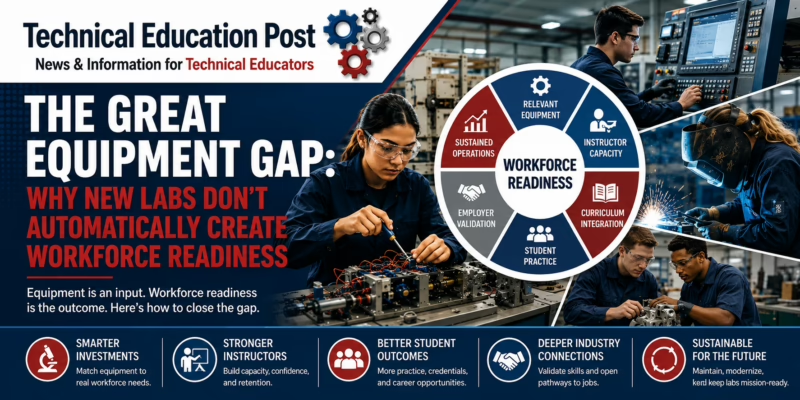
Across the United States, schools, career centers, community colleges, and workforce organizations are investing in robotics cells, CNC machines, welding systems, semiconductor equipment, healthcare simulators, electric vehicle trainers, cybersecurity ranges, automation platforms, and advanced manufacturing laboratories.
The investment is necessary. Students cannot prepare for today’s technical careers using yesterday’s equipment. Employers expect graduates to understand the technologies they use every day, and instructors need modern tools to teach modern skills.
But a new laboratory is not the same as a workforce-ready program.
Equipment can be purchased before instructors are prepared to teach it. It can be installed before curriculum is updated. It can remain underused because only one person knows how to operate it. Students may spend more time watching demonstrations than developing real proficiency. Schools can celebrate ribbon cuttings long before they can demonstrate improved credentials, work-based learning, or employment outcomes.
Technical Education Post calls this disconnect the Great Equipment Gap—the distance between purchasing modern technology and converting that investment into measurable workforce readiness.
The gap is not simply the difference between old and new equipment. It is the difference between owning technology and using it to produce skilled graduates. Closing that gap requires qualified instructors, updated curriculum, meaningful student practice, employer partnerships, assessment, maintenance, and long-term operational support.
As billions of dollars continue flowing into technical education laboratories across the country, the question is no longer whether equipment matters. It clearly does. The real question is whether schools are investing in machines—or in the complete learning systems that transform those machines into workforce-ready graduates.
Key Takeaways
- The Great Equipment Gap is the distance between purchasing modern training technology and producing verified student and workforce outcomes.
- Equipment is necessary for high-quality technical education, but it cannot compensate for weak curriculum, insufficient instructor preparation, limited student practice, or poor employer alignment.
- NSF’s Advanced Technological Education program explicitly connects instrumentation requests to curriculum modification, industry validation, student learning, completion, and placement.
- The true cost of a lab includes installation, utilities, software, consumables, calibration, maintenance, safety, instructor training, downtime, and eventual replacement—not only the purchase price.
- Schools should measure operational readiness, student touch time, competency attainment, credentials, work-based learning, placement, and equipment uptime rather than treating acquisition as success.
- Every equipment proposal should include a multiyear activation, utilization, and sustainability plan before the purchase is approved.
America Is Entering an Equipment Investment Wave
The movement to modernize technical education laboratories is accelerating nationwide. States are investing millions of dollars in robotics, advanced manufacturing, healthcare simulation, semiconductor, and automation equipment to prepare students for high-demand careers.
Massachusetts launched a $60 million Career Technical Education capital grant program designed to add more than 2,000 new student seats. Michigan awarded $24.2 million to expand CTE programs while pairing new equipment with curriculum development and statewide teacher training. Pennsylvania committed more than $24 million through multiple equipment grant programs, while Ohio invested over $11 million in manufacturing and career-technical equipment with strong employer participation. Virginia also awarded grants to help school divisions modernize CTE laboratories.
Federal investment is growing as well. The National Science Foundation’s National Quantum and Nanotechnology Infrastructure initiative will invest up to $100 million in shared facilities that support research, education, and workforce development.
These investments address a real need. Modern technical education depends on specialized equipment that many schools cannot afford through regular operating budgets. The Institute of Education Sciences also notes that CTE programs typically require more expensive facilities, equipment, and hands-on instruction than traditional classrooms.
The question is no longer whether modern equipment matters—it clearly does. The more important question is whether schools treat equipment as the finish line or the starting point for building workforce-ready graduates. That distinction is where the Great Equipment Gap begins.
Defining the Great Equipment Gap
The Great Equipment Gap is the difference between installed capacity and instructional capacity.
Installed capacity answers questions such as:
- Was the machine purchased?
- Was the lab renovated?
- Was the trainer delivered?
- Was the software licensed?
- Was the ribbon cut?
Instructional capacity asks harder questions:
- Can instructors operate and troubleshoot the system?
- Is the equipment embedded in required coursework?
- How many students use it independently?
- How many hours of meaningful practice does each student receive?
- Which competencies are assessed on the equipment?
- Do employers recognize those competencies?
- Can the institution maintain the system?
- Are students earning credentials, completing programs, and entering related employment?
A laboratory can have high installed capacity and low instructional capacity. The equipment may be modern while the program remains weak.
Technical Education Post Definition
The Great Equipment Gap: The distance between acquiring modern instructional technology and converting that technology into verified student competencies, credentials, work experience, employment outcomes, and long-term program value.
Equipment Isn’t the Program
A machine is not a curriculum. A simulator is not an instructor. A robotics cell is not a workforce strategy.
Equipment provides a platform for learning, but learning depends on the instructional system built around it.
The National Science Foundation’s Advanced Technological Education (ATE) program reflects this principle. Rather than treating equipment as an end in itself, NSF requires proposals to connect new instrumentation to curriculum improvements, industry partnerships, student skill development, completion rates, and job placement. Industry partners must explain why the technology is needed and how it will influence curriculum and workforce preparation.
Successful programs also integrate equipment into a sequence of courses, laboratories, work-based learning, and faculty development. The expectation is clear: technology should improve student outcomes, not simply modernize a classroom.
Equipment should be purchased as part of a learning strategy, not as a substitute for one.
As Technical Education Post noted in its recent feature on the CTE instructor shortage, schools can often purchase advanced equipment much faster than they can recruit and develop qualified instructors. A machine may arrive within months, but preparing educators to teach, assess, troubleshoot, and maintain that technology effectively can take years. That’s why equipment investment and instructor development must advance together.
The Workforce Readiness Equation
Technical Education Post proposes the following conceptual equation:
Workforce Readiness = Relevant Equipment × Instructor Capacity × Curriculum Integration × Student Practice × Employer Validation × Sustained Operations
This is not a statistical formula. It is a planning model.
The multiplication sign is intentional. When one factor approaches zero, the value of the entire investment collapses.
| Factor | What it means | What failure looks like |
|---|---|---|
| Relevant equipment | Technology reflects current or emerging workplace practice | Students train on obsolete or nontransferable systems |
| Instructor capacity | Enough qualified educators can teach, supervise, troubleshoot, and assess | Equipment is underused or dependent on one person |
| Curriculum integration | Equipment is embedded in sequenced learning outcomes and assessments | Technology is used for tours, demonstrations, or isolated activities |
| Student practice | Learners receive sufficient hands-on time to develop independent competence | Students watch more than they perform |
| Employer validation | Skills, processes, and assessments reflect real occupational demand | The lab looks modern but teaches low-value or irrelevant tasks |
| Sustained operations | Funding and systems support maintenance, software, consumables, safety, and renewal | The lab degrades after the grant period ends |
This equation shifts the planning conversation from “Can we buy it?” to “Can we convert it into durable student and workforce value?”
The Seven Equipment Gaps
1. The Specification Gap
The first risk appears before procurement. Schools may purchase equipment based on a vendor demonstration, a general advisory-board recommendation, or the availability of grant funds rather than a documented competency need.
Employer input should be specific. Instead of asking whether industry supports “automation equipment,” ask:
- Which occupations will use the system?
- Which tasks should entry-level workers perform?
- Which control platforms, interfaces, instruments, and safety practices are common?
- Which competencies are transferable across employers?
- Which capabilities are proprietary and better taught after hiring?
- How quickly is the technology expected to change?
NIST’s June 2026 analysis of the Manufacturing USA Occupation and Competency Framework identified 132 occupations and 235 knowledge, skill, and ability statements across advanced-manufacturing technology areas. The report organized those needs into 13 competencies and 68 subcompetencies to create a common language among employers, educators, and workers.
That is the level of specificity equipment planning requires. Institutions should purchase against competencies, not trends.
2. The Activation Gap
Delivery is not activation.
A system may require electrical upgrades, ventilation, compressed air, water, network access, cybersecurity approval, flooring, shielding, guarding, software configuration, calibration, inspection, and instructor authorization before students can use it.
Current NSF ATE rules reveal how easily these costs can fall outside the equipment award itself. The program generally does not fund construction, renovation, installation, routine supplies, or maintenance contracts unless maintenance is included in the initial equipment cost.
An institution that budgets only for the purchase price can receive equipment it is not financially prepared to activate.
Before approval, every purchase should include:
- Site-readiness requirements
- Installation responsibility
- Inspection and commissioning
- Software and network approval
- Instructor training before delivery
- Safety documentation
- Consumables for the first full year
- Service response and warranty terms
- A realistic instructional launch date
3. The Instructor Gap
The most advanced lab in the region creates little value without qualified instructors.
Instructor preparation should occur before procurement, not after installation. At least two people should be capable of operating every critical system whenever possible. This reduces the single-point-of-failure risk created when a program depends on one teacher, adjunct, or vendor representative.
Training should include more than basic operation. Instructors need to understand:
- Why the equipment matters occupationally
- How to sequence novice and advanced tasks
- Common failure modes
- Safe troubleshooting boundaries
- Assessment criteria
- Accessibility adaptations
- Preventive maintenance
- Software and firmware updates
- How the technology connects with other systems
A one-day vendor orientation is rarely sufficient for instructional mastery. Schools should build faculty externships, certification, practice time, curriculum-development time, peer observation, and continuing technical education into the project.
4. The Curriculum Gap
New equipment often arrives faster than courses can be formally revised.
Without curricular integration, the lab becomes an enrichment experience rather than a core learning environment. Students may visit it, observe it, or complete one introductory activity without using it to demonstrate required competencies.
Every major system should be mapped to:
- Course and program outcomes
- Industry standards
- Academic integration
- Safety competencies
- Technical assessments
- Industry credentials
- Work-based learning preparation
- Capstone projects
The IMTS curriculum-audit framework provides a useful comparison. Exposure to current technology is valuable, but the greater question is whether a program’s curriculum reflects what students see in the modern workplace.
Equipment should change what students learn, not merely what the room looks like.
5. The Student Access Gap
A laboratory can exist without being meaningfully available.
Access may be limited by class capacity, scheduling, transportation, fees, prerequisites, disability barriers, consumable costs, or the amount of equipment available per student.
Technical learning requires touch time: the amount of supervised, purposeful practice each student receives on the system.
A class of 24 students sharing one workstation does not have the same learning opportunity as six teams using four workstations. A student who completes one programmed sequence does not have the same competence as a student who performs setup, operation, measurement, fault diagnosis, correction, documentation, and restart.
Programs should calculate:
- Students per workstation
- Practice hours per student
- Independent operations completed
- Faults diagnosed
- Projects completed
- Competencies verified
- Students unable to participate and why
The recent federal CTE civil-rights policy change examined in Access Is Now a Leadership Test makes this measurement even more important. Possessing equipment does not establish that every student can access, use, and benefit from it.
6. The Outcome Conversion Gap
Programs frequently report inputs because inputs are easy to count:
- Dollars awarded
- Machines purchased
- Square footage renovated
- Students enrolled
- Events held
Those measures describe activity. They do not establish workforce readiness.
Outcome conversion asks whether students can use the equipment to produce evidence valued beyond the classroom.
That evidence may include:
- Performance-based assessment results
- Industry-recognized credentials
- Employer-validated capstones
- Apprenticeship entry
- Paid work-based learning
- Postsecondary credit
- Program completion
- Related employment
- Retention and wage progression
The recent shift toward performance-based apprenticeship funding reflects a broader policy movement: public investment is increasingly expected to produce measurable progression and completion rather than enrollment alone.
Equipment grants should move in the same direction.
7. The Sustainability Gap
Capital money is often easier to secure than recurring operating money.
The full cost of a laboratory includes:
- Consumables and raw material
- Replacement tooling
- Software licenses and cloud services
- Calibration
- Preventive maintenance
- Repairs and service calls
- Instructor recertification
- Cybersecurity updates
- Utilities
- Safety inspections
- Insurance and compliance
- Eventual replacement
The original grant may purchase a $200,000 system. It may not fund the annual costs required to keep the system current and available.
NSF’s ATE solicitation explicitly asks projects to demonstrate sustainability beyond the award period. Institutions are expected to commit resources, maintain positions, and continue supporting project products and services after grant funding ends.
Every lab should therefore have a five-year operating plan and a replacement reserve. Without one, modernization becomes a cycle of acquisition followed by deterioration.
The Difference Between a Showroom and a Learning Laboratory
| Showroom model | Learning-laboratory model |
|---|---|
| Success is defined by installation | Success is defined by verified learning and workforce outcomes |
| Equipment is selected by trend or availability | Equipment is selected against documented competencies |
| One instructor attends vendor training | Multiple instructors receive sustained technical and pedagogical preparation |
| Technology is used for demonstrations | Students complete sequenced, assessed practice |
| Advisory boards approve a purchase | Employers validate tasks, assessments, and graduate performance |
| The grant covers acquisition | The institution funds activation, operation, maintenance, and renewal |
| Reports count equipment and enrollment | Reports measure touch time, competencies, credentials, placement, and uptime |
| The lab belongs to one program | The institution considers shared use, scheduling, and regional access |
Shared Infrastructure Can Close the Access Gap
Not every institution should purchase every technology.
Some equipment is too expensive, specialized, or rapidly changing to justify duplication across multiple campuses. Shared infrastructure can provide broader access while concentrating technical expertise and maintenance resources.
Ohio’s RAPIDS program notes that funded equipment is often shared among campuses. NSF’s new quantum and nanotechnology infrastructure initiative is explicitly designed as an open-access network. The National Network for Microelectronics Education is developing regional nodes that connect hundreds of organizations rather than expecting every school to create a complete semiconductor facility independently.
Shared models may include:
- Regional technical centers
- Mobile laboratories
- Rotating equipment
- Cross-district scheduling
- Community college–high school partnerships
- Employer-hosted instruction
- Open-access cleanrooms and fabrication facilities
- Remote operation paired with local hands-on practice
- Simulation before physical access
Technical Education Post’s analysis of semiconductor education as national infrastructure demonstrates why shared systems are becoming essential. No individual institution can independently reproduce the entire semiconductor ecosystem.
The same logic applies to advanced robotics, additive manufacturing, high-voltage systems, data-center infrastructure, aviation maintenance, healthcare simulation, and other capital-intensive fields.
Shared access, however, still requires clear responsibility for transportation, scheduling, supervision, liability, consumables, assessment, and student practice. A facility is not accessible merely because it exists within the region.
Simulation Should Extend Equipment, Not Excuse Its Absence
Simulation, virtual reality, digital twins, and remote laboratories can reduce the equipment gap when used appropriately.
NSF-supported semiconductor education projects have used virtual cleanroom environments to introduce students to tools and processes they may not otherwise encounter. Simulation can help learners practice sequencing, recognize hazards, understand system architecture, repeat rare scenarios, and prepare for expensive physical equipment.
Simulation is especially valuable for:
- Introductory orientation
- Hazard recognition
- Fault diagnosis
- Process visualization
- Rare emergency scenarios
- Pre-lab preparation
- Equipment that cannot be repeatedly stopped or damaged
But simulation should not be used to claim hands-on readiness where tactile, physical, measurement, setup, and maintenance skills are essential.
A student can learn a sequence virtually and still lack the judgment required to align a component, terminate a conductor, measure a tolerance, control a weld puddle, respond to vibration, handle a sterile field, or recognize a failing bearing.
The strongest model is often:
Simulation for repetition + physical equipment for performance + work-based learning for context.
The Lab Activation Framework
Technical Education Post proposes an eight-stage framework for converting equipment into workforce readiness.
Stage 1: Validate the Occupational Need
Identify occupations, competencies, employer demand, program outcomes, and the technology’s expected useful life.
Stage 2: Design the Learning Model
Define where the equipment appears in the course sequence, what students will perform, how competence will be assessed, and how the experience connects to credentials and work-based learning.
Stage 3: Prepare the Site
Complete utilities, networking, cybersecurity review, accessibility, safety, installation, inspection, and commissioning before the instructional launch.
Stage 4: Develop Instructor Capacity
Train multiple instructors, provide curriculum-development time, create troubleshooting support, and establish a continuing technical-development plan.
Stage 5: Guarantee Student Touch Time
Set student-to-equipment ratios, practice-hour expectations, rotation schedules, consumable budgets, and alternatives for students who cannot access the equipment as designed.
Stage 6: Validate Competence
Use performance tasks, rubrics, industry standards, credentials, capstones, and employer review to determine whether students can perform independently.
Stage 7: Measure Workforce Conversion
Track completion, credentials, dual credit, apprenticeship entry, work-based learning, placement, retention, wage progression, and employer satisfaction.
Stage 8: Sustain and Renew
Budget for maintenance, software, consumables, instructor recertification, replacement, and planned technology updates.
The Metrics Every New Lab Should Report
Schools should establish baseline and annual metrics before approving equipment purchases.
| Metric | What it reveals |
|---|---|
| Operational readiness date | How long acquisition takes to become instructionally usable |
| Equipment uptime | Whether students can reliably access the system |
| Qualified instructors per system | Dependence on one person and succession risk |
| Courses using the equipment | Depth of curricular integration |
| Students per workstation | Practical access and scheduling pressure |
| Hands-on hours per student | Amount of purposeful practice |
| Competencies assessed | Connection between equipment and learning outcomes |
| Credential and assessment results | Externally or internally verified mastery |
| Work-based learning participation | Connection to real occupational settings |
| Related placement and retention | Conversion into workforce outcomes |
| Annual operating cost | True cost beyond acquisition |
| Employer validation date | Whether the technology and competencies remain relevant |
A lab that cannot report these measures may be modern, but its workforce value remains unproven.
What Leaders Should Do Before Approving the Next Purchase
1. Require a Competency-to-Equipment Map
Every requested feature should connect to a specific learning outcome, assessment, credential, or occupational task.
2. Require Two Qualified Instructors
Where possible, identify a lead and backup instructor before purchase. Include training costs and time.
3. Price the Five-Year Cost
Include installation, utilities, consumables, maintenance, software, calibration, instructor development, and replacement planning.
4. Calculate Student Touch Time
Determine how many students can use the system, for how long, and at what level of independence.
5. Obtain Specific Employer Commitments
Ask employers to validate tasks, provide instructors with workplace exposure, review assessments, support work-based learning, and interview qualified completers.
This is a stronger role than approving a purchase at an advisory-board meeting. It reflects the deeper education-industry partnership described in Industry’s Role in Technical Education.
6. Identify the Credential and Placement Strategy
Do not assume that modern equipment automatically produces a valued credential or employment advantage. Confirm how mastery will be recognized.
7. Review Accessibility Before Installation
Examine work height, control placement, visual and auditory alerts, pathways, safety systems, software, and work-based learning access before the system is fixed in place.
8. Decide Whether the Equipment Should Be Shared
Consider regional access, mobile delivery, dual enrollment, evening use, adult training, and shared maintenance.
9. Establish an Operating Owner
Name the person responsible for uptime, inventory, maintenance, software, safety records, vendor support, and replacement planning.
10. Delay the Ribbon Cutting Until Students Perform
Celebrate the first verified student demonstration, credential, apprenticeship placement, or employer-validated capstone—not merely the delivery date.
Administrator Takeaway
A grant award purchases equipment. Institutional leadership creates instructional capacity. Before approving a new lab, require evidence that the program can activate, teach, assess, maintain, and convert the technology into measurable student and workforce outcomes.
Common Mistakes
- Purchasing because money is available. Grant eligibility is not evidence of program need.
- Letting the equipment define the curriculum. Competencies should determine technology selection.
- Training only one instructor. This creates a single point of failure.
- Underbudgeting installation and operation. The purchase price is only part of the total cost.
- Counting demonstrations as hands-on learning. Observation is not independent performance.
- Using enrollment as the primary result. Enrollment does not establish competency, completion, or placement.
- Allowing advisory boards to remain ceremonial. Employers should validate tasks and graduate performance.
- Ignoring accessibility until after installation. Retrofitting can be expensive and incomplete.
- Buying duplicate systems without considering shared access. Regional infrastructure may create more student value.
- Assuming new equipment stays current. Software, standards, and industrial processes continue changing.
Questions to Ask Your Program
- Which verified occupational competencies require this equipment?
- Which employers confirmed the need, and how specifically did they validate it?
- What can students do after training that they cannot do now?
- Where will the equipment appear in the required curriculum?
- How will student performance be assessed?
- How many instructors can operate, troubleshoot, and teach the system?
- How many hands-on hours will each student receive?
- What is the student-to-workstation ratio?
- Are the lab, controls, software, and workstations accessible?
- What installation, utility, safety, network, and cybersecurity work is required?
- What are the five-year operating and maintenance costs?
- Which credentials, dual-credit opportunities, apprenticeships, or placements will the equipment support?
- Can the equipment serve multiple programs, campuses, or adult learners?
- What happens if the lead instructor leaves?
- Which outcomes will be reported one, three, and five years after purchase?
What to Watch Next
More Shared National and Regional Facilities
The NSF quantum and nanotechnology network and the microelectronics regional-node model point toward a future in which expensive technical infrastructure is shared across institutions and industries.
Capital Grants With Stronger Outcome Requirements
Equipment funders may increasingly require evidence of student use, credentials, program completion, work-based learning, and placement rather than relying mainly on procurement documentation.
AI-Enabled and Software-Defined Equipment
Modern tools increasingly depend on software, data, cloud services, cybersecurity, and AI-supported diagnostics. The equipment lifecycle will be shaped as much by updates and licenses as by mechanical wear.
This reinforces Technical Education Post’s argument that AI literacy must become applied occupational judgment.
Instructor Capacity as a Capital Requirement
Future grant programs may follow the strongest current models by pairing equipment with teacher training, curriculum, industry validation, and technical assistance.
Performance-Based Workforce Funding
As apprenticeship and workforce grants move toward verified outcomes, equipment investments may face similar pressure to demonstrate completion, placement, retention, and wage value.
Regional Competition for the Same Technology
Schools may find themselves purchasing similar systems without enough instructors, students, employers, or maintenance resources to use all of them effectively. Regional planning will become more important.
Faster Technology Obsolescence
Semiconductors, cybersecurity, robotics, EVs, and data-center systems are changing faster than conventional capital-replacement cycles. Programs will need modular equipment, software update plans, simulation, and employer-hosted learning to remain current.
The rapid workforce changes described in The Data Center Boom Is Becoming a CTE Capacity Test illustrate the problem. By the time a laboratory is designed, funded, constructed, and staffed, the target technology may already have changed.
Frequently Asked Questions
Why is modern equipment important in CTE?
Students need experience with tools, systems, interfaces, safety practices, and processes that reflect current employment. Modern equipment can improve technical relevance, employer confidence, student engagement, and credential preparation.
What is the Great Equipment Gap?
It is Technical Education Post’s term for the distance between acquiring modern equipment and converting it into verified competencies, credentials, work experience, employment outcomes, and long-term program value.
How should schools select CTE equipment?
Schools should begin with occupational competencies, labor-market need, curriculum, assessment, student access, instructor readiness, employer validation, and total cost of ownership. Equipment should be selected to support those requirements.
What costs are commonly missed?
Commonly missed costs include installation, electrical and mechanical work, software, cybersecurity, consumables, calibration, replacement tooling, maintenance, instructor training, accessibility modifications, and eventual replacement.
How much practice should students receive?
There is no universal number. Practice time should be sufficient for students to progress from observation to guided performance and then to independently assessed competence. Programs should track hands-on hours and completed performance tasks.
Should every school have its own advanced lab?
No. Shared regional facilities, community college partnerships, mobile labs, employer-hosted training, and open-access infrastructure may provide better utilization and broader access for expensive or specialized equipment.
Can virtual reality replace physical equipment?
Virtual tools can strengthen orientation, repetition, process understanding, and fault diagnosis. They generally cannot replace physical performance when the occupation requires tactile skill, measurement, setup, maintenance, and real-world judgment.
How should equipment return on investment be measured?
Measure operational readiness, student access, hands-on hours, competencies, credentials, completion, work-based learning, related placement, retention, employer satisfaction, uptime, and the full operating cost.
Technical Education Post Perspective
The United States does not have a single technical-equipment problem.
Some programs still need modern tools. And communities lack laboratories entirely. Some schools cannot afford the systems local employers use. Those gaps deserve investment.
But the next phase of technical-education modernization must move beyond acquisition.
A machine does not become workforce development when it crosses the school’s loading dock. It becomes workforce development when a prepared instructor uses a current curriculum to give students repeated, equitable, assessed practice connected to recognized skills and real occupational opportunity.
This is why equipment and workforce readiness should never be treated as synonyms.
The strongest public programs already recognize the distinction. NSF links instrumentation to curriculum, faculty development, industry partnership, student learning, completion, placement, evaluation, and sustainability. Michigan’s new middle-school manufacturing initiative combines tools with curriculum and statewide teacher preparation. Ohio uses employer input and equipment sharing. National semiconductor and quantum initiatives are building networks rather than expecting every institution to operate independently.
The policy lesson is straightforward: capital investment must be matched by instructional investment.
Every major lab should have an activation plan, an instructor plan, a curriculum plan, a student-access plan, an assessment plan, an employer-validation plan, and a five-year operating plan.
Equipment is an input. Workforce readiness is the outcome.
The Great Equipment Gap closes only when institutions can show the conversion from one to the other.
Continue Reading
- America’s Skills Gap Has a Multiplier: Missing CTE Instructors
- Semiconductor Education Is Becoming National Infrastructure
- The Data Center Boom Is Becoming a CTE Capacity Test
- IMTS 2026 Is More Than a Field Trip
- AI Literacy Is Not Enough
- Apprenticeship Funding Is Shifting to Results
- Industry’s Role in Technical Education
- Technical and STEM Education 2026
Sources and Further Reading
- Massachusetts: $60 Million in Career Technical Education Capital Funding
- Michigan: $24.2 Million in CTE Expansion Grants
- Pennsylvania Supplemental Equipment Grant Guidelines
- Pennsylvania: $4.3 Million in Competitive Equipment Grants
- Ohio Super RAPIDS Equipment Grants
- Ohio Manufacturing CTE Access Grants
- Virginia CTE Equipment Grants
- NSF National Quantum and Nanotechnology Infrastructure
- NSF Advanced Technological Education Solicitation
- NIST Manufacturing USA Occupation and Competency Framework
- Institute of Education Sciences: Measuring the Cost of CTE
- Congressional Research Service: Perkins V Primer
- NSF: National Network for Microelectronics Education Regional Nodes
- NSF: Virtual Cleanroom Learning and Semiconductor Workforce Access