
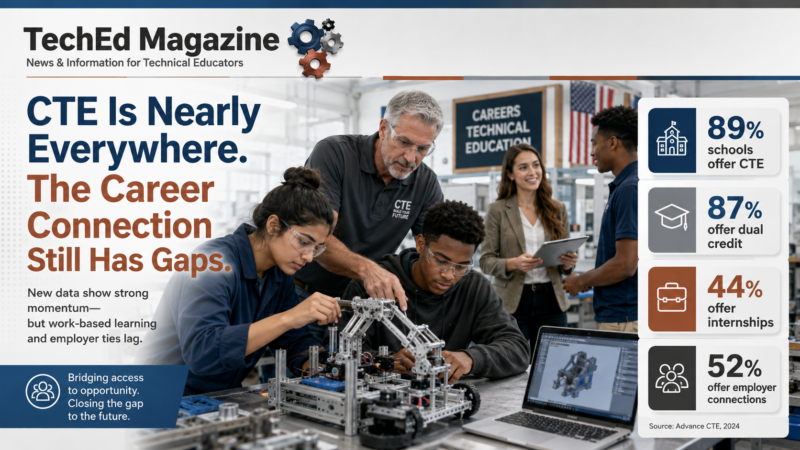
Career and technical education has become a mainstream part of the American high school experience. But new national data suggests that simply offering CTE is no longer the most important measure of whether a school has built an effective career-readiness system.
An analysis released August 16 by the Association for Career and Technical Education found that 89% of counselors said their high school offers CTE, while 79% reported offering career pathways, clusters or programs of study. Dual credit is also widespread: 87% of counselors at schools offering CTE said students can earn dual credit through those courses.
The numbers become more complicated when the focus shifts from courses to actual workplace exposure.
Only 44% of counselors reported internships, 50% reported job-shadowing opportunities and 37% reported school-based enterprises. Just 52% said their schools provide connections with local employers as a career-preparation resource.
That distinction matters because the next challenge for CTE may no longer be simply expanding the number of schools with programs. It may be ensuring that students can move from career awareness to career experience — and from classroom participation to meaningful interaction with the industries those programs are intended to serve.
TechEd Magazine has examined that transition before in Work-Based Learning Propels Students Toward Jobs, where students’ experiences illustrated what can happen when career education moves beyond classroom instruction and into real workplaces.
Key Takeaways
- 89% of counselors reported that their high school offers CTE.
- 79% reported career pathways, clusters or programs of study.
- 87% said students can earn dual credit through CTE courses.
- Among schools where ninth graders can participate in CTE programs, administrators reported an average ninth-grade participation rate of 41%.
- 69% of counselors reported community service or work-based learning experiences, but individual forms of immersive career experience were considerably less common.
- Only 44% reported internships and 52% reported connections with local employers as a career-preparation resource.
- The data suggests that the next CTE access question should examine not only whether a program exists, but what students actually experience once they enter it.
Why This Matters
CTE availability has expanded to the point that simply counting programs no longer tells education leaders enough.
The more important questions are whether students can enter those programs, complete coherent pathways, earn portable credentials or college credit, interact with employers, participate in meaningful work-based learning and successfully transition into further education or employment.
For administrators, that changes the definition of CTE success from program availability to student progression and outcomes.
What the New National CTE Data Shows
The findings come from the High School and Beyond Longitudinal Study of 2022, or HS&B:22, conducted by the National Center for Education Statistics.
HS&B:22 began with a nationally representative cohort of students who were ninth graders in fall 2022. Students were initially surveyed during the 2022–23 school year along with parents or guardians, teachers, school administrators and school counselors.
The study was designed to examine how students’ high school resources, experiences and environments relate to educational and life outcomes.
ACTE analyzed newly available information through NCES DataLab and identified several measures that provide a useful national snapshot of career preparation in high schools.
Statistics Call-Out: The High School CTE Access Gap
89% — High schools offering CTE
87% — Dual credit available through CTE
79% — Career pathways, clusters or programs of study
69% — Community service or work-based learning opportunities
56% — Cooperative education
52% — Connections with local employers
50% — Job shadowing
44% — Internships
37% — School-based enterprises
29% — Mentoring
The percentages reflect different survey questions and respondent groups and should not be interpreted as mutually exclusive categories. The complete figures are available in ACTE’s analysis of the new NCES data.
The pattern is nevertheless revealing: CTE coursework is widespread, while deeper forms of employer engagement and career experience are considerably less universal.
CTE Availability Is Not the Same as CTE Access
An administrator can truthfully report that a school offers a pathway even when only a fraction of students participate in it.
That is why one of the more revealing numbers in the new dataset may be 41%.
Among administrators who said ninth graders were permitted to participate in CTE programs, the average ninth-grade participation rate was 41%, according to ACTE’s analysis.
That does not necessarily represent a program weakness. Many CTE sequences intentionally become more specialized later in high school.
But the number illustrates an important measurement problem for districts and policymakers.
“Does our school offer CTE?” is a different question from:
- How many students participate?
- When do they begin?
- Which pathways can they access?
- Which students are not participating?
- How many complete a coherent sequence?
- How many earn a credential or college credit?
- How many participate in work-based learning?
- How many transition into related education, apprenticeship or employment?
A program can exist in a course catalog long before it becomes a meaningful pathway for a large share of students.
That distinction becomes increasingly important as policymakers look to technical education to help meet broader workforce needs. As TechEd Magazine explored in The Return of Industrial Policy Is Reshaping Career and Technical Education, CTE programs are increasingly being asked to translate major investments in manufacturing, infrastructure and emerging technologies into actual local workforce capacity.
That requires more than simply offering courses.
Dual Credit Is a Major Strength
One of the strongest findings involves dual credit.
Among counselors reporting CTE availability, 87% said students could earn dual credits through CTE courses, according to ACTE.
That matters because modern CTE increasingly operates across the boundary between secondary and postsecondary education.
A student might complete an advanced manufacturing course in high school, earn community-college credit, receive an industry credential, continue into a technical degree and eventually enter an apprenticeship or employer-sponsored education program.
The Institute of Education Sciences has highlighted how contemporary CTE pathways can combine work-based learning, industry-valued credentials and college credit through dual enrollment, providing multiple routes between high school, continued education and employment.
For districts, the strategic question is therefore not simply whether dual credit exists.
It is whether those credits actually stack into something students can use.
Schools should examine whether credits transfer into certificates and degrees, whether students and families understand their value, and whether articulation agreements remain aligned with the programs students are likely to enter after graduation.
Work-Based Learning Is Where the Numbers Become More Uneven
The national picture changes when students move beyond classrooms and into workplaces.
Sixty-nine percent of counselors reported that their schools provide community service and work-based learning experiences. Within that broader category, however, availability varied significantly:
- Community service: 59%
- Cooperative education: 56%
- Job shadowing: 50%
- Internships: 44%
- School-based enterprises: 37%
- Mentoring: 29%
Those experiences are not interchangeable.
A career fair can introduce students to occupations.
A workplace tour can improve awareness.
A job shadow can show what an occupation looks like.
An internship can require students to perform tasks, communicate with supervisors, solve problems and experience workplace expectations over time.
The Institute of Education Sciences describes work-based learning as a continuum, moving from career awareness and exploration toward more immersive experiences such as internships, apprenticeships, practicums and school-based enterprises.
That distinction has become increasingly important as researchers examine which forms of work-based learning are most strongly associated with measurable student outcomes.
Research Snapshot
A 2026 systematic review and meta-analysis from the CTE Research Network screened more than 7,000 potentially relevant reports examining work-based learning.
Only 23 unique studies met the researchers’ design and work-based-learning criteria, illustrating how much more rigorous research is still needed.
Among the evidence that did meet those standards, researchers found promising overall effects from immersive work-based learning, with particularly encouraging findings for internship-based programs and outcomes involving academic advancement and socioemotional development.
Researchers also stressed that the evidence base remains incomplete, particularly around apprenticeships, adult-training programs and longer-term employment and earnings outcomes.
That makes the 44% internship figure in the new national data especially noteworthy.
If internships are among the work-based-learning models for which researchers are seeing particularly promising evidence, schools cannot evaluate CTE quality solely by counting courses and pathways.
The Employer Connection Remains a Weak Point
Perhaps the most important finding for workforce-development leaders is that only 52% of counselors reported connections with local employers among the career-preparation resources available at their schools.
By comparison, schools were much more likely to offer career fairs, career nights and career-aptitude information.
Those activities have value.
But they do not replace sustained employer relationships.
An effective employer partnership can influence:
- Curriculum
- Equipment selection
- Technical competencies
- Workplace safety instruction
- Instructor professional development
- Job shadows
- Internships
- Apprenticeships
- Career presentations
- Student capstones
- Industry-recognized credentials
- Hiring pipelines
TechEd Magazine’s earlier coverage of Employers Involved in CTE examined the deeper role employers can play when they participate not just in delivering career training but in helping shape educational programs themselves.
That relationship is becoming increasingly important for manufacturers as well. In Where Workforce Development Begins, TechEd Magazine examined why manufacturers confronting long-term talent shortages are increasingly looking upstream — toward schools, internships, technical programs and earlier career exposure — rather than relying solely on recruitment after students enter the labor market.
Workforce Perspective
For employers, the 52% employer-connection figure should be viewed as more than an education statistic.
Manufacturers, health systems, construction firms, technology companies and other employers regularly compete for workers with both technical capabilities and an understanding of workplace expectations.
Waiting until students graduate to begin building those relationships may be too late.
Employers can strengthen their future talent pipelines by participating in:
- CTE advisory committees
- Curriculum review
- Facility and equipment planning
- Instructor externships
- Classroom demonstrations
- Job shadowing
- Mentoring
- Internships
- Youth apprenticeships
- Student capstone projects
- Credential validation
- Direct recruiting
The strongest school-employer partnerships do not simply introduce students to companies.
They help shape the pathway students travel before entering them.
Modern Equipment Alone Does Not Close the Gap
Employer engagement also matters when schools invest in new technology.
A career center may purchase robotics systems, CNC machines, welding equipment, automation trainers or sophisticated simulation platforms and still fail to produce the workforce outcomes its investment was intended to support.
TechEd Magazine explored this problem in The Great Equipment Gap: Why New Labs Don’t Automatically Create Workforce Readiness.
The central distinction is between installed capacity and instructional capacity.
Installed capacity asks whether the machine was purchased, the laboratory renovated or the software licensed.
Instructional capacity asks whether instructors can effectively teach with it, whether students receive enough meaningful practice, whether competencies are assessed, whether employers recognize those competencies and whether the technology connects to credentials, work-based learning and employment outcomes.
The new national CTE data reinforces that distinction.
Equipment, courses and pathways are parts of a system.
They are not the system itself.
Career Planning Is Common. Career Navigation Is Harder.
Another noteworthy finding is that 67% of counselors said their schools require students to have an education or career plan.
Plans can be useful.
But completing a planning document should not be mistaken for career development.
ACTE’s analysis also found that 62% of counselors said they often or very often assist students with career choices and planning, while only 27% reported doing so as frequently for job placement and employability skills.
That gap reinforces an issue TechEd Magazine recently examined in New Federal CTE Challenge Puts Students in Charge of Career Exploration.
Students do not only need to identify an occupation.
They need opportunities to understand:
- What the work actually involves
- What education or credentials are required
- What employers expect
- What entry-level jobs exist
- What those jobs pay
- Whether advancement is possible
- How to enter apprenticeships or college programs
- Whether a chosen pathway still makes sense after real-world exposure
Career planning describes a destination.
Career navigation helps a student reach one.
Student Impact
For students, the difference between career planning and career experience can be significant.
A student may believe that welding, nursing, automation, cybersecurity or engineering is the right career based largely on classroom information.
A job shadow or internship can confirm that choice — or reveal that the day-to-day work is very different from what the student expected.
Both outcomes have value.
Discovering during high school that an occupation is not a good fit can prevent a student from committing substantial time and money to a pathway that does not match their interests or abilities.
Discovering that a career is a good fit can give that same student a clearer reason to complete coursework, earn credentials and pursue postsecondary training.
Work-based learning therefore does more than prepare students for jobs.
It can help students make better decisions about their futures.
What CTE Leaders Should Measure Next
The new national figures offer useful benchmarks, but local leaders can go further.
Instead of reporting only the number of pathways offered, districts and career centers should consider developing a career-experience funnel.
Measure how many students move through each stage:
Career Awareness → Career Exploration → CTE Participation → Technical Skill Development → Employer Interaction → Work-Based Learning → Credential/Dual Credit → Career or Postsecondary Transition
Then identify where students disappear from the pathway.
For example, a district could discover that:
- 95% attend a career-exploration activity.
- 70% enroll in at least one CTE course.
- 45% complete a pathway.
- 30% earn a credential.
- 18% participate in immersive work-based learning.
- 12% enter related employment or postsecondary training.
Those percentages are illustrative, not national figures.
The point is that this type of measurement provides far more actionable information than simply saying a district offers 15 CTE programs.
The goal is not more activity for its own sake.
It is stronger conversion from exposure to opportunity.
The importance of measuring actual outcomes is also supported by the broader research base. The CTE Research Network has previously reviewed evidence linking CTE participation with positive outcomes such as academic achievement, high school completion, employability skills, college readiness and postsecondary transitions.
TechEd Magazine examined the broader evidence in Positive Impacts of CTE.
As the evidence base becomes stronger, the question for individual schools becomes more specific:
Is our program producing those outcomes?
Administrator Takeaways
District and career-center leaders should consider five immediate questions.
1. Are We Measuring Participation or Simply Counting Programs?
A pathway’s existence says little about how many students can actually access and complete it.
2. Which Students Reach Immersive Work-Based Learning?
Track internships, apprenticeships and sustained employer experiences separately from career fairs, guest speakers and workplace tours.
3. Are Dual Credits Genuinely Portable?
Confirm that students can apply earned credits toward certificates, associate degrees or other postsecondary credentials.
4. Does Every Pathway Have Meaningful Employer Involvement?
Employer participation should extend beyond occasional guest speakers and career-day appearances.
5. What Happens After Students Leave?
Whenever possible, track pathway completion, credential attainment, postsecondary enrollment, apprenticeship participation and related employment.
What Educators and Administrators Should Do
Audit Access, Not Just Availability
Document who actually enrolls in each pathway and who completes it.
A program that exists but remains difficult to access because of scheduling, transportation, prerequisites or limited capacity should not be treated the same as a pathway that reaches a substantial share of eligible students.
Separate Career Exposure From Work-Based Learning
Career fairs, speakers and tours are useful, but districts should distinguish them from sustained experiences requiring students to perform authentic work.
This distinction matters both educationally and when districts begin evaluating outcomes.
Set an Employer-Engagement Target
Every CTE pathway should have active employer involvement appropriate to the field.
That might include advisory committees, curriculum review, instructor externships, equipment recommendations, workplace tours, mentorship, internships, apprenticeships or direct hiring relationships.
Build Work-Based Learning Into Program Design
Do not treat internships and apprenticeships as optional opportunities available only to the most proactive students.
If immersive experiences are important to career preparation, schools should design systems that make participation possible for substantially more students.
Track Dual-Credit Usability
Determine whether credits actually advance students toward certificates, associate degrees or other postsecondary credentials.
A credit that students cannot transfer or apply to their next program has far less value than one embedded in a clearly articulated pathway.
Examine Barriers
Transportation, scheduling, insurance, employer capacity, age requirements and students’ existing work or family obligations can all affect participation.
Knowing that an opportunity exists is not enough.
Schools need to understand who can realistically access it.
Measure Outcomes Beyond Enrollment
Track credentials, dual credit, pathway completion, work-based-learning participation, postsecondary transition, apprenticeship entry and related employment whenever reliable data is available.
Questions to Ask Your Program
- What percentage of our students take at least one CTE course?
- What percentage complete a coherent CTE pathway?
- At what grade do students first experience meaningful career exploration?
- Can every pathway lead to dual credit, a recognized credential or another portable outcome?
- What percentage of students interact directly with employers?
- How many students participate in internships, apprenticeships or other immersive work-based experiences?
- Which student groups participate least often, and why?
- Are transportation, scheduling or age restrictions limiting work-based learning?
- Do employers regularly review curriculum and student competencies?
- Are students receiving career guidance throughout high school or completing a one-time planning requirement?
- Can students explain how their CTE pathway connects to further education and employment?
- What outcomes do we measure after students leave the program?
“A course in a catalog is access to a course. A pathway connecting instruction, employers, experience and recognized outcomes is access to an opportunity.”
Future Outlook: A Data Problem Worth Watching
The HS&B:22 study is particularly valuable because longitudinal research can potentially connect students’ high school experiences with later educational and workforce outcomes.
The National Center for Education Statistics describes HS&B:22 as a nationally representative longitudinal study of students who were ninth graders in fall 2022, designed to examine their educational experiences and subsequent transitions.
However, questions have emerged about the study’s future.
ACTE reported in its August 16 analysis that a planned follow-up data collection was terminated amid NCES staffing cuts and contract cancellations.
The American Statistical Association’s NCES Study and Project Tracker is documenting the status of NCES studies and education-data projects using publicly available federal information.
Policy Watch
For CTE leaders, the future of longitudinal education data is not merely a research-administration issue.
Longitudinal studies allow policymakers to move beyond questions such as How many students enrolled? toward more consequential questions:
What happened to them afterward?
Without reliable follow-up information, determining whether particular pathways, credentials, internships or other experiences actually translate into better educational and workforce outcomes becomes considerably more difficult.
As public investment increasingly emphasizes measurable workforce results, reliable longitudinal education data becomes more — not less — important.
Education leaders should therefore watch for additional clarification regarding the future of HS&B:22 and other NCES longitudinal programs.
TechEd Magazine Perspective
The most encouraging finding in the new national data is that CTE is no longer operating on the margins of American secondary education.
When 89% of counselors report that their schools offer CTE and 87% of schools with CTE provide dual-credit opportunities, career and technical education has clearly become part of the mainstream high school experience.
That achievement should be recognized.
But it also changes what education leaders should demand next.
The first generation of CTE expansion was largely about availability: Does the school offer technical education? Does it have pathways? Are students able to earn credentials or college credit?
The next generation must focus much more aggressively on connection.
Does classroom learning connect to employers?
Does technical training connect to real work?
Does dual credit connect to a postsecondary credential?
Does career exploration connect to informed decision-making?
And ultimately, does participation connect to meaningful opportunities after graduation?
The new data suggests that the American education system has made substantial progress building the infrastructure of career and technical education.
The more uneven numbers around internships, mentoring, job shadowing and employer connections show where the next phase of work must occur.
That distinction should matter to policymakers as well as practitioners.
Funding a laboratory, launching a pathway or adding a CTE course is relatively easy to document. Measuring whether students actually move through those investments into meaningful work-based experiences, credentials, apprenticeships, further education and employment is considerably harder.
But those are increasingly the outcomes that matter.
For TechEd Magazine readers, the central takeaway is therefore not that American high schools need more CTE simply for the sake of expansion.
They need more complete CTE ecosystems.
The strongest programs will connect career exploration, technical instruction, dual credit, credentials, employers, work-based learning and postsecondary transitions into a continuous student pathway.
The question facing CTE leaders is no longer simply:
“Do we offer it?”
It is:
“Where does it lead?”
Related Reading
- Work-Based Learning Propels Students Toward Jobs — How hands-on workplace experiences help students connect classroom learning with real career opportunities.
- Employers Involved in CTE — Why employer participation can strengthen curriculum, training, career awareness and workforce pipelines.
- Where Workforce Development Begins — Why employers facing long-term talent shortages are increasingly looking to schools and technical education programs to build future workforce capacity.
- The Great Equipment Gap: Why New Labs Don’t Automatically Create Workforce Readiness — Why investments in advanced equipment must be paired with instructor capability, curriculum, employer engagement and meaningful student practice.
- The Return of Industrial Policy Is Reshaping Career and Technical Education — How manufacturing investment and workforce policy are increasing expectations for CTE programs and technical education.
- New Federal CTE Challenge Puts Students in Charge of Career Exploration — A look at efforts to give students a more active role in exploring careers and connecting education with local workforce opportunities.
- Positive Impacts of CTE — Research examining how CTE participation can influence graduation, employability, college readiness and postsecondary outcomes.
Sources
- Association for Career and Technical Education — New NCES Data on CTE in High Schools — ACTE’s August 16, 2026 analysis of newly available High School and Beyond data, including CTE availability, dual credit, work-based learning, internships, employer connections and career-planning statistics.
- National Center for Education Statistics — High School & Beyond Longitudinal Study of 2022 — Official NCES overview of HS&B:22, the nationally representative longitudinal study of students who were ninth graders in fall 2022.
- CTE Research Network — Impacts of Work-Based Learning Programs on Student Outcomes — 2026 systematic review and meta-analysis examining the effects of immersive work-based-learning programs, including internships.
- CTE Research Network — What We Know About the Impact of Career and Technical Education — Systematic review of rigorous research examining the effects of CTE participation on academic achievement, high school completion, employability skills, college readiness and postsecondary outcomes.
- Institute of Education Sciences — Supporting Multiple Pathways to Career Success — Federal research overview examining CTE, dual enrollment, industry credentials and work-based learning as components of education-to-career pathways.
- American Statistical Association — NCES Study and Project Tracker — Public tracker documenting the current known status of NCES studies, data collections and related projects.
Frequently Asked Questions
What Percentage of U.S. High Schools Offer CTE?
In ACTE’s analysis of the new HS&B:22 data, 89% of counselors reported that their school offers career and technical education. The findings are available in ACTE’s analysis of the NCES data.
How Common Are High School CTE Career Pathways?
Seventy-nine percent of counselors said their schools offer career pathways, clusters or programs of study, according to ACTE.
Can Students Earn College Credit Through High School CTE?
At schools offering CTE, 87% of counselors reported that students could earn dual credits in CTE courses.
How Common Are Internships for High School Students?
Forty-four percent of counselors in the new national data reported internships among the community-service and work-based-learning experiences their schools provide.
How Common Are Employer Connections?
Fifty-two percent of counselors reported connections with local employers as a career-preparation resource.
Does Research Support Work-Based Learning?
A 2026 CTE Research Network systematic review and meta-analysis found promising evidence that immersive work-based learning can improve learner outcomes, with particularly encouraging findings for internship-based programs and some academic and socioemotional outcomes. Researchers also identified substantial gaps in the evidence base.
Are Career Plans Enough to Prepare Students for Employment?
No single planning document can provide all of the experiences, information and relationships students need. Career plans are most useful when accompanied by counseling, employer interaction, career exploration, work-based learning and regular review.
What Should Schools Measure Beyond CTE Enrollment?
Useful measures include pathway completion, industry credentials, dual credit, employer engagement, work-based-learning participation, postsecondary enrollment, apprenticeship entry and related employment.