
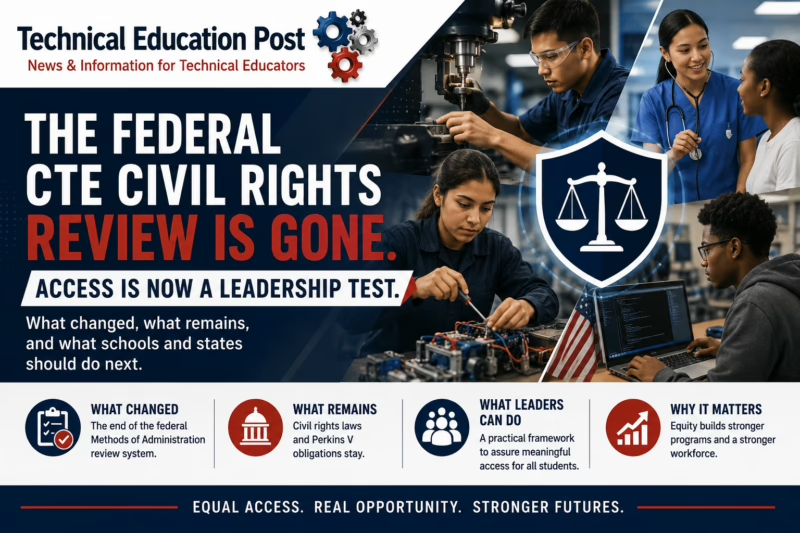
The U.S. Department of Education rescinded the 1979 civil rights guidelines that created the Methods of Administration program, commonly known as MOA. The program required state agencies to collect and analyze civil rights data, select CTE providers for periodic compliance reviews, conduct interviews and facility walkthroughs, issue findings, negotiate corrective plans, provide technical assistance, and report their activities to the federal Office for Civil Rights.
The Department described the system as outdated, duplicative, uniquely burdensome to CTE, and unnecessary because Title VI, Title IX, Section 504, the Americans with Disabilities Act, and other federal civil rights protections remain in force. States may continue conducting the reviews voluntarily, but the federal government no longer requires them.
That distinction is essential. The legal obligation did not disappear. The operating system used to verify compliance did.
For CTE leaders, this creates a new governance problem. A school may remain legally responsible for equal access while no longer receiving the same recurring external prompt to examine admissions rules, counseling, recruitment, physical accessibility, financial aid, work-based learning, placement, disability services, and comparable facilities.
Technical Education Post calls the resulting risk the access assurance gap: the distance between having a legal promise of equal opportunity and possessing current evidence that students can actually see, enter, use, complete, and benefit from a technical program.
The appropriate response is not to preserve every federal form indefinitely. It is to preserve the preventive discipline underneath the former review process. Data should not be treated as proof of discrimination, but neither should leaders wait for a formal complaint before asking whether a program is accessible.
Fewer compliance requirements can create room for better local leadership. They can also create blind spots. What happens next will depend on whether states, districts, career centers, and colleges treat access as an annual management responsibility or as a problem to address only after a student files a complaint.
Key Takeaways
- The Department of Education rescinded the 1979 vocational-education civil rights guidelines and the federally mandated Methods of Administration review structure effective July 23, 2026.
- Federal civil rights obligations remain in force under Title VI, Title IX, Section 504, the ADA, and related regulations.
- The rescission removes a proactive state review and reporting process; it does not eliminate OCR complaints, compliance reviews, directed investigations, or local legal responsibility.
- The Department estimates that state agencies devoted nearly 60 full-time-equivalent employees to MOA administration and argues that the system’s burden no longer justified its benefits.
- Aggregate participation parity does not by itself establish equal access to individual programs, high-wage pathways, accessible facilities, work-based learning, or credential attainment.
- CTE leaders should replace automatic federal review cycles with a documented local access-assurance system tied to Perkins V data, the comprehensive local needs assessment, facilities, counseling, placement, and student experience.
What Changed?
The final rule rescinded Appendix B to 34 CFR Part 100 and related cross-references under the Department’s Section 504 and Title IX regulations. Those provisions contained the Guidelines for Eliminating Discrimination and Denial of Services on the Basis of Race, Color, National Origin, Sex, and Handicap in Vocational Education Programs.
The guidelines originated in civil rights litigation during the 1970s. Federal compliance reviews conducted between 1973 and 1978 had identified segregated vocational institutions, inaccessible facilities, discriminatory admissions practices, unequal services for students with disabilities, barriers affecting students with limited English proficiency, discriminatory job-placement practices, and other violations.
In response, the 1979 framework created a CTE-specific proactive oversight system. State agencies were required to:
- Collect and analyze civil rights information and data.
- Conduct periodic compliance reviews of selected CTE providers.
- Provide technical assistance.
- Report MOA activities and findings to the Office for Civil Rights.
The reviews examined nine broad areas:
- Administrative requirements
- Recruitment, admissions, and counseling
- Physical accessibility
- Comparable facilities
- Services for students with disabilities
- Financial assistance
- Work-study, cooperative education, and job placement
- Housing
- Employment practices
The Department updated the procedures in 2020 but left the underlying 1979 guidelines in place. Under the system, states reviewed a subset of CTE providers, issued findings, negotiated voluntary compliance plans, and submitted biennial reports to OCR.
The 2026 rule ended that federal requirement without a prior notice-and-comment period and made the rescission effective immediately. The Department relied on a federal rulemaking exception for matters related to grants and other forms of federal financial assistance.
Policy Snapshot
Effective date: July 23, 2026
Removed: The CTE-specific federal Methods of Administration review and reporting structure
Still in force: Title VI, Title IX, Section 504, the ADA, OCR complaint procedures, and other applicable federal and state obligations
State option: State agencies may continue conducting similar reviews voluntarily
Why the Department Ended the Program
The Department’s case for rescission rests on four arguments: legal change, factual change, administrative burden, and the availability of other enforcement tools.
The Legal Landscape Changed
The final rule argues that court decisions issued after 1979 changed the legal framework surrounding disparate outcomes, agency authority, and the use of race in government decision-making. The Department concluded that portions of the old guidelines could not be cleanly separated from provisions it viewed as legally questionable, duplicative, or outdated.
CTE Participation Looks Different Than It Did in 1979
The Department compared historical evidence with more recent national data. It noted that 2019 NCES data showed relatively small differences by race in the percentage of public high school graduates earning any CTE credit. It also cited high graduation rates for CTE concentrators across racial groups and near-parity between the percentage of secondary CTE participants with disabilities and the percentage of students receiving services under the Individuals with Disabilities Education Act.
The Department explicitly stated that it does not claim discrimination has been eradicated. Its argument is narrower: it has not found recent evidence that discrimination is more prevalent in CTE than in other federally funded educational programs.
The System Required Substantial Staff Time
According to the final rule, reports from 68 state education agencies for school years ending in 2023 and 2024 showed that states devoted at least 54 full-time-equivalent employees to MOA compliance. Because five agencies did not report staffing information, the Department estimated the total at nearly 60 FTE positions.
The rule also cited the example of Valencia College, which reported dedicating approximately 100 staff hours to a compliance review. State reviews could require document collection, interviews, accessibility walkthroughs, responses to findings, and multi-year corrective plans.
The Department’s position is that these resources can now be redirected to other education and enforcement priorities. Assistant Secretary for Civil Rights Kimberly Richey called the action a “win-win,” describing it as a way to reduce burdens while keeping substantive protections in place.
OCR Retains Other Enforcement Mechanisms
Students, families, employees, and organizations may still file complaints with OCR. The complainant does not have to be the person directly affected. OCR also retains the authority to initiate compliance reviews and directed investigations.
In June 2026, the Department announced an interagency agreement under which the Department of Justice would assist with civil rights enforcement and complaint resolution. The administration argues that this broader enforcement structure is sufficient to address discrimination in CTE just as it does in other educational settings.
What Did Not Change?
The most important sentence in the federal announcement is also the easiest to overlook: recipients of federal financial assistance remain responsible for complying with civil rights laws.
The rescission does not authorize a school to:
- Exclude students from CTE because of race, color, or national origin
- Deny opportunities on the basis of sex
- Operate inaccessible programs or facilities for students with disabilities
- Use discriminatory admissions, counseling, discipline, financial-aid, employment, or placement practices
- Retaliate against a student, parent, employee, or advocate who raises a civil rights concern
Federal requirements may also apply through the ADA, the Individuals with Disabilities Education Act, Perkins V, state civil rights statutes, state education law, accreditation standards, collective bargaining agreements, and institutional policy.
Perkins V remains particularly important. The law requires states and local recipients to analyze performance, disaggregate data, address disparities or gaps, provide equal access for special populations, prepare learners for nontraditional fields, and conduct a comprehensive local needs assessment.
The former MOA review and the Perkins accountability system were never identical. MOA focused on civil rights compliance. Perkins focuses on program quality, performance, access, special populations, and improvement. The end of one system does not erase the duties created by the other.
Important Distinction
The federal requirement to conduct a particular review has ended.
The duty to operate a nondiscriminatory, accessible program has not.
The Real Shift: From Scheduled Prevention to Risk-Based Leadership
The former MOA process was preventive by design. It did not require a student to recognize discrimination, understand federal law, document an incident, locate the correct office, and file a complaint within the applicable timeframe before anyone examined the program.
That matters because complaints are lagging indicators. They are filed after a person believes harm has occurred.
CTE access barriers can also affect people who never enter the program. A student steered away by a counselor, unable to reach an off-site career center, discouraged by a prerequisite, unable to navigate an application, or shown promotional materials that signal “this program is not for you” may never become a participant. A person who never enrolls may not know enough about the program to identify a legal issue or file a complaint.
This creates an access paradox: the students most affected by an entry barrier may be the least visible in program data because the barrier worked before they entered.
The end of a scheduled federal review does not necessarily require a return to the same paperwork. It does require leaders to decide what will replace the preventive function.
Data Are a Smoke Alarm, Not a Verdict
The Department’s final rule objects to treating statistical disparities as automatic proof of unlawful discrimination. That concern should be taken seriously. Different participation rates can result from student interests, prior preparation, geography, scheduling, available programs, family preferences, labor-market information, and many other factors.
But rejecting automatic conclusions does not require rejecting data.
Data are best treated as a smoke alarm. An alarm does not prove there is a fire. It tells responsible leaders where to investigate.
Recent research from Georgia Policy Labs demonstrates why the level of analysis matters. Aggregate participation can look balanced while program choices remain sharply divided. Researchers studying multiple states and metro Atlanta found that racial participation differences were often driven by differences among schools and the programs those schools offered. Within the same school, some racial gaps became much smaller.
The research also found substantial gender sorting among CTE fields. Female students were more likely to concentrate in pathways connected to lower-paying occupations, while male students were more likely to enter pathways with higher earnings potential. In the researchers’ analysis, the expected earnings differences associated with male and female pathway selection were larger than the overall labor-market gender pay gap in some locations.
This does not prove that students were unlawfully directed or discriminated against. It does show why a district should look beyond the percentage of students taking “any CTE.”
A system can achieve demographic parity in overall participation while offering very different economic opportunities through:
- Advanced manufacturing versus lower-wage service pathways
- Cybersecurity versus general business courses
- Engineering versus human services
- Apprenticeship-connected programs versus programs without placement partners
- Credentials with demonstrated labor-market value versus credentials with weak employer recognition
Technical Education Post’s earlier feature, CTE as an Equity Strategy, made the same central point: expansion alone is not equal opportunity. Leaders must ask who receives access to high-value pathways and what happens after enrollment.
Five Layers of Meaningful CTE Access
Access should not be measured by a single enrollment percentage. Technical Education Post proposes a five-layer model.
| Layer | Leadership question | Evidence to review |
|---|---|---|
| Visibility | Did every student receive clear, accurate information about the opportunity? | Recruitment materials, counselor practices, translations, career exploration, family communication |
| Entry | Can qualified students apply and enroll without unnecessary barriers? | Prerequisites, applications, deadlines, selection criteria, scheduling, transportation, waitlists |
| Usability | Can students fully participate once enrolled? | Physical accessibility, accommodations, equipment, safety gear, climate, language access, fees |
| Completion | Do students receive the support needed to finish the pathway and earn its credentials? | Retention, completion, credential attempts, credential pass rates, tutoring, work-based learning |
| Value | Does the program lead to meaningful further education, employment, wages, and advancement? | Placement, earnings, apprenticeships, postsecondary credit, credential value, employer validation |
A program may perform well at one layer and poorly at another. Strong recruitment does not compensate for an inaccessible laboratory. Balanced enrollment does not guarantee equitable credential completion. An impressive completion rate does not make a weak credential valuable.
The Technical Education Post Access Assurance Framework
The following framework is a management tool, not a substitute for legal advice or a formal civil rights review. Its purpose is to preserve preventive oversight while reducing unnecessary duplication.
1. Build a Program Opportunity Map
List every CTE pathway by school, location, grade level, delivery model, transportation requirement, admissions process, capacity, credential, postsecondary credit, work-based learning partner, and likely labor-market value.
Then ask whether students’ opportunities depend primarily on the school they attend, the counselor assigned to them, or their ability to travel.
2. Audit Every Entry Rule
Review prerequisites, GPA thresholds, attendance requirements, discipline exclusions, application essays, interviews, teacher recommendations, testing, lotteries, deadlines, and informal selection practices.
For each requirement, document:
- The educational or safety purpose
- Whether a less restrictive alternative exists
- Who is screened out
- Whether the rule is applied consistently
- How students may appeal or receive support
3. Analyze Programs, Not Just Total CTE Enrollment
Disaggregate participation, concentration, completion, credentials, postsecondary credit, work-based learning, and placement by program—not only across the entire CTE department.
Compare high-wage and lower-wage pathways. Review waitlists as well as enrollment. A student denied a seat is part of the access picture even if another CTE course is available.
4. Conduct an Annual Accessibility Walkthrough
Examine entrances, routes, restrooms, labs, workstations, safety equipment, emergency procedures, transportation, digital platforms, instructional materials, and work-based learning sites.
Participation percentages cannot determine whether a specific welding booth, automotive lift, simulator, culinary station, or off-site internship is accessible.
5. Review Counseling and Recruitment
Observe how programs are described to students. Review brochures, websites, presentations, course catalogs, family events, and counseling scripts.
Ask whether students receive:
- Comparable information about every pathway
- Accurate wage and education requirements
- Examples of people from varied backgrounds succeeding in each field
- Clear information about accommodations and support
- Exposure before high-stakes pathway decisions
The exposure problem examined in Skills Shortage or Exposure Shortage is also an access problem. Students cannot choose a pathway they were never shown.
6. Audit Work-Based Learning and Placement
Review which students receive internships, apprenticeships, clinical placements, cooperative education, job interviews, employer mentoring, and paid experiences.
Employer partners should receive clear nondiscrimination expectations, accommodation procedures, supervisory requirements, and a process for reporting concerns. A school’s responsibility does not end when a student leaves campus.
7. Create a Local Early-Warning System
Monitor indicators that may signal an access problem:
- Repeated demographic differences in applications, offers, and enrollment
- High withdrawal rates in one student group
- Credential gaps that persist after academic preparation is considered
- Students unable to participate because of transportation, tools, uniforms, or fees
- Accommodation delays in laboratories or placements
- Patterns in counselor recommendations
- Complaints clustered around one instructor, program, or employer
- Facilities that repeatedly remain on improvement lists
No single indicator proves discrimination. Patterns should trigger documented inquiry.
8. Make Student Voice Safe and Usable
Students should know how to report concerns locally and federally without retaliation. Complaint systems should be understandable, accessible, translated when necessary, and available to prospective students as well as enrolled participants.
Leaders should not rely solely on complaints, but they should make complaints easier to submit and resolve.
9. Require an Annual Leadership Certification
Each program leader should certify that the institution reviewed access, admissions, facilities, counseling, accommodations, work-based learning, outcomes, and grievances during the year.
The certification should identify unresolved risks and assign responsibility, funding, and deadlines. The purpose is not to declare perfection. It is to prevent known problems from disappearing between departments.
How States Can Respond
The federal announcement makes clear that states may continue reviews as they see fit. States now face several choices.
Retain the Existing MOA Process
A state may determine that its current process provides sufficient value to continue under state authority. This preserves continuity but may also preserve administrative requirements that could be simplified.
Move to Risk-Based Reviews
States could use Perkins data, complaints, program expansion, rapid enrollment changes, facility age, accreditation findings, and prior compliance history to select providers for targeted reviews.
Integrate Access Into the Comprehensive Local Needs Assessment
The Perkins V comprehensive local needs assessment already requires local providers to examine performance, program size and quality, labor-market alignment, special populations, recruitment, retention, and professional development. States could incorporate key access-assurance questions into that existing cycle rather than create a duplicate process.
Create a Statewide Self-Assessment With Verification
Providers could complete a common annual self-assessment, while states verify a rotating sample through document review, interviews, and facility walkthroughs.
Publish Access Dashboards
States could report program-level participation, concentration, credentials, work-based learning, and placement while protecting student privacy. Public information creates accountability without treating every difference as a violation.
Preserve Technical Assistance
The former system did more than find noncompliance. It also gave schools access to state personnel who understood CTE operations and civil rights requirements. States should decide where that expertise will reside after MOA staffing changes.
What District and College Leaders Should Do in the Next 90 Days
- Confirm the state response. Determine whether the state will end, retain, revise, or replace its review process.
- Preserve records. Do not discard MOA documentation, corrective plans, accessibility findings, or prior review materials without consulting records-retention requirements and counsel.
- Identify unresolved findings. A federal rescission does not make an existing physical barrier or discriminatory practice acceptable.
- Assign executive ownership. Name the administrator responsible for CTE access assurance.
- Map applicable laws and policies. Include federal civil rights laws, Perkins V, ADA requirements, state law, institutional procedures, and accreditation standards.
- Review high-risk transitions. Examine admissions, competitive programs, clinical placements, internships, apprenticeships, and off-site instruction.
- Conduct a facility and equipment walkthrough. Include students with disabilities and accessibility personnel where appropriate.
- Audit program-level data. Do not rely only on overall CTE participation.
- Train counselors and instructors. Explain what changed federally and what responsibilities remain.
- Update grievance information. Ensure that students, families, and employees can find local and OCR complaint procedures.
- Integrate access into the next CLNA. Use the existing Perkins improvement cycle rather than treating access as a separate side project.
- Report to the governing board. Explain the institution’s replacement for the former preventive review structure.
Administrator Takeaway
The question is no longer whether a federal MOA review is scheduled. The question is whether your institution can produce current evidence that every CTE program is visible, accessible, usable, completable, and connected to meaningful opportunity.
Common Mistakes
- Assuming the civil rights laws were rescinded. They were not.
- Ending all internal reviews because the federal mandate ended. Legal responsibility and operational risk remain.
- Using demographic parity as proof that no barrier exists. Aggregate data can conceal program-level differences.
- Treating every disparity as proof of discrimination. Data should trigger investigation, not automatic conclusions.
- Reviewing enrollment without reviewing program value. Equal access to low-value programs is not the same as equal access to economic mobility.
- Ignoring prospective students. Barriers may divert students before they appear in enrollment data.
- Leaving work-based learning outside the audit. Internships and placements are part of the pathway.
- Relying on one complaint channel. Students need safe local options and information about external rights.
- Discarding institutional knowledge when MOA positions change. Staff expertise can be lost even when paperwork is reduced.
Questions to Ask Your Program
- What preventive process will replace the former federally required MOA review?
- Which civil rights, accessibility, and Perkins obligations still apply to each program?
- Do our data show applications, offers, enrollment, completion, credentials, and placement by individual pathway?
- Which students never apply, and what do we know about why?
- Are competitive admissions requirements educationally necessary and consistently applied?
- Can students with disabilities safely and fully use every laboratory and work-based learning site?
- Do counseling and recruitment materials present all students with high-wage and nontraditional pathways?
- Are transportation, equipment, uniforms, fees, and scheduling creating hidden entry barriers?
- Which programs lead to the strongest credentials, wages, college credit, apprenticeships, and advancement?
- Who receives paid work-based learning and employer referrals?
- Have prior findings and corrective plans been fully resolved?
- Do students understand local grievance procedures and OCR complaint options?
- Who reports access risks to senior leadership and the governing board?
- Will our state continue any form of proactive CTE review?
- Can we demonstrate meaningful access without waiting for a complaint?
What to Watch Next
State-by-State Divergence
Some states may retain their current review systems, while others may end them quickly. This could produce substantial differences in oversight, data collection, technical assistance, and provider expectations.
OCR and DOJ Enforcement Priorities
The Department says OCR and the Department of Justice will continue complaint investigations, compliance reviews, and directed investigations. CTE leaders should watch whether the agencies publish CTE-specific cases, technical assistance, or enforcement guidance after the rescission.
Perkins Reauthorization
Future federal CTE legislation may address how access, special populations, nontraditional fields, outcomes, and civil rights oversight fit together. Policymakers may choose to strengthen data and local accountability rather than restore the former system unchanged.
Program-Level Outcome Transparency
Researchers are increasingly moving beyond total CTE participation to examine who enters high-earning pathways, completes credentials, receives work-based learning, and transitions into employment. That work may become more important as dedicated federal compliance reporting recedes.
Physical Accessibility in Advanced Labs
New investments in robotics, semiconductors, EVs, welding, aviation, healthcare simulation, and advanced manufacturing create new accessibility questions. Modern equipment does not automatically create modern access.
Nontraditional Career Sorting
Gender concentration remains pronounced across many technical fields. Programs such as Women in Machining demonstrate that exposure, peer support, employer culture, and intentional recruitment can widen opportunity without lowering technical standards.
Frequently Asked Questions
Did the Department of Education eliminate civil rights protections for CTE students?
No. The Department rescinded the 1979 CTE-specific guidelines and required Methods of Administration review process. Title VI, Title IX, Section 504, the ADA, and other applicable protections remain.
What was the Methods of Administration program?
MOA required state agencies to collect and analyze civil rights data, review selected CTE providers, provide technical assistance, issue findings, negotiate corrective action, and report activities to OCR.
Can states continue MOA-style reviews?
Yes. The Department’s announcement expressly states that state agencies may continue conducting the reviews as they see fit.
Can students still file an OCR complaint?
Yes. A student, parent, employee, advocate, or organization may file a complaint. The complainant does not have to be the person directly affected. Filing deadlines and procedural requirements apply.
Does a participation gap prove discrimination?
No. A disparity can have many causes. It should be treated as a reason to investigate program structure, information, rules, supports, and outcomes rather than as an automatic legal conclusion.
Is overall CTE enrollment enough to measure access?
No. Leaders should examine access to individual pathways, credentials, work-based learning, high-wage fields, facilities, accommodations, completion, and post-program outcomes.
Can the Perkins V needs assessment replace a civil rights review?
Not automatically. The CLNA serves a different statutory purpose, but states and institutions can incorporate access-assurance questions into it to reduce duplication and preserve preventive analysis.
What should programs do first?
Determine the state’s response, preserve prior records and corrective plans, assign leadership responsibility, review program-level data, and conduct an accessibility and admissions risk assessment.
Technical Education Post Perspective
The debate over the former MOA system should not be reduced to a false choice between paperwork and civil rights.
The Department has presented a legitimate management question: after nearly five decades, did the required review structure consume more resources than its current benefits justified? A system involving approximately 60 state-level FTE positions, recurring reports, interviews, facility reviews, and corrective plans should be able to demonstrate value.
But the end of a compliance process does not prove that every function performed by that process has become unnecessary.
The strongest CTE leaders will separate the paperwork from the purpose. They will eliminate duplication while preserving data review, accessibility walkthroughs, transparent admissions, technical assistance, student voice, and accountability for work-based learning.
They will also avoid two analytical errors. The first is assuming every statistical difference is evidence of unlawful discrimination. The second is assuming that comparable total enrollment proves comparable opportunity.
CTE access is more complex than either conclusion. Students may participate at similar rates while entering pathways with very different economic value. Students with disabilities may be represented in statewide enrollment while facing barriers in a particular laboratory. A district may offer the same course title at two schools while one has modern equipment, dual credit, and paid internships and the other does not.
That is why data should function as a smoke alarm rather than a verdict.
The federal government has removed a recurring external review requirement and returned more discretion to states and institutions. That discretion creates an opportunity to build leaner, more useful systems tied to actual program design and student outcomes.
It also creates a leadership test.
Equal access cannot be demonstrated by the absence of a complaint. It must be demonstrated by the presence of evidence.
Continue Reading
- CTE as an Equity Strategy
- Skills Shortage or Exposure Shortage
- Women in Machining Program
- Robots and Shop Class
- Students Share Benefits of CTE
- Solve the Talent Crisis With CTE
- Next Generation of Students and Workers
- Perkins Act Changes and Opportunities
Sources and Further Reading
- U.S. Department of Education: Elimination of the Methods of Administration Program
- Federal Register Final Rule: Rescinding the 1979 Vocational Education Civil Rights Guidelines
- U.S. Department of Education: 1979 Vocational Education Guidelines
- OCR and OCTAE: 2020 Methods of Administration Memorandum
- U.S. Department of Education: Education and Title VI
- Office for Civil Rights Complaint Procedures
- Department of Education and Department of Justice Civil Rights Partnership
- Congressional Research Service: Perkins V Primer
- Georgia Policy Labs: Equity in Career and Technical Education
- Georgia Policy Labs: Who Takes High-Earning CTE Pathways?
This article provides education-policy analysis and general program-management guidance. It is not legal advice. Institutions should consult qualified counsel regarding specific legal obligations and circumstances.