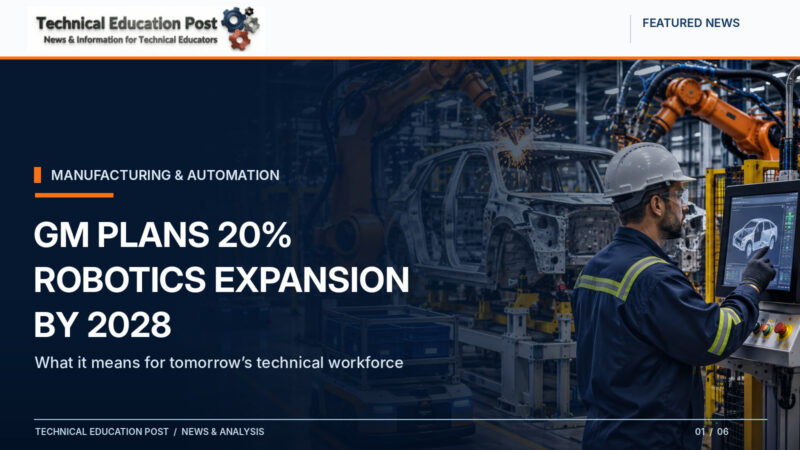
General Motors is reportedly preparing to expand robotics and automation across its North American manufacturing operations by 20% by 2028, signaling another major shift in the technology and skills required inside American factories.
The initiative, reported by Reuters on November 17, 2026, comes as automakers respond to manufacturing costs, growing pressure to produce vehicles domestically, and the need to operate increasingly sophisticated production systems.
For career and technical education programs, the implications extend beyond automotive manufacturing.
A production environment that relies more heavily on industrial robots, autonomous material-handling equipment, sensors, and interconnected control systems requires technicians who can do more than operate individual machines. Workers increasingly need to understand how equipment, software, electrical systems, and production processes function together.
The development raises an important question for manufacturing educators: Are today’s training programs preparing students for the automated workplaces employers are building for the next decade?
Key Takeaways
- Reuters reports that GM is targeting a 20% increase in robotics and other factory automation by 2028.
- The company is reportedly developing and assembling some robotic equipment in Indiana.
- Automation capabilities may increasingly influence how automotive suppliers compete for contracts.
- Technical programs should examine whether their curricula adequately cover robotics integration, troubleshooting, industrial controls, and automation maintenance.
- Expanded automation creates opportunities for technical specialization while also raising legitimate concerns about employment displacement.
What GM Is Planning
According to Reuters, people familiar with GM’s manufacturing strategy described an initiative to expand the automaker’s use of robotics and automation throughout its North American facilities.
The report also identified work involving autonomous mobile robots designed to transport parts and materials through manufacturing facilities.
Unlike traditional industrial robots, which often operate within fixed production cells, autonomous mobile robots can navigate changing factory environments and communicate with other production systems.
Reuters also reported that GM is evaluating automation plans submitted by suppliers as part of its purchasing decisions.
That development could be especially important for the broader automotive industry.
If automation readiness becomes a consideration when manufacturers award contracts, suppliers may face additional incentives to modernize their operations and invest in employee training.
GM told Reuters that it uses automation to improve manufacturing safety, quality, and efficiency. The reported 20% target, however, was attributed to sources familiar with the matter rather than presented as a formally announced company commitment.
Why This Matters for Technical Education
The modern manufacturing technician increasingly operates at the intersection of several disciplines.
Mechanical knowledge remains essential, but automated production environments also require familiarity with electrical systems, programming, industrial networking, machine diagnostics, and safety procedures.
These competencies are becoming interconnected.
A malfunctioning robotic production cell, for example, may involve a mechanical failure, an electrical problem, an incorrect sensor signal, a controller fault, or a communication issue between machines.
Successful troubleshooting requires understanding the complete system rather than examining each technology in isolation.
The National Institute of Standards and Technology reinforced this need in its 2026 analysis of the Manufacturing USA Occupation and Competency Framework.
That research identified 132 advanced manufacturing occupations and 235 associated knowledge, skills, and abilities, organized into broader competency categories intended to help educators and employers align training with industrial needs.
GM’s reported plans provide a contemporary example of why that alignment matters.
Five Skills Manufacturing Programs Should Reevaluate
1. Industrial robotics and motion control
Students should understand industrial robot fundamentals, coordinate systems, end effectors, programming concepts, and safe operating practices.
2. Programmable logic controllers
PLC instruction should connect controller logic to sensors, actuators, motors, safety systems, and actual production sequences.
3. Autonomous material handling
Automated guided vehicles and autonomous mobile robots introduce additional competencies involving navigation, fleet management, material flow, and human-machine interaction.
4. Industrial diagnostics
Students should learn structured troubleshooting rather than relying exclusively on replacement of malfunctioning components.
5. Automation safety and system integration
The ability to identify hazards, understand safeguards, and diagnose interactions between production systems is increasingly important.
These subjects do not necessarily require schools to purchase entirely new production lines. Many concepts can be demonstrated through smaller integrated training cells, simulation platforms, and coordinated exercises using existing equipment.
The Workforce Question
Automation presents both opportunities and risks for manufacturing employment.
Robotics may reduce the labor required for particular production tasks while increasing demand for technicians who install, program, maintain, and improve automated equipment.
However, new technical positions do not automatically replace every job affected by automation. The effects depend on production growth, equipment investment, worker retraining, and company decisions.
The United Auto Workers has expressed concerns about automation and artificial intelligence affecting workers.
For technical educators, the appropriate response is not to assume automation will eliminate manufacturing careers or guarantee employment growth.
It is to prepare learners for an industry in which occupational responsibilities are changing.
What Educators and Administrators Should Do
Manufacturing programs should consider conducting an annual curriculum review with local employers.
That review can identify which automation technologies are already deployed, which competencies employers struggle to recruit, and whether current laboratory exercises reflect actual workplace troubleshooting.
Schools should also examine professional development for instructors.
An effective automation curriculum requires instructors who understand both the underlying technologies and how those technologies are applied in production.
Partnerships with automotive suppliers, system integrators, equipment manufacturers, and maintenance departments can help bridge that gap.
Frequently Asked Questions
Is GM eliminating 20% of its manufacturing jobs?
No such conclusion follows from the Reuters report. The reported target concerns expanded robotics and automation, not a stated workforce reduction of 20%.
Will manufacturing students need programming skills?
Programming knowledge is increasingly valuable, particularly for robotics, industrial controls, and automated production systems. The appropriate depth depends on the occupation.
Should schools replace their existing equipment?
Not necessarily. Programs should first identify competency gaps and determine whether existing equipment can support more integrated, systems-based instruction.
TechEd Magazine Perspective
The most significant lesson from GM’s reported automation strategy is not the 20% target itself.
It is the growing importance of technical workers who can understand and maintain complete automated systems.
Manufacturing education built around isolated machine operation may become less effective as companies adopt integrated robotics, connected equipment, and autonomous material movement.
Programs that combine mechanical fundamentals, electrical troubleshooting, controls, programming, and process improvement will be better positioned to prepare students for changing industrial requirements.
For educators, the question is no longer simply whether automation belongs in the curriculum.
It is whether students are learning enough about automation to remain adaptable as the technology evolves.