A new advanced manufacturing center in Ohio is testing an increasingly important idea for technical education: What if the manufacturing workforce pipeline begins in elementary school rather than high school?
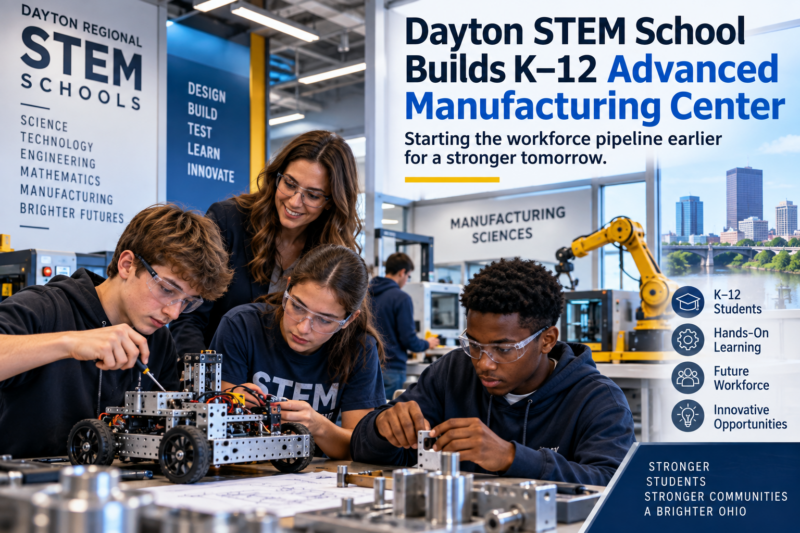
Dayton Regional STEM Schools is developing an approximately 11,000-square-foot Center for Manufacturing Sciences at its middle and high school campus in Kettering, Ohio. Construction is expected to begin in fall 2026, with the center scheduled to open during the 2027–28 school year.
The facility will give students access to manufacturing sciences and chemical physics laboratories, collaborative learning spaces and technologies associated with modern manufacturing and engineering. It is designed to support hands-on experiences in which students can design, build, test and solve authentic engineering problems.
But the most significant feature may be the age range.
The new center is intended to strengthen manufacturing and STEM learning opportunities across kindergarten through 12th grade, rather than limiting advanced manufacturing exposure to students who have already selected a high-school CTE pathway.
That strategy aligns with a growing concern among manufacturers: by the time employers begin recruiting young adults, students may have spent years forming career preferences without meaningful exposure to modern manufacturing.
The Manufacturing Institute has responded to that challenge by developing manufacturing career-exploration experiences for students as young as grades four through nine. The organization argues that early exposure is particularly important because today’s fourth graders will graduate around 2033—the same year manufacturers could need to fill as many as 3.8 million positions.
Dayton’s project provides a real-world example of what beginning that pipeline earlier can look like.
Key Takeaways
- Dayton Regional STEM Schools is developing an approximately 11,000-square-foot Center for Manufacturing Sciences in Kettering, Ohio.
- Construction is expected to begin in fall 2026, with the facility targeted for the 2027–28 school year.
- Students will have access to laboratories for manufacturing sciences and chemical physics, along with collaboration and presentation spaces.
- The center will expand hands-on learning involving manufacturing, engineering and emerging technologies.
- The project supports the school’s existing CTE pathways in engineering, healthcare and computer science.
- The center is designed to strengthen opportunities across K–12, making early manufacturing career awareness one of the project’s most important features.
- Manufacturing Institute research estimates manufacturers could need 3.8 million additional workers between 2024 and 2033, with as many as 1.9 million positions potentially remaining unfilled.
What Dayton Regional STEM Schools Is Building
The new facility will be known as the Larry R. & Elaine A. Dosser Center for Manufacturing Sciences.
The project was made possible through a philanthropic gift from Dr. Larry Dosser and his late wife, Elaine, and represents a substantial expansion of the school’s existing manufacturing education capacity.
The center will include laboratories dedicated to manufacturing sciences and chemical physics, along with spaces where students can collaborate and present their work.
The objective is not simply to add another classroom.
Students will be able to design, fabricate, experiment, test ideas and work through engineering problems using technologies representative of contemporary industry.
That approach fits naturally with the school’s existing emphasis on project-based STEM education and CTE pathways.
It also connects with a larger shift Technical Education Post has been following in Technical and STEM Education 2026: schools are increasingly being asked to connect STEM concepts with the technologies, occupations and problems students will encounter outside the classroom.
Why Starting in K–12 Matters
The most interesting part of the Dayton project is not its square footage.
It is when students encounter manufacturing.
Manufacturing education has traditionally been concentrated toward the end of the education pipeline.
Students might encounter career exploration in middle school, enter a CTE program during high school, enroll in a technical or community college program and then transition into employment.
That sequence remains important.
But manufacturers increasingly recognize that waiting until students are 16 or 17 years old to introduce manufacturing careers may be too late.
The Manufacturing Institute has made early career awareness a significant part of its workforce strategy.
Its recently launched Innovators Quest, for example, targets students in grades four through nine with hands-on activities involving additive manufacturing, aerospace engineering, robotics and quality control.
Manufacturing Institute President and Executive Director Carolyn Lee has argued that manufacturing career awareness needs to begin around ages 9 or 10, precisely because today’s elementary students will become the workers entering the labor market around 2033.
Dayton’s K–12 strategy closely reflects that philosophy.
Today’s Fourth Graders Are Part of the 2033 Workforce
The dates make the issue particularly tangible.
A fourth-grade student entering a manufacturing-related learning experience today could be graduating from high school around 2033.
That happens to be the same year at the center of one of the manufacturing industry’s most widely cited workforce projections.
Deloitte and the Manufacturing Institute estimate U.S. manufacturers could need as many as 3.8 million additional employees between 2024 and 2033.
Without substantial improvements in talent development, as many as 1.9 million positions could remain unfilled.
The challenge is not simply finding enough workers.
Manufacturers increasingly need people capable of operating and maintaining sophisticated equipment.
Technical Education Post examined that transition in America’s Advanced Manufacturing Workforce, where the convergence of automation, robotics, AI, digital systems and advanced production technologies is changing what employers require from technicians.
That means the workforce problem has two dimensions:
Manufacturing needs more people.
And:
Those people increasingly need more sophisticated technical skills.
Early STEM and manufacturing exposure can help address the first challenge by making students aware that these careers exist.
Strong CTE and postsecondary programs must address the second.
Career Awareness Comes Before Career Preparation
That distinction is important for K–12 educators.
An elementary manufacturing program should not be treated as an attempt to train 10-year-olds for specific factory occupations.
The objective is different.
At younger ages, schools can build career awareness, technological confidence and engineering habits of mind.
Students can learn that manufactured products are designed.
They can discover that robots have to be programmed.
They can see that materials behave differently.
They can investigate why a design failed.
They can build something, test it and redesign it.
They can discover that mathematics and physics solve tangible problems.
And, perhaps most importantly, they can begin imagining themselves as engineers, technicians, machinists, automation specialists or other technical professionals.
That is fundamentally different from occupational training.
But it can make later occupational training much more likely.
Manufacturing Is Increasingly a STEM Career
Early exposure is also important because public perceptions of manufacturing frequently lag behind the industry itself.
Manufacturing Institute President Carolyn Lee has described the persistent challenge of convincing young people that today’s manufacturing environments are technologically sophisticated rather than dirty, repetitive workplaces.
Modern manufacturing increasingly incorporates:
- robotics;
- industrial automation;
- sensors;
- machine vision;
- CNC machining;
- additive manufacturing;
- advanced materials;
- artificial intelligence;
- data analytics;
- industrial cybersecurity; and
- digitally connected production systems.
Those technologies make manufacturing increasingly inseparable from STEM education.
A robotics project is simultaneously an engineering lesson and exposure to an industrial occupation.
A materials-science experiment can become an introduction to advanced manufacturing.
A programming exercise can lead naturally into automation.
A physics problem can become a design challenge.
That gives schools an opportunity to connect academic STEM content with tangible careers without turning elementary or middle school into vocational training.
Photonics Adds Another Dimension
Dayton’s existing work with photonics makes the project particularly interesting.
Photonics—the science and application of light—is important across industries ranging from telecommunications and medical technology to aerospace, semiconductor manufacturing, sensing and advanced manufacturing.
Students who encounter photonics alongside manufacturing and engineering therefore gain exposure to technologies that cross traditional occupational boundaries.
That matters because future technical careers are becoming increasingly interdisciplinary.
A technician may need mechanical knowledge, electronics skills, programming experience and an understanding of sensors or optics.
A manufacturing sciences center capable of connecting those concepts can help students understand technology as an integrated system rather than a collection of unrelated school subjects.
Project-Based Learning Makes the Connection Visible
The center’s emphasis on designing, building, testing and solving problems is another significant feature.
Students often encounter mathematics and science as separate academic disciplines.
Industry rarely works that way.
A manufacturing problem might simultaneously require geometry, physics, materials science, electronics, programming, communication and teamwork.
Project-based learning makes those connections visible.
Instead of asking why they need to learn a particular mathematical concept, students encounter a problem that cannot be solved without it.
Instead of learning physics solely from a textbook, they can observe forces acting on something they designed.
Instead of treating programming as an isolated computer-science exercise, students can use code to control a physical system.
That is where STEM education and CTE increasingly overlap.
Technical Education Post’s broader coverage of CTE and Workforce Development has documented the increasing importance of creating clearer pathways between academic learning, technical skills and employment.
Facilities like Dayton’s center can begin establishing those connections long before students formally choose a career pathway.
Manufacturers Are Looking to K–12 Schools
Industry workforce strategies increasingly reflect this same thinking.
More than nine in 10 manufacturers surveyed by Deloitte and the Manufacturing Institute reported forming partnerships intended to improve talent attraction and retention.
Among those partnerships, 44% involved K–12 schools, while 73% involved technical colleges and 48% involved universities.
That is significant.
Manufacturers are not looking exclusively to community colleges and universities for talent.
They are moving upstream.
The objective is increasingly to build a continuum:
Elementary STEM exposure → middle-school career exploration → high-school CTE → dual enrollment → postsecondary technical education → apprenticeship/work-based learning → manufacturing employment
Dayton’s Center for Manufacturing Sciences occupies the beginning of that continuum.
What Other Schools Can Learn From Dayton
Few districts can immediately construct an 11,000-square-foot manufacturing sciences center.
But the underlying strategy does not require every school to reproduce the facility.
Several aspects are transferable.
Start career exposure earlier.
Manufacturing awareness does not need to wait until high school.
Connect STEM concepts with authentic technology.
Robotics, materials, automation and fabrication can make abstract concepts tangible.
Use project-based learning.
Students should design, build, test, fail, revise and try again.
Connect schools with employers and colleges.
Industry partners can provide equipment insight, mentors, facility tours, classroom speakers and authentic problems.
Build pathways across grade levels.
Elementary exposure should connect naturally with middle-school exploration and eventually high-school CTE.
Avoid treating manufacturing as a fallback career.
Modern manufacturing includes highly technical occupations requiring substantial STEM knowledge.
Questions to Ask Your Program
At what age do our students first encounter advanced manufacturing?
If the answer is 11th or 12th grade, the pipeline may be starting too late.
Do students understand what a modern manufacturing facility actually looks like?
Career perceptions can be outdated even when local factories are highly automated.
Are our STEM activities connected to real occupations?
Students should understand where engineering, robotics, physics and programming are used professionally.
Do elementary and middle-school programs connect with high-school CTE?
Career awareness is more powerful when students can see the next step.
Are local manufacturers involved?
Employers can provide authentic projects, mentors, tours, equipment knowledge and career information.
Are students building and testing things?
Hands-on experimentation is particularly valuable for connecting STEM concepts with engineering.
Do students encounter emerging technologies?
Robotics, automation, additive manufacturing, photonics and other technologies can broaden their understanding of manufacturing careers.
Are we measuring career awareness?
Schools should consider whether students’ knowledge and perceptions of technical careers change after participating.
What to Watch Next
Construction of the Center for Manufacturing Sciences is expected to begin in fall 2026, with opening planned during the 2027–28 school year.
The most important outcomes will come later.
How many students use the facility?
At what grade levels?
Does early exposure increase participation in engineering and CTE pathways?
Do more students pursue manufacturing, engineering or technical postsecondary programs?
Do local employers become active partners?
And can the school demonstrate that early career exposure actually changes students’ perceptions and eventual choices?
Those are the measures that will determine whether Dayton’s project becomes merely an impressive STEM facility or a replicable workforce-development model.
Frequently Asked Questions
What is the Dayton Center for Manufacturing Sciences?
The Larry R. & Elaine A. Dosser Center for Manufacturing Sciences is a planned approximately 11,000-square-foot expansion at Dayton Regional STEM Schools’ middle and high school campus in Kettering, Ohio.
When will the manufacturing center open?
Construction is expected to begin in fall 2026, with the center anticipated to open during the 2027–28 school year.
What will the facility contain?
Plans include laboratories for manufacturing sciences and chemical physics as well as collaboration and presentation spaces designed to support hands-on STEM and engineering learning.
Which students will benefit?
The initiative is intended to strengthen STEM and manufacturing opportunities across the school’s K–12 educational pipeline, with the physical addition located at the middle/high school campus.
Why introduce manufacturing to elementary students?
Early programs are primarily about awareness and exploration rather than occupational training. The Manufacturing Institute has specifically expanded manufacturing career-exploration programming into grades four through nine as part of its strategy for developing the future workforce.
How serious is the manufacturing workforce shortage?
Deloitte and the Manufacturing Institute estimate manufacturers could need 3.8 million additional workers between 2024 and 2033, with as many as 1.9 million positions potentially going unfilled if workforce challenges are not addressed.
Are manufacturers actually working with K–12 schools?
Yes. In Deloitte and Manufacturing Institute research, 44% of surveyed manufacturers reported workforce-related partnerships with K–12 schools. Technical colleges were the most common partner at 73%.
Technical Education Post Perspective
The most consequential aspect of Dayton’s Center for Manufacturing Sciences may ultimately have little to do with the building.
It is the decision to think about the manufacturing workforce as a K–12 pipeline.
The manufacturing industry cannot wait until students are preparing to graduate and then ask why more of them did not choose technical careers.
Career decisions develop over years.
So do perceptions.
A child who has never seen an industrial robot, programmed a physical system, designed a manufactured object or met someone working in advanced manufacturing has little reason to imagine that career as part of his or her future.
Early manufacturing education should not lock children into occupations.
It should do precisely the opposite.
It should expand the number of futures they can imagine.
The strongest lesson from Dayton is therefore not that every school needs an 11,000-square-foot manufacturing center.
It is that manufacturing workforce development may need to begin long before workforce development traditionally begins.
Today’s fourth graders will enter adulthood around the same time manufacturers expect their talent challenge to become especially acute.
The industry is already looking toward them.
Education systems should understand why.
Recommended Reading
America’s Advanced Manufacturing Workforce — How automation and emerging technology are changing manufacturing occupations and the skills technicians need.
CTE and Workforce Development — Technical Education Post’s coverage of education-to-career pathways and workforce development.
Technical and STEM Education 2026 — The broader trends reshaping STEM, technical education and workforce preparation.
High School CTE Data Reveals Career-Readiness Gaps — Analysis of career readiness and the challenge of building stronger student pathways.
Sources
Dayton Regional STEM Schools expansion coverage — WYSO — Detailed reporting based on information supplied by Dayton Regional STEM Schools, including the facility size, planned laboratories, construction schedule and 2027–28 opening.
The Manufacturing Institute — Innovators Quest — Primary industry source documenting the Manufacturing Institute’s grades 4–9 manufacturing career-exploration initiative and its rationale for reaching students earlier.
The Manufacturing Institute — Manufacturing Workforce Study — Primary workforce-development source for the 3.8 million worker projection, potential 1.9 million-worker shortfall and manufacturer education-partnership data.