
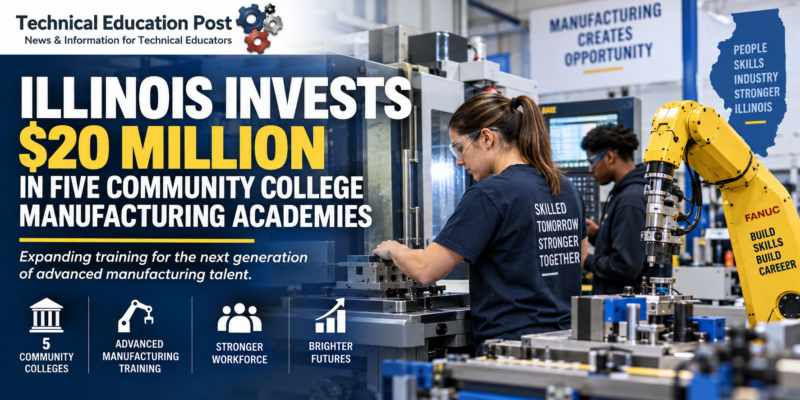
Illinois is making a significant investment in community colleges as infrastructure for the state’s advanced manufacturing economy.
On September 14, 2026, Gov. JB Pritzker and the Illinois Department of Commerce and Economic Opportunity announced more than $20 million in capital grants to establish five Manufacturing Training Academies at community colleges across downstate Illinois. The academies will prepare students and workers for careers in automation, robotics, industrial maintenance, CNC machining, manufacturing engineering technology, process control, metal fabrication and biomanufacturing.
The investment is significant beyond Illinois. American manufacturers could need as many as 3.8 million additional workers between 2024 and 2033, according to research from Deloitte and The Manufacturing Institute. If persistent workforce problems are not addressed, approximately 1.9 million of those positions could remain unfilled.
Illinois’ strategy offers one possible response: rather than concentrating advanced manufacturing education in a single flagship institution, the state is building a distributed network of community college training centers aligned with regional employers and local labor markets.
That approach reinforces a broader trend explored in Technical Education Post’s America’s Advanced Manufacturing Workforce: as manufacturing becomes more automated and technically sophisticated, the availability of skilled technicians is becoming as important to industrial expansion as capital investment and new technology.
Key Takeaways
- Illinois is investing more than $20 million in five new community college Manufacturing Training Academies.
- Training will include automation, robotics, CNC machining, industrial maintenance, process control, manufacturing engineering technology, metal fabrication and biomanufacturing.
- The academies are being distributed across downstate Illinois rather than concentrated at a single institution.
- Each college’s training focus reflects different regional workforce and industry needs.
- National research estimates manufacturers could need 3.8 million additional workers by 2033, with as many as 1.9 million positions potentially going unfilled.
- New September 2026 research suggests AI could also help manufacturers accelerate technician training and broaden the pool of workers capable of moving into manufacturing careers.
Five Colleges, Five Regional Manufacturing Strategies
The five Manufacturing Training Academies will not be identical.
That is one of the most important features of the Illinois strategy.
According to the state’s announcement, each institution will concentrate its investment around particular manufacturing capabilities:
| Community College | Investment | Primary Training Areas |
|---|---|---|
| Illinois Central College | $3 million | Industrial electrical, industrial maintenance, manufacturing engineering technology |
| Kaskaskia College | $6 million | Automation, CNC machining, industrial maintenance, logistics, robotics |
| Lake Land College | $3 million | Automation, robotics |
| Lewis & Clark Community College | $2.369 million | Automation, industrial maintenance systems, process control, robotics |
| Parkland College | $6 million | Biomanufacturing, metal fabrication |
The grants will pay for construction, facility improvements and modern training equipment, while the colleges work with regional employers to align programs with available jobs and workforce demand.
This regional specialization matters.
Modern manufacturing is too broad for every technical college to reproduce every possible industrial environment. A college serving employers that depend heavily on CNC machining and automation may require a very different laboratory from one supporting biomanufacturing.
Illinois is effectively allowing its community colleges to develop specialized capabilities while remaining part of a larger statewide manufacturing workforce strategy.
Why Community Colleges Are Becoming Manufacturing Infrastructure
It is tempting to classify investments such as these simply as education spending.
They are increasingly also economic-development investments.
A manufacturer deciding where to expand needs more than available land, transportation, electricity and tax incentives. It also needs confidence that the region can continually supply technicians capable of operating, maintaining and troubleshooting increasingly sophisticated production systems.
That makes technical education capacity part of a region’s industrial infrastructure.
A community college equipped with modern CNC machines, industrial robots, automation systems and qualified instructors can perform several roles simultaneously.
It can prepare students entering manufacturing for the first time.
It can retrain workers moving from declining or adjacent industries.
It can provide incumbent-worker training as manufacturers introduce new technology.
It can deliver short-term credentials and specialized technical instruction.
And it can give smaller manufacturers access to training capacity they might never be able to build independently.
This is why community colleges figure so prominently in the workforce strategy examined in America’s Advanced Manufacturing Workforce. As manufacturing technology changes, colleges increasingly serve as the bridge between technological investment and the people required to make that technology productive.
Illinois Is Expanding an Existing Manufacturing Academy Model
The five new academies are not Illinois’ first attempt at this strategy.
The state launched its Manufacturing Training Academy initiative through its 2019 Economic Growth Plan. Previous investments supported academies at Heartland Community College, Southwestern Illinois College, Richland Community College and Kankakee Community College.
Heartland Community College, for example, opened an Electric Vehicle Energy Storage Manufacturing Training Academy in 2024 in partnership with Rivian. Its programs include robotics, HVAC, welding, digital media and electric-vehicle technologies.
Southwestern Illinois College subsequently opened a 33,000-square-foot manufacturing education hub, adding training in additive manufacturing, tool-and-die mold making and advanced automation/multi-axis CNC.
The five new colleges therefore represent an expansion of an existing model rather than a one-time grant program.
Illinois’ 2025 Economic Growth Plan update explicitly called for adding more Manufacturing Training Academies and described the centers as a mechanism for supporting priority industries, high-wage careers, regional specialization and employer workforce pipelines.
That continuity makes the initiative more consequential.
Illinois is not merely funding individual manufacturing programs. It is gradually building a statewide network of regional advanced manufacturing training capacity.
The Manufacturing Skills Gap Is Changing
The workforce challenge confronting these academies is not simply that manufacturers need more people.
Manufacturers increasingly need people with different combinations of skills.
Deloitte and The Manufacturing Institute estimated that U.S. manufacturing could require as many as 3.8 million additional employees between 2024 and 2033. Without significant improvements in the talent pipeline, approximately 1.9 million positions could remain unfilled.
The challenge coincides with major changes in the factory itself.
As discussed in Technical Education Post’s America’s Advanced Manufacturing Workforce, today’s production environments increasingly combine robotics, automation, artificial intelligence, connected sensors, additive manufacturing and sophisticated data systems.
A modern manufacturing technician may need to understand mechanical systems, electrical controls, software interfaces, sensors, automated equipment and industrial data.
That convergence has important implications for CTE and community colleges.
Training students exclusively on older equipment may teach useful fundamentals, but it does not necessarily prepare them for the increasingly connected production environments they will encounter after graduation.
Illinois’ emphasis on automation, robotics, process control, industrial electrical systems and manufacturing engineering technology suggests the state is attempting to address that shift directly.
AI Is Adding Another Layer to Manufacturing Training
A new workforce study released just days before the Illinois announcement makes the timing particularly noteworthy.
On September 10, Deloitte and The Manufacturing Institute published new research examining how artificial intelligence could help manufacturers accelerate skills development and expand the technician workforce.
The analysis identified nearly 2 million technicians working in adjacent industries whose skills could potentially transfer into manufacturing. It also estimated that manufacturing technician employment could grow six times faster than traditional production occupations between 2025 and 2030.
Manufacturing and adjacent industries could need to fill approximately 2.3 million technician openings during that period as a result of growth, retirements, occupational transfers and other labor-force changes.
The researchers argue that AI could help workers transition into these positions by digitizing technical knowledge, providing guidance at the point of work and reducing the time technicians spend searching for information.
That connects directly with Technical Education Post’s earlier coverage of AI Training for Manufacturing Workers, which examined the growing need to prepare manufacturing employees for workplaces where AI is increasingly embedded in production and decision-making.
For colleges building new manufacturing laboratories in 2026, the implication is important:
The academy should not be designed only for the factory that exists today. It needs to prepare technicians for the factory that is emerging.
The Regional Model May Be the Most Transferable Part
Illinois could have invested $20 million in one large statewide advanced manufacturing institute.
Instead, the funding is distributed among five colleges.
That choice has practical workforce implications.
Manufacturing labor markets are often regional. Students in rural or smaller industrial communities may be unwilling or unable to relocate several hours away for technical training. Employers likewise need institutions that understand their specific equipment, occupations and hiring needs.
Distributed academies bring education closer to both.
They also make specialization possible.
Kaskaskia can develop deeper capabilities around automation, CNC machining, logistics and robotics.
Parkland can focus on biomanufacturing and metal fabrication.
Illinois Central can build expertise around industrial electrical systems, maintenance and manufacturing engineering technology.
Lewis & Clark can concentrate on automation, process control and industrial maintenance systems.
Lake Land can strengthen automation and robotics.
Together, those institutions can provide a broader set of capabilities than any one location could easily offer.
That model could be particularly relevant to states with manufacturing clusters spread across multiple regions.
Manufacturing Education Is Becoming Part of a Larger Career Pathway
The Illinois initiative also fits a broader movement toward connecting technical education more directly to employment outcomes.
Technical Education Post has been tracking this shift across career and technical education and workforce pathways, including the increasing emphasis on apprenticeships, credentials and employer-validated programs.
An effective manufacturing talent system increasingly looks less like a single college program and more like a continuum:
K–12 career exploration → high-school CTE → dual enrollment → community college → industry credentials → apprenticeship/work-based learning → employment → incumbent-worker upskilling
Manufacturing academies can become important hubs within that system.
They can serve high-school students through dual-credit arrangements, traditional college students pursuing certificates or degrees, displaced workers seeking new careers and incumbent employees who need to learn new technologies.
That flexibility is particularly valuable in an industry where technology changes faster than traditional academic program cycles.
Equipment Alone Will Not Solve the Workforce Problem
There is an important caution for other states considering similar investments.
Building a modern laboratory is relatively straightforward.
Building a sustainable workforce pipeline is harder.
Equipment must be accompanied by qualified instructors, continuously updated curriculum, employer engagement, work-based learning and measurable employment outcomes.
Manufacturing technology also changes rapidly.
Robots, CNC machines, controls platforms and software purchased through a capital grant eventually become outdated.
Colleges therefore need long-term equipment modernization strategies rather than treating the initial grant as the end of the investment.
Instructor recruitment may present an equally difficult problem.
Someone capable of teaching advanced automation, industrial maintenance or manufacturing engineering may also be highly valuable to private employers. Technical colleges are competing for many of the same people they are trying to produce.
The strongest academy models will therefore require manufacturers to participate not merely as advisory-board members but as active partners in curriculum development, equipment selection, instructor training, internships, apprenticeships and student recruitment.
What Other States Can Learn From Illinois
Illinois’ approach offers several lessons for other state governments, community colleges and workforce agencies.
Locate advanced training near the manufacturing jobs. Regional access makes it easier for students to enter nearby employment and allows colleges to develop deeper relationships with the employers hiring their graduates.
Build around multiple technical disciplines. Manufacturing increasingly combines mechanical, electrical, digital and automation skills. Training infrastructure should reflect that convergence.
Let regional demand shape specialization. Not every college needs the same equipment or programs.
Connect capital investment to workforce outcomes. Buildings and equipment are inputs. Credentials, employment, wages, retention and employer satisfaction are the outcomes that determine whether the investment works.
Build networks rather than isolated programs. Regional academies can share curriculum, instructor expertise, employer relationships and best practices.
Plan for continuous modernization. The technology purchased in 2026 should be the beginning of the modernization strategy, not the end.
Questions to Ask Your Program
For community colleges, career centers and state workforce agencies considering similar investments, these are the questions that matter most:
Are our labs equipped for the manufacturing environment students will actually encounter?
Training should reflect current industrial automation, robotics, machining, controls and maintenance technologies.
Which occupations are local manufacturers struggling hardest to fill?
Program expansion should begin with verified labor-market demand and direct employer input.
Are employers involved before equipment is purchased?
Industry partners can help institutions avoid investing in technologies that do not reflect regional production environments.
Can high-school CTE students enter the pathway before graduation?
Dual enrollment and articulation agreements can turn community college academies into part of a longer manufacturing talent pipeline.
Do students have access to work-based learning?
Technical instruction becomes more valuable when paired with internships, apprenticeships and authentic industrial experience.
Are instructors being trained on the same technologies as students?
Equipment modernization without faculty development creates a different kind of skills gap.
How will success be measured?
Enrollment matters, but credential attainment, placement, wages, retention and employer satisfaction provide a much better picture of workforce impact.
How will equipment remain current?
Institutions should establish a modernization plan before the first machines arrive.
Broader Industry Trend: States Are Building Talent Ecosystems
Illinois’ investment reflects a larger change in workforce development.
The traditional model often treated education and economic development as separate systems.
A manufacturer expanded. Employers reported worker shortages. Colleges then attempted to develop programs in response.
The emerging approach is more proactive.
States are trying to build workforce capacity before talent shortages constrain industrial expansion.
That requires state governments, economic-development agencies, manufacturers, K–12 schools, CTE programs and community colleges to plan together.
Illinois’ Manufacturing Training Academies put physical infrastructure behind that strategy.
The state’s broader economic plan also identifies advanced manufacturing as a priority industry and calls for education and training to be aligned with regional employer needs.
Illinois has also established a State Attainment Working Group to develop statewide goals for degrees and credentials tied to workforce needs through 2040. The state says more than 70% of Illinois jobs are projected to require education or training beyond high school by 2031.
The Manufacturing Training Academies should therefore be understood as one part of a larger attempt to align education, workforce development and industrial strategy.
What to Watch Next
The most important measure of these academies will not be how many square feet are renovated or how many robots are installed.
It will be what happens to students and employers.
Technical Education Post will be watching for enrollment growth, credential attainment, apprenticeship participation, employer partnerships, job placement and wage outcomes as the five academies develop.
It will also be worth watching whether Illinois more formally connects its existing and new academies into a statewide manufacturing education network.
If that occurs, the initiative could become an important model for states attempting to balance two competing needs: specialized advanced manufacturing training and geographic accessibility.
Frequently Asked Questions
How much is Illinois investing in the new manufacturing academies?
Illinois announced more than $20 million in capital grants for five new Manufacturing Training Academies at downstate community colleges. The grants will support construction, facility improvements and modern training equipment.
Which Illinois community colleges are receiving funding?
The recipients are Illinois Central College, Kaskaskia College, Lake Land College, Lewis & Clark Community College and Parkland College.
What will students study?
Programs vary by college but collectively include automation, robotics, CNC machining, industrial maintenance, industrial electrical systems, logistics, manufacturing engineering technology, process control, metal fabrication and biomanufacturing.
Is this Illinois’ first Manufacturing Training Academy initiative?
No. Illinois previously supported academies at Heartland Community College, Southwestern Illinois College, Richland Community College and Kankakee Community College. The new grants expand that existing strategy.
How large is the national manufacturing workforce shortage?
Deloitte and The Manufacturing Institute estimated that U.S. manufacturing could need as many as 3.8 million additional employees between 2024 and 2033, with approximately 1.9 million positions potentially remaining unfilled if workforce challenges persist.
How is AI changing manufacturing workforce training?
New September 2026 research from Deloitte and The Manufacturing Institute suggests AI could help technicians access technical knowledge and accelerate training. The study identified nearly 2 million technicians in adjacent industries whose skills may be transferable to manufacturing.
Why are community colleges important to manufacturing workforce development?
Community colleges can provide entry-level education, short-term credentials, incumbent-worker training and employer-responsive technical programs within the regions where manufacturers operate. They can also connect high-school CTE, postsecondary education, work-based learning and employment into a more continuous workforce pathway.
Technical Education Post Perspective
The most important part of Illinois’ $20 million investment is not the money.
It is the underlying definition of a community college.
In a modern manufacturing economy, these institutions increasingly function as more than places where students earn degrees. They can become regional technical infrastructure—places where students enter careers, workers update their skills, employers help shape training and communities develop the human capital required to attract and retain industry.
Robotics, automation and artificial intelligence will continue changing what happens inside factories.
That does not eliminate the need for manufacturing workers. It changes the technical level at which many of those workers must operate.
States that want advanced manufacturing investment therefore need more than incentives for companies.
They need education and workforce systems capable of producing the people who can make advanced manufacturing work.
Illinois is putting more than $20 million behind that proposition.
Recommended Reading
America’s Advanced Manufacturing Workforce — How community colleges and workforce systems can respond to the changing technical demands of U.S. manufacturing.
Technical Education Post: Career Pathways — Coverage of apprenticeships, workforce pathways and education-to-employment strategies.
Technical Education Post: Manufacturing — Recent coverage of advanced manufacturing, technical education and workforce development.
Sources
Illinois Governor’s Office — Gov. Pritzker Announces More Than $20 Million to Train Illinois’ Next Generation of Manufacturers — Primary source for the September 14, 2026 announcement, award amounts, participating colleges, academy focus areas and Illinois’ Manufacturing Training Academy strategy.
Illinois DCEO — Statewide Economic Development Plan 2025 Annual Update — State documentation of Illinois’ existing Manufacturing Training Academies and plans to expand the network.
Deloitte — U.S. Manufacturing Could Need as Many as 3.8 Million New Employees by 2033 — Workforce research supporting the 3.8 million worker need and potential 1.9 million unfilled positions.
Deloitte and The Manufacturing Institute — AI Could Accelerate Manufacturing Skills Training — September 10, 2026 research on manufacturing technicians, transferable skills and the potential role of AI in workforce training.