New statewide figures show increasing demand for career-focused training as students pursue practical skills and employment opportunities.
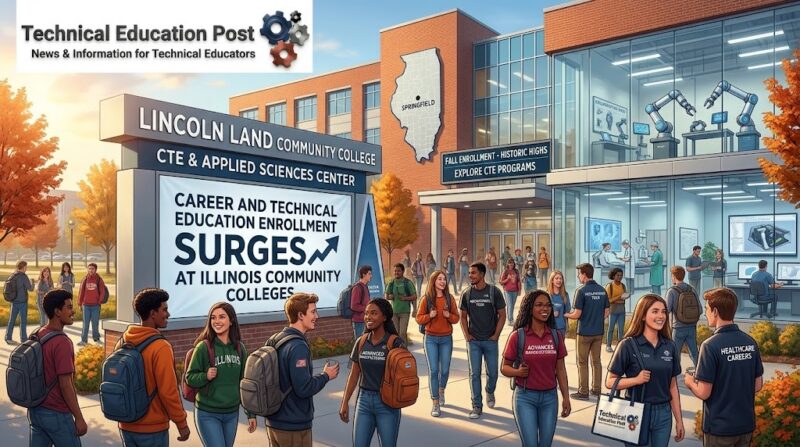
Career and technical education enrollment is growing across Illinois community colleges, providing fresh evidence of student interest in programs connected to specific occupations and industries.
The Illinois Community College Board (ICCB) announced October 27 that enrollment in career and technical education (CTE) programs increased by 5.9% during fall 2026.
The increase brought statewide CTE enrollment to 75,208 students, representing 27.7% of all Illinois community college enrollment.
The growth is particularly notable because overall enrollment across the state’s community colleges declined slightly during the same period.
For educators and workforce-development professionals, the figures illustrate a broader opportunity to strengthen career-focused education and its connections to industry.
CTE Enrollment Continues Growing
According to the ICCB’s Fall 2026 Opening Enrollment Report, Illinois community colleges enrolled approximately 271,845 students this fall.
That figure represented a 0.7% decrease compared with fall 2025.
Despite the modest overall decline, career and technical education enrollment continued its upward trajectory.
CTE participation has increased every year since fall 2022, growing 26.1% over that period.
Vocational skills training programs also recorded a substantial increase, growing 9.6% compared with the previous year.
The report identified several additional enrollment developments:
- CTE enrollment increased 5.9% to 75,208 students.
- CTE students accounted for 27.7% of statewide enrollment.
- Vocational skills training increased 9.6%.
- Dual-credit enrollment increased 2.0% to 56,043 students.
- Overall community college enrollment declined 0.7%.
- More than one-third of students took at least one online course.
Together, these figures suggest that career-focused programs are gaining a larger share of the community college student population.
Why Career-Focused Programs Are Attracting Students
Career and technical education provides pathways into occupations that often require specialized skills but not necessarily a traditional four-year degree.
Programs may prepare students for careers in advanced manufacturing, healthcare, information technology, transportation, construction, and other technical fields.
Many CTE pathways combine classroom instruction with laboratory experiences, industry certifications, workplace learning, and practical assessments.
This structure can appeal to students seeking a direct relationship between their education and employment.
CTE also serves working adults who want to update existing skills, change careers, or pursue advancement opportunities.
However, enrollment growth alone does not establish why individual students choose these programs.
Affordability, regional job opportunities, program availability, and changing attitudes toward education may all influence enrollment decisions.
Understanding those motivations requires additional student-level research.
Illinois Is Investing in Technical Training
Illinois has supported career and technical education through investments in manufacturing training academies, electric vehicle training, and other workforce-oriented programs.
The state has also increased community college funding since fiscal year 2019, according to the ICCB.
These investments are intended to expand training opportunities and help institutions respond to regional workforce needs.
Specialized programs can be particularly important when employers need workers with technical competencies that are difficult to develop through general academic instruction alone.
For example, advanced manufacturing education may require industrial machinery, robotic systems, electrical training equipment, and instructors with current industry experience.
Such resources are expensive to acquire and maintain.
Public funding, employer partnerships, and coordinated regional planning can help make them accessible.
Dual Credit Is Creating Earlier Career Pathways
One notable finding in the enrollment report involves dual-credit education.
Enrollment among high school students earning college credit increased to 56,043, representing growth of 44.8% since fall 2022.
Dual-credit programs can allow high school students to begin technical coursework before graduation.
Depending on the program, participants may earn college credits, explore career options, and reduce the time needed to complete a postsecondary credential.
For school districts, partnerships with community colleges can also provide access to specialized instructors and equipment.
These opportunities are particularly relevant to rural and smaller districts that may not have the resources to offer extensive technical training independently.
What the Numbers Mean for Educators
Illinois’ enrollment figures provide several considerations for institutions evaluating their own CTE programs.
First, demand for career-focused training may justify reviewing program capacity, equipment availability, and instructor recruitment.
Second, institutions should consider whether their technical offerings reflect changing regional labor markets.
Third, growth in dual-credit participation suggests the importance of strong partnerships between secondary schools and community colleges.
Finally, administrators should evaluate outcomes beyond enrollment.
Program completion, credential attainment, employment placement, earnings, and student satisfaction are essential measures of whether career-focused education is delivering meaningful value.
The Future of Career and Technical Education
The Illinois data provides encouraging evidence that students are increasingly participating in technical education.
Nevertheless, enrollment is only one part of the broader workforce-development picture.
Educational institutions must also ensure that programs maintain high instructional quality, respond to technological change, and prepare students for sustainable careers.
If rising enrollment is accompanied by strong completion rates and positive employment outcomes, CTE can play an increasingly important role in regional economic development.
For educators nationwide, Illinois offers a timely example of how community colleges are responding to interest in practical, career-connected learning.
Primary source: Illinois Community College Board, October 27, 2026.
https://www.iccb.org/2026/10/27/2026-fall-enrollment/