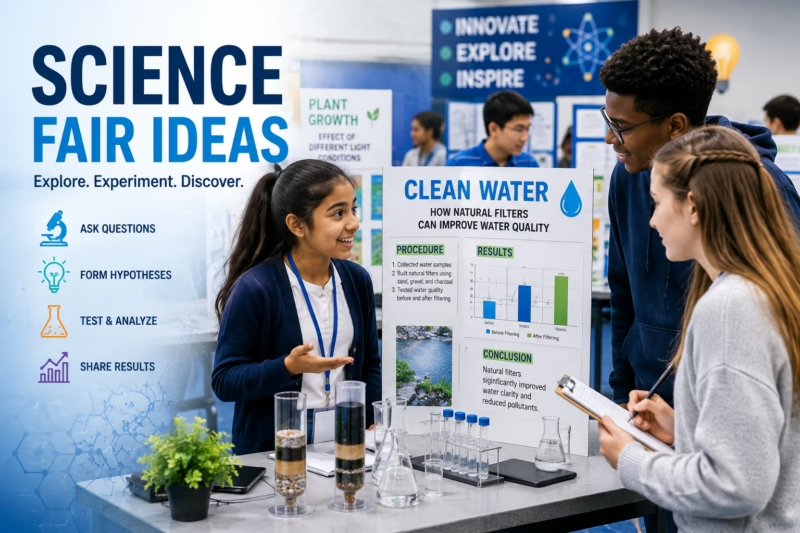
A strong science fair idea is not just a “cool experiment.” It is a question students can investigate with evidence, appropriate methods, and enough control of variables to make a defensible claim.
For STEM educators, CTE instructors, curriculum directors, and school leaders, the goal is to move students beyond demonstration projects—volcanoes, posters about planets, or copied internet experiments—and toward authentic inquiry, engineering design, data analysis, and technical communication.
High-quality science fair projects usually have five characteristics:
- A testable question or design challenge
- A clear independent variable, dependent variable, and controls
- A method that can be repeated
- Data that can be measured, analyzed, and visualized
- A conclusion based on evidence, not opinion
This aligns with the National Research Council’s Framework for K–12 Science Education, the Next Generation Science Standards, and the Science and Engineering Practices, especially asking questions, planning investigations, analyzing data, constructing explanations, designing solutions, and communicating information.
Science fair ideas should also comply with safety and ethics guidance. Programs that connect to regional, state, or international competitions should review rules from the Society for Science’s Regeneron International Science and Engineering Fair, especially around human participants, vertebrate animals, hazardous materials, microorganisms, and controlled substances.
For CTE programs, science fairs can also become technical research showcases. Projects can connect to agriculture, health science, manufacturing, robotics, energy systems, cybersecurity, construction, environmental technology, and transportation. The best projects allow students to apply real tools, standards, and industry-relevant documentation.
If you’re looking for innovative Science Fair Ideas, you might find inspiration in the article discussing bold strategies for economic reimagination. This piece highlights the importance of creativity and innovation in various fields, which can also apply to science projects. To explore how new ideas can lead to job creation and economic growth, check out the article here: Biden Needs This Bold Strategy to Reimagine the Economy.
Why Science Fair Ideas Matter for STEM and CTE Programs
Science fairs are often treated as enrichment activities, but they can serve a much larger instructional purpose. When planned well, they support college and career readiness, technical literacy, and standards-based assessment.
They Build Research and Technical Communication Skills
Students must learn how to:
- Identify a problem
- Review existing research
- Design a procedure
- Collect and analyze data
- Document failures
- Defend conclusions
- Present to technical and nontechnical audiences
These skills are central to STEM careers and CTE pathways. A student in an engineering pathway who tests bridge truss designs is practicing the same reasoning used in civil engineering. A student in health science who studies surface contamination reduction is building early laboratory and public health thinking.
They Make Data Literacy Visible
Science fairs require students to produce and interpret data. This is valuable because many classroom labs are recipe-based. In science fair work, students must decide:
- What counts as valid evidence?
- How many trials are enough?
- What tools provide sufficient precision?
- How should uncertainty be represented?
- Does the data support the claim?
These questions help students develop statistical and computational thinking.
They Support Career-Connected Learning
CTE instructors can use science fair projects to connect academic standards with industry sectors. For example:
- Agriculture students can test soil amendments, irrigation schedules, or seed germination rates.
- Manufacturing students can compare material strength, surface finish, or 3D printing parameters.
- Health science students can examine ergonomics, sanitation protocols, or simulation-based training outcomes.
- Information technology students can analyze network latency, password entropy, or machine-learning model bias.
- Construction students can test insulation materials, fastener strength, or concrete curing conditions.
They Promote Student Agency
A science fair project gives students ownership. Instead of answering a question from a textbook, students generate and refine their own question. That shift increases motivation, especially when students investigate local issues: water quality, energy use, traffic flow, heat islands, food waste, air quality, or accessibility.
How to Choose Science Fair Ideas That Are Rigorous and Feasible
The strongest ideas sit at the intersection of student interest, measurable variables, safety, time, and available tools.
Start With a Problem, Not a Topic
A topic is broad: “solar energy,” “plants,” “robots,” or “bacteria.”
A researchable question is specific:
- How does panel angle affect the voltage output of a small solar cell during different times of day?
- Which soil composition produces the greatest germination rate for radish seeds over 10 days?
- How does wheel diameter affect the energy efficiency of a small robotic vehicle?
- How effective are different handwashing durations at reducing simulated contamination?
Educators should train students to convert topics into questions using this structure:
How does [independent variable] affect [dependent variable] under [controlled conditions]?
For engineering projects, the structure can be:
How can we design [solution] to improve [measurable outcome] within [constraints]?
Match the Idea to Available Equipment
A project requiring a spectrophotometer may be appropriate in an advanced biotechnology program but unrealistic for a middle school general science class. Similarly, a machine-learning project may be excellent if students have access to computers, datasets, and programming instruction, but weak if it becomes a copied online model with little understanding.
Before approving an idea, ask:
- Can students collect data themselves?
- Are the tools available and safe?
- Can the project be completed within the timeline?
- Is adult supervision required?
- Are special approvals needed?
- Is there a backup plan if equipment fails?
Build in Replication
A common weakness in science fair projects is insufficient trials. One measurement is not enough. Educators should require repeated trials, multiple samples, or repeated observations.
For example:
- Instead of testing one plant per condition, use at least three to five plants per condition.
- Instead of testing one bridge design once, test several models of each design.
- Instead of timing a robot once, run multiple timed trials and calculate averages.
- Instead of measuring water pH once, measure over multiple days or locations.
Replication strengthens student claims and introduces uncertainty, variation, and reliability.
Sure, here is the sentence with the clickable link:
I am passionate about the intersection of Education & Technology.
Science Fair Ideas by STEM and CTE Pathway
Below are practical science fair ideas suitable for different grade levels and program types. Educators should adapt complexity, safety protocols, and data expectations to local standards and student readiness.
Environmental Science and Agriculture Ideas
1. Soil type and plant growth
Students test how sand, clay, compost, or mixed soil affects plant height, biomass, or germination rate.
- Variables: soil composition, water amount, light exposure
- Data: height, leaf count, germination percentage
- Extension: soil pH, nutrient testing, water retention
2. Effects of mulch on soil moisture
Students compare bare soil, straw mulch, wood chips, and synthetic cover.
- CTE connection: agriculture, landscaping, environmental systems
- Measurement tools: soil moisture meter or mass-based water loss
- Real-world application: irrigation efficiency
3. Microplastics and water filtration models
Students design filters using sand, activated carbon, fabric, or biochar substitutes to capture simulated particles.
- Important safety note: avoid releasing plastic particles into drains
- Engineering focus: filter efficiency, flow rate, cost per liter
- Extension: compare turbidity before and after filtration
4. Urban heat island investigation
Students measure surface temperatures of asphalt, grass, concrete, mulch, and shaded areas.
- Tools: infrared thermometer or temperature probes
- Data: time of day, surface type, ambient temperature
- Local relevance: school grounds planning and sustainability
5. Compost conditions and decomposition rate
Students compare moisture, aeration, particle size, or carbon-to-nitrogen mixtures.
- CTE connection: agriculture, culinary arts waste reduction, sustainability
- Data: mass loss, temperature, visual rating scale
- Safety: avoid meat, dairy, and unsafe biological materials
Engineering, Robotics, and Manufacturing Ideas
1. 3D printing infill pattern and part strength
Students compare infill patterns or percentages using standardized test specimens.
- Variables: infill density, pattern, print orientation
- Data: load to failure, deflection, mass, print time
- CTE connection: additive manufacturing, CAD, materials testing
2. Bridge truss design comparison
Students build bridges with identical material limits and compare strength-to-weight ratios.
- Engineering constraint: same material type and mass limit
- Data: maximum load, failure location, efficiency ratio
- Extension: finite element simulation or CAD modeling
3. Robot wheel design and traction
Students test how wheel diameter, tread material, or surface type affects speed, slippage, or energy use.
- Tools: robotics kits, stopwatch, current sensor
- Data: distance/time, battery draw, incline performance
- Real-world connection: autonomous vehicles and mobile robotics
4. Fastener strength in different materials
Students compare screw types, pilot holes, or material substrates.
- CTE connection: construction, carpentry, manufacturing
- Data: pull-out force or failure load
- Safety: requires supervised testing and eye protection
5. Thermal insulation materials
Students test how different materials reduce heat transfer.
- Variables: insulation type, thickness, container shape
- Data: temperature change over time
- Application: building science, HVAC, energy efficiency
Health Science and Biomedical Ideas
Projects involving humans, bodily fluids, microorganisms, or medical claims require extra review. Educators should consult ISEF rules, local institutional review policies, and school district safety procedures before approval.
1. Ergonomics and workstation posture
Students compare workstation setups and measure posture angles using photographs or motion-analysis apps.
- Human subjects note: may require consent and privacy protections
- Data: neck angle, wrist position, discomfort survey
- CTE connection: health science, occupational safety, office technology
2. Simulated contamination and handwashing technique
Use safe fluorescent lotion or powder to simulate contamination before and after different washing durations or techniques.
- Do not culture unknown microbes from hands or surfaces without proper protocols
- Data: remaining fluorescence area or scoring rubric
- Application: infection prevention and health education
3. Heart rate recovery and exercise intensity
Students examine how different exercise intensities affect recovery time.
- Human subjects note: requires consent, screening, and safe participation limits
- Data: heart rate at intervals after activity
- Extension: compare trained vs. untrained groups only with ethical safeguards
4. Assistive device design
Students design a low-cost tool to improve grip, reach, organization, or communication.
- Engineering design focus: user needs, constraints, prototype testing
- Data: task completion time, user feedback, durability
- CTE connection: biomedical engineering, rehabilitation, health occupations
Computer Science, Cybersecurity, and Data Science Ideas
1. Password strength and cracking time simulation
Students analyze how length, character variety, and passphrases affect estimated cracking time using safe offline tools or mathematical models.
- Avoid real credentials
- Data: entropy estimates, time comparisons
- CTE connection: cybersecurity fundamentals
2. Machine-learning model bias with public datasets
Students train or evaluate simple models and compare accuracy across categories.
- Data source: public, anonymized datasets
- Focus: fairness, accuracy, false positives/negatives
- Advanced extension: confusion matrices and model documentation
3. Network latency and device load
Students measure how number of connected devices affects latency on a controlled local network.
- Requires IT coordination and network safety rules
- Data: ping time, throughput, packet loss
- Application: infrastructure planning and networking
4. Algorithm efficiency comparison
Students compare sorting algorithms or search methods using different dataset sizes.
- Data: runtime, memory use, operation counts
- Grade fit: middle school with visual blocks; high school with Python or Java
- Extension: Big O notation
Physical Science and Energy Ideas
1. Solar panel angle and energy output
Students test small photovoltaic cells at different angles and times.
- Data: voltage, current, power
- Controls: light source or outdoor conditions
- Extension: geographic latitude and seasonal variation
2. Wind turbine blade design
Students compare blade pitch, number, length, or shape using a fan and small generator.
- Data: voltage output, rotation speed, startup speed
- Engineering focus: optimization under constraints
- Safety: guard spinning blades
3. Surface color and heat absorption
Students compare temperature changes in black, white, reflective, and colored materials.
- Data: temperature over time
- Application: roofing, clothing, urban design
- Extension: infrared measurement and albedo
4. Battery performance under temperature conditions
Students test how safe household battery performance changes under moderate temperature conditions.
- Safety: avoid extreme heat, puncturing, short-circuiting, or rechargeable battery abuse
- Data: voltage over time under load
- Application: electric vehicles, robotics, emergency systems
If you’re looking for innovative Science Fair Ideas, exploring the importance of STEM education can provide valuable insights. A related article discusses how the Pentagon has highlighted a significant deficit in STEM education, which they believe is weakening America’s global competitiveness. This article emphasizes the need for engaging projects that inspire students to pursue careers in science and technology. You can read more about this pressing issue in the article here.
Grade-Level Considerations for Science Fair Ideas
Science fair expectations should grow with students’ cognitive development, mathematical skill, and technical experience.
Elementary School
At the elementary level, projects should emphasize observation, measurement, comparison, and explanation.
Appropriate projects include:
- Which paper towel absorbs the most water?
- How does light affect seed germination?
- Which surface creates the most friction for a toy car?
- How does water temperature affect dissolving rate?
Students should learn:
- How to ask a testable question
- How to make predictions
- How to measure carefully
- How to record results in tables
- How to explain what happened using evidence
Avoid overly complex projects where adults do most of the work. The student should be able to explain every step.
Middle School
Middle school students can handle more controlled experiments, repeated trials, graphing, and basic statistical comparisons.
Appropriate expectations include:
- Independent and dependent variables
- Controlled variables
- Multiple trials
- Bar graphs, line graphs, and averages
- Basic discussion of error or limitations
Good project areas include environmental testing, simple robotics, plant growth, materials strength, and energy transfer.
High School
High school students should be expected to conduct more rigorous investigations or engineering design projects.
Appropriate expectations include:
- Literature review
- Formal research plan
- Risk assessment
- Statistical analysis
- Data visualization
- Technical abstract
- Engineering notebook or lab notebook
- Discussion of uncertainty and limitations
Advanced students may work with university labs, industry mentors, or specialized equipment, but student ownership must remain clear.
CTE and Early College Programs
CTE students can align science fair projects with industry credentials, capstones, work-based learning, and technical standards.
Examples include:
- OSHA-informed ergonomic assessment in a shop setting
- Energy audit of a school building
- CNC parameter testing for surface finish
- Hydroponic system optimization
- Cybersecurity risk modeling
- Biomedical device prototyping
- Automotive fuel efficiency or braking-distance analysis
These projects should include technical documentation, safety procedures, cost analysis, and performance specifications.
Comparison Table: Choosing the Right Science Fair Project Type
| Project Type | Best For | Strengths | Common Risks | Assessment Focus |
|---|---|---|---|---|
| Controlled Experiment | Elementary through high school | Clear variables and measurable data | Too few trials or weak controls | Hypothesis, procedure and data quality |
| Engineering Design Project | Middle school, high school and CTE | Real-world problem-solving and prototyping | Students skip testing or redesign | Criteria, constraints and iteration |
| Data Science Project | High school, computer science and CTE | Strong analytics and computational thinking | Dataset bias or copied code | Data cleaning and model evaluation |
| Environmental Field Study | Middle school through CTE | Local relevance and authentic data | Weather variability and sampling errors | Sampling plan and trend analysis |
| Product or Material Testing | CTE, engineering and manufacturing | Industry alignment and measurable performance | Unsafe test setups or inconsistent specimens | Test protocol and reliability |
| Human Factors Study | Health science and engineering | Connects to usability and ergonomics | Consent and privacy issues | Ethics and measurement validity |
| Demonstration Project | Early elementary only | Accessible and visual | Not true research | Explanation and observation |
Practical Classroom Implementation
Science fair projects require structure. Without milestones, students often spend too long choosing a topic and too little time collecting quality data.
Recommended Timeline
A typical 8- to 10-week timeline might look like this:
Week 1: Topic exploration and question development
Students brainstorm problems, review examples, and draft testable questions.
Week 2: Background research and proposal
Students identify prior research, define variables, and submit a project proposal.
Week 3: Safety and ethics review
Teachers check materials, procedures, human subject concerns, and risk level.
Weeks 4–5: Data collection
Students conduct trials, document results, and troubleshoot methods.
Week 6: Data analysis
Students calculate averages, graph results, and identify patterns.
Week 7: Conclusion and technical writing
Students write claims supported by evidence and discuss limitations.
Week 8: Display, presentation, and judging practice
Students prepare boards, slide decks, prototypes, and oral explanations.
For advanced projects, extend the timeline to a semester, especially when projects involve fabrication, programming, field sampling, or mentor collaboration.
Require a Project Proposal
A project proposal should include:
- Research question or design problem
- Background research summary
- Hypothesis or design goal
- Variables or engineering criteria
- Materials list
- Step-by-step procedure
- Safety considerations
- Data collection plan
- Analysis plan
- Timeline
- Required approvals
This prevents unsafe, vague, or impossible projects from reaching the build stage.
Use Lab Notebooks or Engineering Notebooks
Students should document:
- Dates and times
- Materials used
- Measurements
- Changes to procedures
- Failed attempts
- Photos or sketches
- Raw data
- Reflections
A strong notebook helps teachers assess process, not just the final display.
Common Mistakes Educators Should Prevent
Mistake 1: Approving Questions That Are Too Broad
“Which fertilizer is best?” is too broad. Better: “How does a 5%, 10%, and 15% compost mixture affect radish seedling height over 14 days?”
Specificity improves measurement and repeatability.
Mistake 2: Allowing Demonstrations Instead of Investigations
A baking soda volcano demonstrates a reaction but does not necessarily investigate a variable. To become investigative, students might ask: “How does the ratio of vinegar to baking soda affect the maximum foam height?”
Mistake 3: Ignoring Safety and Ethics Until the End
Projects involving humans, animals, microorganisms, chemicals, tools, electricity, or heat must be reviewed before students begin. Consult district policy, ISEF rules, OSHA-aligned shop safety practices, and local lab safety requirements.
Mistake 4: Too Few Trials
One test does not produce reliable evidence. Require repeated trials or multiple samples whenever possible.
Mistake 5: Overreliance on Parent or Mentor Work
Mentors are valuable, but students must understand and perform the work appropriate to their level. Judges and teachers should ask process questions to verify student ownership.
Mistake 6: Weak Data Analysis
Many students graph results but do not analyze them. Require students to explain trends, variation, outliers, and limitations. Advanced students should use standard deviation, percent error, confidence intervals, or statistical tests when appropriate.
Mistake 7: Judging Only the Display Board
The board is communication, not the project itself. Assessment should include the notebook, proposal, data quality, analysis, and oral defense.
Costs, Materials, and Funding Options
Science fair costs vary widely. Strong projects do not need to be expensive, but programs should plan for equitable access.
Low-Cost Project Materials
Many effective projects use:
- Seeds and soil
- Cardboard, wood craft sticks, or recycled materials
- Measuring cups and digital scales
- Thermometers
- Stopwatches
- pH strips
- Small solar cells
- LEDs and resistors
- Simple robotics kits
- Open-source datasets
- Free coding platforms
Higher-Cost Equipment
Advanced programs may benefit from:
- Digital sensors and probes
- 3D printers
- Microcontrollers
- Vernier or PASCO-style data systems
- Spectrophotometers
- Environmental testing kits
- Robotics platforms
- CAD/CAM equipment
- Safety cabinets or PPE
Equity Considerations
A science fair can unintentionally reward students with more family resources. Schools can reduce inequity by:
- Providing common materials kits
- Offering in-school work sessions
- Creating equipment checkout systems
- Limiting maximum project budgets
- Encouraging school-based data collection
- Partnering with local colleges, libraries, makerspaces, and employers
- Allowing digital or data-based projects using public datasets
Funding Sources
Possible funding sources include:
- Perkins V funds for CTE-aligned projects and equipment
- State STEM grants
- Local education foundations
- School-business partnerships
- University outreach programs
- Cooperative extension offices
- Environmental agencies or watershed groups
- DonorsChoose-style classroom funding
- Career pathway advisory boards
For CTE programs, purchases should connect clearly to program standards, industry skills, and allowable uses under local funding rules.
Assessment Methods for Science Fair Projects
A strong assessment system evaluates both process and product.
Recommended Rubric Categories
Use a rubric that includes:
- Research question or problem definition
- Background research
- Experimental design or engineering plan
- Safety and ethics compliance
- Data collection quality
- Data analysis
- Conclusion or design evaluation
- Iteration or reflection
- Technical communication
- Oral defense
Assessment by Project Type
For controlled experiments, emphasize variables, controls, trials, and evidence-based conclusions.
For engineering projects, emphasize criteria, constraints, prototype testing, redesign, and performance metrics.
For data science projects, emphasize dataset quality, code documentation, model evaluation, and interpretation.
For CTE projects, include technical accuracy, tool use, safety practices, documentation, and workplace relevance.
Oral Defense Questions
Ask students:
- What problem were you trying to solve?
- Why did you choose this method?
- What was your independent variable?
- What did you control?
- How many trials did you complete?
- What was your strongest evidence?
- What surprised you?
- What would you change next time?
- How does this connect to a real career or industry problem?
These questions reveal whether students understand the project or simply assembled a presentation.
Science Fair Ideas Checklist for Educators
Use this checklist before approving student projects.
- Does the project have a testable question or clear design challenge?
- Can the student explain the purpose in one or two sentences?
- Are the independent and dependent variables clear?
- Are controlled variables identified?
- Is the procedure realistic within the timeline?
- Are enough trials or samples planned?
- Are measurement tools available and appropriate?
- Are safety risks identified and addressed?
- Are human subjects, animals, microorganisms, or hazardous materials involved?
- Are required approvals completed before work begins?
- Is the cost reasonable and equitable?
- Can the student collect original data?
- Does the project connect to standards or pathway outcomes?
- Is there a plan for data analysis?
- Is the project student-driven?
Questions to Ask Your Program
School leaders and curriculum directors should look beyond individual project ideas and examine the system supporting science fair work.
- Do our science fair expectations align with NGSS, state standards, CTE pathway standards, and local graduation outcomes?
- Do we distinguish between experiments, engineering design projects, demonstrations, and research reports?
- Do teachers have a shared rubric for evaluating projects across grade levels?
- How do we ensure safety and ethics review before students begin?
- Are students taught how to analyze data, or are they only asked to collect it?
- Do all students have access to materials, workspace, technology, and adult support?
- How are CTE instructors, science teachers, math teachers, librarians, and industry partners collaborating?
- Do we provide project examples that reflect local industries and community problems?
- How do we prevent parent-built or mentor-built projects from overshadowing student work?
- What evidence shows that science fair participation improves student learning, confidence, or pathway readiness?
What to Watch Next in Science Fair Projects
Science fair work is changing as STEM fields change. Educators should watch several developments.
Artificial Intelligence and Student Research
AI tools can help students brainstorm, summarize background information, write code, or analyze data. However, they also create risks: fabricated sources, copied analysis, and reduced student ownership.
Programs should establish clear AI use policies. A reasonable approach is to allow AI for brainstorming or debugging while requiring students to document how it was used and verify all claims with credible sources.
Open Data and Citizen Science
Government agencies and universities increasingly provide public datasets on climate, health, transportation, agriculture, and space science. Sources such as NASA, NOAA, USGS, USDA, EPA, and local public health departments can support advanced projects without expensive equipment.
Students can ask powerful questions using real data:
- How has local temperature changed over time?
- Do rainfall patterns affect stream turbidity?
- How does land cover relate to surface temperature?
- What air quality trends appear near major roads?
Engineering Design With Sustainability Constraints
Expect more projects focused on energy efficiency, materials reuse, water conservation, and circular economy design. These are especially relevant for CTE pathways in construction, manufacturing, agriculture, and transportation.
Stronger Safety Expectations
Competitions and school districts continue to tighten rules around biological agents, human subjects, chemicals, and hazardous tools. Teachers should review updated rules annually rather than relying on past practice.
Industry-Aligned Capstones
In high school and CTE settings, science fair projects may increasingly merge with capstone projects, work-based learning, and pathway demonstrations. This creates opportunities for authentic assessment but requires careful planning so projects remain research-based rather than simple product displays.
FAQs About Science Fair Ideas
1. What is the difference between a science fair project and a demonstration?
A demonstration shows a known concept, such as a chemical reaction or physical principle. A science fair project investigates a question by changing a variable and collecting data. Demonstrations can become science fair projects when students test a measurable variable and analyze results.
2. How many trials should students complete?
It depends on the project, but one trial is rarely enough. Elementary students should complete multiple observations when possible. Middle and high school students should usually conduct at least three trials per condition, and advanced projects may require larger sample sizes.
3. Are projects with bacteria allowed?
They may be allowed only under strict rules and supervision. Culturing unknown microorganisms from hands, bathrooms, phones, or school surfaces can create safety risks. Programs should consult ISEF rules, district policy, and lab safety guidance before approving any microbiology project.
4. Can students use artificial intelligence in science fair projects?
Yes, if program rules allow it and use is transparent. Students should document AI assistance, verify sources, understand all code or analysis, and produce original work. AI should not replace student reasoning, experimentation, or interpretation.
5. What are good science fair ideas for CTE students?
Strong CTE-aligned ideas include testing 3D printing parameters, comparing insulation materials, optimizing hydroponic growth, analyzing ergonomic workstation design, measuring robot traction, evaluating solar panel output, or modeling cybersecurity risk. The key is measurable performance data.
6. How can schools make science fairs more equitable?
Provide materials, workspace, time during school, equipment checkout, clear budget limits, and teacher feedback. Avoid rewarding expensive projects simply because they look polished. Assess the quality of thinking, data, and communication.
7. Should every student do an individual project?
Not necessarily. Individual projects make student ownership easier to assess, but team projects can mirror real STEM and technical workplaces. If teams are allowed, require role documentation, individual reflections, and oral questioning of each student.
8. What should be included on a science fair display board?
A display board should include the question, background, hypothesis or design goal, variables or criteria, materials, procedure, data tables, graphs, analysis, conclusion, limitations, and next steps. For engineering projects, include prototype photos, test results, redesign notes, and performance metrics.