Pennsylvania is making $12 million available to schools, career and technical centers, colleges and other educational institutions to build or expand programs serving the heavy-highway construction industry.
But one of the most consequential details of the initiative sits outside that $12 million headline.
According to the Pennsylvania Department of Transportation’s official Career and Technical Education Grant program, an additional $3 million is available for supportive services, with assistance of up to $10,000 per student.
That makes Pennsylvania’s emerging heavy-highway workforce strategy more than another equipment-and-curriculum grant.
The state is beginning to address a problem technical educators encounter constantly: creating a training program does not guarantee that students will be able to complete it.
Transportation, childcare, work schedules, equipment, personal expenses and other barriers can derail students even when tuition and instruction are already funded.
Pennsylvania has already incorporated this thinking into its infrastructure workforce programs. The state’s Construct PA initiative provides participants with required safety and personal protective equipment, while the broader Commonwealth Workforce Transformation Program supports services including childcare, transportation and professional development.
For career and technical education, that distinction deserves attention.
The next generation of workforce policy may increasingly have to fund both sides of the equation:
the capacity to train people and the capacity of people to remain in training.
Key Takeaways
- PennDOT is offering $12 million in competitive grants to Pennsylvania educational institutions for heavy-highway career and technical education.
- Individual educational institutions can request up to $500,000.
- A separate $3 million supportive-services pool is available, with assistance of up to $10,000 per student.
- Eligible applicants include public and private schools, cyber schools, Career and Technical Centers, Youth Development Centers and institutions of higher learning.
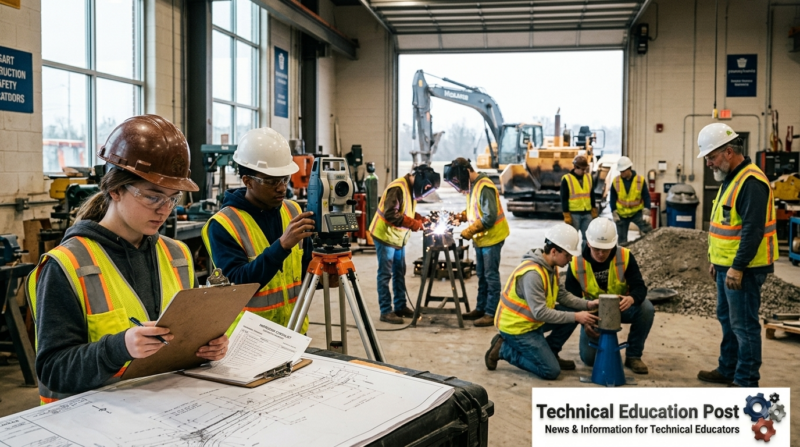
- Programs can prepare students for occupations including construction inspection, mechanics, electrical work, welding, surveying, estimating and other transportation-construction careers.
- PennDOT is simultaneously developing an approximately 140-hour Transportation Construction Inspection Certification Program designed for high schools, CTE programs and community colleges.
- Applications for the current grant competition close September 1, 2026, at 5 p.m. Eastern.
Pennsylvania Is Putting $12 Million Into Heavy-Highway CTE
PennDOT and the Pennsylvania Department of Education announced the new Heavy Highway Industry workforce initiative on July 7.
The competitive grant program is designed to support career-pathway education, technical training, industry certifications and on-the-job learning connected with highway construction.
According to PennDOT, eligible institutions can use the funding to develop new technical-training curriculum or expand existing training related to the heavy-highway industry.
The state has identified possible pathways including:
- Transportation construction inspection
- Mechanics
- Construction labor
- Electrical work
- Stone masonry
- Welding
- Painting
- Cost estimating
- Surveying
The potential reach is unusually broad.
PennDOT says the initiative can support programming for elementary, middle-school, high-school and college students.
Eligible institutions include public and private schools, cyber schools, Career and Technical Centers, Youth Development Centers and higher-education institutions.
Each applicant can seek up to $500,000, according to the official PennDOT grant application page.
But the $12 million allocated to institutional capacity is only part of the story.
The Bigger Story May Be the Other $3 Million
Buried within the grant details is another allocation that deserves national attention.
PennDOT states:
“An additional $3 million is available, up to $10,000 per student, in supportive services through PennDOT’s Supportive Services Center.”
The full program details are available from PennDOT here.
That changes the nature of the initiative.
Workforce programs are frequently designed as though the primary obstacle separating a potential worker from a skilled occupation is a lack of training.
Sometimes it is.
But students can also leave technical programs because life interferes with education.
A student may have access to an excellent welding course but no reliable transportation.
An adult learner may be able to enroll in a construction program but cannot afford childcare during training hours.
A young worker may complete technical instruction but lack the tools, equipment or resources necessary to transition smoothly into employment.
Pennsylvania’s broader infrastructure-workforce strategy already recognizes these barriers.
The state says its Commonwealth Workforce Transformation Program provides supportive services that can assist workers with childcare costs, transportation and professional development.
The important policy idea is therefore not simply:
Train more workers.
It is:
Remove the barriers preventing people from becoming workers.
TechEd Analysis: America May Have a Participation Gap
Technical Education Post has examined several structural weaknesses in the American workforce-development system.
In America’s Skills Gap Has a Multiplier: Missing CTE Instructors, we examined what happens when the country attempts to expand technical training without enough qualified educators.
In The Great Equipment Gap: Why New Labs Don’t Automatically Create Workforce Readiness, we argued that new equipment alone cannot create a workforce without instructor capacity, curriculum integration, student practice and employer validation.
Pennsylvania’s program highlights another weakness.
Call it the Participation Gap.
A training seat can exist.
A qualified instructor can exist.
An interested student can exist.
An employer with an opening can exist.
And the pathway can still fail.
Why?
Because the student cannot consistently get from home to the training site.
Because a parent cannot attend a six-hour program without childcare.
Because an unpaid or low-paid transition period is financially impossible.
Because required tools, protective equipment, licensing expenses or other costs exceed the student’s resources.
Because training is structured around institutional convenience rather than the realities of working adults.
Workforce systems have traditionally concentrated heavily on creating educational capacity.
Pennsylvania’s supportive-services investment acknowledges that educational capacity is useful only when people can actually access and complete it.
Why Heavy-Highway Construction Is a Useful Test Case
The construction workforce provides an unusually strong environment for testing this model.
The U.S. Bureau of Labor Statistics projects about 649,300 openings annually across construction and extraction occupations between 2024 and 2034 as workers leave occupations and employment expands.
Construction laborers and helpers alone are projected to have approximately 149,400 openings each year.
The BLS also projects approximately 46,200 annual openings for construction equipment operators.
Pennsylvania is seeing the workforce pressure directly.
In its July 7 announcement, PennDOT cited a 2025 Associated General Contractors of America survey indicating that 92% of contractors were having difficulty filling open positions.
PennDOT also reported strong educational demand: nearly 100 Pennsylvania schools or districts contacted the department within roughly one month about participating in its Heavy Highway Industry Career Day initiative.
Transportation construction is therefore not merely an infrastructure problem.
It is increasingly an education-and-workforce capacity problem.
Pennsylvania Is Building a Credential Into the System
Another significant piece of the initiative has received relatively little attention.
PennDOT is developing a statewide Transportation Construction Inspection Certification Program specifically for implementation in high schools, career and technical education programs and community colleges.
According to the PennDOT CTE program description, the proposed curriculum includes approximately 140 hours of instruction.
That framework consists of roughly:
- 110 hours of instructor-led classroom education
- Self-paced learning modules
- Hands-on activities
- Assessments
- Industry-based field experiences
The curriculum will focus on competencies required of entry-level Transportation Construction Inspectors while emphasizing workforce readiness and real-world application.
Students who successfully complete the program are expected to earn a PennDOT-recognized certification supporting advancement into Transportation Construction Inspector Trainee positions.
PennDOT anticipates making the curriculum available for school-based implementation beginning in 2027, pending final development and approval.
This is significant because workforce initiatives frequently fund education without creating a clearly identifiable route between training and employment.
Pennsylvania is attempting to connect those pieces:
career exploration → technical instruction → recognized credential → entry-level occupation → infrastructure workforce
That architecture may ultimately matter more than any individual course.
Heavy-Highway CTE Is Much Broader Than Operating Equipment
The phrase “highway construction” may initially suggest bulldozers, excavators and asphalt crews.
The actual occupational ecosystem is considerably broader.
PennDOT specifically identifies pathways in construction inspection, mechanics, construction labor, electrical work, masonry, welding, painting, cost estimating and surveying in its Heavy Highway Industry grant announcement.
A modern transportation project can involve:
- Civil engineering
- Surveying technology
- Materials testing
- Concrete testing
- Welding
- Equipment maintenance
- Electrical systems
- Digital documentation
- Safety compliance
- Project management
- Cost estimation
- Quality assurance
That gives CTE systems an opportunity to connect programs that schools may currently treat as unrelated.
A welding student, diesel student, electrical student and engineering-technology student may ultimately contribute to the same transportation project.
Career pathways become stronger when students can see the larger industrial system into which their individual skill fits.
Pennsylvania Is Starting Career Exposure Earlier
The state is not limiting the initiative to students approaching graduation.
PennDOT says the grant program can support career-pathway education for elementary, middle-school, high-school and college students.
That matters because recruiting a 17-year-old into an occupation he or she has never heard of is difficult.
Career awareness has to begin before the point at which students make major educational decisions.
Construction inspection provides a good example.
Few middle-school students are likely to say they want to become transportation construction inspectors because most have never encountered the occupation.
Yet the field can combine technical knowledge, fieldwork, mathematics, materials, infrastructure, documentation and quality assurance.
The problem is not necessarily that students reject the occupation.
Many students never discover it.
PennDOT is also developing Heavy Highway Industry Career Days, which bring industry representatives and career information directly into Pennsylvania schools.
The combination of early career exposure and later technical certification could create a more coherent pipeline than career recruitment that begins only after graduation.
The Instructor Question Still Matters
Pennsylvania’s funding can help schools establish programs, but expansion creates another challenge.
Someone has to teach them.
A $500,000 award can purchase equipment, expand laboratories and support curriculum development.
It cannot automatically create an experienced instructor.
This is particularly difficult in skilled occupations because schools compete directly against industry for workers with the technical experience necessary to teach.
An experienced welder, diesel technician, electrician, surveyor or construction inspector may face a substantial financial tradeoff when leaving industry for education.
As Technical Education Post examined in America’s Skills Gap Has a Multiplier: Missing CTE Instructors, one missing technical instructor can remove an entire class of future workers from the pipeline year after year.
That means states attempting large-scale CTE expansion should consider instructor-development capacity alongside student capacity.
Otherwise, funding can create training demand faster than schools can create qualified faculty.
The $10,000-Per-Student Model Deserves National Attention
The most transferable part of Pennsylvania’s experiment may not be highway construction at all.
It may be the decision to attach meaningful supportive-service capacity to technical training.
Imagine applying the same logic to:
- Advanced manufacturing
- Nursing and allied health
- Welding
- HVAC
- Electrical trades
- Automotive technology
- Semiconductor manufacturing
- Industrial maintenance
- Cybersecurity
- Energy
- Shipbuilding
Programs in these fields frequently focus on increasing seats.
But a seat that a student cannot consistently occupy does not solve a workforce shortage.
If completion is the objective, workforce agencies may need to think differently about what qualifies as a workforce-development investment.
A bus pass can be a workforce investment.
Childcare can be a workforce investment.
Required safety equipment can be a workforce investment.
Career navigation can be a workforce investment.
Removing the barrier between a learner and an occupation may sometimes produce greater value than purchasing another piece of laboratory equipment.
That does not make equipment or facilities unimportant.
It means workforce readiness has both an institutional side and a human side.
TechEd has previously examined this intersection in CTE and Workforce Development, including the importance of connecting learners with transportation, childcare, career navigation and other workforce-system supports.
Pennsylvania is now attaching substantial dollars to that principle.
Pennsylvania Has Already Tested the Concept
The state’s Construct PA workforce initiative offers an early example of how the model can operate.
Its inaugural cohort consisted of young adults ages 18 to 24 who had previous contact with the justice system.
Participants completed four weeks of training that included:
- PennDOT Transportation Construction Inspector certification
- Field experience with earthwork equipment
- Concrete testing
- Worksite safety certification
- Safe-driving training
- Flagging
- Construction mathematics
- Construction-plan reading
- Professionalism and employment skills
After graduation, participants were connected with potential employers.
PennDOT says Construct PA will expand to additional Pennsylvania communities.
The program also supplied participants with safety and personal protective equipment required for training and employment.
That is a small detail with large implications.
The state did not assume that providing instruction alone would create a worker.
It attempted to complete the transition between learning and employment.
This Fits a Larger Change in Workforce Policy
Pennsylvania’s approach also connects with a broader shift that TechEd recently examined in The Return of Industrial Policy Is Reshaping Career and Technical Education.
Infrastructure spending does not automatically create infrastructure capacity.
Government can appropriate billions of dollars for roads, bridges, energy systems, factories and transportation networks.
But those investments ultimately depend upon local workers capable of building and maintaining them.
That creates what Technical Education Post has called the Industrial Policy Translation Gap: the distance between a public decision to build something and the local education-and-workforce capacity required to produce the people who can actually build it.
Pennsylvania’s heavy-highway initiative illustrates one method of closing that gap.
The state is not waiting for employers to experience shortages and expecting education to react afterward.
It is attempting to build the workforce pipeline alongside the infrastructure investment.
What Schools Should Notice Before September 1
Pennsylvania institutions considering the grant should recognize that this is not simply an opportunity to purchase construction equipment.
PennDOT expects applicants to document workforce-development and employer partnerships.
The official application instructions specifically request letters of commitment, when available, documenting strong workforce-development and employer-partner relationships.
A competitive proposal should therefore begin with the regional labor market rather than the equipment catalog.
Schools should be asking:
What transportation occupations are difficult to fill locally?
Which employers will help shape instruction?
What competencies do those employers actually require?
Can students earn credentials that carry value beyond a single employer?
Can secondary and postsecondary programs connect?
Can students gain field experience before graduation?
What prevents interested students from participating or completing the program?
What happens after the credential is earned?
Those questions produce a workforce pathway.
Buying machinery produces a laboratory.
The two are not the same thing.
FAQ
How much funding is available?
PennDOT is making $12 million in competitive grant funding available to Pennsylvania educational institutions, with individual awards of up to $500,000.
An additional $3 million is available for supportive services, with assistance of up to $10,000 per student.
View the official PennDOT Career and Technical Education Grant program.
When is the application deadline?
Applications must be submitted through PennDOT’s eGrants system by 5 p.m. Eastern on September 1, 2026.
View PennDOT application information.
Who can apply?
Eligible applicants include Pennsylvania public and private schools, cyber schools, Career and Technical Centers, Youth Development Centers and institutions of higher learning.
What types of programs can receive funding?
Projects can develop or expand technical-training curriculum relevant to the heavy-highway industry.
PennDOT identifies potential pathways including construction inspection, mechanics, construction labor, electrical work, welding, masonry, painting, surveying and cost estimating.
Does PennDOT have its own construction credential?
PennDOT is developing an approximately 140-hour Transportation Construction Inspection Certification Program intended for high schools, CTE programs and community colleges.
School-based implementation is anticipated beginning in 2027 following final development and approval.
Read PennDOT’s certification-program description.
TechEd Perspective
The most important number in Pennsylvania’s new program may not be $12 million.
It may be $10,000.
That is the maximum supportive-services assistance available per student.
For decades, workforce policy has often operated on an assumption that if government finances a classroom, purchases equipment and creates a credential, motivated people will find their way through the system.
Real life is messier.
Students have children.
Cars break down.
Work shifts change.
Training sites are far from home.
People cannot always afford the period between deciding to pursue a technical career and earning a full wage in that career.
Those realities are not separate from workforce development.
They are workforce development.
Pennsylvania’s heavy-highway initiative therefore deserves attention far beyond Pennsylvania.
The state is simultaneously investing in educational institutions, curriculum, employer partnerships, credentials and individual participation.
That is closer to a complete workforce system.
America does not merely need more technical programs.
It needs more people who can successfully make it all the way through them.
Related TechEd Magazine Coverage
The Return of Industrial Policy Is Reshaping Career and Technical Education
Explains how infrastructure and industrial investment increasingly depend on local education and workforce capacity.
America’s Skills Gap Has a Multiplier: Missing CTE Instructors
Examines how instructor shortages restrict the number of students who can enter technical workforce pathways.
The Great Equipment Gap: Why New Labs Don’t Automatically Create Workforce Readiness
Explores why equipment investment must be combined with instructors, curriculum, student practice and employer validation.
CTE and Workforce Development
Examines coordination between CTE institutions and workforce systems, including student supports such as transportation and childcare.
Sources
Pennsylvania Department of Transportation — Apply for a PennDOT Career and Technical Education Grant
https://www.pa.gov/services/penndot/apply-for-a-penndot-career-and-technical-education-grant
Official program page confirming eligibility, the $12 million direct grant pool, maximum $500,000 awards, the additional $3 million supportive-services allocation, assistance of up to $10,000 per student, the September 1 application deadline and the proposed Transportation Construction Inspection Certification Program.
Pennsylvania Department of Transportation — Shapiro Administration Launches New Initiative to Expand Pennsylvania’s Workforce in the Heavy Highway Industry
https://www.pa.gov/agencies/penndot/news-and-media/newsroom/statewide/2026/shapiro-admin-new-initiative-to-expand-pa-s-heavy-highway-indust
Official July 7, 2026 announcement describing occupational pathways, employer-partnership requirements, eligible educational institutions, workforce demand and the Heavy Highway Industry Career Day initiative.
Pennsylvania Department of Transportation — Shapiro Administration Growing Pennsylvania’s Construction Workforce Through New Construct PA Initiative
https://www.pa.gov/agencies/penndot/news-and-media/newsroom/statewide/2026/shapiro-admin-growing-pa-s-construction-workforce-through-new-in
Official information on Construct PA, participant training, employer connections, personal protective equipment and supportive services including childcare and transportation.
Pennsylvania Department of Transportation — Heavy Highway Industry Career Days
https://www.pa.gov/agencies/penndot/news-and-media/newsroom/statewide/2026/penndot-invites-schools-to-sign-up-to-host-transportation-indust
Official information on PennDOT’s school-based transportation-industry career-exploration initiative.
U.S. Bureau of Labor Statistics — Construction and Extraction Occupations
https://www.bls.gov/ooh/construction-and-extraction/
National employment projections for construction and extraction occupations.
U.S. Bureau of Labor Statistics — Construction Laborers and Helpers
https://www.bls.gov/ooh/construction-and-extraction/construction-laborers-and-helpers.htm
National employment and job-opening projections for construction laborers and helpers.
U.S. Bureau of Labor Statistics — Construction Equipment Operators
https://www.bls.gov/ooh/construction-and-extraction/construction-equipment-operators.htm
National employment outlook and projected annual openings for construction equipment operators.