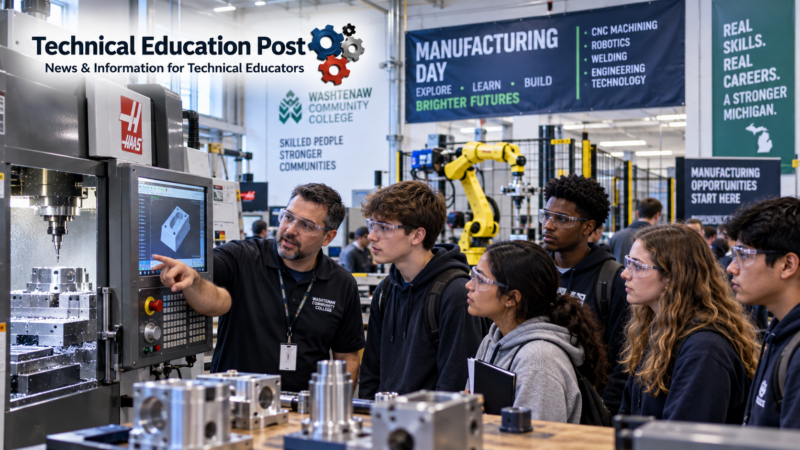
Washtenaw Community College in Ann Arbor, Michigan, scheduled approximately 180 high school students to participate in its October 2 Manufacturing Day program, connecting young learners with advanced manufacturing technologies, local employers, and postsecondary technical education opportunities.
The annual event featured tours of the college’s computer numerical control (CNC) machining, robotics, engineering technology, and welding laboratories. Students were also scheduled to meet with regional manufacturing employers to learn about occupational opportunities and the education required to pursue them.
Organized in collaboration with the Washtenaw Intermediate School District, the visits brought together career and technical education programs serving communities including Ann Arbor, Chelsea, Manchester, Saline, and Ypsilanti.
The initiative addresses a longstanding challenge in manufacturing workforce development: students may have limited opportunities to experience modern industrial environments before making decisions about education and careers.
For CTE directors, technical college administrators, and manufacturing employers, the event illustrates how regional partnerships can connect career exploration with practical educational pathways.
Its significance extends beyond a single day of laboratory tours. Effective career awareness initiatives can help students connect classroom learning with industrial applications, understand available training programs, and make more informed decisions about their futures.
The college’s announcement identified approximately 180 students as expected participants. A final attendance count and the event’s educational outcomes have not yet been independently confirmed.
Key Takeaways
-
Approximately 180 students expected: High school students from across Washtenaw County were scheduled to participate in Manufacturing Day activities.
-
Hands-on technical exposure: The event featured CNC machining, robotics, engineering technology, and welding laboratories.
-
Regional collaboration: The Washtenaw Intermediate School District coordinated visits involving multiple high school CTE programs.
-
Employer engagement: Students had opportunities to learn about local manufacturing occupations and educational requirements.
-
Beyond career awareness: Washtenaw Community College offers technical education and apprenticeship pathways that students can explore after the event.
-
Long-term measurement: The value of Manufacturing Day should be evaluated through changes in student awareness, program participation, and career pathway outcomes.
What Happened: Washtenaw Community College Hosts Manufacturing Career Exploration
Washtenaw Community College planned morning and afternoon Manufacturing Day sessions for Friday, October 2, 2026.
Students were scheduled to spend approximately half a day exploring advanced manufacturing laboratories, meeting with employers, and learning about the technical programs available through the college.
The program focused on four areas of technical education:
-
CNC machining
-
Robotics and automation
-
Engineering technology
-
Welding and fabrication
These disciplines represent different but interconnected components of advanced manufacturing.
The event was coordinated through the Washtenaw Intermediate School District, connecting college faculty, regional high schools, and industry representatives.
Participating schools and programs were drawn from communities throughout the county, including Ann Arbor, Chelsea, Manchester, Saline, and Ypsilanti.
The college’s October 1 announcement established the planned activities and participation estimate. Subsequent reporting confirms that the event was scheduled, but the publicly available accounts reviewed do not establish a verified final turnout for 2026.
Manufacturing Day at a Glance
180
Students expected
4
Featured technical laboratory areas
October 2
2026 event date
Ann Arbor
Michigan location
Source: Washtenaw Community College’s October 2026 announcement. The student figure is an expected attendance estimate.
Why Manufacturing Day Matters for Technical Education
Manufacturing is often misunderstood by people who have limited experience with modern production facilities.
Students may be familiar with traditional images of factories without recognizing the extent to which contemporary manufacturing depends on computer programming, advanced measurement, robotics, digital systems, and applied engineering.
Career exploration programs can help address those perceptions by allowing students to encounter technologies and occupations directly.
1. CNC Machining Connects Mathematics With Production
Computer numerical control machining combines precision equipment, programming, measurement, and technical problem-solving.
Students who observe CNC operations can see how mathematical concepts translate into the production of physical components.
Dimensions, tolerances, coordinates, and geometric relationships become more concrete when applied to actual parts.
For students considering technical careers, exposure to machining laboratories can help explain the relationship between classroom mathematics and industrial applications.
It also introduces career possibilities in machining, manufacturing technology, production engineering, and quality assurance.
2. Robotics Demonstrates the Role of Automation in Modern Industry
Industrial robotics provides a visible example of how engineering, computer science, electronics, and mechanical systems work together.
Manufacturing robots are used for tasks such as assembly, material handling, welding, inspection, and production support.
Students observing robotic systems can begin to understand the technical competencies required to program, operate, maintain, and troubleshoot automated equipment.
This exposure may be especially useful for students interested in computing who have not previously considered industrial careers.
The connection between programming and physical automation can make those pathways more tangible.
3. Welding Highlights the Importance of Skilled Fabrication
Welding remains a foundational industrial skill across manufacturing, construction, transportation, and infrastructure.
Modern welding education involves more than joining metal.
Students must understand materials, joint preparation, safety, fabrication procedures, and quality requirements.
Laboratory demonstrations can help students recognize the precision and technical judgment required in skilled trades.
They may also discover pathways that combine welding with automation, inspection, industrial maintenance, or advanced fabrication.
4. Engineering Technology Connects Design With Practical Systems
Engineering technology occupies an important position between scientific principles and applied industrial work.
Programs may involve equipment operation, testing, troubleshooting, mechanical systems, electronics, and production processes.
For high school students, laboratory experiences can demonstrate how technical professionals convert designs and engineering concepts into functional equipment and systems.
This can broaden their understanding of careers beyond conventional distinctions between engineers and skilled trades workers.
A Continuing Manufacturing Day Tradition at WCC
Washtenaw Community College has organized similar Manufacturing Day experiences in previous years.
In October 2025, the college welcomed nearly 200 students from across the Washtenaw Intermediate School District.
That event included visits to mechatronics, CNC, and welding laboratories.
Students participated in hands-on activities, including manufacturing metal cell phone stands, engraving keychains, and interacting with a robot through a tic-tac-toe activity.
The 2025 activities offer evidence of how the college has previously approached career exploration through direct engagement with equipment and technical processes. They should not be confused with verified activities from the 2026 event.
The recurring nature of the program matters because career exploration is more effective when it becomes part of a sustained educational strategy rather than an isolated promotional activity.
Repeated partnerships can help schools and colleges improve their planning, develop relationships with teachers, and connect interested students with additional educational experiences.
From Manufacturing Day to Apprenticeships and Technical Careers
Career awareness becomes more valuable when students can identify clear next steps.
Washtenaw Community College maintains apprenticeship partnerships with regional manufacturers, including programs associated with the Federation for Advanced Manufacturing Education (FAME).
The FAME model combines college instruction with paid workplace learning, allowing students to develop technical competencies while gaining manufacturing experience.
According to WCC’s published description, its FAME pathway spans five semesters and includes approximately 1,800 hours of paid hands-on workplace training. Participants generally attend college classes two days per week during their program.
This establishes a potential progression from initial exposure to structured technical education.
ILLUSTRATIVE EDUCATION-TO-CAREER PATHWAY
Manufacturing Day
Explore technologies and occupations
High School CTE
Develop foundational technical competencies
College or Apprenticeship
Complete applied training and credentials
Technical Employment
Enter manufacturing and advance occupational skills
Illustrative pathway developed for TechEd Magazine. Individual students may enter or progress through different routes.
For educators and advisers, the objective is not to push every participating student toward manufacturing.
Instead, it is to ensure that students understand the available pathways and can evaluate whether those opportunities align with their interests and capabilities.
Broader Industry Trends: Manufacturing Employers Need a Stronger Talent Pipeline
Manufacturing employers continue to confront workforce challenges involving retirements, changing technologies, and the availability of workers with specialized skills.
A 2024 study by Deloitte and The Manufacturing Institute estimated that the United States could need approximately 3.8 million manufacturing workers between 2024 and 2033.
The study projected that as many as 1.9 million of those positions could remain unfilled if workforce challenges were not addressed.
These are scenario-based projections rather than actual unfilled jobs, but they illustrate why manufacturers are investing in recruitment, education partnerships, and workforce training.
The educational implications are substantial.
As industrial equipment becomes more automated and digitally connected, workers increasingly need combinations of mechanical, electrical, programming, and troubleshooting competencies.
That reality creates opportunities for CTE programs to connect traditional skilled trades education with emerging technologies.
Programs serving local manufacturers should continuously evaluate whether students are developing the capabilities employers need while retaining transferable technical knowledge.
Expert Perspective: A Michigan Teacher Connects Students With Manufacturing
The college’s recurring Manufacturing Day program has attracted educators who maintain strong connections with technical career pathways.
In July 2026, WCC profiled Chelsea High School teacher Duane Moss, a former college student who regularly brings his own students to Manufacturing Day activities.
His experience illustrates one advantage of sustained partnerships: teachers who understand the opportunities available at regional colleges can help students navigate the transition from high school to postsecondary technical education.
Such relationships support more consistent advising and give students access to information from educators familiar with both institutions.
However, education leaders should avoid assuming that participation automatically leads to enrollment or employment.
Evidence of effectiveness requires tracking what students learn and what decisions they make after attending.
Practical Takeaways for CTE Directors and Community College Leaders
Manufacturing Day can be adapted by school districts, colleges, and workforce partnerships seeking to increase student awareness of technical careers.
The strongest events are organized around learning objectives rather than equipment demonstrations alone.
Prepare students before the event. Provide an overview of occupational pathways and relevant technologies. Encourage students to develop questions about required skills, training, compensation, and career advancement.
Make laboratory experiences interactive. Where safety, staffing, and time permit, supervised hands-on activities can help students understand technologies more effectively than passive observation.
Include employers and educational advisers. Students should have opportunities to learn both what workers do and how to prepare for those occupations.
Show multiple career pathways. Manufacturing includes positions in production, engineering technology, quality assurance, maintenance, automation, logistics, and management.
Build follow-up into the program. Schools should provide information about relevant courses, dual enrollment, certificates, apprenticeships, and college visits after the event.
Measure learning and engagement. Short surveys, follow-up advising, and longer-term program enrollment data can help institutions evaluate outcomes.
Questions to Ask Your Program
-
Do our students have regular opportunities to explore modern manufacturing environments?
-
Are career exploration activities connected to classroom learning objectives?
-
Do students understand the difference between technical occupations and their educational requirements?
-
Are employers involved in explaining workplace expectations?
-
Does our program include appropriate hands-on activities?
-
Can interested students identify specific educational pathways after participating?
-
Do we measure changes in student interest and technical program enrollment?
Future Outlook: Turning Career Exploration Into Career Preparation
Manufacturing Day activities can provide an introduction to technologies and occupations that students might not otherwise encounter.
However, their lasting value depends on how effectively institutions connect those experiences with further education.
For Washtenaw Community College, the next steps may include continued engagement with participating high schools, additional campus visits, advising, and information about available technical programs.
The college’s existing apprenticeship relationships provide opportunities for students to explore work-based learning after high school.
WCC is also continuing its broader industry engagement. On October 6, the college and Automation Alley scheduled a Microelectronics and Semiconductor Innovation Exchange addressing technology changes and regional workforce needs.
Together, these initiatives demonstrate the range of activities through which community colleges can participate in regional workforce development, from high school career awareness to employer-focused technical planning.
Frequently Asked Questions
1. What is Manufacturing Day at Washtenaw Community College?
It is an annual career exploration event designed to introduce high school students to advanced manufacturing technologies, occupations, and educational pathways.
2. When was the 2026 event scheduled?
Friday, October 2, 2026.
3. How many students participated?
Approximately 180 students were expected. A verified final attendance count was not available in the sources reviewed.
4. Which technologies were featured?
The planned tours included CNC machining, robotics, engineering technology, and welding laboratories.
5. Which schools participated?
Students were expected from CTE programs serving communities including Ann Arbor, Chelsea, Manchester, Saline, and Ypsilanti.
6. Who coordinated the visits?
The Washtenaw Intermediate School District coordinated the visits with participating schools and Washtenaw Community College.
7. What educational opportunities are available after Manufacturing Day?
Students can investigate related technical education programs, college pathways, and eligible apprenticeship opportunities, including employer partnerships associated with WCC.
8. How should educators evaluate Manufacturing Day programs?
Useful measures include changes in career awareness, student engagement, participation in relevant technical courses, subsequent college enrollment, and long-term educational outcomes.
TechEd Magazine Perspective
Manufacturing Day provides an important opportunity to improve students’ understanding of technical careers.
Its value lies not simply in exposing students to sophisticated machinery, but in helping them connect technical competencies with meaningful educational and professional pathways.
The Washtenaw Community College initiative illustrates how high schools, community colleges, and regional employers can collaborate to make those pathways more visible.
For career and technical education leaders, the essential challenge is continuity.
A student who becomes interested in robotics, CNC machining, or welding should leave a career exploration experience knowing how to pursue that interest.
A successful program therefore extends beyond one day. It connects initial curiosity with appropriate coursework, practical learning opportunities, and informed career decisions.
The larger lesson is that workforce development begins well before recruitment. It begins when students have the information and experiences needed to imagine themselves in technical careers.