
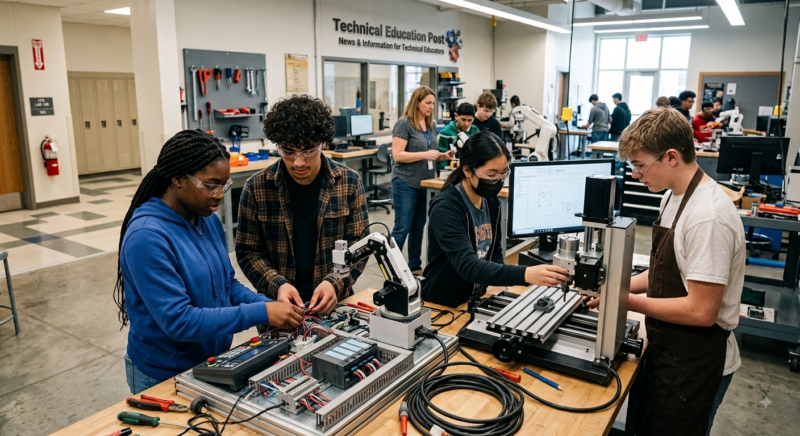
Illinois has enacted a significant change to its high school graduation framework that could elevate career and technical education from an elective pathway to a more central part of students’ academic programs.
Gov. J.B. Pritzker approved Senate Bill 3070 on August 7, 2026, creating Public Act 104-0814. Beginning with students entering ninth grade in the 2028–29 school year, Illinois students will be able to satisfy a new two-year graduation requirement through either two years of foreign language—including American Sign Language—or at least two years of coursework authorized by the Illinois State Board of Education as approved career and technical education coursework.
On its face, the change looks like another effort to give students greater flexibility.
A closer reading of the legislation shows something more consequential.
Illinois is effectively placing a sustained CTE sequence alongside foreign-language study as a legitimate route through part of the state’s core graduation framework. And the final law is substantially different from the legislation originally proposed—an important detail that helps explain what Illinois policymakers ultimately decided CTE should represent.
For CTE directors, high school administrators, counselors and workforce partners, the question is no longer simply whether students should have access to technical education.
It is how schools prepare for a system in which two years of CTE can become part of the graduation architecture itself.
Key Takeaways
- Illinois Gov. J.B. Pritzker signed SB 3070 into law on August 7 as Public Act 104-0814.
- Beginning with the 2028–29 ninth-grade cohort, students may complete two years of foreign language or at least two years of qualifying CTE coursework.
- The CTE option is not simply any locally created vocational class. The law specifically refers to coursework authorized by the Illinois State Board of Education as meeting requirements for an approved CTE course.
- The final legislation is notably broader—and in another respect narrower—than the bill originally introduced.
- An earlier version linked the option to a College and Career Pathway Endorsement and contained provisions concerning foreign-language admission requirements at Illinois public universities. Those university provisions were removed before passage.
- The Senate passed the bill 58–0 and the House passed it 107–0, with four members recorded separately from the affirmative and negative totals, indicating unusually broad legislative support for the underlying policy.
What Illinois Changed
Illinois already permits CTE to play a role in graduation.
Under the state’s existing framework beginning with the 2024–25 school year, students must complete one year chosen from several areas, including music, art, foreign language, career and technical education or forensic speech.
SB 3070 goes further.
For students entering ninth grade beginning in 2028–29, the law creates an additional choice:
Two years of foreign language, including American Sign Language, or at least two years of approved CTE coursework.
Completing either route also satisfies the existing one-year elective requirement contained in the graduation statute.
That makes the change more important than simply allowing another CTE elective.
Illinois is creating room in the four-year high school schedule for students to pursue a sustained technical sequence without necessarily adding those courses on top of every other graduation requirement.
For students interested in advanced manufacturing, welding, engineering technology, construction, health sciences, information technology, agriculture, transportation or other career pathways, scheduling has long been an underappreciated barrier.
A student can want a technical pathway and still discover that graduation requirements, college-preparatory expectations and other required courses leave very little room for a multi-course CTE sequence.
SB 3070 begins altering that equation.
The Detail Other Coverage Could Miss: The Bill Changed Significantly
The legislative history is particularly revealing.
The bill as originally introduced was more tightly connected to Illinois’ broader college-and-career-readiness system.
According to the Illinois General Assembly’s legislative synopsis, the original proposal would have allowed students to substitute career-focused coursework tied to requirements for a College and Career Pathway Endorsement under the Postsecondary and Workforce Readiness Act.
It also proposed changes affecting Illinois public universities. Under that version, a public university generally could not have required Illinois public high school graduates to complete foreign-language courses for admission unless it permitted a College and Career Pathway Endorsement as an alternative.
Those provisions did not survive in that form.
A Senate amendment replaced the underlying language.
The final high-school provision instead refers more broadly to two years of coursework authorized by the State Board of Education as meeting requirements for an approved career and technical education course. The public-university statutory changes contained in the earlier version were deleted.
That distinction matters.
What the final compromise appears to do
The enacted law strengthens CTE’s position within the high school graduation system without simultaneously rewriting university admission policy.
It also avoids limiting the alternative solely to students completing the more extensive College and Career Pathway Endorsement structure.
That potentially makes the CTE alternative accessible to a broader group of students—but places considerable importance on how the Illinois State Board of Education defines and authorizes qualifying coursework.
That will be one of the most important implementation issues to watch.
This Is Not Permission to Count Any Technical Elective
District leaders should pay close attention to the wording of the law.
The statute does not merely say that students may take any two courses labeled “career and technical education.”
It requires at least two years of coursework authorized by the State Board of Education as meeting the requirements for an approved CTE course.
Illinois already maintains a substantial state CTE infrastructure, including program alignment guidance, Perkins accountability measures, work-based learning resources, CTE licensing guidance and career-development reporting.
The practical question for districts will be exactly which local sequences qualify and what documentation, program approval, instructor credentials or course alignment will be necessary.
For schools without extensive CTE programs, the issue may become more fundamental:
Can they provide enough approved coursework for students to meaningfully choose the CTE route?
Why the 2028–29 Start Date Matters
The policy does not immediately affect every Illinois high school student.
The new requirement begins with students entering ninth grade in 2028–29.
That lead time gives districts roughly two academic planning cycles to determine whether their CTE capacity matches the opportunity the law is creating.
Schools may need to evaluate:
- whether existing CTE programs can accommodate additional enrollment;
- whether additional teachers or industry instructors will be needed;
- whether current labs and equipment have enough capacity;
- whether transportation to regional career centers creates scheduling constraints;
- whether courses form coherent sequences rather than isolated electives;
- whether counselors understand which courses qualify;
- and whether families understand the implications of selecting CTE rather than foreign language.
For districts that wait until the affected students arrive in high school, 2028 could be too late to solve instructor, facility or equipment constraints.
Illinois Is Already Building More Career-Pathway Infrastructure
SB 3070 does not arrive in isolation.
Illinois has been expanding its career-pathway infrastructure through the College and Career Pathway Endorsement system. ISBE materials describe the endorsement as a combination of individualized career planning, career-focused instructional sequences and professional learning experiences.
State planning materials have also anticipated progressively broader access to pathway endorsements across Illinois high schools.
Meanwhile, Illinois economic-development policy is increasingly targeting advanced manufacturing.
The state’s Advancing Innovative Manufacturing incentive program supports projects involving technologies and sectors including semiconductors, automotive manufacturing, aerospace, robotics, machine manufacturing and advanced materials.
Illinois also maintains the Manufacturing Illinois Chips for Real Opportunity, or MICRO, program for semiconductor, microchip and quantum-related manufacturing investment, including training-related incentives.
And earlier this year, the state made $24 million available to establish six additional Manufacturing Training Academies at community colleges in downstate Illinois.
Taken together, the pieces point toward a broader strategy.
Illinois is not merely trying to create more career programs.
It is gradually connecting secondary-school scheduling, technical pathways, community-college training and industrial-development policy.
SB 3070 moves one of those connections directly into graduation requirements.
The Scheduling Effect Could Be Bigger Than the Policy Effect
One reason this legislation deserves national attention is that CTE expansion is frequently discussed as a funding problem.
Sometimes it is.
But high school schedules themselves can limit participation.
A student cannot enroll in welding, precision machining, cybersecurity, engineering technology or health-sciences sequences if every available period is consumed by other graduation and college-preparation requirements.
That is what makes Illinois’ approach noteworthy.
Rather than simply telling districts to offer more career education, the state has altered the academic framework that determines whether students actually have room to take it.
For technical educators, that is a fundamentally different type of CTE policy.
There Is Also a Legitimate Tradeoff
The legislation should not be interpreted as a declaration that foreign-language education lacks value.
Students will continue to have the option of completing the two-year foreign-language sequence.
And concerns raised during debate over reducing students’ exposure to language study represent a legitimate curriculum question, particularly for students whose postsecondary plans may involve universities or programs with their own admission or degree requirements.
That makes counseling critical.
The state’s graduation requirement and an individual college’s admission expectations are not necessarily the same thing.
In fact, the legislative history makes that distinction especially important because the earlier bill included changes affecting Illinois public-university admission requirements, while those provisions were removed from the final legislation.
Students choosing the CTE route therefore should not automatically assume that doing so eliminates every foreign-language consideration associated with their future college plans.
Questions to Ask Your Program
Illinois CTE and district leaders have time before the first affected cohort enters high school, but the planning questions can begin now.
- Which of our existing CTE courses are likely to qualify under the new requirement?
- Can students complete a coherent two-year technical sequence without scheduling conflicts?
- What happens to enrollment if substantially more students choose CTE?
- Do we have enough qualified instructors?
- Can our labs support additional sections?
- Will regional career-center transportation limit participation?
- Are counselors prepared to explain both graduation and college-admission implications?
- Are our employer partners prepared for expanded work-based learning demand?
- Could dual-credit arrangements allow the two-year sequence to lead directly into certificates or associate degrees?
- Which pathways align with actual regional labor demand rather than simply existing course inventory?
What Educators Should Watch Next
Three developments will determine how important Public Act 104-0814 ultimately becomes.
1. ISBE implementation guidance
The most immediate question is how the Illinois State Board of Education interprets the phrase “approved career and technical education course.”
Districts will need clarity well before the 2028–29 cohort begins planning high school programs.
2. Student participation
The law creates an option; it does not tell us how many students will choose it.
If participation is modest, the change may primarily provide flexibility for students already pursuing CTE.
If participation is large, districts could face significant demand for instructors, facilities, equipment and partnerships.
3. Whether other states follow
The larger national question is whether Illinois’ approach becomes part of a broader shift in graduation policy.
CTE advocates have spent years arguing that technical pathways should not be treated as extracurricular alternatives to the “real” academic curriculum.
Illinois has now changed its graduation framework in a way that gives that argument tangible policy consequences.
Other states will have an opportunity to watch what happens when students are given more room to substitute sustained technical study for another traditional graduation sequence.
TechEd Magazine Perspective
For decades, one of the contradictions surrounding career and technical education has been easy to identify: policymakers praise CTE as essential to workforce development while high school schedules often continue to treat technical programs as something students must fit around the traditional academic program.
Illinois has begun addressing that contradiction structurally.
Public Act 104-0814 does not merely fund another lab, launch another pilot program or encourage students to consider the skilled trades.
It changes what can count toward graduation.
That distinction is important.
The success of the policy, however, will depend on what happens between now and 2028. If students gain scheduling flexibility but districts lack instructors, equipment, transportation or coherent technical sequences, the statutory option will exist primarily on paper.
If schools use the lead time to build strong multi-year pathways connected to community colleges, apprenticeships and regional employers, Illinois could demonstrate something much more significant:
CTE does not have to sit beside the high school curriculum. It can be built into the architecture of the diploma itself.
Frequently Asked Questions
When did Illinois approve the change?
Gov. J.B. Pritzker approved SB 3070 on August 7, 2026. It became Public Act 104-0814.
When does the new CTE option begin?
It applies beginning with students entering ninth grade during the 2028–29 school year.
Does Illinois eliminate foreign language?
No. Students may still complete two years of foreign language, including American Sign Language. The legislation establishes CTE as an alternative route.
Can students take any two CTE classes?
The statute specifies coursework authorized by the Illinois State Board of Education as meeting requirements for approved CTE coursework. Additional implementation guidance will therefore be important.
Does the law force students into vocational education?
No. It creates an additional graduation option.
Does completing CTE guarantee that a student meets every college foreign-language requirement?
No. Graduation requirements and college admission requirements should be considered separately. Notably, provisions affecting Illinois public-university foreign-language admission policies appeared in an earlier version of SB 3070 but were removed before final passage.
Was the legislation partisan?
The final measure received overwhelming bipartisan legislative support. The Senate recorded a 58–0 vote, and the House recorded 107 votes in favor, zero against and four in another recorded category.
Recommended Internal Links
Relevant existing TechEd Magazine content includes:
- What is CTE? — foundational CTE resource.
- How to Strengthen Career and Technical Education for the 21st Century — useful historical policy context.
- Students for In-Demand Careers — example of multi-course manufacturing CTE pathways.
- Workforce Pell Grant Program — connects the secondary pathway discussion to short-term postsecondary workforce education.
- Technical and STEM Education 2026 — broader technical-education landscape.
Primary Sources
Illinois General Assembly — SB 3070 bill status and legislative history. The official record confirms the August 7 gubernatorial approval, Public Act 104-0814, vote history and amendments.
Illinois General Assembly — enrolled SB 3070 text. The enacted language establishes the two-year foreign-language/CTE choice for the 2028–29 ninth-grade cohort.
Illinois State Board of Education — Career and Technical Education. State resources governing CTE programs, work-based learning, licensing and program alignment.
Illinois State Board of Education — Postsecondary and Workforce Readiness. Background on Illinois’ College and Career Pathway Endorsement framework.