New state funding will help launch career and technical education programs in underserved communities, bringing Michigan’s 2026 CTE expansion investment to $68.5 million.
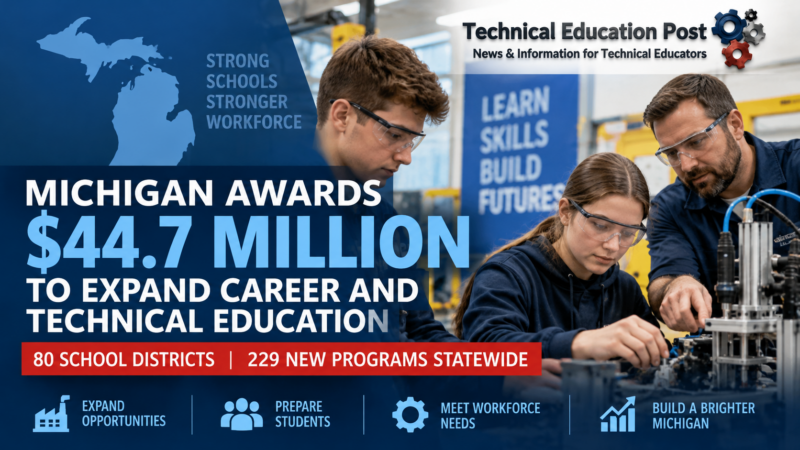
LANSING, Mich. — October 14, 2026 — Michigan is making another substantial investment in career and technical education (CTE), awarding nearly $44.7 million to 80 school districts to expand career-focused programs and provide students with greater access to hands-on technical training.
Announced by the Michigan Department of Education (MDE) on October 8, the competitive grants are intended to address longstanding gaps in career education, particularly in communities where students have limited access to state-approved CTE programs.
The latest awards bring Michigan’s combined 2026 CTE expansion grant funding to approximately $68.5 million, including $24.2 million awarded in April.
Across both funding rounds, the state expects to support 229 new CTE programs in 117 school districts, including programs at 57 middle schools.
The investment represents a significant effort to strengthen Michigan’s skilled workforce pipeline while helping students explore technical occupations before graduating from high school.
Addressing Career Education Deserts Across Michigan
One of the primary objectives of the funding is to expand access in communities considered CTE deserts—areas where students have few opportunities to enroll in state-approved career and technical education programs.
Geography, transportation constraints, inadequate facilities, and differences in local funding can prevent students from pursuing technical education even when demand for skilled workers remains strong.
Michigan’s Section 61v CTE Expansion Grant program is designed to reduce these disparities by supporting districts that demonstrate unmet needs and opportunities to introduce new career pathways.
The competitive grants are distributed over three years and prioritize programs aligned with high-skill, high-wage, and in-demand occupations.
Eligible recipients include traditional public school districts, public school academies, and intermediate school districts.
The latest awards are intended to help schools develop instructional environments where students can gain practical skills, explore industries, and prepare for employment or additional education.
Funding Supports Manufacturing, Construction, Agriculture and More
Modern career and technical education extends far beyond traditional vocational classes.
Michigan’s expanding CTE programs span industries such as:
- Advanced manufacturing and mechatronics
- Construction trades and woodworking
- Engineering and digital technology
- Agriculture and agricultural operations
- Health sciences
- Business administration and management
- Hospitality and culinary arts
- Other technical and career-focused occupations
These pathways give students opportunities to connect academic knowledge with practical applications while developing competencies relevant to local and regional employers.
The funding also creates opportunities for school districts to establish or expand partnerships with businesses, postsecondary institutions, and workforce development organizations.
For technical educators, those partnerships can help keep instruction relevant as workplace technologies, equipment, and employment requirements evolve.
Grand Rapids Public Schools Receives Nearly $488,000
Grand Rapids Public Schools is among the districts receiving second-round funding.
The district was awarded $487,810 to support programs in agricultural operations and related sciences, woodworking, and business administration management and operations.
Grand Rapids Public Schools already operates several career-focused academies and provides opportunities for dual enrollment, college preparation, and hands-on learning.
The additional funding will support expansion into fields that can connect students with regional employment opportunities.
The district’s participation illustrates how CTE grants can complement existing educational pathways rather than functioning as separate programs.
Mackinac Island Students Gain Construction Trades Opportunities
Another notable recipient is Mackinac Island Public Schools, which received $133,100 to support a new construction trades program.
The district faces challenges that distinguish it from many mainland school systems.
Students who might otherwise seek vocational instruction outside their community can encounter significant transportation and seasonal accessibility barriers, particularly during winter.
Establishing a construction trades program locally could provide students with career training while reducing the need to travel to vocational facilities on the mainland.
The program also aligns with the island’s practical need for workers skilled in building maintenance, construction, and the preservation of existing structures.
The Mackinac Island award demonstrates how regional workforce needs can influence the design of technical education programs.
Michigan Expands Career Exploration into Middle Schools
A particularly important aspect of Michigan’s CTE expansion strategy is its emphasis on introducing career exploration earlier in students’ education.
The two 2026 funding rounds collectively support new CTE programs in 57 middle schools.
Traditionally, many students have their first substantial exposure to vocational education during high school.
Earlier career exploration may help students identify interests, understand the relationship between academic subjects and technical occupations, and make more informed decisions about future coursework.
For example, middle school experiences involving manufacturing, digital technology, and engineering can introduce concepts that students may later pursue in specialized high school CTE programs.
However, early exposure should be accompanied by broad exploration rather than premature pressure to select a specific occupation.
Schools will need age-appropriate instruction, qualified educators, suitable learning environments, and effective connections between middle school and high school programs to realize the benefits.
Career and Technical Education Continues Growing in Michigan
Michigan’s latest investment follows several years of increasing participation in career-focused education.
According to previously released MDE data, 55,431 students completed CTE programs during the 2024–25 school year, compared with 52,625 the previous year.
The 2024–25 figure was more than double the 27,014 students completing CTE programs in 2014–15.
These figures demonstrate substantial long-term growth in program completion, although participation and completion alone do not establish employment or wage outcomes.
The state’s April 2026 grant announcement also identified demand for programs involving computer programming, digital design, construction, welding, and advanced manufacturing.
By investing in new facilities and educational pathways, Michigan is attempting to accommodate student interest while responding to changing workforce requirements.
What the Funding Means for Technical Educators
For teachers, administrators, and workforce development professionals, the new grants represent more than an increase in available funding.
Launching successful technical education programs requires careful planning and ongoing collaboration.
School leaders may need to address several priorities.
Industry-aligned curriculum: Courses should reflect current occupational practices, recognized credentials, and relevant safety standards.
Instructor recruitment and development: Districts need educators who combine teaching expertise with familiarity with modern industry equipment and processes.
Equipment and learning spaces: Effective technical instruction depends on appropriate facilities, tools, laboratory resources, and maintenance plans.
Employer partnerships: Local businesses can provide insight into required skills and may support mentoring, workplace visits, internships, or work-based learning experiences.
Measurable student outcomes: Enrollment growth is important, but schools should also evaluate program completion, credentials earned, student transitions, and employment or postsecondary opportunities.
These considerations will become increasingly important as districts move from receiving grants to implementing sustainable educational programs.
A Long-Term Investment in Michigan’s Skilled Workforce
Michigan’s approximately $68.5 million in CTE expansion awards reflects a statewide effort to make technical education more accessible and relevant.
The funding addresses both immediate opportunities to establish new programs and longer-term challenges involving educational equity, workforce preparation, and regional economic development.
With 229 new programs expected across 117 districts, the scale of the initiative provides an opportunity to examine how investments in career and technical education translate into meaningful student outcomes.
The next test will be implementation: whether districts can recruit qualified instructors, establish effective programs, sustain operations, and connect students with opportunities after graduation.
For educators and industry partners, Michigan’s latest CTE investment offers an opportunity to strengthen the connection between classroom learning and the technical skills employers need.
Sources
- Michigan Department of Education: Nearly $44.7M Awarded to Expand Career and Technical Education Access Across Michigan — October 8, 2026.
- Michigan Department of Education: $24.2M in Grants Will Expand Student Access to In-Demand CTE Programs — April 8, 2026.
- Michigan Department of Education: 61v Michigan CTE Expansion Grant.
- Michigan Department of Education: Career and Technical Education Numbers Increase Again in Michigan — September 23, 2025.