
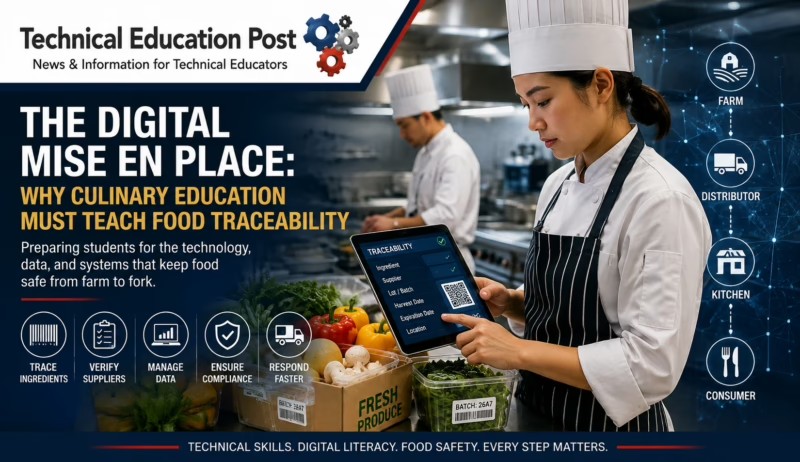
Culinary food traceability is becoming an essential workforce skill as professional kitchens rely increasingly on digital supplier records, inventory systems, and rapid recall response.
In a professional kitchen, mise en place means having every ingredient, tool, and process ready before service begins. The next generation of culinary education will need a second kind of preparation: every high-risk ingredient’s identity, source, receiving information, and movement through the supply chain must also be organized and retrievable.
That lesson emerged from a series of Food and Drug Administration traceability-readiness exercises conducted in March and April 2026. Fifteen companies participated across six supply-chain scenarios involving producers, processors, distributors, retailers, and restaurants. Most firms supplied requested information within 24 hours, but the FDA found uneven data quality, incomplete traceability-lot information, inconsistent buyer requirements, and major differences in how well trading partners coordinated.
The agency’s most important finding was not that restaurants need the newest barcode, blockchain, or inventory platform. It was that supply-chain alignment mattered more than technology.
This is more than a compliance story. It is a curriculum signal.
Culinary programs have traditionally emphasized technique, sanitation, nutrition, cost control, purchasing, and kitchen management. Those competencies remain essential. But modern chefs and food-service managers also work inside increasingly digital supply chains. They receive electronically documented ingredients, use inventory and enterprise systems, respond to recalls, manage supplier data, and may need to produce accurate records under severe time pressure.
Technical Education Post calls the educational response Digital Mise en Place: preparing the ingredient data, supplier relationships, recordkeeping procedures, and response skills required to operate a safe, traceable, technology-enabled kitchen.
Key Takeaways
- FDA’s 2026 tabletop exercises showed that most participating firms could respond within 24 hours, but significant gaps remained in data completeness and information sharing.
- The strongest traceability results came from supply-chain partners that had agreed in advance on what data to collect and how to exchange it—not necessarily from those using the most advanced technology.
- Restaurants generally need to maintain receiving records for covered foods unless an exemption applies, but they usually are not required to connect lot codes to individual meals sold directly to consumers.
- Culinary students increasingly need spreadsheet, inventory, barcode, supplier-communication, recall-response, and data-quality skills alongside cooking and sanitation competencies.
- Schools can teach traceability without purchasing an expensive proprietary platform by using sample invoices, spreadsheets, labels, barcode scanners, and simulated recalls.
- Programs should assess whether students can retrieve and explain accurate records under time pressure—not merely whether they can scan a code.
What Happened
The FDA’s Food Traceability Rule establishes additional recordkeeping requirements for covered entities that manufacture, process, pack, or hold foods on the agency’s Food Traceability List. The list includes products commonly found in culinary laboratories and commercial kitchens, including leafy greens, soft and semi-soft cheeses, shell eggs, fresh-cut produce, nut butters, certain seafood, and ready-to-eat deli salads.
The rule organizes information around Critical Tracking Events, such as shipping, receiving, and transformation, and the Key Data Elements associated with those events. Required records may include a traceability lot code, the location where it was assigned, product descriptions, quantities, dates, and information about the businesses sending or receiving the food.
Covered entities must be able to make required information available to the FDA within 24 hours of an official request or within another time accepted by the agency. In certain situations, the information must be provided in an electronic sortable spreadsheet.
Congress has directed the FDA not to enforce the rule before July 20, 2028. The additional time, however, is being used for preparation rather than abandonment. In May 2026, the FDA and the Food Safety Preventive Controls Alliance launched an industry training curriculum on the rule. In June, the FDA published the findings of its readiness exercises and held a public meeting focused on lot-level tracking and possible implementation flexibilities.
What the FDA Tested
The readiness exercises involved 15 participating companies across six food-supply scenarios. Participants included national and regional restaurant chains, retailers, distributors, processors, and producers. The exercises covered soft and semi-soft cheese, wild-caught finfish, whole-head leafy greens, fresh-cut leafy greens, and nut butter.
The FDA sent a simulated records request to a restaurant or retail food establishment, which is where many outbreak investigations begin. Participants were asked to locate and submit traceability data in an electronic sortable spreadsheet within 24 hours. If the restaurant or retailer could not provide enough information, the FDA continued its request upstream through distributors, processors, and producers.
The report was based on a small voluntary sample and was not designed to represent the entire industry. It nevertheless produced several practical findings that culinary and hospitality programs should not ignore.
Speed Was Better Than Completeness
Most firms met the 24-hour response window. That was encouraging. But rapid submission did not always mean the information was complete or correct.
The FDA found that traceability lot codes were available or inconsistently present in 80% of participating firms’ records, and the source location for those codes appeared in 73%. However, only 40% of participant records captured the properly assigned lot code across every applicable tracking event, while only 27% captured the complete source information for every applicable event.
In other words, many businesses could find records quickly, but fewer could produce a complete, consistently connected data trail.
Coordination Outperformed Technology
Participants used systems ranging from invoices and purchase orders to warehouse-management software, enterprise resource planning systems, RFID tags, and two-dimensional barcodes.
The FDA concluded that the specific technology mattered less than whether supply-chain partners had agreed on what information to capture, where it would appear, and how it would move from one organization to another.
“Supply chain alignment mattered more than technology.”
— FDA Traceability Readiness Tabletop Exercises Final Report
In scenarios where companies coordinated with suppliers before the exercise, information was more complete and arrived faster. In at least two cases, restaurants or retailers worked with suppliers to provide the entire supply chain’s information within the first 24-hour response, compressing a process that might otherwise have required multiple requests over several days.
Why This Is a Culinary Education Story
Food traceability may sound like a regulatory, logistics, or information-technology responsibility. In practice, the restaurant kitchen is one of the final operational points in a long data chain.
A chef or food-service manager may receive the product, confirm its quantity and condition, determine where it is stored, decide how it is used, communicate with suppliers, isolate recalled inventory, document corrective action, and explain what happened to inspectors, administrators, or customers.
O*NET’s 2026 profile for chefs and head cooks reflects this operational reality. The occupation includes checking received products, ordering supplies, monitoring sanitation, inspecting equipment and work areas, recording production data, and managing food-service operations. The listed technology skills include inventory and recipe systems, enterprise software, supply-chain tools, spreadsheets, and office applications.
The National Restaurant Association’s 2026 industry outlook similarly identifies workforce development, digital ordering, automation, and data analytics as important to long-term competitiveness. The association argues that technology works best when paired with stronger managers and an adaptable workforce.
Meanwhile, the Bureau of Labor Statistics projects 7% employment growth for chefs and head cooks from 2024 through 2034, with approximately 24,400 openings each year. Food-service managers are projected to grow 6%, with about 42,000 annual openings.
The employment opportunity is not disappearing. The job is becoming more technologically and operationally complex.
Technical Education Post has previously examined automation in restaurant work and the need to prepare frontline workers for digital change. Food traceability reveals another side of that transition. Culinary technology is not only the robot cooking a burger or the AI system forecasting demand. It is also the data architecture that allows a restaurant to identify where an ingredient came from and act quickly when safety is at stake.
The Kitchen Is Becoming a Data Node
A modern kitchen transforms physical ingredients, but it also receives, generates, and communicates information.
| Kitchen activity | Physical task | Data task |
|---|---|---|
| Receiving | Inspect quantity, temperature, packaging, and quality | Confirm product, supplier, date, lot information, and receiving records |
| Storage | Place food safely and rotate inventory | Preserve identity, location, date, and status |
| Preparation | Wash, cut, combine, cook, or portion ingredients | Understand when transformation changes recordkeeping responsibilities |
| Service | Produce and deliver meals | Maintain relevant receiving and operational information without creating unnecessary records |
| Recall response | Locate, isolate, and remove affected food | Retrieve accurate information, communicate, and document action |
| Management | Control cost, quality, labor, and waste | Analyze purchasing, inventory, safety, and supplier performance |
The record is becoming part of the product’s operational integrity. A case of leafy greens may look acceptable and remain at the proper temperature, but the kitchen is still vulnerable if no one can determine which lot arrived, who supplied it, or whether it is included in a recall.
This does not mean culinary students must become regulatory attorneys. It means they must understand that food safety increasingly depends on the quality and retrievability of information.
Digital Mise en Place
Traditional mise en place reduces errors during service by organizing ingredients, tools, timing, and responsibilities in advance.
Digital Mise en Place applies the same logic to food information.
Technical Education Post proposes six stages:
1. Identify
Recognize foods that require enhanced traceability and determine whether the operation or transaction may be covered, modified, or exempt.
Students do not need to memorize every regulatory exception. They should be able to recognize high-risk categories, locate authoritative guidance, and know when to seek clarification.
2. Capture
Record the required information at the moment it is most reliable—usually when food is received, shipped, packed, or transformed.
Waiting until a recall to reconstruct the record invites missing data, transcription errors, and uncertainty.
3. Connect
Keep the traceability lot code connected to its source, product description, date, quantity, and supplier information.
A scanned number without context is not a usable traceability system.
4. Verify
Check that records match the physical product and the business process. Students should learn to detect a wrong lot code, missing source location, duplicate record, incomplete invoice, or mismatch between a label and a spreadsheet.
5. Retrieve
Locate and export the information in a usable format under time pressure. A good system is not one that stores data; it is one that allows authorized people to find the right data quickly.
6. Respond
Use the information to isolate food, notify responsible parties, communicate with suppliers, protect customers, and document corrective action.
Traceability is valuable only when it improves the speed and accuracy of a response.
Technical Education Post Definition
Digital Mise en Place: The advance preparation of ingredient data, supplier relationships, recordkeeping procedures, technology tools, and response responsibilities required to operate a safe and traceable professional kitchen.
Restaurants Have Specific—Not Unlimited—Responsibilities
Culinary instruction should be accurate about what the rule does and does not require.
Restaurants are generally required to maintain receiving information for covered foods unless an exemption applies. However, restaurants that transform food and sell or send it directly to consumers generally are not required to maintain transformation records for that activity. They also are not required to connect traceability lot codes from incoming ingredients to individual meals or consumer sales.
A central kitchen that transforms food and ships it to another business may have different responsibilities because it is functioning as a processor rather than only as a restaurant serving consumers.
The distinction is educationally important. Students should not leave class believing every plate requires a blockchain record or that every ingredient must be linked to every customer. That exaggeration would make traceability appear unmanageable and would teach the wrong operational model.
The goal is to understand where the restaurant enters the data chain, what information it must preserve, and how it can work with suppliers during a recall.
The Expensive-Technology Fallacy
Schools may assume that teaching traceability requires an enterprise restaurant platform, commercial warehouse system, or custom blockchain environment.
The FDA’s findings suggest otherwise.
Smaller and mid-sized firms already held much of the required information in conventional business records. Their challenge was often not the absence of technology but inconsistent information, unclear expectations, disconnected records, and poor coordination with trading partners.
A culinary program can create meaningful traceability instruction with:
- A spreadsheet application
- Sample purchase orders and invoices
- Product labels and lot codes
- A low-cost barcode or QR scanner
- A label printer or ordinary printer
- A shared digital folder with controlled permissions
- A mock inventory or point-of-sale environment
- Sample supplier contact information
- A written traceability plan
- Timed recall scenarios
Commercial software becomes useful when it improves instruction or reflects the systems used by regional employers. It should not substitute for understanding the process.
A student who can click through one vendor’s interface but cannot explain the data, detect an error, or export a usable file is not traceability-ready.
A Culinary Traceability Lab
Traceability can become a practical culinary laboratory rather than a lecture on federal regulation.
Stage 1: Receive the Shipment
Students receive simulated cases of leafy greens, soft cheese, tuna, shell eggs, or nut butter. Each shipment includes labels, quantities, supplier information, and one or more intentionally incomplete or inconsistent records.
Stage 2: Inspect and Record
Students perform normal receiving tasks—temperature, condition, count, date, and quality—while capturing the applicable traceability information.
Stage 3: Store and Produce
Students place ingredients in assigned storage areas and use selected products in a production exercise. The instructor changes a label, relocates a container, or introduces a substitution to test whether records continue to match operations.
Stage 4: Inject the Recall
The instructor issues a mock notice identifying a supplier, product, date range, or traceability lot code. Students must determine whether the kitchen received the affected food.
Stage 5: Produce the Response
Teams isolate affected inventory, identify missing information, contact a simulated supplier, and submit an electronic sortable spreadsheet within a set period.
Stage 6: Conduct the After-Action Review
Students explain which records were useful, which fields were missing, where communication failed, and how the traceability plan should change.
The exercise mirrors the FDA’s readiness method while remaining appropriate for secondary or postsecondary education.
What Should Be Assessed?
| Competency | Evidence of mastery |
|---|---|
| Ingredient identification | Correctly recognizes covered food categories and locates current guidance |
| Receiving accuracy | Records product, quantity, date, supplier, and available lot information without transcription errors |
| Data connection | Links the lot code to the correct source and receiving event |
| Data quality | Detects missing, conflicting, or incorrectly assigned information |
| Technology use | Uses labels, scanners, spreadsheets, or inventory systems accurately |
| Retrieval | Finds and exports relevant records within the assigned time |
| Communication | Requests missing information clearly from suppliers or team members |
| Recall response | Identifies, isolates, and documents affected inventory |
| Process improvement | Recommends a realistic correction to the traceability plan |
The assessment should reward accuracy, completeness, reasoning, communication, and response—not simply speed.
Traceability Connects Culinary Arts to STEM
Food traceability is an unusually strong bridge between culinary education and other technical disciplines.
- Information technology: databases, permissions, data formats, system integration, and exports
- Cybersecurity: protecting supplier records, access credentials, and operational data
- Mathematics: quantities, yields, inventory balances, and reconciliation
- Supply-chain management: receiving, distribution, sourcing, and vendor requirements
- Biology and food science: pathogens, spoilage, risk, and outbreak investigation
- Engineering and automation: scanners, sensors, smart labels, and connected equipment
- Business: procurement, cost control, liability, and continuity planning
- Communication: supplier requests, public-health reporting, and crisis response
The American Culinary Federation’s current Culinology certificate reflects this broader technical direction by combining culinary practice with food science, shelf life, preservation, processing technology, microbial management, packaging, and food safety.
Culinary technology should therefore be understood as more than appliances and cooking devices. It includes the systems that make food production measurable, explainable, and controllable.
Instructor Preparation Matters
Many culinary instructors entered education from kitchens where traceability was handled by corporate purchasing departments, distributors, managers, or proprietary systems. Others may work in small operations exempt from portions of the federal rule.
That means instructor professional development must accompany curriculum change.
Useful partners include:
- Local and state health departments
- Restaurant and hospitality associations
- Food distributors
- Institutional food-service operations
- School nutrition departments
- Hospital and long-term-care kitchens
- Food manufacturers and central kitchens
- Food-safety consultants
- Community-college supply-chain or information-technology programs
The FDA and Food Safety Preventive Controls Alliance training course launched in May 2026 provides an additional professional-development option. It covers recordkeeping, supply-chain activities, data transmission, and traceability plans.
Schools should also invite employers to provide anonymized sample records and participate in mock-recall exercises. A meaningful advisory-board contribution is not merely saying that traceability is important. It is helping educators understand what information actually arrives at receiving, where it is stored, who uses it, and what fails during real recalls.
Do Not Wait Until 2028
The delayed enforcement timeline may tempt programs to postpone action.
That would miss the larger point.
The competencies involved—accurate receiving, data quality, supplier coordination, inventory control, spreadsheet use, and recall response—already have value. They support food safety, waste reduction, cost control, allergen management, purchasing, and operational resilience regardless of the final implementation details.
Recent foodborne-illness events reinforce that urgency. In June 2026, federal and state agencies investigated a multistate Listeria outbreak associated with soft cheese. The investigation involved product sampling, distributor and manufacturer tracing, whole-genome sequencing, a voluntary recall, and suspension of a manufacturer’s operating license. At the time of the FDA’s report, seven hospitalizations and one death had been reported.
CDC estimates that foodborne illness sickens approximately 48 million people in the United States annually, hospitalizes 128,000, and causes 3,000 deaths.
Traceability does not prevent every contamination event. It can reduce the time required to identify affected food and remove it from service.
Common Mistakes
- Teaching the rule as a vocabulary test. Students need operational practice, not only definitions.
- Buying software before designing the workflow. Technology cannot correct unclear responsibilities or missing supplier data.
- Assuming a scan guarantees accuracy. A barcode can transmit incorrect or incomplete information.
- Overstating restaurant requirements. Students should understand exemptions and the limits of required restaurant records.
- Ignoring paper and hybrid systems. Conventional records can work when they are complete, organized, and retrievable.
- Teaching one proprietary interface as the competency. Graduates will encounter different systems.
- Separating traceability from culinary production. Records should follow the ingredient through receiving, storage, and use.
- Skipping supplier communication. FDA found that coordination was a major determinant of success.
- Measuring speed without accuracy. A fast incomplete spreadsheet can delay an investigation.
- Waiting for enforcement. The underlying skills already support safer and more efficient operations.
Questions to Ask Your Program
- Do students learn how ingredients move through the supply chain before reaching the kitchen?
- Can students identify foods that appear on the FDA Food Traceability List?
- Do receiving labs include supplier, date, quantity, and lot-information checks?
- Can students explain the difference between a traceability lot code and its source location?
- Do students practice identifying incomplete or contradictory records?
- Can students use a spreadsheet to organize and export receiving information?
- Does the program use barcode or label scanning in a way that teaches data meaning rather than button pushing?
- Have students completed a timed mock-recall exercise?
- Can they isolate affected inventory and document corrective action?
- Does the program have a written traceability plan for its own teaching kitchen?
- Do instructors understand which restaurant activities generally require records and which do not?
- Has the advisory board reviewed the program’s traceability instruction?
- Can local distributors provide sample documents or participate in simulations?
- Are cybersecurity and access controls addressed when records are stored digitally?
- Can students transfer their skills across paper, spreadsheet, and commercial systems?
What to Watch Next
Implementation Flexibilities
The FDA is continuing discussions about lot-level tracking and possible implementation flexibilities. Programs should teach the current rule while making clear that guidance and implementation details may continue to evolve.
The 2026 FDA Food Code
The FDA has identified an updated Food Code as a 2026 priority. Because state and local jurisdictions use the code as a model for restaurant and retail-food regulations, the update may create additional curriculum-review needs.
Data Standardization
The FDA exercises found that inconsistent buyer requirements create costly custom work for suppliers. Greater standardization across restaurants, distributors, and technology providers could change which technical skills become most valuable.
Food-Safety Technology
Two-dimensional barcodes, RFID, connected temperature sensors, cloud inventory systems, AI-assisted forecasting, and automated receiving will continue to expand. Schools should evaluate whether each tool improves data quality and decision-making rather than adopting technology for appearance.
Credential and Competition Updates
Food safety and sanitation already occupy a substantial share of culinary credential assessments. Educators should watch whether the American Culinary Federation, ProStart, FCCLA, state standards, and local certifications add more explicit traceability and digital-operations competencies.
Technology-Enabled Management Careers
As restaurants adopt automation and analytics, advancement may increasingly favor culinary professionals who can move between food production, people management, safety systems, and operational data.
Frequently Asked Questions
What is food traceability?
Food traceability is the ability to identify and follow food and relevant information through stages of production, processing, distribution, receiving, and use.
What is the FDA Food Traceability Rule?
It is a federal rule requiring covered entities to maintain additional records for foods on the FDA Food Traceability List. The records are organized around specific tracking events and required data elements.
When will the FDA begin enforcing the rule?
Congress has directed the FDA not to enforce the Food Traceability Rule before July 20, 2028. Schools and businesses should continue monitoring official FDA guidance because implementation details may evolve.
Does every restaurant have to comply?
No. Exemptions and modified requirements may apply based on factors such as sales volume, sourcing, and the activity being performed. Programs should use current FDA guidance rather than make assumptions.
Must restaurants link lot codes to individual meals?
Generally, no. Restaurants typically are not required to connect incoming traceability lot codes to meals sold directly to consumers, and transformation records generally are not required for food transformed and sold directly to consumers.
Does a culinary program need expensive software to teach traceability?
No. Programs can teach the core competencies with spreadsheets, sample records, labels, scanners, written procedures, and mock recalls. Commercial software can be added when it supports regional employer needs.
What is Digital Mise en Place?
Digital Mise en Place is Technical Education Post’s term for preparing ingredient data, supplier coordination, records, technology, and response procedures before they are needed during an inspection, outbreak, or recall.
How can traceability be assessed in a culinary laboratory?
Students can receive simulated shipments, capture data, store products, respond to a mock recall, export records, isolate affected inventory, and explain how the system should be improved.
Technical Education Post Perspective
Culinary education has always taught that preparation determines performance. A cook who begins service without organized ingredients, sharpened tools, or a production plan creates unnecessary risk.
The same principle now applies to information.
A restaurant cannot wait until an outbreak or recall to determine which supplier records exist, where lot information is stored, who can retrieve it, or whether its systems communicate with those used by trading partners.
The FDA’s 2026 exercises offer a valuable warning against treating culinary technology as a shopping list. Expensive systems did not automatically produce stronger traceability. The decisive advantage came from aligned processes, shared expectations, complete information, and practiced coordination.
That should shape how schools respond.
The future-ready culinary laboratory is not simply a kitchen with connected appliances, automated cooking equipment, and digital ordering. It is a learning environment where students understand the relationship between food, data, suppliers, safety, and public trust.
Knife skills still matter. Temperature control still matters. Flavor, timing, sanitation, nutrition, leadership, and hospitality still matter.
But the professional kitchen is also becoming an information system.
Tomorrow’s strongest culinary graduates will not only know how to transform ingredients into meals. They will know how to preserve the information that makes those ingredients accountable—and how to act when that information reveals a risk.
Continue Reading
- Hands-On Experience: ProStart and Hospitality Education
- Robots Creating Fast-Food Jobs
- Prepare the Workforce for Digital Change
- Can AI Transform CTE?
- Trade School Enrollment Surges
- CTE Is Preparation for Careers
- The Great Equipment Gap
- Industry’s Role in Technical Education
Sources and Further Reading
- FDA Traceability Readiness Tabletop Exercises Final Report
- FDA Food Traceability Rule
- FDA Food Traceability Rule Frequently Asked Questions
- FDA Industry Training on the Food Traceability Rule
- FDA Human Foods Program 2026 Priorities
- CDC Foodborne Illness Facts and Statistics
- FDA Listeria Outbreak Investigation: Soft Cheese
- Bureau of Labor Statistics: Chefs and Head Cooks
- Bureau of Labor Statistics: Food Service Managers
- O*NET: Chefs and Head Cooks
- National Restaurant Association 2026 State of the Restaurant Industry
- American Culinary Federation: Culinology Certificate