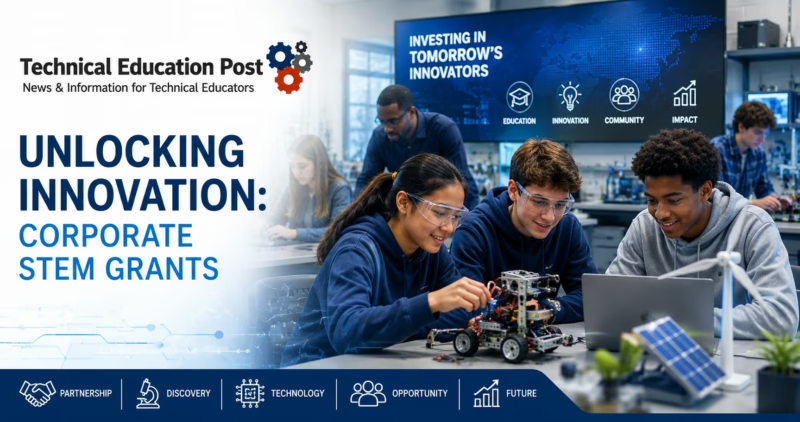
Corporate STEM grants can provide schools and nonprofit organizations with far more than a one-time equipment purchase. Depending on the company and program, support may include direct funding, classroom technology, teacher professional development, student competitions, engineering mentors, curriculum, scholarships, site visits or a multiyear workforce-development partnership.
Finding that support, however, is not as simple as searching for a national list of open applications.
Some corporate foundations accept proposals from individual teachers. Others limit eligibility to nonprofit organizations, schools in specific communities or programs located near company operations. Several well-known corporations do not accept unsolicited proposals at all. Their education investments are developed through invitation-only partnerships with districts, universities, national nonprofits and workforce organizations.
The corporate-giving environment is also uneven. Data released by Chief Executives for Corporate Purpose in July 2026 found that median community investment among a matched group of companies increased from $21.9 million in 2024 to $23.5 million in 2025, even though more than half of participating companies reduced their giving. That combination suggests that meaningful funding remains available, but it is becoming more concentrated and strategically allocated.
For schools, the opportunity is real—but success requires understanding how each company gives, why it invests in STEM and what kind of partnership it is prepared to support.
Funding status note: Program availability and application information in this guide were reviewed on August 2, 2026. Corporate grant cycles, geographic priorities and eligibility rules frequently change. Applicants should verify all requirements through the linked official program page before preparing a proposal.
Key Takeaways
- Corporate STEM support includes grants, competitions, equipment, professional development, mentoring and strategic partnerships.
- Toshiba America Foundation offers one of the most accessible national grant programs for individual K–12 STEM teachers.
- Samsung Solve for Tomorrow provides a major competition-based route for public school students in grades 6–12.
- Akamai, Motorola Solutions, Honda and Dow operate recurring or annual corporate funding cycles with specific eligibility restrictions.
- Bosch, Toyota, Lockheed Martin and Northrop Grumman illustrate the importance of regional and invitation-based relationship building.
- Companies increasingly connect STEM giving to workforce preparation, digital inclusion, advanced manufacturing, artificial intelligence, engineering and skilled technical careers.
- Schools should approach corporate funders with an educational plan, not merely an equipment request or sponsorship package.
Why Companies Invest in STEM Education
Corporate STEM philanthropy often serves several objectives at once.
Companies may seek to:
- Strengthen regional talent pipelines
- Introduce students to technical careers
- Improve access to computer science and engineering
- Support communities where employees live and work
- Increase participation among groups underrepresented in STEM
- Build relationships with schools, colleges and workforce organizations
- Engage employees as mentors or volunteers
- Support environmental sustainability
- Improve digital access
- Encourage student innovation and entrepreneurship
The workforce context helps explain the sustained interest. The U.S. Bureau of Labor Statistics projects employment in its defined group of STEM occupations to grow 8.1% from 2024 to 2034, compared with 2.7% for non-STEM occupations. The median annual wage reported for STEM occupations in 2024 was $103,580, compared with $48,000 for non-STEM occupations.
Those figures do not mean every student must pursue a traditional science or engineering degree. Corporate funders increasingly support a broader range of pathways involving:
- Automation
- Cybersecurity
- Advanced manufacturing
- Computer science
- Artificial intelligence
- Robotics
- Renewable energy
- Skilled trades
- Data analysis
- Automotive technology
- Engineering technology
- Environmental science
This broader view is especially relevant to TechEd Magazine readers working at the intersection of STEM education, technical education and workforce development.
Corporate STEM Grants Are Not One Category
The phrase “corporate STEM grant” is often used to describe several very different funding models.
Direct Classroom Grants
A teacher or school submits a conventional application requesting funding for a defined project.
Example: Toshiba America Foundation.
Student Competitions
Students develop and present solutions to real-world problems, with winning schools receiving technology, supplies or cash-equivalent awards.
Example: Samsung Solve for Tomorrow.
Annual Corporate Foundation Grants
A corporate foundation opens a competitive application cycle for eligible nonprofit organizations or institutions.
Examples: Akamai Foundation and Motorola Solutions Foundation.
Regional Community Grants
Funding is limited to cities, counties or states where the company has facilities, employees or major operations.
Examples: Honda, Dow and Bosch.
Strategic Partnerships
A company selects districts, universities or nonprofit organizations for a multiyear initiative built around shared workforce or community priorities.
Examples: Toyota Driving Possibilities and Verizon Innovative Learning.
Invitation-Only Grantmaking
A company identifies and invites prospective partners rather than accepting unsolicited applications.
Examples: Lockheed Martin and Northrop Grumman Foundation.
In-Kind and Programmatic Support
The company provides curriculum, software, training, equipment, scholarships, connectivity or employee expertise rather than a conventional cash award.
Examples: Amazon Future Engineer, Verizon Innovative Learning and Infosys Foundation USA.
Recommended Infographic Placement
Place the “Corporate STEM Funding Access Map” infographic here, immediately after this section and before the funding-opportunity table.
The infographic should show six paths:
Direct Grant → Competition → Annual Foundation Cycle → Regional Giving → Invitation-Only Partnership → In-Kind Support
Suggested caption:
Corporate STEM funding ranges from open teacher grants to invitation-only workforce partnerships. Understanding the access model is the first step toward selecting a realistic opportunity.
Corporate STEM Funding Opportunities
| Corporate program | Access model | Best fit | Status as of August 2, 2026 |
|---|---|---|---|
| Toshiba America Foundation | Direct teacher and school grants | K–12 teachers proposing hands-on, project-based science or mathematics learning | Active recurring schedule. K–5 teachers may request up to $1,000 by October 1. Grades 6–12 applications under $5,000 have recurring deadlines, including September 1 and December 1. Requests above $5,000 have a November 1 upcoming deadline. |
| Samsung Solve for Tomorrow | National student competition | Publicly funded schools serving grades 6–12 | Upcoming cycle. Samsung announced that applications for the 2026–27 competition would open in August 2026. Schools should monitor the official page for the updated opening date and rules. |
| Akamai Foundation Early Learner STEM Grants | Annual foundation application | Eligible nonprofit organizations delivering K–12 mathematics, science or technology programs, particularly for underserved learners | 2026 cycle closed. The portal typically opens annually from early February through late March. |
| Motorola Solutions Foundation | Annual nonprofit grant cycle | Organizations providing technology, engineering, coding, robotics, scholarships or workforce pathways | 2026 cycle closed. The foundation states that its 2027 cycle will begin in late November 2026. |
| Honda and Honda USA Foundation | Annual programmatic funding | Eligible schools, school districts and nonprofits serving communities connected to Honda operations | Current programmatic cycle closed. Information for the 2027–28 cycle is expected in fall 2026. |
| Dow Promise | Location-based community grant | Eligible nonprofits and government agencies in designated Dow communities | Currently closed. Awards may reach $10,000 and must align with Dow priorities that include STEM and skilled trades. |
| Bosch Community Fund | Regional and strategic grantmaking | Schools and nonprofits in Bosch communities developing project-based STEM or environmental education | Relationship and location dependent. Bosch does not present the program as a national open classroom-grant cycle. |
| Toyota Driving Possibilities | Multiyear strategic partnership | Districts and community partners located near Toyota operations | Strategic selection model. It is not presented as a national unsolicited school application. |
| Northrop Grumman Foundation | Invitation-only grantmaking | Established nonprofits advancing STEM access and technical workforce pathways | Invitation only. The foundation does not accept or acknowledge unsolicited requests. |
| Lockheed Martin Charitable Contributions | Invitation-only charitable investment | Established organizations supporting engineering, computational science, cyber and technical career pipelines | Invitation only. Lockheed Martin does not accept unsolicited grant proposals. |
The table demonstrates why applicants should not treat every corporate education initiative as an open grant. A school can prepare immediately for Toshiba, plan ahead for Akamai or Motorola, monitor Samsung, investigate regional eligibility for Honda or Dow, and develop a longer-term relationship strategy for Bosch, Toyota, Northrop Grumman or Lockheed Martin.
Toshiba America Foundation: The Most Accessible Direct Grant
The Toshiba America Foundation offers one of the clearest national corporate STEM funding paths for classroom educators.
Its funding is divided by grade level.
Grades K–5
Elementary educators may request up to $1,000 for project-based science or mathematics activities. The annual deadline is October 1.
Elementary schools developing a proposal can also use TechEd Magazine’s companion guide, Empowering Young Minds: STEM Grants for Elementary Schools, to structure the project around student need, instructional outcomes and sustainability.
Grades 6–12
Middle and high school educators may request:
- Up to $5,000 through recurring application rounds
- More than $5,000 through larger-award cycles
The official schedule lists upcoming 2026 deadlines including September 1 and December 1 for requests below $5,000 and November 1 for larger requests.
Toshiba emphasizes project-based learning and generally does not support ordinary operations, salaries, textbooks, standalone computer hardware, electronic whiteboards or unrelated audiovisual equipment.
That restriction is useful. It requires applicants to explain what students will investigate, build, test, analyze or design—not simply what the school wants to buy.
Strong Toshiba Project Example
Project: Monitoring Microclimates Around the School
Grade: Seventh grade
Request: $4,750
Activities: Students use environmental sensors to measure temperature, humidity, soil moisture and light across several campus locations.
Student work: Data analysis, mapping, hypothesis testing and recommendations for improving outdoor learning spaces.
Outcomes: Improved proficiency in data interpretation and environmental systems.
Sustainability: Reusable sensors are incorporated into the science curriculum for future classes.
The equipment supports the project, but the project remains the center of the request.
Samsung Solve for Tomorrow: Funding Through Student Innovation
Samsung Solve for Tomorrow operates more like an innovation competition than a conventional grant.
Public school students in grades 6–12 identify a community problem and develop a STEM-based solution with a teacher. Projects may address environmental sustainability, accessibility, public health, community resilience or other locally relevant needs.
During the 2025–26 competition, Samsung selected 500 schools for prize packages:
- 400 schools received $1,000 in prizes.
- 100 semifinalists advanced, with most receiving $10,000.
- Seven national finalists received $50,000.
- Three national winners received $100,000.
- Additional employee and community-choice awards were available.
Samsung reported awarding $2 million across the competition and announced that the 2026–27 application cycle would open in August 2026. As of August 2, the official competition site still highlighted the completed cycle, so educators should confirm the new dates before preparing an entry.
The most competitive concepts generally begin with a real community challenge rather than a desire to demonstrate a particular technology.
A student team might:
- Develop a low-cost environmental monitoring system
- Design assistive technology
- Use machine learning to analyze a local problem
- Improve emergency communication
- Build a water-conservation prototype
- Design a safer transportation system
- Create a device addressing food access or public health
Samsung also provides mentorship and professional-development opportunities, making the competition a combination of funding, technical support and student experience.
Akamai Foundation: Digital Inclusion and Early STEM Access
The Akamai Foundation supports digital inclusion and equitable STEM access, with an emphasis on learners from underserved and underrepresented communities.
Its Early Learner STEM grant portal typically opens from early February through late March each year. Applicants generally must be tax-exempt organizations under Section 501(c)(3) or 170(c), classified as public charities, or hold an equivalent status outside the United States.
Programs should demonstrate a direct effect on mathematics, science or technology education for elementary through high school students. Akamai gives priority to programs serving underserved populations.
Akamai reported awarding $2.63 million to 91 partners in 2025, including $2.14 million in STEM grants. Its later-stage Empower STEM grants support college, career-pathway and adult learners but are invitation only.
The 2026 Early Learner cycle is closed, but organizations can prepare for the next cycle by documenting:
- Number and demographics of learners served
- Access barriers
- Mathematics or technology outcomes
- Teacher capacity
- Community partnerships
- Evidence of digital inclusion
- Program sustainability
Individual teachers who are not directly eligible may be able to partner with a district foundation, library, museum, university or qualified education nonprofit.
Motorola Solutions Foundation: Engineering and Technology Pathways
The Motorola Solutions Foundation focuses its grantmaking on first responders and technology and engineering education.
Its education priorities include:
- Computer science
- Coding
- Robotics
- Hands-on engineering
- Scholarships
- Workforce placement
- Access for under-resourced groups
- Diversification of the technology workforce
The foundation’s 2026 application cycle is closed, with award announcements scheduled for August. The 2027 cycle is expected to begin in late November 2026. In 2025, Motorola Solutions Foundation reported 187 grants totaling $10 million across 22 countries.
This opportunity is more suitable for established organizations and partnerships than for a teacher seeking a small classroom award.
A strong applicant might be:
- A nonprofit operating regional robotics programs
- A university-school engineering partnership
- A workforce organization providing cybersecurity training
- A technical college expanding access for underrepresented students
- A youth organization offering structured coding pathways
- A scholarship and career-placement program
The scale and design should reflect measurable progression rather than one-time exposure.
Honda: Regional Funding for Schools and Nonprofits
Honda corporate and the Honda USA Foundation provide programmatic support to eligible nonprofit organizations, schools and school districts.
The current programmatic cycle is closed. Honda states that details for its 2027–28 funding cycle will be available in fall 2026, with decisions expected in spring 2027. Some funding pillars may vary from year to year, and some opportunities may be invitation only.
Eligible organizations include:
- U.S. 501(c)(3) nonprofits
- Organizations using an eligible nonprofit fiscal sponsor
- Schools and school districts listed by the National Center for Education Statistics
Programs generally must benefit communities in states where Honda has a significant operational presence, including:
- Alabama
- California
- Colorado
- Connecticut
- District of Columbia
- Florida
- Georgia
- Indiana
- Iowa
- Michigan
- New Jersey
- New York
- North Carolina
- Ohio
- Oregon
- South Carolina
- Texas
Honda requires prospective applicants to complete an eligibility questionnaire before accessing the application.
The geographic requirement is an important lesson: a nationally recognized corporate foundation may still operate as a regional funder.
Dow: Community-Based STEM and Skilled-Trades Funding
Dow’s grant and investment programs support community development, sustainability, STEM and skilled trades.
The Dow Promise is a competitive community program providing grants of up to $10,000. Eligible applicants include qualified nonprofit organizations and municipal or government agencies located in designated Dow communities.
The program is not currently accepting applications. Its location list includes communities in Alabama, Georgia, Illinois, Indiana, Kentucky, Louisiana, Michigan, Pennsylvania, Tennessee, Texas and West Virginia.
Dow’s broader STEM and skilled-trades strategy emphasizes:
- Expanding access to secondary STEM education
- Connecting students to postsecondary education and careers
- Diversifying STEM and skilled-trades pipelines
- Strengthening primary-level STEM teacher pipelines
- Supporting underrepresented learners
Dow also provides grants connected to participation in FIRST programs.
Schools near Dow operations should research both the foundation’s formal grant cycles and the company’s community-relations activity.
Bosch Community Fund: Local Presence Matters
The Bosch Community Fund supports STEM education, environmental sustainability and projects combining both areas.
Its priorities include:
- Project-based STEM curriculum
- Kindergarten through postsecondary education
- Environmental education
- Water-quality testing
- Energy-use projects
- Recycling and circularity
- Teacher support
- Hands-on learning
- Equity and inclusion
Bosch describes its fund as the corporate foundation for Bosch in North America and links its grants to communities where the company operates.
This is not presented as a broad national teacher application cycle. Schools should look for Bosch facilities, divisions and employees in their region and investigate how local grantmaking decisions are made.
TechEd Magazine previously covered a Bosch Community Fund investment in teacher and student STEM engagement, illustrating how a local corporate presence can develop into a significant education partnership.
Toyota Driving Possibilities: A Systems-Level Partnership Model
Toyota Driving Possibilities represents a different model of corporate STEM investment.
Rather than awarding small classroom grants nationally, Toyota works with districts, universities, nonprofit organizations and community leaders in communities connected to its operations.
Toyota announced a $110 million commitment to the initiative, which focuses on PreK–12 education, STEM learning, career awareness and barriers that may prevent students from succeeding.
The program is modeled on the West Dallas STEM School partnership involving Toyota, Southern Methodist University, Dallas Independent School District and the local community.
Its model recognizes that students’ academic opportunities may be affected by:
- Food insecurity
- Transportation
- Family engagement
- Literacy
- Career awareness
- Access to qualified teachers
- School-community coordination
Toyota’s approach is important because it moves beyond funding a collection of devices. It treats STEM access as a systems problem involving instruction, community support and workforce pathways.
A district cannot simply submit an unsolicited national Toyota application for this program. However, school leaders in Toyota communities can position themselves for partnership by building a documented regional strategy and involving community stakeholders.
Invitation-Only Funding Is Still Worth Understanding
Two major aerospace and defense companies demonstrate why “not accepting applications” does not mean “not investing.”
Northrop Grumman Foundation
The Northrop Grumman Foundation supports STEM education and workforce-development initiatives intended to increase access to technical learning and strengthen the talent pipeline.
However, all foundation grants are invitation only. It does not accept or acknowledge unsolicited requests.
Lockheed Martin
Lockheed Martin’s charitable giving includes a Future STEM Workforce focus involving:
- Middle and high school engineering
- Computational science
- Cybersecurity
- Postsecondary education
- Career networks
- Workforce pathways
Lockheed Martin also states clearly that it does not accept unsolicited grant requests.
These companies generally select established partners whose work closely aligns with strategic priorities. Schools may still become involved through:
- A national nonprofit partner
- A university-led program
- A regional workforce coalition
- A local employee-volunteer initiative
- A districtwide STEM partnership
- A technical competition
- A college pathway program
The correct strategy is not to disguise an unsolicited grant request as a partnership inquiry. It is to build a credible program that becomes visible within the company’s education and workforce network.
Corporate Support That Is Not a Cash Grant
Some of the most useful corporate STEM resources do not involve a check.
Amazon Future Engineer
Amazon Future Engineer provides free computer science curriculum and teacher training across grade levels, along with career tours, scholarships and internship opportunities.
The program states that its courses are standards-aligned, culturally responsive and designed so teachers do not need prior coding experience.
Verizon Innovative Learning
Verizon Innovative Learning works with selected Title I schools through district partnerships. Participating schools may receive devices, data plans, professional support and funding for a technology coach.
Verizon reported that the program had reached more than 8.5 million students and added 34 schools for the 2025–26 school year. The company also makes more than 500 STEM-infused lessons and professional-development resources available nationally through Verizon Innovative Learning HQ.
Infosys Foundation USA
Infosys Foundation USA supports computer science and maker education through nonprofit partnerships, teacher professional development and free digital learning.
Its Pathfinders Summer Institute provided foundation-funded professional-development scholarships during 2026 for public and charter school educators.
The foundation reports reaching 1.4 million K–12 educators and 27 million K–12 students since 2015. Its former Infy Makers Awards program, however, operated from 2015 through 2025 and should not be presented as a current application opportunity.
A school estimating the value of corporate support should therefore consider:
- Cash
- Donated technology
- Software access
- Data connectivity
- Curriculum
- Teacher training
- Technical assistance
- Employee mentoring
- Student experiences
- Scholarships
- Internships
- Public recognition
A $20,000 equipment donation accompanied by training and technical support may be more useful than a $20,000 unrestricted award that leaves the school to design and maintain the program alone.
Cash Grant vs. In-Kind Support vs. Strategic Partnership
| Funding form | Primary advantage | Main limitation | Best use |
| Cash grant | Flexibility to purchase defined project needs | May be restricted and time limited | Pilots, equipment, curriculum and evaluation |
| Technology donation | Reduces equipment acquisition costs | Products may create maintenance or compatibility issues | Lab expansion and device access |
| Professional development | Builds teacher capacity | May not cover equipment or implementation time | Curriculum adoption and instructional change |
| Employee mentoring | Connects students with industry knowledge | Scheduling and volunteer continuity can be difficult | Career exploration and project feedback |
| Student competition | Motivates applied problem-solving | Awards are competitive and may be product based | Community challenges and innovation projects |
| Strategic partnership | Can provide sustained, large-scale support | Often requires extensive planning and corporate selection | Districtwide pathways and regional workforce initiatives |
| Scholarship | Directly supports students | Does not necessarily improve the school’s program capacity | Postsecondary access and career pathways |
Recommended Comparison Graphic Placement
Place a graphic version of this table immediately after the table.
Graphic title: More Than a Check: Forms of Corporate STEM Support
How to Find Corporate STEM Funders in Your Community
National lists are useful, but local research may reveal stronger opportunities.
1. Map Major Employers
Identify companies within approximately 25 to 75 miles of the school or district, including:
- Manufacturers
- Utilities
- Hospitals and healthcare systems
- Technology firms
- Engineering companies
- Construction companies
- Automotive suppliers
- Financial institutions
- Logistics companies
- Telecommunications providers
- Agricultural businesses
- Aerospace and defense contractors
Do not limit the search to companies with “technology” in their names. Many industries depend on STEM and skilled technical workers.
2. Search the Correct Corporate Pages
Useful search terms include:
- Company name + foundation
- Company name + community giving
- Company name + charitable contributions
- Company name + STEM education
- Company name + workforce development
- Company name + corporate responsibility
- Company name + community impact
- Company name + grants
A company’s marketing website may not contain its grant information. Look for its foundation, sustainability, corporate-responsibility or community-impact pages.
3. Review the Company’s Giving History
Corporate and private foundation records can reveal:
- Typical award sizes
- Geographic concentration
- Prior recipients
- Education priorities
- Whether most awards are invitation only
- Whether the company funds schools directly
- Whether it prefers nonprofit intermediaries
The IRS Tax Exempt Organization Search provides access to tax-exempt status information and Form 990-series filings, including Form 990-PF returns filed by private foundations.
4. Look for Employees Already Connected to the School
Potential connections may include:
- Parents
- Alumni
- Advisory-board members
- Internship supervisors
- Volunteers
- Vendors
- Chamber of commerce members
- Economic-development partners
- Community-college faculty
An employee champion cannot override foundation rules, but that person may help the school understand the company’s priorities, introduce appropriate staff or strengthen a volunteer component.
5. Examine Regional Workforce Needs
The most credible corporate partnerships solve a shared problem.
Examples include:
- Too few students entering advanced manufacturing
- Limited access to cybersecurity education
- A shortage of qualified technicians
- Low participation by girls in engineering
- Inadequate rural broadband access
- Limited awareness of technical careers
- A lack of instructors trained in automation
- Weak transitions between high school and community college
TechEd Magazine’s coverage of the MiSTEM Network’s $1.75 million expansion shows how a $1 million contribution from General Motors was combined with an existing public program to expand place-, project- and problem-based STEM learning.
That model is stronger than a disconnected donation because the corporate investment extends an established regional strategy.
What Corporate STEM Funders Look For
Each company uses different criteria, but competitive projects often share several characteristics.
Strategic Alignment
The project fits the company’s stated focus areas, such as engineering, digital inclusion, environmental sustainability, AI, skilled trades or workforce development.
Geographic Relevance
The program serves communities where the company has employees, operations, customers or a significant economic presence.
Student Impact
The applicant identifies how many students will participate, what they will experience and what is expected to change.
Equity and Access
The program addresses documented barriers affecting rural communities, low-income students, students with disabilities, girls or groups historically underrepresented in STEM.
Hands-On Learning
Students design, build, program, investigate, test, revise or solve real problems.
Teacher Capacity
The project includes professional development, planning time, technical assistance or a train-the-trainer model.
Measurable Results
The organization can document participation, skill development, course enrollment, credential attainment, project completion or career awareness.
Employee Engagement
When appropriate, the project provides meaningful roles for company employees without making the educational program dependent on volunteer availability.
Sustainability
The school explains how curriculum, equipment, staffing and recurring costs will be handled after the initial investment.
Organizational Readiness
The applicant can manage funding, procurement, student safety, data privacy, reporting and partnership expectations.
How to Approach a Corporate Funder
Begin With the Educational Need
Do not open with:
We are seeking a company to sponsor our robotics laboratory.
Begin with:
Only 14% of students in our three middle schools currently complete an engineering design experience before entering high school. The district is developing a three-year plan to provide every student with standards-aligned engineering instruction and connect those experiences to regional manufacturing, automation and technology careers.
The second approach invites a strategic conversation.
Present More Than One Way to Participate
A corporate partner may not be ready to provide the entire request.
Create an engagement menu:
- $2,500 for consumable project materials
- $10,000 for reusable engineering equipment
- $25,000 for teacher training and curriculum
- Donated employee mentors
- Student facility tours
- Engineering project feedback
- Paid teacher externships
- Student job-shadowing
- Internship support
- Matching funds for a larger grant
- Participation on a program advisory committee
This allows the company to identify an appropriate entry point.
Explain Mutual Value Without Becoming Promotional
It is reasonable to explain how the partnership supports regional workforce awareness and employee engagement.
Avoid turning the proposal into an advertising package.
Corporate STEM philanthropy should primarily benefit students and educators. Naming rights, logos, exclusivity, product endorsements and access to student information may require district policy, legal, procurement and privacy review.
Use a Clear Proposal
TechEd Magazine’s Crafting Winning STEM Grant Proposals provides a full framework for connecting the need, objectives, activities, outcomes, evaluation and budget.
A concise corporate request should still include:
- The need
- Students served
- Project design
- Timeline
- Partner roles
- Expected outcomes
- Budget
- Recognition plan
- Sustainability
- Contact information
Sample Corporate STEM Partnership Concept
Project Title
Regional Automation and Robotics Pathway
Need
Three high schools serve a region with significant demand for automation technicians, industrial maintenance workers and engineering technologists. Current students have limited access to programmable automation, robotics and industry-recognized technical experiences.
Proposed Activities
- Train six instructors in robotics and industrial controls
- Establish shared instructional equipment
- Embed four applied automation projects into existing courses
- Provide company-led career presentations
- Arrange two facility visits per year
- Create paid summer teacher externships
- Build dual-enrollment connections with the local community college
- Track student participation, credential completion and postsecondary transitions
Corporate Request
- $65,000 in equipment and teacher-training support
- Employee participation on the advisory committee
- Two annual facility tours
- Technical review of student capstone projects
- Consideration of internship opportunities
School and Partner Contributions
- Instructional space
- Teacher salaries
- Curriculum-development time
- Equipment maintenance
- Transportation
- Data collection
- Community-college articulation
Outcomes
- 300 students complete an automation project annually
- Six teachers complete technical training
- 75 students earn an industry-recognized credential
- Advanced technical course enrollment increases by 25%
- Employer participation expands from two to six companies
This concept presents the company as one partner within a durable education system—not the sole source of the program’s survival.
Common Corporate Grant Mistakes
Applying Outside the Geographic Footprint
Many corporate programs prioritize communities near company operations. Confirm location eligibility before investing time in a proposal.
Treating the Company Like a Federal Agency
Corporate applications may be shorter and relationship-driven, but they still require evidence, outcomes and budget credibility.
Sending a Generic Sponsorship Letter
A request written for every company is unlikely to align closely with any company.
Asking Only for Equipment
Companies may be more interested in teacher capacity, career pathways, equitable access and measurable student outcomes than in a product list.
Assuming Every Corporate Foundation Accepts Applications
Lockheed Martin and Northrop Grumman explicitly state that their main charitable grants are invitation only.
Promising Excessive Publicity
Corporate recognition should be appropriate and compliant with school policies. It should not replace educational value.
Ignoring In-Kind Costs
Donated equipment may require software, installation, connectivity, storage, maintenance, training or replacement parts.
Building the Program Around One Employee
An employee advocate is helpful, but the partnership should survive a job change or relocation.
Failing to Document Results
Future corporate support depends on credible evidence that the original investment was used responsibly.
Neglecting the Relationship After the Award
Submit reports on time, share student work appropriately, communicate problems early and invite partners to meaningful program milestones.
Corporate STEM Grant Readiness Checklist
Fit
- The project aligns with the company’s published priorities.
- The school is within the eligible geography.
- The applicant type is eligible.
- The request fits the program’s award range.
- The project does not depend on prohibited expenses.
Educational Design
- The need is supported by local evidence.
- Student activities are clearly defined.
- Objectives are measurable.
- Teacher preparation is included.
- Equity and accessibility are addressed.
- Equipment supports instruction rather than replacing it.
Partnership
- Corporate and school roles are clearly separated.
- Employee involvement is realistic.
- Recognition complies with district policy.
- No student information will be shared without authorization.
- Procurement and product-exclusivity issues have been reviewed.
- The partnership can continue if a company contact changes roles.
Budget
- All calculations are documented.
- Installation and training are included.
- Consumables and replacement parts are addressed.
- Donated goods are valued appropriately.
- Recurring costs are identified.
- The school has a maintenance plan.
Evaluation
- Participation will be tracked.
- Student outcomes will be measured.
- Teacher implementation will be documented.
- Demographic access will be reviewed.
- Reporting responsibilities are assigned.
- Results can inform the next phase of the program.
Questions to Ask Your Program
Before approaching a corporate STEM funder, school and district leaders should ask:
- What documented student or workforce need are we addressing?
- Which companies have a genuine connection to this need?
- Does the company operate in our community?
- Is the opportunity open, regional, competitive or invitation only?
- What can we accomplish without corporate funding?
- What form of support would be most valuable?
- Are teachers prepared to implement the project?
- What costs will continue after the award?
- How will we protect educational independence?
- What evidence will demonstrate that the partnership worked?
Future Outlook
Corporate STEM funding is likely to become more closely connected to specific workforce and technology priorities.
Areas to watch include:
- Artificial intelligence literacy
- Cybersecurity
- Semiconductor manufacturing
- Robotics and automation
- Energy technology
- Advanced manufacturing
- Digital inclusion
- Climate and environmental technology
- Skilled technical careers
- Teacher externships
- Work-based learning
- Industry-recognized credentials
- Regional talent-pipeline partnerships
The trend is likely to favor programs that integrate several components—curriculum, teacher development, student projects, mentoring and career pathways—rather than one-time equipment donations.
Companies will also expect stronger measurement. Participation totals alone may not be enough. Schools should be prepared to track:
- Course access
- Skill development
- Student persistence
- Credentials
- Postsecondary transitions
- Work-based learning
- Teacher implementation
- Participation among underserved groups
Corporate giving will remain uneven, but schools with strong local data, realistic program designs and durable partnerships will be better positioned to secure support.
Frequently Asked Questions
What is a corporate STEM grant?
A corporate STEM grant is financial or in-kind support provided by a company or corporate foundation for science, technology, engineering, mathematics, skilled-trades or technical-workforce education.
Can individual teachers apply for corporate STEM grants?
Some programs accept teacher applications. Toshiba America Foundation is a prominent example. Other corporate foundations limit applications to schools, districts, nonprofit organizations or selected partners.
Which corporate STEM grant is currently easiest for a classroom teacher to pursue?
As of August 2, 2026, Toshiba America Foundation provides one of the clearest recurring national application paths for K–12 STEM educators.
Is Samsung Solve for Tomorrow a grant?
It is more accurately described as a student STEM competition. Schools advance through multiple rounds and receive technology and classroom-resource prize packages.
Do companies fund private schools?
Some do, but eligibility varies. Toshiba supports public and nonprofit private schools. Samsung requires participating schools to be at least 50% publicly funded. Other companies exclude non-public schools.
Can a school apply to an invitation-only foundation?
An invitation-only foundation does not accept unsolicited applications. Schools may still participate through an established nonprofit, university, district or regional partnership already connected to the company.
Are corporate grants only available near company headquarters?
No. Some are national or global. However, many corporate giving programs prioritize communities near manufacturing plants, offices, research facilities or large employee populations.
Can corporate funding pay for a STEM laboratory?
Potentially, but many funders prefer a complete educational plan that includes curriculum, teacher development, student access, evaluation, equipment maintenance and sustainability.
What is in-kind corporate support?
In-kind support includes donated technology, software, professional services, connectivity, training, curriculum, employee mentoring or other non-cash resources.
How should a school recognize a corporate donor?
Recognition should follow district policies and the funding agreement. Schools should review logo use, naming, student privacy, procurement, exclusivity and product-endorsement concerns before making commitments.
TechEd Magazine Perspective
Corporate STEM funding is most effective when it strengthens educational capacity rather than creating dependency.
A donated robot, computer or sensor can support excellent instruction, but equipment alone does not build a pathway. Lasting impact requires trained teachers, aligned curriculum, student access, technical support, realistic maintenance and evidence that learning improved.
Schools should also avoid approaching companies as little more than sponsors. Corporate funders increasingly think in terms of workforce systems, community impact and measurable results. The strongest school-industry partnerships therefore begin with a shared regional challenge and define what each institution can contribute.
The goal should not be to persuade a company to purchase everything a program needs. It should be to create an educational strategy strong enough that the school, district, college, nonprofit and industry partners each have a clear reason to participate.
Corporate funding may unlock innovation. Institutional planning determines whether that innovation lasts.
Recommended Internal Links
- Empowering STEM Education Grants — Overview of STEM funding and early-learner opportunities
- Crafting Winning STEM Grant Proposals — Step-by-step grant proposal development
- STEM Grants for Elementary Schools — K–5 funding opportunities and application guidance
- Funding and Grants — Continuing TechEd Magazine funding coverage
- Technical Education Resources — Grants, events, teaching materials and education resources
- Where STEM Educators Shop — Classroom equipment and supply planning
- MiSTEM Launches $1.75 Million Expansion — Public-private STEM funding example
- Perimeter STEM Programs Receive Bosch Grant — Corporate foundation partnership example
- STEM Classroom to Factory — School-industry collaboration model
- Technical and STEM Education 2026 — National education and workforce context
- Volvo Invests in STEM Education — Local industry investment in a school STEM laboratory
- Alcoa Foundation Supports Pittsburgh — Regional corporate STEM investment
Official Corporate Funding and Resource Links
- Toshiba America Foundation
- Samsung Solve for Tomorrow
- Akamai Foundation
- Motorola Solutions Foundation
- Honda Funding Opportunities
- Dow Grants and Investments
- Dow Promise
- Bosch Community Fund
- Toyota Driving Possibilities
- Northrop Grumman Foundation
- Lockheed Martin Charitable Contributions
- Amazon Future Engineer
- Verizon Innovative Learning
- Infosys Foundation USA
- IRS Tax Exempt Organization Search