
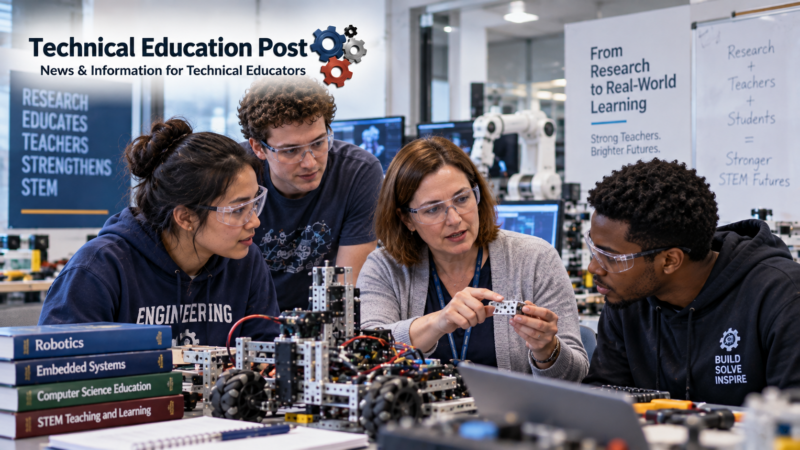
Universities and eligible higher education institutions have until October 14, 2026, to submit proposals for the National Science Foundation’s Research Experiences for Teachers (RET) in Engineering and Computer Science program, which supports research-based professional development for K–12 teachers and community college faculty.
The program, administered through NSF’s Directorates for Engineering (ENG) and Computer and Information Science and Engineering (CISE), provides opportunities for educators to participate directly in scientific and engineering research alongside university faculty, students, and industry partners.
NSF anticipates approximately $5.8 million in annual funding across RET Sites and Supplements, subject to funding availability. Approximately nine RET Site awards are expected annually, with individual Site projects eligible to request up to $600,000 over three years.
Unlike conventional professional development programs built primarily around workshops and classroom instruction, RET emphasizes authentic research experiences that educators can translate into teaching activities, curriculum improvements, and sustained partnerships.
For engineering departments, computer science faculty, STEM education leaders, and community college administrators, the program offers an opportunity to connect current scientific research with the preparation of future technical professionals.
The approaching deadline applies specifically to RET Site proposals submitted by eligible institutions, not to individual teachers seeking a summer research placement.
Key Takeaways
-
Deadline: October 14, 2026, at 5 p.m. in the submitting organization’s local time.
-
Funding: Approximately $5.8 million in anticipated annual program funding, subject to availability.
-
Individual Site awards: Up to $600,000 over a maximum of three years.
-
Expected awards: Approximately nine RET Site awards annually.
-
Participants: In-service and pre-service K–12 STEM teachers and full-time community college faculty.
-
Educational objective: Translate authentic engineering and computer science research experiences into classroom instruction and ongoing institutional collaboration.
NSF Research Experiences for Teachers: Funding at a Glance
Oct. 14
2026 proposal deadline
$600K
Maximum Site award request
$5.8M
Anticipated annual program funding
9
Expected annual Site awards
Source: NSF solicitation 24-503. Figures are anticipated or maximum amounts, not guaranteed awards.
What Happened: NSF’s Annual RET Site Competition Approaches Its Deadline
The current funding opportunity, identified as NSF 24-503, establishes a recurring annual competition for RET Site proposals.
The 2026 deadline is October 14, with subsequent annual deadlines scheduled for the second Wednesday in October, unless NSF changes the solicitation.
RET Sites organize groups of educators around a coherent engineering or computer science research theme.
Participants work with researchers in authentic research environments and then apply their experiences to educational activities.
Projects are intended to create lasting collaborations among universities, schools, community colleges, and potentially industry partners.
RET also supports supplemental funding connected to eligible NSF research awards, but these supplements have different application procedures. They should not be confused with the October 14 RET Site deadline.
NSF’s current solicitation identifies $15,000 as the maximum RET supplement per teacher or community college faculty participant for a one-year period, subject to applicable requirements.
How RET Site Funding Works
Under the solicitation, an RET Site project may request up to $600,000 across three years, with a maximum of $200,000 annually.
Site proposals are designed around a focused research area and typically involve cohorts of eight to ten participating educators.
The solicitation limits the budgeted cost per participant to $15,000 annually, including the participant stipend and eligible educational materials. Up to $2,000 of that amount may support materials, equipment, software, and supplies for developing classroom instruction and experiments.
Projects must also include appropriate participant support, mentoring, program evaluation, and the activities needed to connect research experiences with classroom implementation.
The solicitation anticipates evaluation expenses and requires attendance at annual principal investigator meetings.
For institutions preparing applications, understanding the allowable budget structure is essential. A proposal requesting the maximum award must still comply with annual and participant-level limits.
RET Funding Structure
| Funding component | Maximum or expected amount |
|---|---|
| RET Site project | $600,000 total |
| Site duration | Up to 3 years |
| Annual Site budget | $200,000 |
| Participant cost | $15,000 per year |
| Classroom materials within participant cost | Up to $2,000 |
| RET supplement | $15,000 per participant for 1 year |
| Anticipated annual program funding | Approximately $5.8 million |
Amounts reflect NSF 24-503 requirements. Proposers must review the full solicitation for budget restrictions and applicable NSF policies.
Why Research-Based Teacher Professional Development Matters
Engineering and computer science are continuously changing disciplines.
New methods in artificial intelligence, robotics, cybersecurity, advanced manufacturing, materials engineering, and computational research create challenges for educators responsible for preparing students.
Traditional professional development can introduce teachers to emerging concepts, but it may provide limited opportunities to understand how those concepts are applied in actual research.
RET addresses that gap through direct participation.
1. Teachers Experience the Research Process
Scientific research differs from laboratory exercises designed around known outcomes.
Researchers must define problems, select methods, evaluate evidence, address unexpected results, and revise their approaches.
Teachers who participate in authentic research can develop a deeper understanding of those processes.
That experience may help them design educational activities in which students formulate questions, analyze data, and evaluate solutions rather than simply reproduce predetermined results.
2. University Research Becomes Classroom Content
The program specifically requires participants to translate research experiences into classroom activities or curricula.
An educator working with an engineering research group, for example, might develop instruction involving sensors, measurement uncertainty, materials testing, or computational modeling.
A computer science research experience could inform classroom activities related to algorithms, cybersecurity, data processing, or software development.
Such applications must be adapted to appropriate educational levels and student needs.
The value lies in connecting contemporary research practices with meaningful learning experiences.
3. Institutions Establish Longer-Term Partnerships
RET emphasizes collaboration extending beyond a temporary research placement.
University faculty gain opportunities to understand K–12 and community college educational contexts, while participating educators establish relationships with researchers and technical specialists.
These collaborations can support curriculum development, classroom visits, mentoring, and additional educational projects.
For institutions seeking stronger connections between STEM instruction and research, these relationships may be as important as the initial summer experience.
Who Is Eligible to Apply?
NSF distinguishes between institutions submitting RET Site proposals and educators participating in funded research experiences.
For RET Sites, eligible applicants include accredited U.S. institutions of higher education, including two-year and four-year colleges, acting on behalf of qualifying faculty.
Principal investigator requirements are specific. The solicitation generally requires a full-time, tenured or tenure-track faculty member in engineering, engineering technology, computer science, or a closely related department, whose primary responsibilities include research and teaching.
Institutions should review the full eligibility criteria before proceeding.
Participating teachers and community college faculty do not independently submit RET Site proposals under this deadline.
Instead, educators generally seek participation through funded RET Site programs that recruit teacher cohorts.
Important distinction: A community college may be an eligible submitting institution, but that does not mean every community college administrator or faculty member is eligible to serve as principal investigator.
Broader Industry Trends: Bringing Contemporary Research Into Technical Education
The RET program reflects a broader effort to strengthen relationships between scientific research and technical education.
Research universities generate knowledge and develop new technologies, while K–12 schools and community colleges play essential roles in developing future engineers, computer scientists, and technical professionals.
When these institutions operate independently, educational programs may struggle to incorporate emerging research methods and technologies.
Research partnerships can help bridge that distance.
The model is especially relevant as interdisciplinary technical fields become more prominent.
Research involving robotics, for example, may combine mechanical engineering, electronics, programming, and data analysis.
Cybersecurity research may involve mathematics, computer networks, software engineering, and human behavior.
Educators who participate in such projects can gain practical insight into how disciplines interact in real research environments.
However, translating these experiences into classrooms requires thoughtful instructional planning.
A sophisticated university research project cannot simply be reproduced in a high school classroom without considering available equipment, student preparation, safety, and instructional time.
Successful programs must identify the underlying concepts and practices that students can explore meaningfully.
NSF’s Perspective: Research and Education Should Reinforce One Another
NSF emphasizes reciprocal collaboration in its RET program.
Participating educators gain scientific and technical knowledge, while university researchers develop stronger connections with educational institutions serving future STEM students.
The current solicitation also encourages partnerships involving schools with substantial educational needs and institutions serving populations historically underrepresented in engineering and computer science.
These objectives extend the program beyond individual teacher enrichment.
The intent is to create research experiences that support broader educational improvement and develop sustained institutional relationships.
NSF also encourages the involvement of graduate students in supporting classroom implementation during the academic year.
For education leaders, this is an important design feature.
Professional development becomes more valuable when teachers continue receiving technical support after returning to their classrooms.
Practical Takeaways for Universities and STEM Program Leaders
Institutions considering RET proposals should approach them as research-and-education partnerships rather than conventional teacher training projects.
Select a coherent research theme. Projects should connect participating educators through a meaningful engineering or computer science research focus.
Establish school and college partnerships early. Strong collaborations require coordination with educational institutions that can identify teachers, support participation, and encourage classroom implementation.
Plan authentic research experiences. Participants should engage with meaningful technical questions and research processes rather than simply observe demonstrations.
Provide mentoring and instructional support. Faculty researchers, graduate students, and other mentors should have clear responsibilities.
Develop classroom translation plans. Proposals should explain how teachers will adapt their experiences into lessons, projects, or curricula.
Measure outcomes. Evaluation should examine changes in educators’ disciplinary knowledge, instructional practice, and the continuing effects of research partnerships.
Questions to Ask Your Program
-
Do we have engineering or computer science research projects suitable for teacher participation?
-
Can we establish a coherent research theme for a cohort of educators?
-
Are our university, community college, and school district partnerships strong enough to support implementation?
-
Which faculty members meet NSF’s principal investigator requirements?
-
How will participants translate research experiences into classroom instruction?
-
Can we provide ongoing mentoring after the summer research experience?
-
Have we established meaningful measures of teacher development and classroom impact?
-
Are our grant preparation, budgeting, and institutional approvals ready before October 14?
What Applicants Should Do Before the Deadline
Organizations with proposals already in development should complete a final review of the NSF solicitation and institutional submission requirements.
RET Site Proposal Checklist
Institutions that have not already begun preparing a proposal may find the remaining preparation period insufficient for a competitive submission.
In those cases, establishing partnerships and developing a project for a future competition may be more productive than submitting an incomplete application.
Applicants should also verify requirements for institutional research security, proposal formatting, and other applicable NSF policies.
Future Outlook: Beyond the October 2026 Deadline
The RET program establishes a recurring opportunity for institutions to develop research-based professional development programs.
NSF currently identifies the second Wednesday in October as the annual RET Site proposal deadline.
For institutions awarded funding, subsequent priorities will include teacher recruitment, research project preparation, mentoring, and program evaluation.
The most useful performance measures will extend beyond participant satisfaction.
Longer-term questions include whether teachers adopt new instructional strategies, whether classroom activities reflect authentic engineering and computer science practices, and whether institutional partnerships continue after grant funding ends.
NSF-funded research partnerships may also create opportunities for curriculum development, student mentoring, and further collaboration.
These outcomes will help determine whether research-based professional development produces sustained educational value.
Frequently Asked Questions
1. What is the NSF Research Experiences for Teachers program?
The RET program supports authentic engineering and computer science research experiences for K–12 educators and community college faculty, with an emphasis on translating research knowledge into classroom instruction.
2. When is the 2026 application deadline?
October 14, 2026, at 5 p.m. in the submitting organization’s local time.
3. How much funding can an RET Site receive?
An individual RET Site may request up to $600,000 over a maximum of three years, subject to program requirements.
4. How many RET Site awards does NSF expect to make?
Approximately nine annually, subject to available funding.
5. Can an individual K–12 teacher apply for this grant?
Not directly under the RET Site proposal competition. Individual teachers generally apply to participate in programs operated by funded RET Sites.
6. Can community colleges submit proposals?
Yes. Accredited U.S. two-year institutions are among the eligible applicants, provided all solicitation requirements are satisfied.
7. What types of research qualify?
Projects must involve relevant engineering or computer science research and provide authentic research experiences for participating educators.
8. Where can institutions submit applications?
Applicants should follow the NSF 24-503 solicitation and use the authorized federal proposal submission systems and institutional procedures specified by NSF.
TechEd Magazine Perspective
The NSF Research Experiences for Teachers program highlights an important opportunity to improve STEM education: connecting classroom instruction more directly with the process of scientific discovery.
Engineering and computer science cannot be taught effectively through static content alone.
Students benefit from understanding how technical professionals investigate problems, evaluate evidence, develop solutions, and respond to unexpected results.
Teachers who participate in authentic research can bring valuable insights into those processes back to their classrooms.
The program’s longer-term significance will depend on how effectively universities, community colleges, and school districts sustain those relationships.
A successful research experience should not end when participants leave the laboratory.
It should influence classroom instruction, strengthen professional networks, and create meaningful opportunities for students to engage with contemporary engineering and computer science.
The most valuable outcome of research-based teacher development is not simply a more knowledgeable educator, but a stronger connection between scientific discovery and student learning.