Federal STEM Grants: Fueling Innovation and Education
Information and funding-status references checked August 2, 2026. Applicants should confirm every deadline, eligibility rule, award amount, and program status in the current federal Notice of Funding Opportunity before applying.
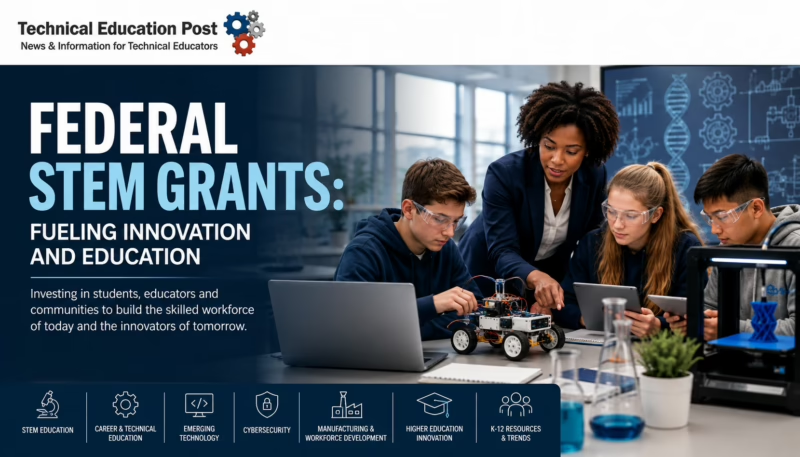
Federal STEM grants are entering a more targeted and strategically demanding phase. Federal agencies are still investing in science, technology, engineering, and mathematics education, but they are increasingly tying those investments to specific national priorities: artificial intelligence, skilled technical workforce preparation, research-backed teaching, career pathways, teacher capacity, environmental learning, and institutional innovation.
That creates substantial opportunities for schools, colleges, universities, museums, nonprofits, and workforce partnerships. It also creates a more complicated funding environment. There is no single federal STEM grant application. Some programs are designed for institutions of higher education, while others are reserved for states, community colleges, Minority Serving Institutions, informal education organizations, public schools, nonprofits, or applicants in defined geographic regions. Still others distribute funding through state formulas rather than national competitions.
The practical challenge is therefore not simply finding money. It is matching the right educational problem, eligible lead applicant, partnership structure, and evidence plan to the right federal program.
That work matters. The U.S. Bureau of Labor Statistics projects employment in STEM occupations to grow 8.1% from 2024 to 2034, compared with 2.7% for non-STEM occupations. STEM occupations also had a 2024 median annual wage of $103,580, more than twice the $48,000 median for non-STEM occupations. At the same time, the National Science Board’s 2026 Science and Engineering Indicators point to continuing challenges in elementary and secondary mathematics and science performance.
Key Takeaways
- Federal STEM funding is spread across agencies with different missions, eligibility rules, and expectations.
- NSF is a major source for STEM education research, technician education, and student-support programs.
- NASA, NOAA, EPA, and USDA fund mission-specific STEM learning in aerospace, environmental science, agriculture, and informal education.
- Perkins V remains one of the most important federal funding channels for secondary and postsecondary CTE, although funding reaches local programs through state systems.
- Strong proposals begin with measurable student and workforce outcomes, not equipment wish lists.
- Registration, partnership development, evaluation, and sustainability planning must begin before a funding notice is released.
Why This Matters
Federal grants can do more than purchase equipment. When strategically designed, they can change who has access to STEM, improve how technical subjects are taught, connect education with regional industries, and build programs that survive after the original award ends.
What Counts as a Federal STEM Grant?
“Federal STEM grant” is an umbrella term rather than a single legal funding category. It includes competitive grants, cooperative agreements, formula funds, research awards, scholarships, and workforce-development investments that support some combination of:
- STEM teaching and learning
- Curriculum development
- Teacher preparation and professional learning
- Laboratory equipment and facilities
- Educational research
- Student scholarships and support
- Informal and out-of-school learning
- Career exploration
- Technician education
- Work-based learning
- Environmental and agricultural education
- AI, computing, cybersecurity, and emerging technology
- Postsecondary completion and workforce entry
These awards are administered by agencies whose missions extend well beyond education. NSF concentrates heavily on research and development. NASA connects learning with aerospace missions. NOAA supports environmental and watershed education. USDA funds agricultural and food-science education. EPA supports environmental literacy. The Departments of Education and Labor connect educational investment with teaching quality, career pathways, and workforce readiness.
The Federal STEM Funding Landscape in 2026
The following table is a planning snapshot as of August 2, 2026. Deadlines, appropriations, and program status can change, so applicants should always confirm details in the current Notice of Funding Opportunity.
| Program | Best Fit | Typical Lead Applicant | Current Planning Status |
|---|---|---|---|
| NSF STEM K-12 | Research and development that advances STEM teaching and learning in formal or informal settings | Eligible institutions, nonprofits, businesses, state or local governments, and Tribal Nations, subject to the solicitation | Proposals accepted at any time; most anticipated awards range from $25,000 to $750,000 |
| NSF Advanced Technological Education | Technician education, community-college programs, curriculum, professional learning, and industry partnerships | Two-year institution or eligible academic partnership, depending on proposal type | Next annual deadline is October 1, 2026 |
| NSF S-STEM | Scholarships and evidence-based student supports for low-income STEM students | Institution of higher education | Next deadline is March 2, 2027; Track 1 and Track 2 awards may request up to $2 million |
| NASA TEAM II | NASA-connected informal STEM education through museums, libraries, and youth-serving organizations | Eligible nonprofit informal education institution | NASA forecasts future opportunities; award levels range from community projects to national partnerships |
| NASA MUREP | Research capacity, technology development, and student engagement at Minority Serving Institutions | Eligible Minority Serving Institution | Current opportunities and forecasts are posted through NASA STEM Engagement |
| NOAA B-WET | Place-based watershed science, teacher development, and K-12 environmental learning | Schools, school systems, colleges, nonprofits, government agencies, or tribes, subject to regional rules | Regional opportunities vary; applicants must verify geographic eligibility and current availability |
| EPA Environmental Education Grants | Community-based environmental education and stewardship | LEAs, nonprofits, colleges, government agencies, and eligible tribal organizations | The 2026 competition closed March 3 |
| USDA NIFA SPECA | K-14 agricultural education, curriculum, faculty capacity, and career preparation | Public secondary schools, community colleges, higher education institutions, or nonprofits | The FY 2026 competition closed July 27; awards ranged from $10,000 to $150,000 |
| Career Pathways Exploration | Statewide K-12 career exploration and workforce-readiness systems | Governor or designated state-level agency or consortium | FY 2026 competition closed June 9; $44 million was available |
| Perkins V Basic State Grants | CTE programs, equipment, professional learning, and program improvement | States receive federal funds and distribute them to eligible local recipients | Formula funding operates through each state rather than a single national competition |
NSF Is Reshaping the K-12 STEM Research Landscape
One of the most consequential recent changes is NSF’s introduction of the broader STEM K-12 program. The solicitation accepts proposals at any time and is intended to support fundamental, applied, and translational research in formal and informal learning environments.
The new structure consolidates work that might previously have been submitted under programs such as Advancing Informal STEM Learning, Computer Science for All, Discovery Research PreK-12, and Translation and Diffusion. NSF anticipates approximately $30 million for the program, with most awards expected to range from $25,000 to $750,000 and last one to three years, subject to funding availability and proposal quality.
This is an important opportunity, but districts should understand what the program is and what it is not.
STEM K-12 is not primarily an equipment program. Its focus is research, development, knowledge generation, and translation into educational practice. An application proposing to purchase robotics kits or build a makerspace without a serious research or development rationale would be poorly aligned.
Schools and districts can lead or participate when eligible under the solicitation, and they may also partner with universities, museums, nonprofits, government agencies, or other organizations that bring complementary research, evaluation, technical, or implementation capacity.
Administrator Takeaway
Do not wait for a university or outside organization to arrive with a prewritten project. Districts should identify the instructional problems they want solved and seek partners whose capabilities align with those needs.
NSF ATE Connects Education With the Skilled Technical Workforce
For community colleges and secondary-postsecondary partnerships, NSF’s Advanced Technological Education program remains one of the most important federal STEM opportunities.
ATE focuses on the education of technicians in high-technology fields. It supports curriculum development, faculty and teacher professional development, career pathways, and applied research related to technician education. The program emphasizes two-year institutions while encouraging collaboration with grades 7-12 schools, universities, employers, economic-development organizations, Manufacturing USA institutes, and NIST Manufacturing Extension Partnership centers.
This makes ATE especially relevant to programs in:
- Advanced manufacturing
- Automation and robotics
- Cybersecurity
- Biotechnology
- Energy technology
- Semiconductor technology
- Engineering technology
- Environmental technology
- Precision measurement
- Industrial maintenance
- Information technology
The strongest ATE proposals do not merely state that employers need workers. They document the specific technician roles involved, the competencies employers require, the deficiencies in current programs, and the institutional changes necessary to improve completion and employment outcomes.
A credible partnership should also show how industry will contribute. That could include curriculum validation, equipment guidance, work-based learning, faculty externships, mentors, technical demonstrations, hiring data, or participation in an active advisory committee.
S-STEM Addresses More Than Tuition
The NSF Scholarships in Science, Technology, Engineering, and Mathematics program helps institutions support academically talented, low-income students enrolled in eligible STEM degree programs.
Scholarship funding is central, but NSF explicitly recognizes that financial assistance alone may not be enough to improve retention and graduation. S-STEM projects are expected to combine scholarships with evidence-based academic and co-curricular supports, such as mentoring, advising, transfer assistance, undergraduate research, career development, and community building.
For community colleges, this creates opportunities to address transfer loss and completion barriers. For universities, it creates an opening to build stronger systems around recruitment, persistence, career preparation, and graduation.
It also illustrates a broader lesson about federal STEM funding: reviewers increasingly expect institutions to address the entire student experience rather than funding a single isolated intervention.
NASA Funding Extends STEM Beyond the Classroom
NASA’s STEM funding serves several different purposes, including institutional research capacity, aerospace education, student engagement, and informal learning.
NASA TEAM II supports NASA-inspired projects led by eligible museums, planetariums, libraries, and youth-serving organizations. Its program structure includes Community Anchor Awards of up to $50,000, STEM Innovator Awards of up to $400,000, and National Connector Awards of up to $900,000, depending on reach, duration, and partnership requirements.
A January 2026 NASA award announcement reported more than $5 million in awards to 29 institutions. NASA Associate Administrator Elaine Ho described TEAM II’s value in practical terms: “NASA’s TEAM II awards enable us to reach students where they are.”
NASA’s Minority University Research and Education Project serves a different role. NASA’s current STEM funding and forecasting page lists MUREP opportunities intended to strengthen research, academic, and technology capacity at eligible Minority Serving Institutions while connecting faculty and students with NASA priorities.
Schools that are not eligible to lead a particular NASA application may still become important delivery partners. A library, science center, or university may need districts to provide student access, educators, curriculum alignment, local facilities, and evidence of community need.
NOAA and EPA Support Environmental STEM Learning
Environmental education remains a meaningful federal STEM funding category, but applicants need to monitor program changes carefully.
NOAA’s Bay Watershed Education and Training program supports locally relevant, experiential K-12 education centered on watersheds, coastal environments, and related ecological systems. In fiscal year 2025, NOAA reported funding 120 institutions, professional development for 4,300 educators, and inquiry-based learning for 53,200 students.
B-WET’s regional structure matters. Eligibility, priorities, and application timing can differ across regions. A strong concept may be ineligible if it does not serve the required geography or address the region’s current priorities.
NOAA’s broader Environmental Literacy Program grant competitions ended in 2025, while B-WET remains active as a distinct funding pathway.
The EPA Environmental Education Grants Program provides another route for hands-on environmental STEM projects. The 2026 competition offered up to 16 awards and closed March 3, 2026. Eligible applicants included local educational agencies, colleges, universities, nonprofits, government agencies, and certain tribal organizations.
EPA’s current program guidance also demonstrates why applicants must read the complete funding announcement. The 2026 competition required a 25% cost share and included specific subaward requirements, details that could easily be missed in a general grant summary.
USDA Grants Connect STEM With Agriculture and Food Systems
USDA’s National Institute of Food and Agriculture supports education in agriculture, food science, natural resources, and related disciplines.
The Secondary Education, Two-Year Postsecondary Education, and Agriculture in the K-12 Classroom Challenge Grants Program, known as SPECA, supports K-14 agricultural education. Its goals include improving curriculum, increasing teacher and faculty capacity, expanding interest in food and agricultural careers, and strengthening collaboration among secondary schools, community colleges, universities, and other organizations.
The FY 2026 SPECA competition offered approximately $750,000 in total program funding, with individual awards ranging from $10,000 to $150,000. Eligible applicants included public secondary schools, nonprofit community colleges, institutions of higher education, and nonprofit organizations.
Agriculture programs should not interpret this funding narrowly. Modern agricultural STEM can include:
- Precision agriculture
- Drones and remote sensing
- Agricultural robotics
- Soil and water science
- Biotechnology
- Controlled-environment agriculture
- Food safety
- Data analytics
- Agricultural engineering
- Supply-chain technology
- Renewable energy
- Agribusiness systems
The strongest projects connect these technologies to a coherent educational sequence rather than presenting them as disconnected demonstrations.
Perkins V Is Federal Funding, but Not a National Grant Competition
One of the most common misunderstandings in school grant planning concerns Perkins V Title I Basic State Grants.
Perkins Title I provides roughly $1.3 billion annually in federal formula funding for CTE. States receive allocations and must distribute at least 85% to eligible local recipients, including school districts, area career and technical schools, community colleges, and other qualifying institutions. Local spending must address needs identified through the Comprehensive Local Needs Assessment and comply with state and federal requirements.
That means a local CTE director does not normally submit a national Perkins application through Grants.gov. The program applies through its state’s CTE agency and local allocation process.
Perkins can support STEM-related CTE improvements when those investments advance approved programs of study and respond to documented needs. Depending on state policy and allowability, this may include curriculum, professional development, equipment, work-based learning, career exploration, student support, and program improvement.
The important distinction is that Perkins is not free equipment money. A purchase should connect to program quality, labor-market alignment, student access, technical skill development, and measurable outcomes.
Career Pathways Are Becoming a Larger Federal Priority
The federal funding environment is increasingly connecting STEM education to career pathways and workforce readiness.
In 2026, the Department of Education established supplemental priorities covering meaningful learning opportunities, career pathways and workforce readiness, and artificial intelligence in education. These priorities may be used in current or future discretionary competitions where legally appropriate.
The Career Pathways Exploration program provided $44 million in competitive funding to states to integrate career exploration into statewide career-pathway and workforce-readiness systems. Only one application per state was permitted, and eligible applicants were governors or designated state-level entities and consortia.
This is a good example of why local educators should monitor state activity even when they cannot apply directly. Districts, career centers, colleges, and employers may become implementation partners, pilot sites, or beneficiaries of state-led federal awards.
Matching the Project to the Funding Lane
A useful way to approach the federal landscape is to classify the proposed work before looking for a grant.
| Proposed Need | Most Relevant Funding Lane |
|---|---|
| Study or develop a new STEM instructional model | NSF STEM K-12 or another research-oriented program |
| Modernize technician education | NSF ATE, Perkins V, or state workforce funding |
| Support low-income STEM majors | NSF S-STEM |
| Expand aerospace learning through a museum or library | NASA TEAM II |
| Build research capacity at an eligible MSI | NASA MUREP or institution-specific federal programs |
| Develop watershed-based K-12 learning | NOAA B-WET |
| Create community environmental education | EPA Environmental Education Grants |
| Improve agricultural education in grades K-14 | USDA NIFA SPECA |
| Build statewide career exploration | Department of Education Career Pathways Exploration |
| Improve an approved local CTE program | Perkins V through the state system |
The central question is not, “Which grant will buy this?” It is, “Which federal mission does this educational problem advance?”
How to Build a Competitive Federal STEM Grant Strategy
1. Define the Problem Before Naming the Solution
Begin with evidence.
A strong needs statement might establish that:
- Students lack access to a required technical experience.
- Course completion is weak at a specific point in a pathway.
- Employers report a documented competency gap.
- Teachers lack the preparation to teach an emerging technology safely.
- Existing equipment cannot support current industry standards.
- Certain student groups are underrepresented or underserved.
- Transfer students are leaving STEM before completing a degree.
- Rural schools cannot independently support specialized instruction.
Avoid beginning with the statement, “We need a new lab.” A lab is a possible response, not the educational problem.
2. Determine Who Is Legally Eligible to Lead
Eligibility can eliminate an otherwise strong idea.
NSF STEM K-12 accepts several categories of eligible organizations under its current solicitation. Career Pathways Exploration was limited to state-level applicants. NASA TEAM II focuses on nonprofit informal education organizations. USDA SPECA allowed public secondary schools and several other institution types.
Read the complete eligibility section before holding extensive planning meetings or writing a narrative. Grants.gov’s applicant resources are a useful starting point, but the controlling eligibility language is always in the current federal notice.
3. Build the Partnership Around Real Responsibilities
A long list of partner logos does not demonstrate collaboration.
Each partner should have a defined role, such as:
- Providing research leadership
- Recruiting students
- Delivering instruction
- Contributing laboratory access
- Hosting work-based learning
- Validating competencies
- Training educators
- Managing evaluation
- Sharing data
- Developing curriculum
- Supporting dissemination
- Sustaining the program after the award
Partners should also understand their budgets, reporting responsibilities, data obligations, and timelines before letters of commitment are signed.
4. Translate Activities Into Measurable Outcomes
Outputs describe what the project does:
- Purchase 20 robotics kits
- Train 30 teachers
- Enroll 200 students
- Create six curriculum units
- Conduct four employer visits
Outcomes describe what changes:
- Teachers demonstrate greater capacity to teach engineering design.
- Students improve technical problem-solving performance.
- More students complete the pathway.
- Participants earn industry credentials.
- Transfer rates increase.
- Enrollment gaps narrow.
- Employers report improved alignment between training and required skills.
Federal reviewers need both. Outputs establish implementation; outcomes establish value.
5. Design the Evaluation While Designing the Project
Evaluation should not be added during the final week of writing.
Programs such as NSF STEM K-12 are explicitly research-oriented. Other grants may require performance measures, independent evaluation, evidence-building, or program-improvement plans. Even when external evaluation is not mandatory, applicants should identify baseline data, measures, collection schedules, responsible staff, and decision points.
A practical evaluation plan should answer:
- What will change?
- How will the change be measured?
- What is the baseline?
- Who will collect the data?
- How frequently will results be reviewed?
- How will findings improve implementation?
- What evidence will be reported to the funder?
6. Budget for the Complete Intervention
A federal STEM proposal may need to budget for more than the visible technology.
Common expenses include:
- Personnel
- Faculty or teacher stipends
- Curriculum development
- Professional learning
- Evaluation
- Equipment
- Software
- Consumables
- Accessibility
- Transportation
- Participant support
- Travel
- Data collection
- Communications
- Indirect costs
- Maintenance
- Partner subawards
- Grant administration
Applicants must distinguish allowable from unallowable costs under the specific notice. A cost permitted under one federal program may be restricted under another.
7. Establish Sustainability Without Making Unrealistic Promises
Sustainability does not mean claiming the district will absorb every cost indefinitely.
A credible sustainability plan identifies:
- Which activities must continue
- Which costs will decline after launch
- What local or state funds may be used
- How consumables and renewals will be covered
- Which partnerships will remain active
- How trained staff will support others
- How curriculum will become part of normal instruction
- How equipment will be maintained and replaced
- What evidence will be used to justify future investment
Sustainability should be operational, not ceremonial.
Federal Registration Is Part of Grant Readiness
An organization applying through Grants.gov generally needs an active SAM.gov entity registration, a Unique Entity ID, and the correct Grants.gov profiles and roles. SAM registration must be renewed annually.
Grants.gov applicant-registration guidance advises organizations to allow up to 10 business days for a straightforward SAM registration to become active and warns that incomplete or difficult-to-verify registrations may take much longer. Some agencies also require additional systems, including eRA Commons, Research.gov, or NASA’s NSPIRES.
A district should know:
- Who controls its SAM.gov registration
- When the registration expires
- Who serves as the Electronic Business Point of Contact
- Who has Authorized Organization Representative authority
- Whether the legal name and address match federal records
- Which staff can create, edit, and submit applications
- Whether agency-specific accounts are active
Discovering an expired registration two days before a deadline can end an application before reviewers ever see it.
Best Practice
Treat federal grant registrations as institutional infrastructure. Do not recreate the process for each competition.
What Federal Reviewers Are Really Testing
Selection criteria differ, but the major programs reviewed for this article repeatedly test six underlying questions.
Is the Project Aligned?
The proposal must address the agency’s program purpose, not merely contain STEM vocabulary.
Is the Need Documented?
The narrative should use institutional data, student outcomes, workforce evidence, research, or community information appropriate to the program.
Is the Intervention Credible?
Activities, staffing, partnerships, timeline, and budget should work together as one plan.
Can the Team Deliver?
Reviewers need evidence that the applicant and partners possess the instructional, administrative, financial, research, and technical capacity required.
Will the Project Produce Knowledge or Results?
The answer may involve student achievement, technical skill attainment, improved teaching, research findings, pathway completion, environmental action, or workforce outcomes.
Will the Investment Last or Inform Future Work?
A project should either create sustainable institutional capacity or generate knowledge that can benefit other programs.
Common Mistakes in Federal STEM Grant Applications
Mistake 1: Chasing Funding Instead of Solving a Priority Problem
Organizations sometimes redesign their goals every time a new competition appears. That produces weak alignment and fragmented programming.
Maintain a multi-year STEM improvement plan first. Use grants to accelerate that plan.
Mistake 2: Treating Equipment as the Outcome
Technology does not create learning by itself. Reviewers need to understand what students will do, what educators will teach, and what evidence will demonstrate improvement.
Mistake 3: Using Generic Workforce Claims
Statements such as “STEM jobs are growing” are not enough for a regional workforce proposal.
Identify the relevant occupations, employers, competencies, credentials, and educational pathways. National BLS data can establish broader context, but local or state labor-market evidence should support regional decisions.
Mistake 4: Selecting Partners for Appearance
A partner that contributes only a support letter is not necessarily a meaningful collaborator. Assign concrete work, decision-making authority, and deliverables.
Mistake 5: Confusing Participation With Impact
Attendance, enrollment, and equipment usage are useful measures, but they do not prove that students learned more, completed pathways, or became better prepared.
Mistake 6: Ignoring Recurring Costs
Robotics parts, software, laboratory supplies, certification exams, maintenance, teacher turnover, and equipment replacement continue after the first budget year.
Mistake 7: Reusing Old Application Language
Agency priorities, terminology, eligibility, and scoring rules change. NOAA’s Environmental Literacy Program ended in 2025, NSF consolidated several earlier K-12 research programs, and other programs may be waiting for new solicitations. Static grant lists become obsolete quickly.
Federal STEM Grant Readiness Checklist
Before pursuing a federal opportunity, confirm that:
- The project addresses a documented institutional or community need.
- The proposed work fits the agency’s mission.
- The organization is eligible to serve as the lead applicant.
- Required partners have agreed to defined responsibilities.
- SAM.gov and Grants.gov registrations are active.
- Agency-specific accounts are active.
- Baseline data are available.
- Activities connect directly to measurable outcomes.
- Evaluation begins at project launch.
- Facilities, cybersecurity, privacy, safety, and accessibility have been reviewed.
- Equipment is connected to defined curriculum and student work.
- Recurring costs are included.
- Staff have enough time to complete the application.
- Fiscal and grants-management offices have reviewed the budget.
- Sustainability responsibilities are assigned.
- The final application responds directly to every selection criterion.
Questions to Ask Your Program
- What problem would federal funding allow us to solve that we cannot solve through normal operations?
- Is the problem educational, technological, workforce-related, research-oriented, or a combination?
- Which federal agency has a mission that most closely matches the project?
- Are we eligible to lead, or should we participate as a partner?
- What measurable student, teacher, institutional, or workforce outcome will change?
- What evidence demonstrates the need?
- Which partners possess capabilities we do not?
- What data can we legally and reliably collect?
- What costs will continue after the award?
- How will the proposed work become part of the institution rather than remain a temporary grant project?
- What would we still implement if the application were not funded?
- Could the planning work strengthen a state, foundation, or industry proposal if the federal application is unsuccessful?
What Educators and Administrators Should Do Next
Create a Federal Funding Map
List current institutional priorities and match each one to possible federal, state, foundation, and industry funding channels.
Do not organize the map only by grant name. Organize it by need:
- Teacher capacity
- Laboratory modernization
- Student access
- Research and evaluation
- Scholarships
- Career exploration
- Work-based learning
- Curriculum development
- Rural access
- Postsecondary transfer
- Advanced manufacturing
- AI and computing
- Agriculture
- Environmental science
Build Relationships Before Competitions Open
University research offices, community colleges, workforce boards, state education agencies, museums, employers, and nonprofits should know the institution’s priorities before a deadline appears.
Study Previously Funded Projects
NSF, EPA, NASA, USDA, and the Department of Education publish award information, project abstracts, or funded-project databases. These resources reveal the scale, terminology, partnership structures, and outcomes associated with successful applications. They should inform, not be copied into, the new project.
Subscribe to Official Notices
Grants.gov allows users to search federal opportunities and receive notifications about new and revised notices. Agencies also operate program newsletters and listservs. Because federal programs can open, close, merge, or shift priorities, official notices should be the primary source of current information.
Assign Ownership
Every institution pursuing federal funding needs clearly assigned responsibility for:
- Opportunity monitoring
- Program design
- Partner coordination
- Proposal writing
- Budget preparation
- Authorized submission
- Compliance
- Evaluation
- Reporting
- Post-award management
Grant development should not depend entirely on one teacher working after school.
Broader Trends to Watch
Artificial Intelligence Is Becoming an Explicit Funding Priority
NSF’s STEM K-12 solicitation encourages work involving AI and other emerging technologies. The Department of Education has also established a supplemental priority on advancing AI in education. Future competitions are likely to distinguish between superficial AI adoption and proposals that address learning, teacher capacity, data quality, privacy, bias, responsible use, and measurable educational value.
STEM Funding Is Converging With Workforce Policy
ATE, Perkins V, Career Pathways Exploration, and Department of Labor investments all reflect growing interest in education-to-workforce systems. Strong projects will connect instruction, credentials, work-based learning, employer needs, and advancement opportunities without reducing education to short-term job training.
Place-Based Learning Remains Competitive
B-WET, EPA environmental education, and USDA agricultural education programs show continued federal interest in learning connected to local environments, industries, and community problems. Place-based projects are strongest when they combine rigorous STEM content with student investigation, action, and evidence.
Evidence Requirements Will Continue to Matter
Federal programs increasingly expect applicants to explain not only what they will do, but why the intervention is credible and how its effects will be evaluated.
That does not mean every project needs a randomized controlled trial. It means the evidence strategy should be appropriate to the program, project maturity, and claims being made.
Funding Opportunities Will Continue to Move Between Programs
The end of NOAA’s Environmental Literacy Program, NSF’s consolidation of several K-12 research programs, and changes in agency priorities demonstrate that institutions cannot rely on a static list created several years ago.
The durable strategy is to monitor agencies by mission, not memorize program names.
Frequently Asked Questions About Federal STEM Grants
Can an Individual Teacher Apply for a Federal STEM Grant?
Usually not on behalf of a school program. Most federal education grants are awarded to organizations such as school districts, colleges, universities, nonprofits, state agencies, or tribal entities. Some fellowships and awards accept individuals, but applicants must check the legal eligibility section of the specific funding notice.
Can Federal STEM Grants Pay for Equipment?
Some can, but equipment must be allowable and necessary to accomplish the project. Programs focused on research, scholarships, or teacher preparation may not support a large equipment request. Perkins V, certain USDA programs, and some career-technical grants may permit equipment when it is properly justified.
Do Schools Apply Directly for Perkins V?
Generally, local schools and colleges receive Perkins support through their state’s allocation and application system. States receive the federal formula grant and distribute at least 85% to eligible local recipients.
What Is the Largest Source of Federal STEM Education Grants?
There is no single answer because the federal government uses competitive awards, formula funding, research grants, and agency-specific programs. NSF is a central source for STEM education research, while Perkins V is a major formula-funding source for CTE. Other agencies fund narrower mission areas.
Do Federal Grants Require Matching Funds?
Some do and some do not. Requirements vary by program. Applicants must read the current notice rather than assume a match is required or assume that none is required.
Can a School Partner on a Grant When It Cannot Serve as the Lead Applicant?
Yes. Schools frequently serve as implementation sites, research partners, student-recruitment partners, or curriculum collaborators on applications led by universities, nonprofits, museums, or state agencies.
How Early Should an Organization Begin Preparing?
Institutional planning and partnerships should begin months before a deadline. Registration should also be confirmed early because SAM.gov activation can take up to 10 business days in straightforward cases and much longer when verification problems arise.
Where Should Educators Search for Current Opportunities?
Start with Grants.gov and the official funding pages of NSF, the U.S. Department of Education, NASA, NOAA, USDA NIFA, EPA, and the U.S. Department of Labor. State education and workforce agencies should also be monitored because major federal funding streams are administered at the state level.
TechEd Magazine Perspective
Federal STEM grants are most valuable when they strengthen an educational system rather than create a temporary collection of activities.
The opportunity is not simply to obtain outside money. It is to use federal investment to build stronger teaching, better learning environments, more coherent career pathways, broader student access, and more credible partnerships between education, research, and industry.
Institutions that begin with equipment will usually produce a purchasing proposal. Institutions that begin with a clearly defined student or workforce problem can produce a strategy.
That distinction determines whether federal funding creates a short-lived project or lasting educational capacity.
Official Federal Sources Used in This Guide
- U.S. Bureau of Labor Statistics: Employment in STEM Occupations
- National Science Board: The State of U.S. Science and Engineering 2026
- NSF STEM K-12
- NSF Advanced Technological Education
- NSF S-STEM
- NASA TEAM II
- NASA STEM Engagement Funding Opportunities
- NOAA B-WET
- EPA Environmental Education Grants
- USDA NIFA SPECA
- Perkins V Title I Basic State Grants
- Career Pathways Exploration Grant Program
- Grants.gov Applicant Registration