
A successful STEM grant proposal is not simply a persuasive description of equipment a school would like to purchase. It is a structured argument showing that an eligible organization has identified an important educational need, designed a realistic response, assembled the capacity to carry it out and established a credible way to measure whether the investment works.
That distinction matters because grant reviewers do not evaluate enthusiasm alone. Federal education reviewers score applications against published, program-specific criteria, while National Science Foundation reviewers consider what applicants propose to do, why the work matters, how it will be conducted, how success will be measured and what wider benefits could result. (U.S. Department of Education; National Science Foundation)
For educators, district administrators, colleges and nonprofit partners, the implication is clear: proposal development should begin with the funder’s requirements and the program’s theory of action—not with a product catalog or a blank narrative document.
This guide explains how to translate a STEM program idea into a reviewer-focused application with clear objectives, aligned activities, measurable outcomes, a realistic budget and a strong case for long-term value.
Research note: Federal application procedures and guidance in this article were reviewed on August 2, 2026. Applicants should always follow the current notice, solicitation and application instructions for the specific competition.
Key Takeaways
- Begin with the funding notice, eligibility rules and scoring criteria—not the narrative.
- Build a clear chain connecting the local need, proposed activities, outputs and student outcomes.
- Use local data to establish the problem and credible research to justify the proposed solution.
- Treat the budget, evaluation plan, timeline and staffing plan as parts of one integrated design.
- Write for reviewers who may understand education broadly but may not know the applicant’s institution, community or technical specialty.
- Complete registrations, approvals and document collection before the final application week.
What Makes a STEM Grant Proposal Competitive?
A competitive proposal allows a reviewer to answer five questions without searching through the application:
- What problem is the applicant trying to solve?
- Why is this approach appropriate?
- What exactly will the organization do?
- How will the applicant know whether it succeeded?
- Why should this team be trusted with the funding?
The National Science Foundation uses a similar framework when describing proposal preparation. Its guidance asks applicants to explain what they want to do, why they want to do it, how they will carry out the work, how they will know whether it succeeds and what benefits may result. (National Science Foundation)
Although foundations, corporations, state agencies and federal programs use different terminology, most education proposals contain a common set of elements:
- Statement of need
- Project goals and objectives
- Program design
- Evidence or rationale
- Management plan
- Timeline
- Evaluation plan
- Budget and budget narrative
- Organizational capacity
- Sustainability plan
- Required assurances and attachments
The terminology may change, but the underlying reviewer question remains the same: Does the complete application present a coherent and fundable plan?
The Proposal Alignment Chain
The strongest applications follow an alignment chain:
Need → Goal → Objectives → Activities → Outputs → Outcomes → Evaluation → Budget
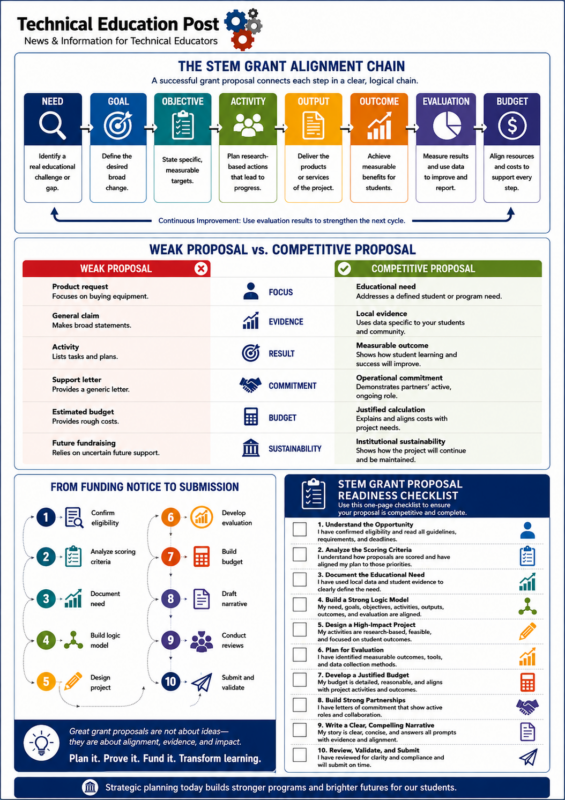
Download: STEM Grant Alignment Guide
Each element should logically support the next.
For example:
- Need: Ninth-grade students have limited access to engineering design experiences.
- Goal: Expand equitable access to standards-aligned engineering education.
- Objective: By the end of year two, 400 ninth-grade students will complete at least four engineering design challenges.
- Activities: Train teachers, revise curriculum, purchase reusable equipment and conduct classroom projects.
- Outputs: Six trained teachers, 24 implemented instructional units and 400 participating students.
- Outcomes: Increased student proficiency in design practices and increased interest in advanced STEM coursework.
- Evaluation: Student rubrics, enrollment data, implementation logs and pre/post interest measures.
- Budget: Personnel time, training, equipment, consumables and evaluation costs directly connected to those activities.
If the application requests equipment that does not clearly support an activity, or promises an outcome that is not measured, the chain breaks.
Step 1: Read the Funding Notice as a Scoring Document
Before writing, create an application summary that captures the funder’s controlling requirements.
For a federal Department of Education competition, the Notice Inviting Applications identifies the program purpose, eligibility, deadlines, competition priorities and selection criteria. Program requirements can change between cycles, so prior applications and older summaries should never replace the current notice. (U.S. Department of Education)
Grant Opportunity Review Table
| Requirement | Questions to answer |
|---|---|
| Eligibility | Is the school, district, college, nonprofit or partnership legally eligible to apply? |
| Program purpose | What result is the funder legally or strategically trying to produce? |
| Absolute priorities | Must the application address a specific population, activity or outcome? |
| Competitive priorities | Can the application earn additional points by addressing identified priorities? |
| Selection criteria | How many points are assigned to need, design, management, evaluation and capacity? |
| Award size | Is the proposed project realistic within the minimum, maximum or estimated award? |
| Project period | Can the objectives be achieved during the permitted performance period? |
| Cost sharing | Is a match required, encouraged, prohibited or subject to specific documentation? |
| Allowable costs | Are equipment, salaries, travel, construction, incentives or indirect costs permitted? |
| Required attachments | Are resumes, letters, logic models, budgets, assurances or partner agreements required? |
| Submission method | Is the application submitted through Grants.gov, Research.gov or another portal? |
| Deadline rules | What time zone, validation requirement and late-submission policy apply? |
Build a Compliance Matrix
Translate each requirement and selection criterion into a working document.
| Criterion | Maximum points | Proposal section | Lead writer | Evidence needed |
| Need for project | 20 | Statement of need | Data lead | Enrollment, access and achievement data |
| Project design | 30 | Program narrative | STEM director | Curriculum, research and work plan |
| Management | 15 | Management plan | Project director | Roles, timeline and governance |
| Evaluation | 20 | Evaluation plan | Evaluator | Measures, targets and analysis |
| Resources and capacity | 15 | Capacity section | Grant lead | Resumes, facilities and prior results |
This prevents a common failure: spending half the narrative on an inspiring program description while giving too little space to a high-value evaluation or management criterion.
Reviewer Principle: The application is not judged according to the applicant’s preferred story. It is judged according to the funder’s published criteria.
Step 2: Establish a Specific and Documented Need
A needs statement should define a problem that is important, measurable and directly connected to the proposed project.
Weak need statements rely on broad declarations:
Technology is changing rapidly, and students need STEM skills for the future.
The statement may be true, but it does not establish why this applicant, population or location requires funding.
A stronger statement uses local evidence:
During the 2025–26 school year, only 18% of the district’s middle school students participated in an engineering, robotics or computer science course. Participation was lowest at the district’s two highest-poverty schools, where fewer than one in ten students had access to a structured engineering experience during the regular school day.
The second version identifies:
- A defined population
- A measurable access gap
- An equity concern
- A baseline against which future progress can be assessed
Useful Sources of Needs Data
Depending on the project, applicants may use:
- Student enrollment and course participation
- Achievement and growth measures
- Program completion rates
- Student, family or employer surveys
- Teacher certification and professional development data
- Equipment inventories
- Laboratory capacity assessments
- Career pathway enrollment
- Postsecondary transition data
- Employer skill-demand information
- Rurality, poverty or demographic data
- Community resource mapping
- Prior program evaluation results
The U.S. Department of Education’s evidence-use resources recommend identifying local needs and possible root causes before selecting an intervention. They also encourage applicants to consider whether the evidence is relevant to the local setting and whether the organization has the capacity to implement the proposed approach. (Institute of Education Sciences)
Separate the Problem From Its Assumed Solution
Do not define the need as the absence of the item you want to buy.
Weak:
Our school needs 30 virtual reality headsets.
Stronger:
Students cannot currently complete immersive technical simulations required for the proposed advanced manufacturing sequence because the school lacks an instructional platform, appropriate devices and teachers trained to integrate simulation into lab instruction.
The second statement leaves room to evaluate whether virtual reality is actually the best response.
Step 3: Identify the Root Cause
A grant should address more than a visible symptom.
Consider a district with low enrollment in advanced STEM courses. The immediate response may be to purchase new equipment, but the underlying causes could include:
- Students do not understand available STEM pathways.
- Prerequisite courses create scheduling barriers.
- Teachers need professional development.
- Equipment exists but is outdated or inaccessible.
- Transportation prevents participation in after-school programs.
- Families lack information about career opportunities.
- Introductory courses are not offered at all schools.
- Students do not see themselves represented in STEM fields.
Each root cause requires a different project design.
A credible proposal therefore explains not only what is happening, but also why the organization believes it is happening.
Step 4: Build a Logic Model
A logic model is a visual representation of how project resources and activities are expected to produce outputs and short-, mid- and long-term outcomes. The Institute of Education Sciences identifies resources, activities, outputs and outcomes as core logic-model components. (Institute of Education Sciences)
Sample STEM Program Logic Model
| Inputs | Activities | Outputs | Short-term outcomes | Long-term outcomes |
| Grant funding | Train eight teachers | Eight teachers complete training | Increased teacher confidence | Sustained engineering instruction |
| STEM coordinator | Develop six engineering units | Six units created | Stronger instructional consistency | Increased student STEM readiness |
| Robotics equipment | Conduct classroom challenges | 500 students participate | Improved design-process skills | Higher advanced-course enrollment |
| University partner | Provide mentoring and evaluation | Four partner visits completed | Increased career awareness | Stronger education-to-career pathways |
| District data staff | Monitor implementation | Quarterly reports produced | Faster program improvement | Replicable district model |
A logic model helps identify gaps before reviewers do.
For example:
- An activity without an output may not be sufficiently defined.
- An outcome without a measure may not be evaluable.
- An expensive budget item without a related activity may not be justified.
- A long-term goal without an intermediate outcome may be unrealistic.
Step 5: Write Goals and Measurable Objectives
Goals describe broad intended results. Objectives define specific achievements during the grant period.
Goal Example
Goal: Increase equitable access to high-quality engineering education across the district’s middle schools.
Objective Example
Objective: By June 2028, increase the percentage of students completing at least one standards-aligned engineering design unit from 22% to 75% across all district middle schools.
A useful objective identifies:
- Target population
- Intended change
- Baseline
- Target
- Measurement method
- Completion date
Weak and Strong Objective Comparison
| Weak objective | Stronger objective |
| Students will become more interested in STEM. | By May 2028, the percentage of participating students reporting interest in an additional STEM course will increase from 41% to 60%, as measured by a consistent pre/post survey. |
| Teachers will receive robotics training. | By August 2027, 12 teachers will complete 18 hours of robotics integration training, and at least 10 will implement three grant-supported units during the following school year. |
| The school will improve STEM access. | During year one, every fifth-grade classroom will complete four engineering investigations, reaching at least 360 students during the regular school day. |
| Students will improve academically. | By the end of year two, 70% of participating students will demonstrate proficiency on the district engineering-design rubric, compared with a baseline of 38%. |
Avoid objectives that promise major changes the project cannot reasonably produce.
A one-year robotics club may increase participation, skill or interest. It is unlikely to prove that the program increased regional employment or transformed the national STEM workforce during the grant period.
Step 6: Design Activities That Directly Support the Objectives
Each proposed activity should answer four questions:
- Who will perform it?
- What will they do?
- When will it happen?
- What will it produce?
Instead of writing:
Teachers will receive professional development.
Write:
During August 2027, the district STEM coordinator and university engineering faculty will deliver three six-hour workshops for 12 middle school teachers. Training will address equipment operation, engineering design pedagogy, student safety, assessment and adaptation for students with disabilities. Each teacher will leave with three completed unit plans and an implementation schedule.
The second version establishes ownership, duration, content, deliverables and implementation expectations.
Sample Work-Plan Table
| Activity | Lead | Timeline | Deliverable | Related objective |
| Recruit teacher cohort | STEM coordinator | May–June 2027 | 12 participating teachers | Objective 1 |
| Conduct professional development | University partner | August 2027 | 18 training hours | Objective 1 |
| Implement design units | Classroom teachers | September 2027–May 2028 | 36 completed units | Objective 2 |
| Conduct student showcase | School partners | April 2028 | District engineering expo | Objective 3 |
| Analyze results | External evaluator | Quarterly | Evaluation reports | All objectives |
Step 7: Support the Approach With Evidence
A proposal should distinguish among three different types of support:
Evidence of Need
Data showing that the problem exists locally.
Evidence for the Intervention
Research or prior program results suggesting that the approach may address the identified need.
Evidence of Applicant Capacity
Information demonstrating that the organization and its partners can implement the project successfully.
These forms of evidence are related but not interchangeable.
A national workforce projection may establish the importance of STEM education, but it does not prove that a particular robotics curriculum will improve outcomes in a specific district. Likewise, a promising curriculum study does not prove that the applicant has enough trained teachers, instructional time or technical support to implement it.
The Department of Education’s evidence guidance describes a continuous-improvement process that begins with needs identification, proceeds through intervention selection and implementation, and continues through examination of results. (U.S. Department of Education; Institute of Education Sciences)
Questions to Ask About Research Evidence
- Does the study involve a similar student population?
- Was the intervention implemented in a comparable setting?
- What outcomes were measured?
- How large and durable were the reported effects?
- What resources were required?
- Was implementation quality monitored?
- Are the findings from one study or a larger body of evidence?
- Can the applicant reproduce the necessary conditions?
Avoid citing research simply to make the proposal appear scholarly. Explain why the evidence supports the chosen design.
Step 8: Create an Evaluation Plan Before Finalizing the Program
Evaluation should not be written after the project design is complete. It should influence the objectives, data collection, staffing and budget from the beginning.
The Institute of Education Sciences describes logic models as tools for both planning and monitoring evaluation. (Institute of Education Sciences)
Process and Outcome Evaluation
A strong plan generally considers both:
Process evaluation: Was the program implemented as intended?
Outcome evaluation: Did the expected changes occur?
| Evaluation question | Measure | Source | Frequency | Responsible party |
| Were teachers trained as planned? | Training completion | Attendance records | After each session | Project director |
| Were instructional units implemented? | Units completed | Teacher logs | Monthly | STEM coordinator |
| Did student skills improve? | Design rubric scores | Student work | Each semester | Evaluation team |
| Did participation become more equitable? | Enrollment by student group | District records | Annually | Data office |
| Did interest in STEM courses increase? | Pre/post survey | Student survey | Beginning and end | External evaluator |
Outputs Are Not Outcomes
Outputs describe what the project delivers:
- 20 teachers trained
- 300 students served
- 15 robotics kits purchased
- Eight workshops conducted
Outcomes describe what changes:
- Teachers implement more inquiry-based instruction.
- Students demonstrate stronger engineering-design skills.
- Participation gaps narrow.
- More students enter advanced STEM coursework.
Serving 300 students is important, but participation alone does not demonstrate educational impact.
Do Not Overstate Causation
A small school project may document changes among participants, but that does not automatically prove the project caused every observed result.
Use language that matches the evaluation design:
- “Participants demonstrated improvement”
- “Results were associated with participation”
- “The project will examine changes over time”
- “The evaluation will assess implementation and outcomes”
Reserve causal claims for designs capable of supporting them.
Step 9: Demonstrate Organizational and Team Capacity
Reviewers need evidence that the applicant can deliver the project.
Include:
- Relevant experience
- Clearly assigned roles
- Staff qualifications
- Partner responsibilities
- Available facilities
- Data-management capacity
- Fiscal controls
- Prior project results
- Leadership commitment
- Procurement and technology support
NSF’s merit-review framework explicitly considers whether the team is qualified and whether adequate resources are available to conduct the proposed work. (National Science Foundation)
Replace Generic Partner Letters With Specific Commitments
Weak:
The university strongly supports this important project.
Stronger:
The university engineering department will provide two faculty members for 36 hours of teacher professional development, host two student laboratory visits each year and assign a graduate assistant to support curriculum review and quarterly implementation meetings.
The second commitment can be incorporated into the work plan and budget.
Before including a partner, determine:
- What will the partner contribute?
- Who will provide it?
- When will it be delivered?
- Is the contribution paid or in-kind?
- How will performance be monitored?
- Is a memorandum of understanding required?
Step 10: Build a Budget That Tells the Same Story as the Narrative
A reviewer should be able to move between the program narrative and budget without finding contradictions.
The National Institutes of Health’s general grant-writing guidance advises applicants to connect the budget to the proposed work, keep project scope realistic and justify requested costs. Those principles apply broadly to education proposals as well. (National Institutes of Health)
Sample STEM Grant Budget
| Category | Amount | Purpose |
| Personnel | $28,000 | Partial support for project coordination and curriculum development |
| Fringe benefits | $8,400 | Benefits associated with grant-supported personnel |
| Professional development | $12,000 | Facilitators, materials and teacher stipends |
| Equipment | $24,000 | Reusable robotics and engineering systems |
| Supplies | $7,500 | Consumables, replacement parts and safety materials |
| Evaluation | $10,000 | Data collection, analysis and reporting |
| Student transportation | $4,500 | University and employer site visits |
| Family engagement | $2,000 | STEM showcase materials and interpretation |
| Indirect costs | $3,600 | Allowable organizational administrative costs |
| Total | $100,000 |
Every Budget Line Needs a Rationale
A budget narrative should explain:
- Quantity
- Unit cost
- Intended use
- Calculation method
- Connection to project activities
- Whether the cost is recurring
- Whether the item will remain useful after the grant
Example:
The project requests $24,000 for 12 reusable robotics systems at an estimated cost of $2,000 each. Each participating school will receive three systems, allowing student teams to complete four curriculum-embedded design challenges annually. The systems will remain district property and will be maintained through the instructional technology replacement schedule after the grant period.
Common Budget Problems
- Equipment totals do not match the narrative.
- Staff time is insufficient for the proposed workload.
- Evaluation is promised but not funded.
- Training covers equipment operation but not instructional integration.
- Consumables are omitted.
- Travel is included without destination or purpose.
- Matching funds are described but not documented.
- Indirect costs are calculated incorrectly.
- The project depends on future funding that has not been identified.
- The budget reaches the maximum award without demonstrating why every dollar is needed.
Step 11: Address Equity Through Project Design
Equity should not appear only in an introductory statement. It should influence recruitment, scheduling, transportation, accessibility, instruction, partnerships and evaluation.
Consider:
- Will students participate during the regular school day?
- Are activities accessible to students with disabilities?
- Are materials available to multilingual learners?
- Do scheduling practices exclude certain students?
- Are transportation or participation fees barriers?
- Will equipment be shared equitably among schools?
- Are demographic participation patterns monitored?
- Are students represented in curriculum examples and career connections?
- Does the budget include necessary accessibility supports?
For NSF proposals, broader impacts may include improving STEM education, developing the STEM workforce, increasing public engagement, broadening participation and building partnerships among education, industry and other organizations. NSF expects applicants to explain the intended societal outcomes and how success will be assessed. (National Science Foundation)
Equity commitments become credible when they are operational:
Weak:
The program will serve diverse students.
Stronger:
Recruitment and enrollment data will be reviewed by school, gender, race and ethnicity, disability status and economic disadvantage. When any group’s participation rate falls more than 10 percentage points below its share of the eligible population, the district will conduct targeted student and family outreach and review scheduling barriers.
Step 12: Explain Sustainability Without Making Empty Promises
Sustainability means identifying which project components should continue, what they will cost and who will support them.
Potential strategies include:
- Integrating units into the adopted curriculum
- Training multiple teachers rather than one specialist
- Creating reusable instructional materials
- Moving recurring costs into the district budget
- Establishing an equipment-replacement schedule
- Using grant results to support future district investment
- Formalizing university or employer partnerships
- Developing a train-the-trainer model
- Sharing curriculum across multiple schools
- Aligning the project with an existing strategic plan
Avoid vague statements such as:
The district will seek additional grants.
Future fundraising may be part of the strategy, but it should not be the entire strategy.
A stronger statement identifies what the district can sustain without another award:
After the grant period, the district will incorporate annual replacement supplies into the secondary science budget, maintain the equipment through its existing technology-support department and use two grant-trained lead teachers to provide annual onboarding for newly assigned instructors.
Write for the Reviewer
Reviewers may read several complex applications in a limited period. The proposal should make accurate scoring easy.
NIH’s grant-writing guidance recommends clear organization, descriptive headings, short paragraphs, restrained use of bold text, limited jargon and direct alignment with review criteria. It also advises applicants to seek feedback from both subject-matter experts and readers who are less familiar with the specialty. (National Institutes of Health)
Reviewer-Friendly Writing Practices
- Follow the same order as the scoring criteria.
- Use criterion language in headings when permitted.
- State the main point at the beginning of each section.
- Use consistent names for programs, objectives and partners.
- Define acronyms on first use.
- Keep paragraphs focused on one idea.
- Use tables for timelines, responsibilities and measures.
- Place important evidence near the claim it supports.
- State who is responsible for each activity.
- Make targets and deadlines easy to locate.
- Remove claims that the application cannot document.
Do Not Make Reviewers Search
Instead of writing:
As discussed previously, the district has substantial experience in this area.
Write:
During the past three years, the district implemented four grant-funded STEM initiatives serving 1,800 students and completed all required performance and financial reports on schedule.
A reviewer should not have to remember information from 12 pages earlier to award points.
Build the Executive Summary Last
The project summary should be drafted after the need, design, evaluation and budget are aligned.
A useful summary answers:
- Who is applying?
- What problem will the project address?
- Who will be served?
- What will the project do?
- What results are expected?
- How much funding is requested?
- How long will the project operate?
- Why is the applicant capable of succeeding?
For NSF proposals, the project summary must include an overview and separate statements addressing intellectual merit and broader impacts. Applicants must follow the exact current solicitation and proposal-preparation requirements. (National Science Foundation)
Sample Summary Opening
The River Valley School District requests $450,000 over three years to expand standards-aligned engineering education across four middle schools serving 2,300 students. Currently, only 22% of students complete an engineering design experience before entering high school, with significantly lower participation at the district’s two highest-poverty schools. The project will train 24 teachers, implement six engineering units, establish shared laboratory resources and create university-supported career exploration experiences. By the end of the project, at least 75% of middle school students will complete a documented engineering design sequence, and the district will evaluate changes in student proficiency, participation and advanced-course enrollment.
The opening identifies the applicant, request, duration, need, population, activities and primary outcome without relying on slogans.
Federal Registration and Submission Planning
Federal applications may require more administrative preparation than local or foundation grants.
The Department of Education instructs organizational applicants to register with the System for Award Management, obtain a Unique Entity Identifier, register with Grants.gov and designate appropriate organizational representatives. The Department states that SAM registration often takes approximately seven to ten business days but may take longer. Applicants must also maintain an active registration during review and after an award. (U.S. Department of Education)
SAM.gov confirms that organizations applying directly for federal awards require an entity registration and receive a Unique Entity Identifier through that process. (SAM.gov)
Administrative Checklist
- Confirm legal applicant name.
- Verify eligibility.
- Confirm active SAM.gov registration.
- Verify the Unique Entity Identifier.
- Confirm Grants.gov roles and permissions.
- Identify the Authorized Organization Representative.
- Obtain board or leadership approval.
- Review procurement requirements.
- Confirm indirect-cost treatment.
- Collect partner documents.
- Verify required assurances.
- Test portal access.
- Submit before the final hours.
- Save the submission confirmation and tracking number.
Grants.gov advises applicants to check eligibility, register, create a Workspace, complete all required forms and submit through the application system. (Grants.gov)
A 90-Day Proposal Development Timeline
Large proposals should be treated as managed projects.
| Time before deadline | Primary tasks |
| 90–75 days | Confirm eligibility, analyze the notice, establish leadership approval and identify partners |
| 74–60 days | Complete needs analysis, define the project concept and assign writers |
| 59–45 days | Build the logic model, objectives, activity plan and preliminary budget |
| 44–30 days | Draft narrative sections, evaluation plan, partner commitments and work plan |
| 29–21 days | Complete full first draft and budget narrative |
| 20–14 days | Conduct criterion-based review, revise weaknesses and verify evidence |
| 13–7 days | Finalize attachments, forms, resumes, letters and approvals |
| 6–3 days | Conduct compliance review, proofreading and portal validation |
| 2–1 days | Submit, save confirmation and resolve validation errors |
The Department of Education notes that applicants often have approximately 30 to 60 days between the opening and closing of a competition. Organizations seeking federal funding should therefore complete registrations and maintain reusable organizational documents before a suitable competition opens. (U.S. Department of Education)
Conduct Three Different Reviews
A final proofreading pass is not enough.
1. Program Review
Does the proposed approach make educational and operational sense?
2. Reviewer Review
Does the application answer every scored criterion with sufficient evidence?
3. Compliance Review
Does the package follow every formatting, attachment, registration and submission rule?
These reviews should involve different perspectives:
- STEM or curriculum expert
- Administrator or project manager
- Fiscal officer
- Evaluator or data specialist
- Grants or compliance specialist
- Reader unfamiliar with the project
The unfamiliar reader is particularly useful. If that person cannot explain the project after reading the summary and main design section, the application may not be clear enough for a multidisciplinary review panel.
Using Artificial Intelligence Responsibly
AI tools can assist with organization, editing, brainstorming, consistency checks and plain-language revision. They should not replace local data, professional judgment or compliance review.
Appropriate uses may include:
- Turning the funding criteria into a draft outline
- Identifying undefined acronyms
- Comparing objectives with evaluation measures
- Checking whether activities appear in the budget
- Producing alternative wording for an unclear paragraph
- Creating an internal compliance checklist
- Summarizing nonconfidential planning notes
- Checking consistency in terminology
Risks include:
- Fabricated citations or statistics
- Incorrect eligibility interpretations
- Outdated program requirements
- Generic narratives that ignore local conditions
- Disclosure of confidential student or organizational information
- Inconsistent claims across sections
- Unoriginal language
- Overstated outcomes
- Budget calculations that have not been verified
The Department of Education maintains grant-related AI guidance and emphasizes accuracy review, privacy protection and records responsibilities in grant-supported uses of AI. Applicants should also follow the rules of the specific competition and their own institutional policies. (U.S. Department of Education)
AI Best Practice: Never submit an AI-generated statistic, citation, quotation, requirement, budget figure or eligibility interpretation without checking the original source.
Common Reasons STEM Proposals Lose Points
The Project Does Not Match the Opportunity
An attractive STEM idea is not automatically appropriate for every STEM funder.
The Need Is Broad but Not Local
National workforce trends cannot replace evidence about the students, teachers or institutions the proposal will serve.
Equipment Drives the Project
The proposal begins with a purchase and constructs an instructional rationale afterward.
Objectives Are Not Measurable
Terms such as “enhance,” “empower,” “transform” and “increase awareness” appear without baselines, targets, measures or deadlines.
Activities and Outcomes Are Confused
Conducting workshops is an activity. Completing workshops is an output. Changing instructional practice is an outcome.
The Evaluation Plan Is Too Vague
The application promises to collect data but does not identify measures, timing, responsibilities or analysis.
The Budget Is Disconnected
Costs appear in the budget without corresponding narrative activities, or major activities have no funding.
Partnerships Are Ceremonial
Letters express support but do not commit staff, facilities, time, expertise or other resources.
Sustainability Depends on Another Grant
The organization offers no plan for curriculum, staffing, maintenance or recurring costs.
The Application Is Hard to Score
Important evidence is scattered, terminology changes and headings do not correspond to the criteria.
Compliance Is Left Until the End
The organization discovers missing registrations, approvals, attachments or authorized users shortly before the deadline.
Pre-Submission STEM Grant Checklist
Alignment
- The applicant is eligible.
- The project directly addresses the program purpose.
- Every absolute priority is satisfied.
- Competitive priorities are clearly identified.
- The narrative follows the scoring criteria.
- Page allocation reflects point allocation.
Need and Evidence
- The need is supported by current local data.
- Root causes are explained.
- External evidence supports the proposed approach.
- Research is relevant to the population and setting.
- Claims are linked to original sources.
Project Design
- Goals and objectives are distinct.
- Objectives contain baselines, targets and deadlines.
- Activities identify responsible parties.
- The timeline is realistic.
- The logic model is internally consistent.
- Equity and accessibility are embedded in implementation.
Evaluation
- Each objective has at least one measure.
- Process and outcome measures are included.
- Data sources and collection schedules are identified.
- Responsibility for analysis is assigned.
- The evaluation budget is adequate.
- Claims match the strength of the evaluation design.
Budget
- Every cost is connected to an activity.
- Calculations are accurate.
- Quantities and unit costs are explained.
- Personnel time matches responsibilities.
- Recurring costs are identified.
- Matching contributions are documented.
- Indirect costs follow current instructions.
Capacity and Partnerships
- Staff qualifications match assigned roles.
- Partner commitments are specific.
- Leadership responsibilities are clear.
- Facilities and existing resources are described.
- Prior performance is documented where relevant.
Submission
- Registrations are active.
- Required forms are complete.
- Attachments use the correct format.
- File names follow instructions.
- Page limits, margins and fonts are correct.
- All required signatures are obtained.
- The package has been validated.
- Submission confirmation is saved.
Questions to Ask Your Program
Before submitting a STEM grant proposal, leadership teams should ask:
- Would we pursue this project if this particular grant did not exist?
- Does local evidence demonstrate the need we describe?
- Have we addressed the problem’s root cause or only its most visible symptom?
- Can every objective be measured with available data?
- Does every major activity have an owner, deadline and budget?
- Can our organization realistically perform the proposed work?
- Are partner commitments operational or merely symbolic?
- What will continue after the grant ends?
- Could a reviewer locate the evidence needed to score every criterion?
- What is the strongest reason a reviewer might decline this proposal?
The final question should be answered before submission—not after the technical review arrives.
Frequently Asked Questions
What is the most important part of a STEM grant proposal?
No single section can compensate for a fundamentally misaligned application. The most important task is building a consistent relationship among the funder’s priorities, the documented need, the proposed solution, the measurable outcomes and the budget.
Should a school choose equipment before finding a grant?
Schools may identify equipment needs during program planning, but the instructional problem and program design should lead the proposal. Beginning with a specific product can create a weak application if the funding opportunity does not support the broader educational need.
How long does it take to write a major education grant?
The writing period varies by application size, partnership complexity and organizational readiness. The Department of Education reports that applicants generally have approximately 30 to 60 days to respond to an open competition, which makes advance planning and current registrations essential. (U.S. Department of Education)
Does every STEM grant need a logic model?
Not every funder requires one, but developing an internal logic model helps test alignment among resources, activities, outputs and outcomes. Applicants should include it in the submission only when required or permitted by the application instructions.
What is the difference between a goal and an objective?
A goal expresses a broad intended result. An objective specifies the population, expected change, target, measure and deadline.
How much data should be included in the needs statement?
Include enough data to establish the size, urgency and character of the problem without overwhelming the narrative. Every statistic should contribute to the argument for the proposed project.
Should applicants contact the program officer?
Applicants should use the contact listed in the funding notice for questions about program rules, eligibility or application procedures. Federal program staff may clarify published requirements but generally cannot provide individualized advice that would give one applicant an unfair competitive advantage. (U.S. Department of Education)
Can a school reuse an old grant proposal?
Prior narratives, data and organizational descriptions can provide a starting point, but the application must be rebuilt around the current competition. Priorities, requirements, selection criteria, deadlines and terminology may change between grant cycles.
Can AI write a grant proposal?
AI can assist with planning and revision, but the applicant remains responsible for accuracy, originality, privacy, compliance and every commitment made in the application. AI-generated facts, citations, budget figures and interpretations should be verified against original sources.
TechEd Magazine Perspective
Winning STEM proposals are not won by dramatic language. They are won through alignment.
The strongest applications make a disciplined case that a particular group of students or educators faces a documented challenge, that the proposed activities are appropriate for that challenge, that the applicant has the capacity to implement them and that meaningful progress can be measured within the funding period.
This approach has value even when an application is not selected. A well-developed needs assessment, logic model, implementation plan and evaluation framework can guide district investment, strengthen future applications and clarify whether a proposed STEM initiative deserves to move forward.
Grant writing should therefore be viewed as more than a search for outside money. At its best, the process forces institutions to make stronger decisions about educational priorities, program design, accountability and long-term capacity.
The proposal may be temporary. The planning discipline should remain.
Recommended Internal Links
- Empowering STEM Education Grants — Overview of the broader STEM grant ecosystem
- STEM Grants for Elementary Schools
- Funding and Grants — Continuing TechEd Magazine funding coverage
- Technical Education Resources — Teaching materials, directories, events and grant resources
- Where STEM Educators Shop — Equipment and classroom-supply planning
- STEM Research Grant — Example of direct support for classroom research equipment
- NASA Expands STEM Learning — Example of a large partnership-based STEM investment
- Funding for STEM Careers — Funding connected to education and workforce pathways
- STEM Next Opportunity Fund — Example of a multistate STEM workforce initiative
- STEM Education Coverage — Related reporting across STEM programs and funding
Authoritative Grant-Writing Resources
- U.S. Department of Education: Getting Started With Discretionary Grant Applications
- Grants.gov: How to Apply for Grants
- Grants.gov: Applicant Eligibility
- SAM.gov Entity Registration
- National Science Foundation: Preparing Your Proposal
- National Science Foundation: Merit Review
- National Science Foundation: Broader Impacts
- Institute of Education Sciences: Logic Models
- Institute of Education Sciences: Program Evaluation Toolkit
- U.S. Department of Education: Evidence-Based Policymaking
- National Institutes of Health: General Grant-Writing Tips
- U.S. Department of Education: Grants and Artificial Intelligence