For career and technical education programs, equipment may be the most visible part of a laboratory, but curriculum determines whether students understand what to do with it.
American Technical Publishers (ATP) has spent more than a century developing instructional materials for the skilled trades and technical occupations. Today, the company serves apprenticeship programs, high-school career and technical education programs, community and technical colleges, universities, and workforce-training organizations with resources spanning electrical systems, construction, manufacturing, facility maintenance, agriculture, culinary arts and other technical fields.
The significance of companies such as ATP extends beyond textbooks. Technical educators are being asked to prepare learners for occupations where industry standards, safety requirements, technologies and credentialing expectations can change considerably faster than traditional academic curricula.
That makes industry-aligned technical curriculum an increasingly important part of America’s workforce-development infrastructure.
Key Takeaways
- American Technical Publishers develops instructional materials specifically for career and technical education, apprenticeships and technician-level education.
- ATP says it has developed career and technical training materials since 1898.
- Its catalog covers fields including electrical and electronic systems, construction, manufacturing and automation, facility maintenance, agricultural systems, culinary education and workforce development.
- ATP combines printed textbooks with eTextbooks, online resources, assessments and instructor materials.
- Technical curriculum is particularly important in apprenticeship because federal Registered Apprenticeship standards require organized related instruction in the technical subjects associated with an occupation.
- For educators, the bigger question is not simply which publisher to use, but whether instructional resources remain aligned with current technology, codes, credentials and employer expectations.
More Than a Technical Textbook Publisher
American Technical Publishers describes its role as developing instructional materials for apprenticeship training, career and technical education, and technician-level programs at community colleges, technical colleges and universities.
Its current product categories illustrate just how broad technical education has become. ATP provides resources in areas including:
- Licensing and certification preparation
- Code and safety compliance
- Electrical and electronic systems
- Construction processes and management
- Facility operation and maintenance
- Manufacturing and automated processes
- Agricultural and power systems
- Culinary arts and services
- Workforce education and development
That breadth is significant because modern CTE increasingly crosses traditional occupational boundaries.
A manufacturing student, for example, may need competencies involving mechanical systems, electrical systems, automation, safety and troubleshooting. Building-trades learners increasingly encounter digital controls and sophisticated electrical equipment. Agricultural programs use technologies that would once have been associated primarily with electrical or industrial education.
Curriculum must evolve accordingly.
ATP’s approach combines traditional instructional publishing with digital delivery and blended-learning resources intended to give instructors flexibility in how technical concepts are taught.
Why Technical Curriculum Matters More Than It May Appear
A modern technical laboratory can contain hundreds of thousands of dollars in equipment. Yet machines and tools do not constitute a curriculum.
Students need a structured progression that connects theory with practical application. They must understand terminology, safety, operating principles, troubleshooting procedures, codes and the reasons behind the procedures they perform in the lab.
The Association for Career and Technical Education’s framework for high-quality CTE programs emphasizes standards-aligned curriculum, including curriculum based on industry-validated technical standards and competencies.
That becomes particularly important when a program prepares students for occupations governed by codes or certifications.
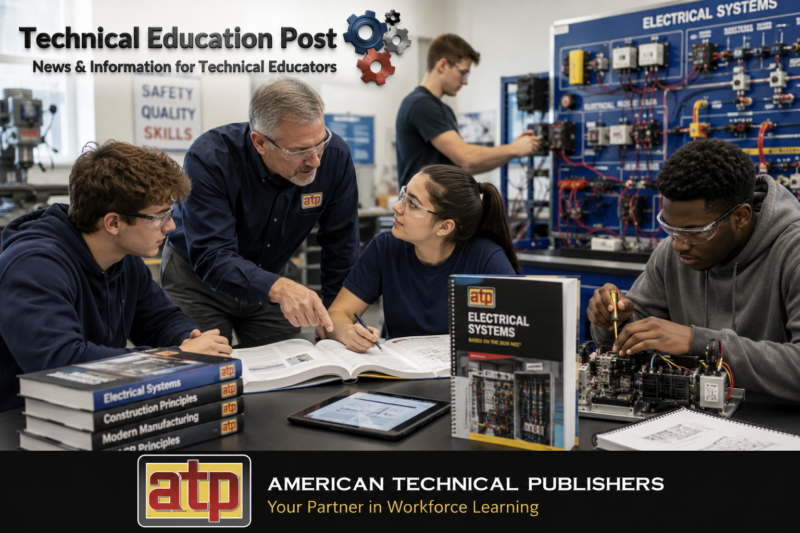
Electrical education is one example. ATP currently offers materials based on the 2026 National Electrical Code, including electrical-systems instruction and journeyman-electrician exam preparation. Its digital versions incorporate features such as highlighting, note taking, text-to-speech, flashcards and study-guide creation.
The principle applies well beyond electrical education.
Technical curriculum cannot remain static when the workplace itself is changing.
Apprenticeship Makes the Curriculum Connection Even Clearer
The relationship between classroom curriculum and employment is especially visible in Registered Apprenticeship.
The U.S. Department of Labor describes Registered Apprenticeship as an industry-driven career pathway combining paid work experience, mentorship, progressive wage increases, classroom instruction and a nationally recognized credential.
Federal apprenticeship guidance also requires organized related instruction in technical subjects associated with the occupation. That instruction can occur in classrooms, through occupational or industrial courses, electronically or through other approved forms of study. Federal regulations recommend approximately 144 hours of related instruction for each apprenticeship year, although programs may structure training in different ways.
This creates an important role for curriculum providers.
An apprenticeship sponsor may have outstanding employers, experienced journeyworkers and excellent on-the-job training, but learners still need a coherent system for mastering the underlying technical knowledge.
The challenge is connecting:
What students read → what instructors teach → what learners practice → what employers expect.
Publishers serving technical education operate directly within that connection.
From Print to Blended Technical Learning
The role of the technical textbook is also changing.
Printed books remain practical in many laboratories and training environments, but contemporary technical instruction increasingly uses a combination of print, digital content, video, presentations, assessments and learning-management systems.
ATP’s current instructor resources illustrate that transition.
For some programs, its online instructor packages can include instructional guides, customizable presentations, pretests and posttests, assessment banks, answer keys, learner resources and eTextbooks. Some assessment materials can also be imported into learning-management or test-development systems.
ATP has also worked with Top Hat on interactive courseware designed to incorporate questions, video and other learning activities into digital course content.
This matters because technical educators face a difficult instructional challenge.
Students need enough theoretical knowledge to understand a system, enough visual explanation to recognize its components, and enough hands-on practice to perform actual work. No single instructional format accomplishes all three particularly well.
The most effective technical programs therefore increasingly operate as blended environments rather than choosing between “books” and “technology.”
The Workforce Need Behind Technical Education
The need for effective skilled-trades education remains substantial.
The Bureau of Labor Statistics’ latest occupational projections, updated in August 2026, identify industrial machinery mechanics among occupations projected to add the largest numbers of new jobs, with approximately 83,800 additional positions projected. Electricians are projected to add approximately 75,900 jobs.
Those projections illustrate an important distinction in the national workforce conversation.
Creating interest in skilled trades is only the beginning.
Schools must then convert that interest into competence.
That requires qualified instructors, functioning equipment, employer partnerships, appropriate safety procedures and instructional materials capable of turning complicated technical systems into teachable sequences.
Curriculum is one piece of that system, but it is a foundational one.
Accessibility Is Becoming Part of Technical Curriculum Quality
Digital transformation also introduces another responsibility: accessibility.
ATP says it is working to have current products conform to WCAG 2.1 AA accessibility standards in support of Section 508 requirements. The publisher also provides mechanisms for requesting alternative formats for qualifying learners and offers digital accessibility options for many materials.
For CTE administrators, accessibility should increasingly be part of curriculum evaluation rather than an afterthought.
A technically accurate resource has limited instructional value if some students cannot effectively use it.
Programs evaluating new instructional systems should therefore consider accessibility alongside technical accuracy, industry alignment, assessment capabilities and instructor usability.
What Educators Should Evaluate in Technical Curriculum
The lesson from American Technical Publishers is not that schools should select one particular publisher. It is that technical curriculum itself deserves the same scrutiny programs give equipment purchases.
When evaluating ATP or any competing curriculum provider, educators should examine several questions.
Is the content current?
Programs teaching electrical codes, safety standards, automation technologies or certification requirements need to know exactly which versions and standards the curriculum reflects.
Who developed the material?
Subject-matter expertise is especially important when students are learning procedures that affect safety, equipment reliability or credentialing.
Does the curriculum align with industry expectations?
The content taught in class should reinforce the skills students encounter in laboratories, apprenticeships and workplaces.
Can instructors adapt it?
A strong curriculum should support instructors rather than force every teacher into an identical teaching method.
Does it work across learning formats?
Print, digital, classroom, laboratory and work-based learning should reinforce one another.
Are assessments meaningful?
Tests should measure actual technical understanding rather than memorization alone.
Is the content accessible?
Digital resources should accommodate the broadest reasonable range of learners.
These questions become even more important when a district or institution plans to use the same curriculum across multiple campuses or instructors.
Administrator Takeaways
CTE leaders should consider curriculum selection part of program modernization.
It is relatively easy to recognize an obsolete machine. Obsolete curriculum can be harder to see.
A textbook may look perfectly usable while referencing older standards, missing emerging technologies or failing to connect classroom instruction with the equipment students now encounter.
Administrators should therefore build curriculum review into the same modernization cycle used for laboratories and equipment.
That review should involve instructors, employers and—where appropriate—credentialing organizations.
The objective should not merely be to purchase newer books.
It should be to ensure that curriculum, equipment, instruction, certification and employer expectations remain synchronized.
Questions to Ask Your Program
- When was our technical curriculum last comprehensively reviewed?
- Which industry standards, codes or competencies does each major course align with?
- Have local employers reviewed our curriculum recently?
- Are instructors supplementing outdated materials because the official curriculum no longer reflects the workplace?
- Do our textbooks and digital resources match the equipment students actually use?
- Can students access course content both inside and outside the laboratory?
- Are our assessments measuring technical understanding and problem solving, or mainly recall?
- Are accessibility requirements considered when we purchase digital curriculum?
- Does our apprenticeship-related instruction align with what apprentices perform on the job?
- Do we have a formal process for reviewing curriculum whenever a major code, technology or industry standard changes?
TechEd Magazine Perspective
American Technical Publishers represents an important but sometimes overlooked part of the technical-education ecosystem: the infrastructure behind instruction.
Robots, CNC machines, electrical trainers, HVAC systems and advanced manufacturing cells naturally attract attention because students can see and operate them. Curriculum receives less attention, even though it determines whether those experiences become coherent learning.
As technical occupations continue to change, curriculum providers will face increasing pressure to move faster. Updating a textbook every several years may be insufficient in fields affected by rapidly changing automation, digital controls, artificial intelligence, cybersecurity, safety requirements and industry standards.
The opportunity is not to replace hands-on technical education with digital learning.
It is to connect the two more effectively.
The future of CTE will likely belong to programs where textbooks, digital resources, instructors, laboratories, employers, credentials and work-based learning function as parts of the same instructional system.
For organizations such as American Technical Publishers—and for the schools that depend on technical curriculum—that represents both the opportunity and the challenge ahead.
About American Technical Publishers
American Technical Publishers is an Illinois-based developer and publisher of career and technical instructional materials. ATP says it has served technical education since 1898 and currently develops resources for apprenticeships, CTE programs, community and technical colleges, universities and workforce-development programs. Its materials are available through print and digital formats across multiple skilled-trades and technical fields.
Recommended Reading
CTE Is Nearly Everywhere. The Career Connection Still Has Gaps — TechEd Magazine examines national data showing that simply offering CTE does not guarantee strong connections between students and actual workplace experiences. Read the TechEd Magazine article
The Future of STEM Education: Trends Shaping CTE Programs — A broader look at how new technology and workforce requirements are changing technical education. Read the TechEd Magazine article
What Is CTE? — TechEd Magazine’s overview of career and technical education and its role in workforce preparation. Read the CTE guide
Sources
American Technical Publishers — Company information, instructional categories and technical-learning resources. ATP Learning
U.S. Department of Labor — Apprenticeship.gov — Registered Apprenticeship requirements and the role of related technical instruction. Registered Apprenticeship Program
Association for Career and Technical Education — High-Quality CTE Program of Study Framework and standards-aligned curriculum guidance.
U.S. Bureau of Labor Statistics — Occupational employment projections for skilled and technical occupations.
Frequently Asked Questions
What is American Technical Publishers?
American Technical Publishers, commonly called ATP, develops instructional materials for career and technical education, apprenticeship programs, skilled-trades training, community and technical colleges, universities and workforce-development programs.
How long has American Technical Publishers been operating?
ATP states that it has been developing career and technical training materials since 1898, giving the company more than a century of involvement in technical education.
What subjects does American Technical Publishers cover?
ATP’s current categories include electrical and electronic systems, construction, manufacturing and automated processes, facility operation and maintenance, agricultural and power systems, culinary arts, licensing and certification preparation, safety and workforce education.
Does ATP offer digital textbooks?
Yes. ATP offers eTextbooks and other online instructional resources in addition to printed materials. Depending on the product, digital resources may include highlighting, text-to-speech, flashcards, note taking, assessments, presentations and instructor resources.
Why is industry-aligned curriculum important in CTE?
Technical education is intended to prepare students for occupations with specific skills, technologies, codes and safety requirements. Industry-aligned curriculum helps connect classroom knowledge with laboratory training, credentials, apprenticeships and employer expectations.
Can technical curriculum support Registered Apprenticeship programs?
Yes. Registered Apprenticeship includes organized related instruction in technical subjects connected with the occupation. That creates an important role for appropriate classroom, digital and self-study curriculum alongside on-the-job learning.