
Student Project to Supersonic Flight
Dawn Aerospace is a multinational space transportation company that develops scalable and sustainable in-space propulsion systems and rocket-powered spaceplanes. Its mission? To deliver the things the next generation of space users care about from Earth to Space, and from Space to everywhere else. Though less than a decade old, the company is rapidly expanding and already on track to become a billion-dollar business. From a small student project at Delft University to making history with its first supersonic flight, let’s explore the rise of Dawn Aerospace and its plans to revolutionize space access for all. Student Project to Supersonic Flight.
Dawn Aerospace’s Origin Story
Dawn Aerospace was founded in 2017 by Stefan Powell, James Powell, Jeroen Wink, Tobias Knop, and Robert Werner.
The company’s origins are loosely traced back to the Delft University of Technology in the Netherlands, where Stefan and Knop were part of the student-run organization, Delft Aerospace Rocket Engineering (DARE). In 2010, a team of eight DARE members took part in the Dawn Project, which aimed to develop a hybrid rocket engine with a simple propulsion system for use within DARE. By 2013, their efforts had resulted in more than 30 static test fires of the “Labscale Motor” and two flights of the “Morning Star” hybrid rocket, which broke European altitude records. “It took us five years to build and was only in the air for 10 minutes,” said Stefan. “That was industry standard. But we knew there had to be a better way.”
Within four years, Stefan and Knop joined forces with the remaining three founders and established Dawn Aerospace headquarters in both Delft, the Netherlands, and Christchurch, New Zealand. The founding group of engineers and scientists hail from around the world – the Powell brothers both live in Christchurch, Wink is based in the Netherlands, and Knop and Werner are German.
Their purpose-driven company is focused on creating a sustainable space environment at scale. “Presently, space junk is only just manageable,” says James. “If we don’t change things, it won’t be long until it could become an irrecoverable mess.”
Dawn Aerospace Today
Dawn Aerospace is already a leading producer of turnkey, flight-proven, green-propulsion systems. Its solutions are compatible with various classes of satellite, including SmallSats, Orbital Transfer Vehicles, and CubeSats, and have flown on Falcon 9, Vega, and Soyuz rockets.
Currently, the company has 167 thrusters, 15 SatDrive systems, and six CubeDrive propulsion systems in orbit, all of which utilize non-toxic fuels and benefit from a simplified, modular, and scalable architecture, enabling them to travel at high speeds. Dawn Aerospace’s propulsion systems also work to remove satellites from their operational orbits at the end of their useful life and bring them back to earth, which significantly reduces space debris and helps to drive a more sustainable orbital environment.
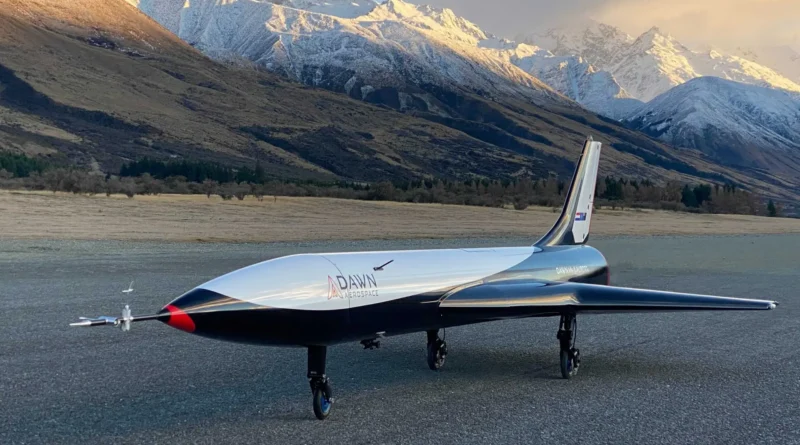
Propulsion systems aside, Dawn Aerospace’s most exciting project is its rocket-powered aircraft, the Mk-II Aurora, which is the fastest, highest-flying aircraft ever to take off from a runway. Measuring just 16 feet long with a wingspan of 13 feet, its pure rocket propulsion system allows it to achieve exceptional speeds. Dawn Aerospace expects the vehicle to bring rapid reusability and fleet economics to spaceflight.
Test Potential
First announced in 2020, the demonstrator aircraft has now completed more than 50 test flights with a range of payloads. In November 2024, it surpassed the speed of sound for the first time and set a record for the fastest climb to 20 kilometers, completing the ascent in just 118.6 seconds. “This achievement highlights the immense potential of rocket-powered aircraft to achieve performance never seen before,” Stefan said.
The Mk-II Aurora is ultimately designed to fly to the edge of space twice a day, reaching speeds of up to Mach 3.5 during its ascent. Unusually, Dawn Aerospace has started taking orders for the aircraft itself, rather than selling launch services, with the hope that a commercial aviation business model will expand its potential market much more quickly. The first deliveries are projected for 2027, with the company expecting each vehicle to fly 100 times a year with a design life of 1,000 flights.
In 2023, Dawn Aerospace was named Most Innovative Hi-Tech Hardware and Hi-Tech Emerging Company of the Year at the NZ Hi-Tech Awards. “We’ve come a long way since winning Start-up of the Year in 2020,” the company said in a statement. “Our headcount has grown from 24 to over 130 employees, we’ve signed multiple customers, closed our Series A round, and exponentially increased our revenue. And we’ve built and flown a rocket plane. Can’t wait to see what we’ll do in the next 3 years!”
What Industries Does Dawn Aerospace Serve?
Dawn Aerospace’s space propulsion systems enable deep-space exploration, serving a broad range of satellite manufacturers across the government, defense, and fast-growing commercial sectors, including areas such as telecommunications, earth observation, and space research.
Its Mk-II Aurora aircraft, meanwhile, will create new opportunities for near-space exploration, with the potential to advance a wide range of industries:
- Life Sciences: Near-space exploration allows scientists to study the microgravity environment in ways that are not possible on Earth, supporting advancements in cellular biology, regenerative medicine, and drug development.
- Semiconductor Technology: According to NASA research, the Earth’s gravitational forces impede high-yield semiconductor production, but a microgravity environment offers a path to overcome such barriers. A vehicle like the Mk-II Aurora will also provide opportunities for semiconductor manufacturers to rigorously test their products in a near-space environment, ensuring that they will not deteriorate when deployed in harsher space conditions.
- Defense: The Mk-II Aurora could be used to test and deploy defense payloads, such as sensors and communications systems, in high-altitude environments.
- Earth Observation: Near-space provides an ideal environment for Earth observation, enabling hyperspectral imaging, weather monitoring, and environmental sensing, which can inform disaster management, climate change activities, and biodiversity preservation.
Clients and Partnerships
Some of Dawn Aerospace’s most prominent clients include Pixxel, Blue Canyon Technologies, Infinite Orbits, and Sidus Space.
Its Mk-II Aurora is also attracting the attention of several U.S. universities, including Arizona State University, Johns Hopkins University, and California Polytechnic State University. In June, the aircraft successfully carried the first U.S. research payload from California Polytechnic State University, reaching a speed of Mach 0.79 and an altitude of 37,000 feet. The payload was designed to test whether student-built hardware could withstand the rigors of high-altitude, spaceflight-like environments.
In June, the Oklahoma Space Industry Development Authority (OSIDA) announced a new partnership with Dawn Aerospace that will bring the space company’s Mk-II Aurora to the Oklahoma Air and Space Port. “Oklahoma is positioned to be at the forefront of the next space frontier and a hub for national defense,” said Oklahoma Lt. Governor Matt Pinnell. “With targeted investment, the state is moving to secure frequent and reliable space access and is set to become America’s busiest suborbital launch site.”
Future Outlook
For now, Dawn Aerospace is committed to further advancing hypersonic flight, with a particular focus on expanding into international markets.
Earlier this year, for example, the space company announced a partnership with the Japanese airline All Nippon Airways (ANA) to expand its spaceplane payload services into Japan.
“We see significant value in Dawn Aerospace’s reusable, runway-launched spaceplanes for expanding the scope of space utilization in Japan and promoting the creation of a more active industry,” said Shinichiro Onitsuka, General Manager of ANA Trading.
The next few years are critical, but Dawn Aerospace is certainly well-positioned to usher in a new era of sustainable commercial spaceflight.
Source: Student Project to Supersonic Flight
Image credit: Dawn Aerospace
From Student Project to Supersonic Flight: The Rise of Dawn Aerospace
https://www.thomasnet.com/insights/dawn-aerospace-overview/
https://www.techedmagazine.com/category/news-by-industry/transportation-education/
Student Project to Supersonic Flight