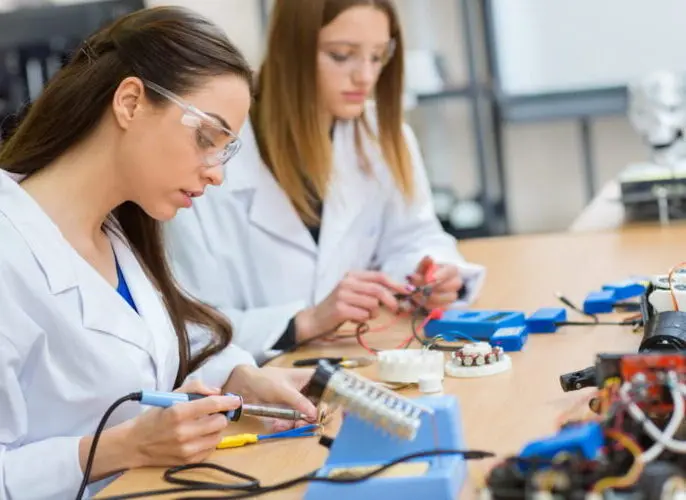
When we think of famous inventors, our minds typically turn to Thomas Edison, Alexander Graham Bell, and other noteworthy men. But women inventors are responsible for some of the most important creations in history—innovations without which many other inventions and technologies may not have been possible (or would have appeared much later). From foundational advances in computing to breakthroughs in communications, manufacturing, medicine, and everyday consumer products, these women helped shape the modern world. Women Inventors Changed Manufacturing.
18+ Women Inventors Making History
You might have already heard of some of the inventors on our list, but many of these women are surprisingly underrepresented in mainstream history, despite transforming entire industries. Let’s take a closer look at who they were and what they created.
1. Ada Lovelace: First Published Computer Algorithm

1843, United Kingdom
Working alongside Charles Babbage in the mid-19th century, Ada Lovelace is widely regarded as the first computer programmer. In 1843, she published detailed notes on Babbage’s proposed Analytical Engine, including what is considered the first published algorithm intended for machine processing. More impressively, she recognized that such a machine could manipulate symbols and create outputs beyond simple calculations. This was an idea far ahead of its time. Her vision laid the groundwork for modern computing, which powers today’s automated manufacturing systems, artificial intelligence, and industrial software.
2. Hedy Lamarr: Frequency-Hopping Spread Spectrum Tech

1942, United States
Known for her acting work during Hollywood’s Golden Age, Hedy Lamarr was far more than a glamorous film star. In 1942, during World War II, she co-patented frequency-hopping spread spectrum technology, a method designed to prevent radio signals from being jammed. Though initially developed for military use, the concept allowed signals to switch frequencies rapidly and securely. Her invention is the basis for modern wireless communication technologies, including Wi-Fi, Bluetooth, and GPS systems used across today’s connected manufacturing and logistics networks.
3. Radia Perlman: Spanning Tree Protocol

1985, United States
With several degrees from the Massachusetts Institute of Technology (MIT), computer scientist Radia Perlman transformed how modern networks operate by developing the Spanning Tree Protocol (STP) in 1985. At a time when Ethernet networks struggled with data loops that could bring entire systems down, Perlman designed a protocol that allowed networks to organize themselves efficiently and prevent failures. This enabled scalable, reliable network infrastructure, critical for data centers, enterprise systems, and industrial automation environments. Today, the stability of global digital communication networks owes much to her work.
4. Margaret Knight: Flat-Bottom Paper Bag Machine

1871, United States
In 1871, Margaret E. Knight patented a machine that produced flat-bottom paper bags, replacing the envelope-style designs of the time. Before securing her patent, she built a wooden prototype to demonstrate how the mechanism would fold and glue the base of each bag. Her invention allowed bags to stand upright and carry heavier goods, dramatically improving functionality for retailers, manufacturers, and shoppers. After successfully defending her patent against a legal challenge, her bag-making machine took off and helped standardize modern packaging production. But Margaret didn’t stop there; she went on to secure dozens more patents throughout her career (including designs for a rotary engine, a shoe-cutting machine, and a window frame with sash).
5. Grace Hopper: Compiler (A-0 system)

1952, United States
As a mathematician and rear admiral in the US Navy, Grace Hopper played an important role in transforming early computing from a specialized scientific tool into a practical business system. Hopper was one of only a handful of female graduate students who earned a mathematics PhD. In 1952, she developed one of the first working compilers, the A-0 system, which translated written instructions into machine code. Hopper later played a key role in the early development of COBOL in 1959, a programming language designed to make software more accessible and standardized for commercial use. Her work made large-scale computing more efficient and usable across government and industry, and it continues to shape the systems that power finance, logistics, and manufacturing today.
6. Stephanie Kwolek: Kevlar

1965, United States
Chemist Stephanie Kwolek discovered Kevlar—the lightweight yet exceptionally strong synthetic fiber that’s five times stronger than steel by weight—in 1965 while working at DuPont. She had been developing lighter, stronger materials for car tires when she produced a polymer solution that appeared cloudy and unusually thin. Since it didn’t resemble a typical high-strength material, it was nearly set aside, but Kwolek insisted that it be tested. The result was the extraordinarily durable, high-performance fiber now used in everything from body armor and aerospace components to industrial protective equipment.
7. Josephine Cochrane: Mechanical Dishwasher

1886, United States
Frustrated that her precious heirloom dishes were being chipped when being washed by hand, Josephine Cochrane thought up a better solution. In 1886, she patented the first practical mechanical dishwasher, a machine that used water pressure rather than scrubbers to clean dishes efficiently. She demonstrated her creation at the World’s Columbian Exposition in Chicago in 1893. Unlike earlier attempts, her design was reliable enough for commercial use, and it quickly gained traction in hotels and restaurants. We have Cochrane to thank for modern commercial dishwashing systems that are now standard in homes and the foodservice/hospitality industries worldwide.
8. Mary Anderson: Windshield Wiper

1903, United States
During a visit to New York in the early 1900s, Mary Anderson noticed streetcar drivers struggling to see through rain and snow. It seems remarkable now that early vehicles did not have windshield wipers (and seat belts, but that’s another story). In 1903, Anderson patented a manually operated windshield wiper that allowed drivers to clear their windshields without leaving the vehicle, enabling them to drive more safely in the rain. Although initially dismissed as unnecessary, the device became standard equipment on automobiles within a few decades and remains an essential automotive safety feature in vehicle manufacturing today.
9. Nancy Johnson: Hand-Cranked Ice Cream Freezer

1843, United States
In 1843, Nancy Johnson patented an early ice cream maker; specifically, a hand-cranked ice cream freezer that simplified and standardized the process of making frozen desserts. Her design used a rotating paddle within a sealed container surrounded by ice and salt, allowing for more efficient and consistent freezing. The mechanism became widely adopted and influenced the development of commercial ice cream production equipment and later frozen food manufacturing systems.
10. Marion Donovan: Waterproof Diaper Cover

1951, United States
Before disposable diapers, reusable cloth versions were the only option available. While more sustainable, they were not always effective at preventing leaks or controlling odors, so Marion Donovan set out to create a more practical alternative. In the late 1940s, Donovan developed a waterproof diaper cover—the “Boater”—that contained leaks while improving comfort and durability, and she secured a patent for her design in 1951. She continued refining the product over the years, adding features such as plastic snaps instead of diaper pins, and eventually hired a manufacturer to produce them at scale, and sold them through Saks Fifth Avenue. Her invention sparked further innovation in disposable hygiene products and contributed to the growth of the global diaper industry.
11. Patricia Bath: Laserphaco Probe

1988, United States
Patricia Bath, a pioneer of laser cataract surgery, was the first Black person to complete a residency in ophthalmology in the US, at New York University, and later the first woman on staff at the Jules Stein Eye Institute. In 1988, Bath patented the Laserphaco Probe, an innovative medical device that used laser technology to remove cataracts with greater precision and less invasiveness than many traditional surgical methods, helping expand access to vision-restoring treatment worldwide.
12. Sarah Guppy: Bridge Construction Improvements

1811, United Kingdom
In 1811, Sarah Guppy patented a method for improving bridge construction by strengthening foundations and preventing structural collapse. Her innovation not only addressed safety and durability in civil infrastructure, but did so at a time when women rarely held engineering patents. Guppy later patented additional designs related to domestic and mechanical improvements, but her bridge work remains particularly significant. Her contributions reflect early advancements in structural engineering that influenced infrastructure development and modern construction practices.
13. Hertha Ayrton: Electric Arc Lighting System Improvements

1899, United Kingdom
Hertha Ayrton spent much of the late 19th century working on electric arc lighting, a crucial technology at the time for factories, shipyards, and public spaces. Through several patents, including important improvements around 1899, she tackled practical problems such as flickering and instability in arc lamps. While she wasn’t the only woman working in engineering, Ayrton was the first woman to present her own research before the Institution of Electrical Engineers—no small feat in that era. She worked on the real-world issues that caused arc lamps to flicker and fail, making them reliable enough for widespread industrial use.
14. Maria Telkes: Solar Heating Systems

1948, United States
Often referred to as the “Sun Queen,” Maria Telkes devoted her career to harnessing solar energy for practical use. In 1948, she helped develop the Dover Sun House, one of the first homes heated entirely by solar energy, using a system that stored heat in salt-based thermal storage units. Telkes held several patents in solar heating and energy conversion at a time when renewable energy was still experimental. Her designs helped shape modern solar thermal systems now used in sustainable building and industrial applications.
15. Marie Van Brittan Brown: CCTV

1966, United States
Concerned about slow police response times in her New York neighborhood, Marie Van Brittan Brown developed an early home security system in 1966 with the help of her husband, Albert, an electrician. She invented a motorized camera that could slide between peepholes, a television monitor, two-way audio communication, and a remote-controlled door lock. The system allowed homeowners to see and speak to visitors before opening the door, an innovation well ahead of its time. Her invention was an early step toward the CCTV and home surveillance systems widely used today.
16. Ann Tsukamoto: Stem Cell Isolation Method

1991, United States
In 1991, Ann Tsukamoto co-patented a method for isolating human hematopoietic stem cells, a breakthrough that allowed scientists to separate those rare blood-forming cells from others for the first time. This opened a whole new chapter in biomedical research, particularly in cancer treatment and regenerative medicine. Doctors could now study and work with pure stem cells rather than mixed cell samples. Tsukamoto’s innovation has had a real-world impact on biotechnology, especially in the development of cell-based therapies and modern biopharmaceutical manufacturing.
17. Melitta Bentz: Paper Coffee Filter

1908, Germany
Looking for a cleaner way to brew coffee, Melitta Bentz devised a simple yet transformative solution in 1908: a paper coffee filter made from blotting paper placed inside a perforated brass cup. She patented the design in Germany and went on to found what would become the Melitta company—a leading global manufacturer of coffee filtration products still in operation today. Her invention helped establish a more standardized way of brewing coffee and supported the development of large-scale paper filter manufacturing. More than a century later, paper filters are still a staple in many household and commercial kitchens alike.
18. Beulah Louise Henry: Multiple Consumer Products

1912, United States
Often called “Lady Edison,” the prolific Beulah Louise Henry built a career on solving practical mechanical problems with her clever inventions. She obtained her first patent in 1912 and went on to earn more than 100 additional patents for numerous products in the consumer and industrial sectors, including improvements to sewing machines, typewriters, and packaging devices. Henry often developed mechanisms that simplified manufacturing processes or improved product performance without requiring entirely new production systems. Her steady stream of ideas contributed to early 20th-century manufacturing and demonstrated the value of practical problem-solving to business success.
Other Notable Female Inventors
Several other women throughout history invented and discovered technologies that helped shape modern technology and manufacturing in meaningful ways, even if their work was not directly tied to large-scale industrial systems. For example, in 1957, American inventor Mary Kenner patented an adjustable sanitary belt designed to improve comfort and reliability in menstrual hygiene products, in what would become a major global manufacturing sector.
Madam C. J. Walker developed and marketed specialized haircare products for Black women in the early 1900s, including treatments for scalp conditions and hair loss. She went on to build a large-scale manufacturing and distribution operation and is widely recognized as one of the first female self-made millionaires in the US.
Beyond patented inventions, scientific breakthroughs also reshaped industrial research. In nuclear physics, Chien-Shiung Wu conducted the 1957 experiment that disproved the principle of parity conservation, a finding that changed how physicists understood the behavior of subatomic particles. In 1939, Marguerite Perey discovered the element francium, adding a new element to the periodic table and furthering research into radioactive materials.
And we would be remiss not to mention Ruth Graves Wakefield, whose 1938 creation at the Toll House Inn, the chocolate chip cookie, led to one of the most iconic products in global food manufacturing.
Women Inventors—Summary
While picturing women inventors nowadays doesn’t feel unusual, many of their breakthroughs were achieved at a time when it was extremely difficult for women to access higher education, funding, or even the patent office to protect their creations. Recognition was even rarer. And yet, they built machines, systems, materials, and ideas that still underpin modern manufacturing and technology today. Thankfully, for young people growing up today, innovative women in science, engineering, and industry are the new normal.
Featured image credit: Zoriana Zaitseva/Shutterstock
Sources: Women Inventors Changed Manufacturing
- https://www.lemelson.org/womens-history-month-2025/
- https://www.amightygirl.com/blog?p=12223
- https://www.womenintech.co.uk/celebrating-ada-lovelace/
- https://www.womenshistory.org/education-resources/biographies/hedy-lamarr
- https://lemelson.mit.edu/resources/radia-perlman
- https://www.invent.org/inductees/radia-perlman
- https://www.britannica.com/biography/Margaret-E-Knight
- https://president.yale.edu/biography-grace-murray-hopper
- https://www.sciencehistory.org/education/scientific-biographies/stephanie-l-kwolek
- https://www.popsci.com/technology/josephine-cochrane-dishwasher-inventor/
- https://www.denso-am.eu/news/deneur19_13_female-pioneers-mary-anderson-and-charlotte-bridgwood
- https://www.museumoficecream.com/blog/a-scoop-of-history-nancy-johnsons-ice-cream-revolution/
- https://invention.si.edu/invention-stories/papers-illustrate-woman-inventors-life-and-work
- https://pmc.ncbi.nlm.nih.gov/articles/PMC11361739/
- https://www.biography.com/scientists/patricia-bath
- https://cliftonbridge.org.uk/did-sarah-guppy-design-the-clifton-suspension-bridge/
- https://interestingengineering.com/engineers-directory/sarah-guppy
- https://blog.sciencemuseum.org.uk/celebrating-the-life-of-hertha-ayrton/
- https://www.pbs.org/wgbh/americanexperience/features/sun-queen-marvelously-inventive-life-maria-telkes/
- https://www.black-inventor.com/marie-van-brittan-brown
- https://www.ebsco.com/research-starters/history/marie-van-brittan-brown
- https://www.carlsoncaspers.com/diversity-and-inclusion/diversity-spotlight/dr-ann-tsukamoto/
- https://www.melitta-group.com/en/stories/150-years-melitta-bentz
- https://www.invent.org/inductees/beulah-louise-henry
- https://www.ladyedisons.com/beulah-louise-henry
- https://www.vaginamuseum.co.uk/the-hidden-story-of-mary-kenner
- https://www.biography.com/business-leaders/madam-cj-walker
- https://www.womenshistory.org/education-resources/biographies/chien-shiung-wu
- https://ahf.nuclearmuseum.org/ahf/profile/chien-shiung-wu/
- https://scientificwomen.net/women/perey-marguerite-147
- https://blog.sciencemuseum.org.uk/marguerite-perey-and-francium/
- https://lemelson.mit.edu/resources/ruth-wakefield
https://www.thomasnet.com/insights/women-inventors-who-changed-modern-manufacturing-and-tech/
Women Inventors Changed Manufacturing
https://www.techedmagazine.com/category/industries/manufacturing/
Women Inventors Changed Manufacturing