
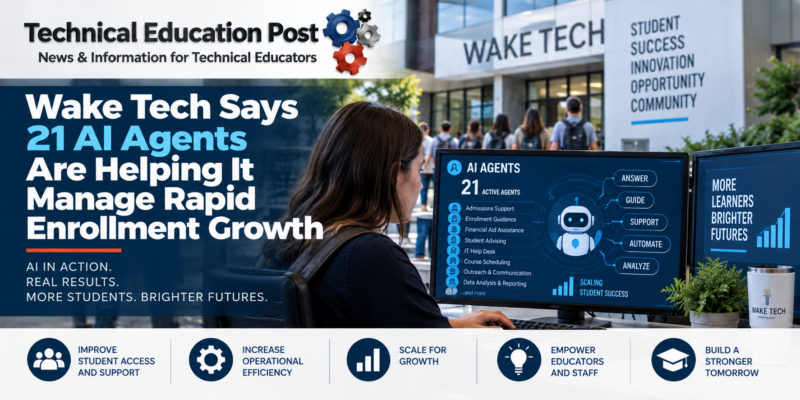
Wake Tech’s 21 AI Agents Offer a Glimpse of the Agentic Campus
Community colleges have spent the past several years asking whether artificial intelligence belongs in student services.
Wake Technical Community College is already answering a more advanced question: what happens when AI assistants become part of the operating structure of the institution?
During an Achieving the Dream discussion on September 22, Wake Tech Vice President for Enrollment and Student Services Brian Gann described a deployment of 21 agentic AI assistants operating across student-services functions.
Gann said only slightly more than 1% of recent conversations handled by the assistants require transfer to a human employee. He also stressed that the deployment has not been used to eliminate positions.
The case deserves attention because Wake Tech is operating at substantial scale. The college served 76,210 unduplicated learners during the previous academic year, according to figures presented during the discussion, while degree-seeking enrollment increased about 30% over three years.
This is no longer a chatbot experiment.
It is organizational redesign.
Key Takeaways
- Wake Tech has deployed 21 AI assistants across student-services operations.
- Fourteen support its advising model, including agents aligned with career fields and military-connected students.
- College leaders say AI is being used to add capacity rather than eliminate positions.
- Wake Tech’s internal reporting suggests a substantial share of AI interactions occur outside normal office hours.
- The case raises important questions about governance, accuracy, data, escalation and measurement.
What Happened
Fourteen of Wake Tech’s agents support care-team advising, including assistants aligned with 13 career-field groupings and one focused on veterans and military-connected learners.
The college is using Element451’s platform for the underlying deployment.
Gann has separately reported that since January 2025 Wake Tech’s agents handled 67,596 interactions and that 46% occurred when offices were closed. He reported 474,086 minutes of human work saved, with the handoff rate falling to about 1.1% over the most recent six months. Those figures are Wake Tech’s own operational measurements and have not been independently audited.
That qualification matters.
The most useful takeaway is not the headline number of 21 agents. It is the operating model developing around them.
Gann described the college’s approach as training each agent much like a new employee: building its knowledge base, testing performance and creating feedback loops before allowing it to support students.
Why It Matters
Community colleges often have a scale problem.
They serve large numbers of students with complicated schedules, work obligations, transfer questions, financial-aid concerns and career decisions, while staffing does not necessarily expand at the same rate as enrollment.
AI can potentially absorb repetitive, high-volume interactions.
But that does not automatically make the technology effective.
A poorly governed AI system can deliver incorrect policy information more efficiently than a person. An agent with access to institutional systems can create more risk than a simple website chatbot. And a high resolution rate is not necessarily the same thing as a successful student outcome.
That is why Wake Tech’s experiment should be evaluated on more than automation.
The Broader Trend: From Chatbots to Agents
The first generation of campus AI tools primarily answered questions.
Agentic systems increasingly promise to perform multi-step work, retrieve information from institutional data and coordinate actions across workflows.
That changes the governance problem.
Achieving the Dream’s framework for an AI-enabled community college recommends strategic leadership, ethical governance, impact measurement, staff capacity-building, professional learning, curriculum redesign, workforce alignment and student-success investment.
Wake Tech’s deployment provides an early real-world example of why those functions need to develop together.
The technology may be new.
The institutional responsibilities are not.
Practical Takeaways for College Leaders
Do not begin with the question, “Which AI agent should we buy?”
Begin with a service problem.
Identify high-volume activities that consume staff time but follow sufficiently consistent policies and workflows to be modeled safely.
Establish an escalation path before launch.
Students should always have a clearly defined route to a person when an issue involves ambiguity, unusual circumstances or high stakes.
Measure more than interactions.
Useful indicators include first-contact resolution, error rate, escalation quality, student satisfaction, time to resolution and whether the intervention ultimately improves persistence or completion.
Colleges should also maintain an accountable human owner for every deployed agent.
Someone needs responsibility for the knowledge base, testing, updates and policy changes that affect an agent’s answers.
Questions to Ask Your Program
- What student-service problem are we trying to solve with AI?
- Who owns each AI agent’s knowledge and performance?
- How do students reach a person when the system cannot resolve an issue?
- How often are answers audited for accuracy?
- What student data can the agent access?
- Are we measuring student outcomes or merely interaction volume?
Future Outlook
Wake Tech’s experience suggests agentic AI may enter higher education through operations faster than through classrooms.
Admissions, advising, registration and student communication all involve repeatable processes that institutions may see as candidates for automation.
The institutions worth watching will not necessarily be those with the most agents.
They will be those capable of demonstrating that agentic systems improve student access and service quality without sacrificing trust, privacy or human judgment.
Frequently Asked Questions
How many AI agents is Wake Tech using?
College leaders say 21 are currently embedded in its organizational workflows.
Is Wake Tech replacing employees?
Gann said the deployment is not being used to eliminate positions, although roles and work may change.
What do the agents do?
They support functions including advising and admissions-related student interactions.
What percentage of conversations reach a human?
Wake Tech reported a recent handoff rate of roughly 1.1%.
Should other colleges copy this approach?
Not automatically. Institutions need governance, clear use cases, reliable data, testing, escalation procedures and meaningful performance measures before scaling.
TechEd Magazine Perspective
Wake Tech’s most important lesson may not be that 21 AI agents can answer thousands of questions.
It is that deploying AI at institutional scale begins to look less like software implementation and more like workforce design.
That means colleges need to think about AI agents in the same terms they would use for people: responsibilities, training, supervision, access, quality control and accountability.