
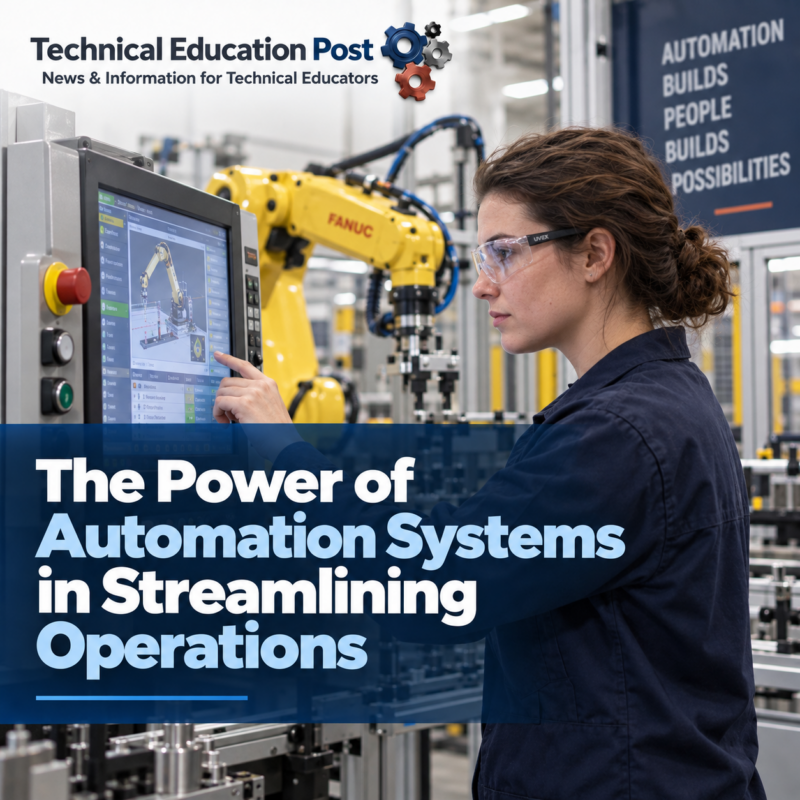
In today’s rapidly evolving industrial landscape, the pursuit of efficiency, precision, and cost-effectiveness is paramount. Across manufacturing floors, logistics hubs, and even service industries, businesses are increasingly turning to automation systems to achieve these critical goals. But what exactly are automation systems, and how do they unlock such transformative potential? This article will demystify the world of automation, exploring its core principles, the technologies that drive it, its profound impact on modern operations, and the opportunities it presents for individuals and industries alike.
Automation systems are revolutionizing industries by enhancing efficiency and productivity, and the role of women in this field is increasingly significant. For a deeper understanding of the contributions women make in STEM, you can explore this insightful article on the topic. It highlights the achievements and challenges faced by women in science, technology, engineering, and mathematics, showcasing their vital role in shaping the future of automation. To read more, visit Celebrating Women in STEM.
Understanding the Fundamentals of Automation Systems

At its heart, automation is the use of technology to perform tasks with minimal human intervention. In the context of industrial operations, an automation system is a collection of interconnected hardware and software components designed to control and manage a process, machine, or set of machines. The primary objective is to replace or augment human effort in repetitive, hazardous, or highly precise tasks, thereby enhancing productivity, quality, and safety.
What Constitutes an Automation System?
An automation system is not a single entity but rather a symphony of integrated parts working in concert. These components generally fall into several key categories:
- Sensors: These are the “eyes and ears” of an automation system. They gather data about the physical environment, such as temperature, pressure, position, light levels, or the presence of an object. For example, a proximity sensor can detect when a product has reached a certain point on a conveyor belt.
- Actuators: These are the “muscles” that carry out actions based on instructions from the control system. They translate electrical signals into physical movements or changes. Common examples include electric motors that drive machinery, pneumatic or hydraulic cylinders that push or pull, and solenoids that open or close valves.
- Controllers: These are the “brains” of the operation. They process the data from sensors and execute pre-programmed logic to determine what actions the actuators should take. The most common type of controller in industrial automation is a Programmable Logic Controller (PLC). PLCs are rugged, digital computers designed for controlling manufacturing processes. They receive input from sensors, run control logic, and send output signals to actuators.
- Human-Machine Interfaces (HMIs): These are the visual interfaces that allow human operators to interact with the automation system. HMIs can range from simple push buttons and indicator lights to sophisticated touch-screen displays that provide real-time data, allow for parameter adjustments, and display alarms.
- Communication Networks: For complex systems involving multiple machines or devices, robust communication networks are essential. These networks enable seamless data exchange between controllers, sensors, actuators, and higher-level management systems. Industrial Ethernet, DeviceNet, and Profibus are common examples of such networks.
The Spectrum of Automation: From Basic to Advanced
Automation is not a one-size-fits-all solution. It exists on a spectrum, with different levels of complexity and capability:
- Fixed Automation: Also known as hard automation, this is used for mass production of a single product or a very limited variety of products. The equipment is specialized and inflexible, making it highly efficient for its intended purpose but difficult and expensive to change. Think of an automotive assembly line for a specific model.
- Programmable Automation: This type of automation allows for changes in product type through reprogramming of the control system and potentially some physical reconfiguration of the machinery. It is more flexible than fixed automation and is suitable for batch production. Examples include CNC (Computer Numerical Control) machines for machining parts.
- Flexible Automation: This is the most advanced form of automation, allowing for a high degree of product variety and rapid changeovers. Flexible manufacturing systems (FMS) can produce a wide range of parts or products with minimal downtime. Robotic work cells that can perform multiple tasks with different end effectors are a good illustration.
- Computer Integrated Manufacturing (CIM): This is a holistic approach that uses computers to control the entire production process, from design and planning to manufacturing and distribution. It integrates all aspects of the manufacturing enterprise.
How Automation Systems Operate: The Underlying Principles

The magic of automation lies in its ability to execute complex sequences of operations reliably and consistently. This is achieved through sophisticated control logic and feedback mechanisms.
Control Logic and Decision-Making
At the core of every automation system is its control logic. This is a set of rules, algorithms, and instructions that dictate how the system should respond to various inputs.
- Sequential Control: This is the most basic form of control, where operations are performed in a predefined order. For instance, a conveyor belt starts, a product is placed on it, a robotic arm picks it up, and then places it in a fixture. Each step must be completed before the next can begin. This is often programmed using ladder logic, a graphical programming language that resembles electrical relay circuits, or structured text.
- Procedural Control: This involves executing a series of steps that may have variations or conditional branches. For example, if a sensor detects a defect, the system might divert the product to a rejection bin.
- Advanced Control: This encompasses more complex strategies like Proportional-Integral-Derivative (PID) control, used for maintaining precise parameters like temperature or speed. Machine learning and artificial intelligence (AI) are also increasingly being integrated for adaptive control, predictive maintenance, and optimizing complex processes in real-time.
The Role of Feedback Loops
A crucial element in maintaining precision and accuracy in automation is the use of feedback loops.
- Open-Loop Systems: In an open-loop system, the controller sends out commands, but there is no mechanism to verify if the intended action has been successfully completed. For example, a simple timer that turns on a light for a set duration is an open-loop system. If the light bulb burns out, the system continues to operate as if the light were on.
- Closed-Loop Systems: These systems employ feedback to monitor the actual output and compare it to the desired output. If there’s a deviation, the controller adjusts its commands to correct the error. A thermostat is a classic example of a closed-loop system. It senses the room temperature (feedback), compares it to the set temperature, and turns the heating or cooling system on or off accordingly. In manufacturing, this could be a robot arm using a vision system to guide its precise placement or a motor controller adjusting its speed based on the load.
Data Acquisition and Processing
Modern automation systems are data-rich environments. Sensors continuously generate vast amounts of data, which is then processed by controllers and often stored for analysis.
- Data Acquisition: This involves collecting raw data from sensors at regular intervals. The frequency of data acquisition is critical for capturing dynamic changes in a process.
- Data Processing: The collected data is then filtered, analyzed, and interpreted by the control system to make decisions. This can range from simple threshold comparisons to complex statistical analysis and pattern recognition.
- Data Storage and Analysis: For performance monitoring, troubleshooting, and continuous improvement, data is often stored in databases or Manufacturing Execution Systems (MES). This historical data can be invaluable for identifying trends, optimizing processes, and predicting potential issues.
Why Automation Systems are Indispensable in Modern Manufacturing
The benefits of implementing automation systems extend far beyond simply reducing labor costs. They are fundamental to achieving competitiveness and sustainability in today’s global marketplace.
Enhancing Productivity and Throughput
One of the most immediate and tangible benefits of automation is a significant increase in productivity. Automated systems can operate 24/7 without fatigue, breaks, or the need for shift changes, leading to higher output volumes. Tasks that once took minutes can be performed in seconds. For example, a robotic palletizing system can stack boxes far faster and more consistently than a human worker.
Improving Product Quality and Consistency
Human operators, however skilled, are susceptible to fatigue, errors, and variations in performance. Automation systems, by contrast, execute tasks with exceptional precision and repeatability. This leads to a dramatic reduction in defects, scrap rates, and product variability. In pharmaceutical manufacturing, for instance, automated dispensing systems ensure precise dosages every time, minimizing the risk of human error.
Boosting Workplace Safety
Many manufacturing environments involve hazardous tasks such as working with heavy machinery, exposure to extreme temperatures, or handling dangerous chemicals. Automation can remove human workers from these dangerous situations. Robotic arms can perform welding in confined spaces, automated guided vehicles (AGVs) can transport materials in high-traffic areas, and automated inspection systems can evaluate products in hazardous conditions, significantly reducing the risk of workplace injuries.
Reducing Operational Costs
While the initial investment in automation can be substantial, the long-term cost savings are often significant. Reduced labor costs, lower scrap rates, decreased energy consumption through optimized processes, and minimized warranty claims due to improved quality all contribute to a lower total cost of ownership.
Increasing Flexibility and Agility
In a market demanding customization and rapid product introductions, flexible automation systems allow manufacturers to adapt quickly to changing demands. Automated production lines can be reconfigured to produce different product variations or even entirely new products with less downtime and expense than traditional manual methods.
Optimizing Resource Utilization
Automation systems can be programmed to operate with maximum efficiency, minimizing waste of materials, energy, and time. For example, precise robotic placement of components reduces material waste, and intelligent energy management systems can power down idle equipment.
Automation systems are transforming various industries, including automotive education, where innovative teaching methods are being implemented to prepare students for the future. A fascinating article discusses how a professor is reshaping the landscape of automotive education by integrating automation technologies into the curriculum. This approach not only enhances learning but also equips students with the necessary skills to thrive in a rapidly evolving job market. For more insights on this topic, you can read the article here.
Common Technologies and Processes Driving Automation
The landscape of automation is powered by a diverse array of technologies, each contributing to the overall efficiency and capability of automated systems.
Robotics: The Versatile Workhorses
Industrial robots are perhaps the most visible manifestation of automation. They are programmable mechanical arms designed to perform a variety of tasks with high precision and speed.
- Articulated Robots: These are the most common type, featuring multiple rotary joints (typically four to six) that mimic the movement of a human arm. They are highly versatile and used for tasks like welding, painting, assembly, and material handling.
- Cartesian Robots: These robots move along three linear axes (X, Y, and Z), making them ideal for pick-and-place operations, dispensing, and palletizing where precise linear motion is required.
- SCARA Robots (Selective Compliance Assembly Robot Arm): These robots offer fast, repeatable horizontal movements with a rigid vertical axis, making them excellent for assembly tasks requiring high speed and precision in a horizontal plane.
- Collaborative Robots (Cobots): Designed to work safely alongside humans, cobots are lighter, more intuitive to program, and equipped with safety features that allow them to operate without extensive guarding. They are increasingly used for tasks requiring human-robot interaction, such as kitting, inspection, and assisting human operators.
Programmable Logic Controllers (PLCs)
As mentioned earlier, PLCs are the backbone of many industrial automation systems. Their rugged design, modularity, and ability to handle complex logic make them indispensable.
- Input/Output (I/O) Modules: These interface the PLC with the outside world, receiving signals from sensors and sending commands to actuators.
- CPU (Central Processing Unit): The brain of the PLC, executing the control program.
- Programming Software: Engineers use specialized software (e.g., ladder logic, function block diagram, structured text) to write and download programs to the PLC.
Supervisory Control and Data Acquisition (SCADA) Systems
SCADA systems are used to monitor and control industrial processes on a larger scale, often across multiple geographically dispersed locations.
- Monitoring: SCADA systems collect real-time data from various devices and present it to operators through HMIs.
- Control: They allow operators to send commands to devices, such as starting or stopping pumps, opening or closing valves, or adjusting setpoints.
- Data Logging: SCADA systems record historical data for analysis, reporting, and troubleshooting. They are commonly used in utilities (water, electricity), oil and gas, and transportation.
Machine Vision Systems
These systems provide automated inspection and guidance capabilities by enabling machines to “see” and interpret images.
- Inspection: Machine vision can detect defects, verify part presence or orientation, and read barcodes or serial numbers, ensuring quality control without human intervention.
- Guidance: Vision systems can guide robots to pick up or place objects with extreme accuracy, even if their positions vary slightly.
Automated Guided Vehicles (AGVs) and Autonomous Mobile Robots (AMRs)
These are mobile robotic platforms used for transporting materials within a facility.
- AGVs: Typically follow predefined paths, often using magnetic strips or optical markers.
- AMRs: Utilize sophisticated sensors and navigation software to move dynamically, avoiding obstacles and finding optimal routes, offering greater flexibility than AGVs.
Automation systems are increasingly becoming integral to modern manufacturing processes, enhancing efficiency and precision. A recent article discusses the innovative training programs for manufacturing technicians at Austin Community College, which aim to equip students with the skills necessary to thrive in environments utilizing advanced automation technologies. For more insights on this topic, you can read the full article here. This initiative not only supports local industry needs but also prepares the workforce for the future of automated manufacturing.
Real-World Manufacturing Applications of Automation Systems
The impact of automation is evident across virtually every sector of manufacturing.
Automotive Manufacturing
The automotive industry has