
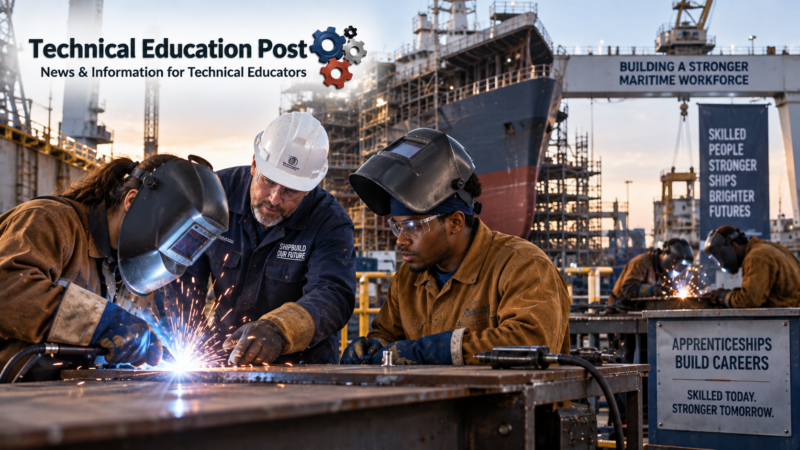
College of the Mainland in Texas City has partnered with Gulf Copper to establish two federally registered apprenticeship programs that combine full-time employment, paid workplace training, and technical instruction to prepare workers for specialized shipbuilding careers.
The programs, formally announced October 5, 2026, focus on marine fabrication and shipfitting, along with quality assurance and quality control inspection. They are the first U.S. Department of Labor-registered apprenticeships in College of the Mainland’s 59-year history.
The partnership comes as Davie Defense advances a planned $1 billion modernization of Gulf Copper’s shipbuilding facilities in Galveston and Port Arthur, Texas. The investment is intended to expand domestic shipbuilding capabilities, including the construction of icebreaking vessels for the U.S. Coast Guard.
The project is expected to create approximately 2,400 direct jobs, increasing demand for skilled workers with experience in structural fabrication, materials inspection, precision manufacturing, and maritime production.
For participating apprentices, the programs provide an opportunity to earn a full-time wage while developing occupational competencies. Gulf Copper covers required tuition and training materials, and successful participants can earn nationally recognized apprenticeship credentials.
For community college administrators, CTE directors, and manufacturing employers, the partnership presents a model for addressing workforce shortages: developing workers through coordinated education and employment rather than relying exclusively on recruitment from an already limited skilled labor pool.
Key Takeaways
-
Two registered apprenticeships: College of the Mainland and Gulf Copper have established pathways for marine fabricator-shipfitters and quality assurance/quality control inspectors.
-
Earn-while-you-learn model: Apprentices are Gulf Copper employees and receive wages while completing technical instruction and supervised workplace training.
-
Employer-funded education: Gulf Copper covers required tuition and training materials, reducing direct educational expenses for apprentices.
-
Training duration: The quality inspection program lasts approximately seven months, while the marine fabrication program takes approximately 15.5 months.
-
Major industrial investment: The programs support workforce development associated with a planned $1 billion shipyard modernization.
-
Transferable workforce model: The partnership demonstrates how colleges and employers can coordinate training with anticipated industrial expansion.
What Happened: College of the Mainland and Gulf Copper Establish Two Apprenticeship Pathways
College of the Mainland and Gulf Copper officially announced their partnership on October 5, establishing structured training programs for two occupations essential to maritime manufacturing.
Both programs are registered with the U.S. Department of Labor.
Unlike conventional college programs in which students complete their education before seeking employment, these apprenticeships begin with employer hiring.
Participants become Gulf Copper employees and receive related technical instruction through College of the Mainland while developing practical skills on the job.
The college serves as the educational partner, while Gulf Copper provides employment, workplace training, and funding for required educational expenses.
The programs include progressive wage advancement tied to apprenticeship milestones.
Successful completion leads to a nationally recognized U.S. Department of Labor apprenticeship credential.
The Two Apprenticeships Compared
| Feature | Quality Inspector | Marine Fabricator-Shipfitter |
|---|---|---|
| Approximate duration | 7 months | 15.5 months |
| Primary focus | Quality assurance, quality control, inspection | Structural fabrication, fitting, assembly |
| Instruction | Technical training at College of the Mainland | Technical training at College of the Mainland |
| Workplace learning | Paid training at Gulf Copper | Paid training at Gulf Copper |
| Tuition | Covered by Gulf Copper | Covered by Gulf Copper |
| Credential | Registered apprenticeship credential | Registered apprenticeship credential |
Source: College of the Mainland’s Gulf Copper apprenticeship program information. Program details and hiring schedules are subject to change.
The two pathways support different but complementary functions within shipbuilding.
Marine fabricators and shipfitters assemble structural components that form the foundations of marine vessels.
Quality inspectors evaluate whether materials, assemblies, and completed work meet specified requirements.
Both occupations require technical knowledge, practical experience, and the ability to perform work consistently within demanding industrial environments.
A $1 Billion Shipyard Modernization Creates New Workforce Demands
The apprenticeships arrive during a significant expansion of shipbuilding activity along the Texas Gulf Coast.
In December 2025, Davie Defense completed the acquisition of Gulf Copper shipbuilding assets in Galveston and Port Arthur.
On June 1, 2026, Texas Governor Greg Abbott participated in a groundbreaking ceremony for a planned $1 billion modernization of the facilities.
The project is intended to support the construction of U.S. Coast Guard icebreakers and restore capabilities associated with complex vessel production.
State officials estimate that the development could generate approximately 2,400 direct jobs, with a broader economic impact supporting nearly 7,000 jobs statewide.
These figures are projections associated with the industrial investment, not verified employment totals.
The modernization creates a substantial workforce planning challenge.
Constructing sophisticated vessels requires more than new buildings, fabrication equipment, and production infrastructure.
Shipyards need experienced workers who understand structural manufacturing, technical documentation, welding processes, inspection procedures, and industrial safety.
Those capabilities take time to develop.
By creating structured apprenticeship pathways alongside the physical modernization, Gulf Copper and its education partners are attempting to address workforce development before production demand reaches its full projected scale.
Why It Matters for Career and Technical Education
The College of the Mainland partnership demonstrates several advantages of employer-integrated technical education.
1. Apprentices Earn While Developing Technical Skills
One of the most significant barriers to entering a technical occupation is the financial challenge of completing training before receiving employment income.
Traditional educational pathways can require students to pay tuition while managing living expenses and potentially reducing their working hours.
Registered apprenticeships address this issue by combining employment and education.
Gulf Copper apprentices receive full-time wages while completing required technical instruction.
The employer also covers tuition and required training materials.
This model may improve access for adults who cannot afford to leave the workforce to pursue extended education.
It also changes the relationship between training and employment.
Rather than treating employment as an uncertain outcome after graduation, apprentices begin developing their skills within the workplace where those competencies will be used.
2. Training Is Organized Around Specific Occupational Requirements
Shipbuilding involves specialized work that may not be fully addressed through broad manufacturing curricula.
For example, shipfitters must interpret technical drawings, understand fabrication sequences, and work with structural components that must meet engineering specifications.
Quality inspectors must understand how to evaluate materials and workmanship against defined requirements.
These competencies benefit from repeated practice under experienced supervision.
Registered apprenticeships create a framework in which technical instruction and workplace assignments reinforce one another.
Colleges can provide foundational concepts and structured learning while employers provide opportunities to apply those concepts in production settings.
This approach is particularly valuable when specialized occupations require a combination of theoretical knowledge and demonstrated practical competence.
3. The Programs Create Opportunities for Recognized Credentials
A nationally recognized apprenticeship credential can provide evidence that a worker completed a structured combination of technical instruction and supervised occupational training.
For learners, this offers a more formal representation of acquired skills than workplace experience alone.
For employers, the credential supports consistent documentation of training requirements and occupational competencies.
However, the credential’s practical value also depends on the quality of training and the worker’s ability to apply those skills.
Institutions should therefore evaluate both formal completion and demonstrated occupational proficiency.
Broader Industry Trends: Maritime Workforce Development Becomes a Regional Priority
The College of the Mainland initiative is part of a wider effort to develop maritime manufacturing talent along the Gulf Coast.
Other institutions are also participating.
Galveston College and Gulf Copper began a shipfitting apprenticeship partnership in 2025. By September 2026, Galveston College was preparing its fourth cohort.
Lamar State College Port Arthur has also partnered with Gulf Copper on paid shipfitting apprenticeships connected to the shipyard modernization.
These initiatives indicate that maritime workforce development is increasingly being coordinated across multiple education providers rather than relying on a single institution.
For workforce planners, this regional approach offers opportunities to expand training capacity while allowing institutions to contribute different facilities, specialties, and geographic access points.
It also creates a need for coordination.
Colleges and employers must consider whether their programs use consistent occupational standards, whether credentials are recognized across organizations, and whether training capacity matches anticipated hiring demand.
Without coordination, institutions risk duplicating resources or producing credentials that do not align with available employment opportunities.
A regional workforce strategy can help address those problems.
Expert Perspective: Workforce Development Must Accompany Industrial Investment
The Texas shipyard expansion has drawn attention from government officials, industry leaders, and regional education institutions.
At the June 2026 groundbreaking, Governor Abbott emphasized the role of the modernization project in expanding domestic shipbuilding capabilities and generating manufacturing employment.
Gulf Copper and College of the Mainland frame the apprenticeship programs as a way to establish direct pathways from technical education into the maritime workforce.
The underlying principle aligns with the U.S. Department of Labor’s registered apprenticeship model: occupational training combines structured, paid workplace experience with related technical instruction.
This model can be especially relevant when employers must develop specialized skills that are difficult to recruit through conventional hiring.
However, a successful apprenticeship initiative must do more than fill immediate vacancies.
It should also develop durable competencies, create opportunities for wage progression, and support long-term career mobility.
The apprenticeship structure provides a framework for those outcomes, but performance will need to be measured as cohorts progress and complete their training.
Practical Takeaways for Community Colleges and CTE Directors
The Gulf Copper partnership offers a useful framework for educational institutions working with manufacturers planning major expansions.
Engage employers before workforce demand peaks. Large industrial investments typically have long implementation schedules. Institutions can use that time to develop curricula, recruit instructors, and establish training capacity.
Define occupations precisely. Apprenticeships should be built around identifiable job functions and documented competencies rather than broad descriptions of workforce needs.
Separate classroom and workplace responsibilities. Colleges and employers should establish which competencies will be taught in laboratories, which will be developed through workplace assignments, and how performance will be assessed.
Plan for sustainable funding. Employer-funded instruction can reduce student costs, but agreements should clearly identify responsibility for tuition, materials, equipment, supervision, and administration.
Build transferable technical competencies. Specialized shipbuilding skills should be supported by foundational abilities in technical documentation, safety, measurement, fabrication, and quality systems.
Measure apprenticeship outcomes. Completion rates, skill attainment, wage progression, job retention, and participant satisfaction can help determine whether the partnership is achieving its intended objectives.
Questions to Ask Your Program
-
Are regional employers planning expansions that will create new technical workforce demand?
-
Which occupations are difficult to recruit through conventional hiring?
-
Could registered apprenticeships provide a stronger education-to-employment pathway?
-
Do our laboratories and instructors support the required occupational competencies?
-
Are employers prepared to provide structured supervision and paid workplace training?
-
Can participants earn recognized credentials and progress into higher-skilled positions?
-
How will the college and employer evaluate program quality and graduate outcomes?
Future Outlook: What Comes Next for Texas Shipbuilding Training?
The next important measure of success will be how effectively the apprenticeship programs recruit, train, and retain workers.
Gulf Copper’s investment in training is occurring alongside a multiyear industrial modernization project, creating opportunities for educational institutions to adjust program capacity as production requirements become clearer.
The programs also provide an opportunity to evaluate whether employer-funded apprenticeships improve participation among adults who would otherwise struggle to afford full-time technical education.
College of the Mainland will need to coordinate instructional schedules, faculty availability, and assessment practices with Gulf Copper’s production requirements.
Over time, the effectiveness of these programs should be measured through completion rates, occupational credentials, employee retention, wage progression, and workplace performance.
The wider Gulf Coast region will also provide an important test of whether multiple colleges can coordinate their training programs to support shared industrial workforce needs.
Frequently Asked Questions
1. What apprenticeships are available through College of the Mainland and Gulf Copper?
The partnership offers two registered apprenticeship programs: QA/QC Quality Inspector and Marine Fabricator-Shipfitter.
2. Are apprentices paid during training?
Yes. Apprentices are hired as full-time Gulf Copper employees and receive wages while completing workplace training and technical instruction.
3. How much does tuition cost?
Gulf Copper covers tuition and required training materials for participating apprentices.
4. How long do the programs take?
The Quality Inspector apprenticeship lasts approximately seven months. The Marine Fabricator-Shipfitter apprenticeship lasts approximately 15.5 months.
5. What credential do graduates receive?
Successful participants earn a nationally recognized U.S. Department of Labor registered apprenticeship credential.
6. Can apprenticeship training count toward a college degree?
Potentially. College of the Mainland indicates that eligible apprentices may receive college credit through prior learning assessment. Credit is evaluated individually and is not automatic.
7. How do interested applicants apply?
Applicants must apply through Gulf Copper and be hired before beginning apprenticeship training through College of the Mainland. Applications open during designated hiring periods rather than continuously.
8. Where can applicants check upcoming apprenticeship opportunities?
The college maintains a dedicated Gulf Copper Registered Apprenticeships page with program requirements, hiring information, and an interest form. Applicants should confirm dates with the college because some cohort labels and dates on the published schedule appear inconsistent.
TechEd Magazine Perspective
The College of the Mainland–Gulf Copper partnership illustrates a fundamental principle of industrial workforce development: investments in manufacturing capacity must be accompanied by investments in the people who operate that capacity.
A modern shipyard requires sophisticated equipment, specialized production processes, and significant capital.
But those investments cannot deliver their intended value without workers who possess the technical knowledge and practical experience needed to build complex vessels safely and accurately.
Registered apprenticeships provide one way to develop those capabilities while creating paid career pathways for local residents.
For community colleges, the partnership also demonstrates the value of engaging employers before major industrial expansions reach full production.
The broader lesson applies well beyond shipbuilding.
Whether a region is investing in aerospace manufacturing, semiconductor production, industrial automation, or energy infrastructure, workforce preparation should be an integral part of the investment strategy—not an issue addressed only after employers struggle to fill positions.
The ultimate success of the Texas initiative will depend on its ability to transform industrial investment into measurable educational achievements and sustainable technical careers.