
America’s Technical Colleges Are Building Again
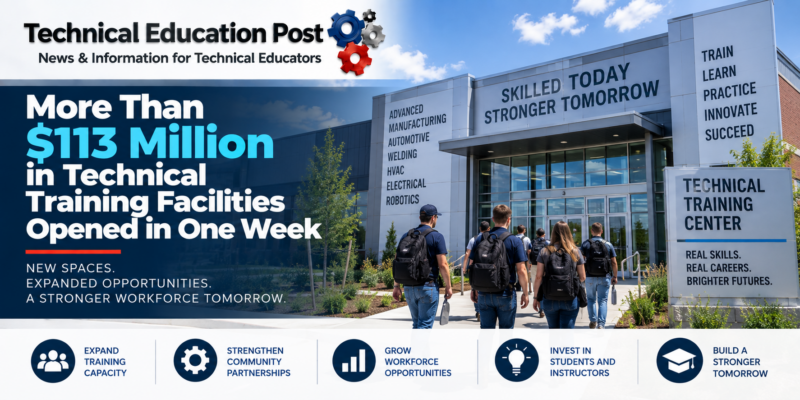
In the span of one week, new advanced manufacturing, automotive and semiconductor training facilities opened in Illinois, Nebraska, Florida and Idaho.
Three public-college projects alone represent at least $113.3 million in disclosed facility cost or state grant support, based on TechEd Magazine’s calculation from institutional announcements.
Elgin Community College opened an $88 million, 150,000-square-foot Manufacturing & Technology Center in Illinois.
Central Community College in Nebraska opened a $23 million, 42,000-square-foot Automotive Careers Training Center.
Florida State College at Jacksonville opened an advanced semiconductor training lab supported by a $2.3 million state capitalization grant.
Meanwhile, ABM opened a semiconductor technical-training center in Boise, Idaho, with capacity for approximately 500 participants annually at launch. No project-cost figure was disclosed in its announcement, so it is not included in TechEd Magazine’s $113.3 million calculation.
Individually, these are local workforce stories.
Together, they reveal something larger: hands-on training capacity is becoming strategic workforce infrastructure.
Key Takeaways
- ECC opened an $88 million manufacturing center September 24.
- Central Community College opened a $23 million automotive center.
- FSCJ opened a semiconductor learning lab backed by a $2.3 million state grant.
- ABM launched another semiconductor training center with roughly 500-participant annual capacity.
- New labs increasingly combine physical equipment, automation, data systems and simulation.
Elgin: 150,000 Square Feet for Advanced Manufacturing
ECC’s new center supports advanced manufacturing, robotics and automation, industrial maintenance, welding, HVAC, energy and green-energy technology.
The college says the facility includes approximately 55,000 square feet of advanced lab space and more than triples its previous capacity for hands-on technical learning.
That capacity issue deserves attention.
When technical programs develop waiting lists, instructor recruitment receives much of the attention.
Physical space can be an equally significant constraint.
A welding booth can train only so many students simultaneously. A robot cell requires floor space. Industrial maintenance training requires equipment. HVAC requires working systems.
Technical education cannot be infinitely scaled through lecture halls.
Florida: A Semiconductor “Learning Factory”
FSCJ’s new lab takes a different approach.
The facility uses Festo’s Semiconductor Learning Factory to simulate fab operations.
Students work with wafer-handling equipment, metrology and inspection tools, industrial robotics and manufacturing execution technology.
FSCJ says the system will support at least 15 engineering-technology courses and includes a 14-workstation cyber-physical manufacturing system.
The lab is noteworthy because semiconductor workforce development requires far more than electrical theory.
Technicians need exposure to automated production, process control, contamination awareness, metrology, robotics and safety procedures found in highly controlled manufacturing environments.
Nebraska: Automotive Training Becomes More Technical
Central Community College’s new Automotive Careers Training Center houses its automotive-technology and auto-body programs.
The building includes five classrooms, a welding laboratory, parts and tool areas and specialized storage.
Automotive instruction itself is also changing.
Modern technicians increasingly work with electronics, diagnostics, computerized networks, sensors and advanced vehicle systems alongside traditional mechanical tasks.
That means facility modernization is not simply about adding more service bays.
It involves building environments capable of teaching the electronic and digital systems now embedded in vehicles.
Idaho: Employers Are Building Training Capacity Too
ABM’s Boise facility adds another dimension.
The company says the semiconductor program combines classroom instruction, technical labs and virtual-reality simulation and is expected to accommodate about 500 participants annually at launch.
This matters because workforce education is no longer occurring solely inside colleges.
Manufacturers, contractors, equipment suppliers and workforce intermediaries are creating training infrastructure of their own.
The result is a more complex technical-education ecosystem.
Broader Trend: The Lab Is Becoming a Regional Asset
The most effective new technical facilities increasingly perform several roles.
They educate traditional students.
They support incumbent-worker training.
They host employer-designed short courses.
They provide space for apprenticeships.
They expose K–12 students to careers.
They allow companies to test or demonstrate technology.
And, increasingly, they combine physical machinery with simulation and digital systems.
The old distinction between “school lab” and “industry training center” is becoming less useful.
Practical Takeaways for Colleges Planning New Labs
Do not begin with equipment.
Begin with competencies.
Map the skills local employers require, then determine what physical and digital environments students need to demonstrate those competencies.
Design for modularity.
A million-dollar piece of specialized equipment can become an expensive monument if industry changes faster than the curriculum.
Measure utilization.
A sophisticated lab used six hours per week is difficult to justify. Facilities should support credit programs, noncredit training, employer upskilling and secondary-school partnerships when possible.
Plan lifecycle costs.
Installation is only the beginning. Software licenses, consumables, calibration, maintenance, replacement parts and instructor training can determine whether the lab remains modern.
And preserve hands-on learning.
Simulation can increase access and allow students to practice safely, but the strongest facilities this week are combining digital simulation with real physical equipment rather than treating one as a substitute for the other.
Questions to Ask Your Program
- Are current lab capacity limits restricting enrollment?
- Which equipment reflects actual regional workplaces?
- Can the facility support both students and incumbent workers?
- How will equipment be maintained and replaced?
- Can simulation reduce cost without eliminating hands-on competency?
- Are employers contributing equipment, expertise or curriculum validation?
Future Outlook
The new facilities opened this week suggest capital investment is following the growing strategic importance of technical workforce development.
Semiconductor fabrication, automation, skilled maintenance and increasingly complex vehicles all require workers whose abilities cannot be developed solely through online content.
Expect more institutions to combine physical training systems with simulation, digital twins, robotics and data-rich learning environments.
The winners will not necessarily be the institutions with the newest buildings.
They will be those that keep those buildings closely connected to rapidly changing employer requirements.
Frequently Asked Questions
How was the $113.3 million figure calculated?
It combines ECC’s disclosed $88 million facility cost, Central Community College’s $23 million facility and the $2.3 million Florida grant supporting FSCJ’s semiconductor lab. ABM’s facility is excluded because its announcement did not provide a project cost.
What programs does ECC’s new center support?
Areas include advanced manufacturing, automation and robotics, industrial maintenance, welding, HVAC and energy-related programs.
What is unusual about FSCJ’s semiconductor lab?
It simulates aspects of a semiconductor fabrication environment and integrates robotics, metrology, wafer handling and digital manufacturing systems.
Are employers opening training facilities too?
Yes. ABM’s new Boise semiconductor center is one current example.
Will VR replace hands-on technical labs?
The facilities highlighted this week suggest a hybrid model: simulation complements physical practice rather than eliminating it.
TechEd Magazine Perspective
Buildings do not solve skills shortages.
Capacity does.
The noteworthy part of this week’s construction announcements is that the facilities are increasingly designed not as classrooms with machinery, but as regional workforce platforms.
That model can justify major capital investment—provided colleges continuously update the programs, instructors and employer relationships operating inside them.