
In 2026, advanced technologies can automate the activities accounting for 57% of US work hours. That’s according to a report by McKinsey that explores the changing face of the nation’s workforce in an AI-enhanced world. Tech-Enabled Craftsmanship.
These technologies won’t be replacing human workers any time soon, with more than 70% of the skills sought by employers today being used in both automatable and non-automatable work. But employees will be expected to adapt their skill sets, work collaboratively with intelligent machines, and improve their digital literacy. This is evidenced by the fact that demand for AI fluency has grown sevenfold in the past two years, faster than any other skill in US job postings and across all industries.
As AI-powered technology increasingly performs complex workplace tasks, let’s explore the rise of tech-enabled craftsmanship.
What is Tech-Enabled Craftsmanship?
White-collar jobs are the most susceptible to disruption by automation technologies, which excel at repetitive, data-focused, and predictable cognitive tasks. In blue-collar industries, the complexity and variability of the practical work and high implementation costs make automation more challenging.
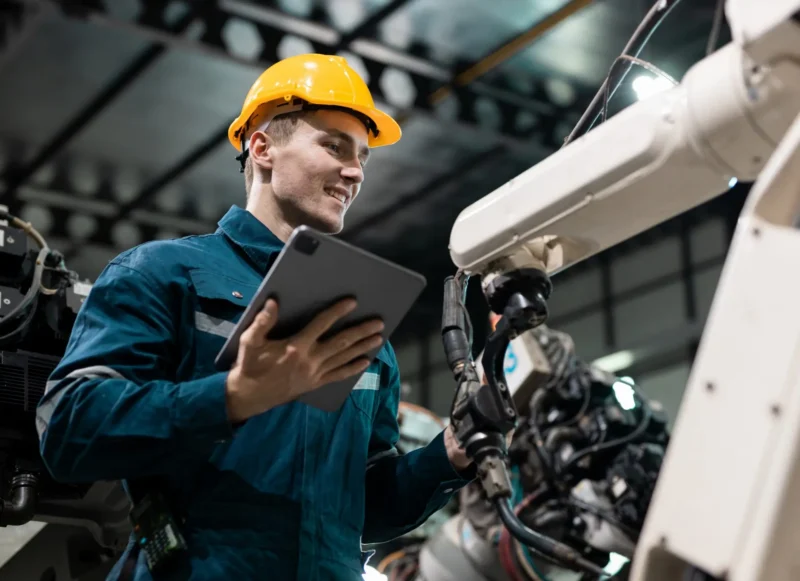
Nonetheless, change is coming to the industrial sector, as more workplaces adopt advanced systems and robots become capable of performing more precise and complex tasks. This is placing new expectations on industrial workers, who increasingly find themselves responsible for supervising automated processes, collaborating with robots, and operating complex machinery.
An emerging term, “tech-enabled craftsmanship,” describes the practice of industrial employees who are best positioned to adapt to these developments, seamlessly blending their practical vocation with digital expertise.
The perfect hybrid worker might have the specialized skill set and physical dexterity to operate, build, repair, assemble, cut, or weld, but they also work well alongside automated technologies and robots; problem solving in high-pressure environments, making difficult judgment calls, considering process optimization opportunities, integrating new workflows, troubleshooting intelligent systems, and performing quality control and maintenance activities.
Demand for this type of worker is growing rapidly. As of 2025, 90% of manufacturers have adopted “some form” of AI technology in their business operations, but they need to ensure they recruit the right talent to wield it. In a recent Opinium survey, 34% of manufacturing leaders said staff struggled to deploy AI due to a lack of skills, 31% found training the models harder than expected, and 30% had difficulty integrating AI with current business processes. With this in mind, it’s no surprise that industrial job descriptions increasingly reference a broad range of technical capabilities alongside critical human-centric skills.
What are the Most In-Demand Industrial Jobs in 2026?
Many of the most coveted industrial jobs in 2026 combine traditional manufacturing expertise with digital literacy.
This includes Maintenance Technicians and Hybrid Machine Operators, who use both mechanical and computerized systems; CNC Programmers and Machine Operators, who are in particular demand in the age of precision manufacturing; Quality Engineers, who use data analytics and automated testing to oversee the output of automated processes and make complex decisions; and Digital Maintenance Techs, who leverage traditional repair skills and technologies like smart maintenance software to maintain and fix digital devices.
Hybrid workers offer numerous benefits to industrial employers, driving operational efficiencies, enhancing product quality, and improving workplace safety. In turn, their employees can pursue more challenging and fulfilling roles, with much greater scope for career advancement.
Future-Proofing the Industrial Workforce
How can industrial employers and employees prepare for the rise of tech-enabled craftsmanship?
For employers…
- Hiring for Critical Skills: Tailor job descriptions and hiring processes to attract talent with cross-disciplinary or hybrid skills. Tech-enabled craftsmanship requires adaptable lifelong learners and problem-solvers who are comfortable working collaboratively with automated technologies.
- Partnering with Specialized Recruiters: Experienced tech recruiters have access to broader talent pools and can advise on how to attract, recruit, and retain qualified candidates
- Upskilling the Existing Workforce: Identify skills gaps and invest in tailored training programs and workshops. When workers receive the best tools and training, they are more engaged and motivated.
- Investing in Skilled Tech Professionals: Hybrid workers will benefit from the support of some highly-skilled tech professionals, who can implement new technologies, train AI solutions, and support the wider workforce.
- Fostering a Tech-Friendly Workplace Culture: Showcase the benefits and impacts of newly-implemented technologies, communicate long-term plans with the workforce, celebrate tech-related workforce achievements, and create safe spaces for people to experiment, fail, and provide feedback.
For employees…
- Upskilling and Reskilling: Participate in learning and development opportunities in the workplace, request employer funding to pursue additional certifications and qualifications, sign up for mentorship programs, and attend industry events and workshops.
- Developing Human Skills: The rise of automation in the industrial sector requires workers with a broad set of human skills, including problem-solving, decision-making, collaboration, critical thinking, and adaptability.
- Embracing Lifelong Learning: Continuous learning is a mindset, so it’s important to remain curious about and open to new technologies. Keep up to date with industry trends and technical innovations. Sign up for online webinars and courses, and engage with cross-functional teams to gain additional knowledge.
- Providing Feedback: Consider how newly implemented technologies are benefiting the workplace and any challenges they present. Sharing employee experiences helps employers fine-tune their technology.
- Pursuing Hybrid Roles: Take a leap of faith and seek employment opportunities that require human-machine collaboration. Gain valuable on-the-job experience, and prepare for long-term career success.
Long-Term Outlook
Automated technologies and robotics are slowly creating space for the next generation of industrial workers. Those with open minds and hybrid skill sets. There’s a long way to go until these professionals dominate the workplace. Most of the sector’s physical work still requires the superior dexterity, fine motor skills, and situational awareness of human beings. Currently, industrial robots can only perform tasks that occupy 13% of physical workplace activities.
The growth of tech-enabled craftsmanship also demands collaboration between industrial companies, equipment manufacturers, and educational institutions.
The Trimble Technology Lab was established at the University of Massachusetts Amherst. With the goal of giving construction students a well-rounded understanding of modern industry technologies. To set them up for long-term career success. The lab provides access to state-of-the-art equipment. Including laser building scanners, imaging rovers, Global Navigation Satellite System (GNSS) positioning receivers, and total stations. Since its inception, the program has expanded to 30-plus labs across 14 countries and has served around 12,000 students.
As technology further advances and more companies implement automated solutions and robotics, tech-enabled craftsmanship will come to the fore. Employers will invest in upskilling and reskilling their workforces while pivoting their recruitment strategies to attract digitally proficient talent.
Source: Tech-Enabled Craftsmanship
https://www.thomasnet.com/insights/the-rise-of-tech-enabled-craftsmanship/
Image credit: FOTO Eak/Shutterstock
https://www.techedmagazine.com/category/news-by-industry/