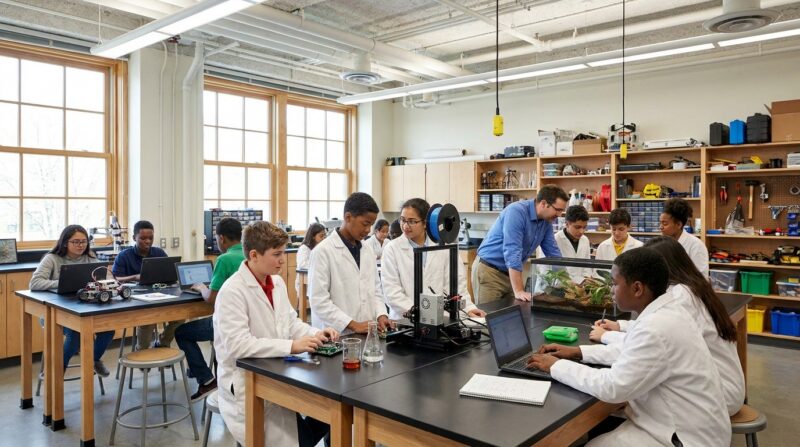
STEM classroom funding is not one grant category. It is a braided mix of federal, state, local, philanthropic, workforce, and institutional funds used to support science, technology, engineering, mathematics, computer science, robotics, cybersecurity, advanced manufacturing, health science, agriculture, and related career-connected learning.
For STEM educators and CTE leaders, the central question is not simply, “Where can we find money?” It is, “Which funding source fits the instructional purpose, compliance requirements, students served, and evidence of impact?”
A well-funded STEM program usually combines several funding streams:
- Formula funds, such as Title I, Title IV-A, IDEA, Perkins V, or state CTE allocations
- Competitive grants from federal agencies, state departments, foundations, or industry partners
- Local district funds, capital funds, bonds, or technology levies
- Workforce and economic development partnerships
- In-kind donations, equipment loans, mentorships, and dual-enrollment agreements
The best STEM funding plans begin with curriculum and labor-market needs, not with a shopping list. A robotics kit, CNC router, greenhouse sensor network, or biomedical simulation lab should be tied to standards, student outcomes, teacher capacity, safety, sustainability, and assessment.
Primary sources that should guide planning include the U.S. Department of Education, National Science Foundation, Institute of Education Sciences, U.S. Department of Labor, FCC E-Rate program guidance, state education agencies, Perkins V state plans, Next Generation Science Standards documentation, CSTA K–12 Computer Science Standards, Advance CTE resources, and local workforce data from state labor departments or the Bureau of Labor Statistics.
In exploring the importance of STEM classroom funding, it’s essential to consider the broader educational landscape, including alternative pathways to success in technology and engineering fields. A related article that delves into this topic is available at Tech Ed Magazine, which discusses non-degree pathways that can complement traditional education and provide students with valuable skills. This resource highlights how innovative funding and support can enhance these alternative routes, ultimately benefiting STEM education as a whole.
Why STEM Classroom Funding Matters Now
STEM demand is broader than “future jobs”
STEM funding is often justified through workforce projections, and that argument is valid. The U.S. Bureau of Labor Statistics continues to project strong growth in many STEM-related occupations, including data science, information security, health technologies, engineering technologies, and skilled technical fields.
But STEM classroom funding is not only about producing engineers or coders. It supports scientific literacy, quantitative reasoning, design thinking, digital fluency, and technical problem-solving across all pathways.
A middle school student using sensors to investigate water quality is building STEM literacy. A high school welding student interpreting a CAD drawing is applying mathematics and spatial reasoning. A biology student using statistical software to analyze environmental data is participating in authentic scientific practice.
Equity depends on access to equipment, time, and trained teachers
Unfunded STEM expectations widen opportunity gaps. Districts may adopt engineering standards or computer science requirements, but if some schools lack lab materials, devices, broadband, industry-aligned equipment, or trained teachers, implementation becomes uneven.
Funding matters because high-quality STEM instruction often requires:
- Consumable lab supplies
- Durable equipment
- Updated software and licenses
- Safe lab infrastructure
- Teacher professional learning
- Smaller group facilitation
- Industry-standard tools
- Transportation for work-based learning
- Partnerships with colleges or employers
- Technical support and maintenance
A STEM funding strategy should explicitly address who has access, who is participating, and who is completing advanced coursework or credentials.
CTE and STEM are converging
Modern CTE programs increasingly depend on STEM competencies. Advanced manufacturing uses robotics, measurement systems, materials science, and digital design. Agriculture programs use drones, GIS, sensors, and biotechnology. Health science programs use anatomy, data systems, simulation, and diagnostic reasoning.
Likewise, academic STEM courses benefit from CTE’s emphasis on applied learning, industry standards, safety protocols, credentials, and work-based learning. Funding plans should avoid separating “STEM” and “CTE” when the stronger approach is often an integrated program of study.
Major Sources of STEM Classroom Funding
Federal formula funds
Federal formula funds are allocated based on statutory criteria, not individual grant competitions. They are often the most reliable sources for multi-year STEM planning, though they come with strict allowability rules.
| Funding Source | Best Uses for STEM | Key Cautions |
||||
| Title I, Part A | STEM interventions, extended learning, supplemental materials for eligible schools or students | Must align with schoolwide or targeted assistance plans and supplement, not supplant, local obligations |
| Title IV-A Student Support and Academic Enrichment | Well-rounded education, educational technology, STEM enrichment, computer science, professional learning | District allocation size affects flexibility; technology infrastructure limits may apply |
| Perkins V | CTE programs of study, industry equipment, career exploration, work-based learning, credentials, teacher externships | Must align with CLNA, state plan, size/scope/quality requirements, and approved CTE programs |
| IDEA | Assistive technology, accessible STEM materials, supports for students with disabilities | Must be tied to IEP needs and special education requirements |
| E-Rate | Broadband, internal connections, network equipment, Wi-Fi | Does not usually fund general classroom devices or STEM equipment |
| USDA, DoD, NASA, NIH, NSF grants | STEM outreach, research experiences, rural learning, health science, teacher development | Competitive, specific eligibility, reporting expectations |
For CTE instructors, Perkins V is often the most direct federal source for equipment, program improvement, industry certification alignment, and career-connected STEM pathways. However, purchases should be grounded in the Comprehensive Local Needs Assessment, labor-market demand, stakeholder input, and the approved program of study.
Competitive federal grants
Competitive federal grants can fund innovation, scaling, research-practice partnerships, and specialized STEM initiatives. Examples include programs associated with the National Science Foundation, U.S. Department of Education Education Innovation and Research, NASA STEM engagement opportunities, NIH Science Education Partnership Award-type opportunities, and Department of Defense STEM initiatives.
These grants are rarely good fits for last-minute purchases. They often require evidence-based models, partnerships, evaluation plans, dissemination, institutional commitment, and detailed budgets.
A district seeking to buy 20 3D printers may not be competitive unless the equipment supports a coherent instructional model, documented need, professional development, and measurable outcomes.
State and local funding
State STEM funding varies widely. Many states fund computer science expansion, career pathways, equipment modernization, dual enrollment, apprenticeship, early college, or regional technical centers. State departments of education, workforce boards, and economic development agencies are often better sources than national grant databases.
Local funds remain essential. STEM labs require maintenance, replacement cycles, safety upgrades, and consumables that one-time grants rarely cover. District leaders should consider:
- Capital improvement plans
- Technology replacement cycles
- Bond proposals
- Local education foundations
- Career center equipment budgets
- Regional cost-sharing agreements
- Community college shared-use facilities
- Municipal broadband or infrastructure partnerships
Philanthropy and industry partnerships
Foundations and employers can be valuable STEM funding partners, but educators should maintain curricular control. Donations should not become product placement or narrow training for one employer unless aligned with a broader program of study.
Useful partner contributions include:
- Equipment donations with training and maintenance support
- Paid teacher externships
- Student transportation to job sites
- Mentorship programs
- Real-world design challenges
- Industry credentials or exam vouchers
- Guest instruction aligned to standards
- Advisory board participation
- Internship and apprenticeship pipelines
Before accepting donated equipment, ask whether it is current, safe, compatible, supported, and instructionally useful. “Free” equipment can become expensive if it requires special wiring, ventilation, proprietary software, repairs, or consumables.
Sure, here is the sentence with the clickable link:
I am passionate about the intersection of Education & Technology.
Building a STEM Funding Strategy That Holds Up
Start with the instructional problem
Strong STEM funding proposals define the learning gap before naming the product. For example:
Weak rationale: “We need a makerspace.”
Stronger rationale: “Our grade 6–8 students have limited opportunities to apply engineering design practices, and our current science sequence lacks tools for iterative prototyping, data collection, and computational modeling. We will implement a standards-aligned engineering design progression supported by teacher professional learning, low-cost prototyping materials, sensors, and shared fabrication tools.”
The second version is fundable because it connects resources to standards, teaching practice, and measurable student learning.
Align funding to standards and program requirements
For K–12 STEM, alignment may include:
- Next Generation Science Standards or state science standards
- State mathematics standards
- CSTA K–12 Computer Science Standards
- ISTE student and educator standards
- State CTE standards
- Industry-recognized credentials
- Career cluster frameworks
- Local graduation requirements
- Dual-enrollment course outcomes
- Safety standards and lab regulations
For CTE, alignment should also include the program of study, advisory committee feedback, labor-market need, and credential value.
Build a braided funding map
A braided funding map identifies which source pays for which component. This prevents overcharging one grant and helps sustain the program.
Example: Middle school robotics and automation pathway
| Component | Possible Funding Source | Notes |
||||
| Intro robotics kits | Title IV-A, local STEM funds, foundation grant | Use for broad access and exploratory STEM |
| Teacher professional learning | Title II-A, Title IV-A, Perkins if CTE-connected | Align to implementation plan |
| Career exploration modules | Perkins V, state career readiness funds | Connect to local automation careers |
| Competition fees | Local foundation, booster, business sponsorship | Avoid making competition the only access point |
| Network upgrades | E-Rate, district technology funds | E-Rate eligibility depends on category and rules |
| High school mechatronics equipment | Perkins V, state CTE equipment grant | Must connect to approved CTE program |
| Student transportation to employer site | Perkins V, state work-based learning funds, local funds | Check allowability and supervision requirements |
Budget for the full lifecycle
STEM classroom funding fails when districts fund the launch but not the lifecycle. Include:
- Initial purchase
- Installation
- Electrical, ventilation, storage, or safety upgrades
- Software licenses
- Consumables
- Replacement parts
- Calibration
- Warranties
- Teacher training
- Substitute coverage
- Student safety materials
- Accessibility adaptations
- Technical support
- Evaluation
- Replacement cycle
A $7,000 laser cutter may require ventilation, fire safety review, materials, maintenance, training, and supervision procedures. A biotech lab may require cold storage, consumables, PPE, disposal protocols, and recurring reagent costs. A drone program may require insurance, FAA-related training, local policies, and field supervision.
In the ongoing discussion about enhancing STEM education, the importance of adequate funding for classrooms cannot be overstated. A recent article highlights how various departments are working together to improve resources and support for educators. For more insights on this collaboration, you can read the article on the Departments of Education and Labor. This initiative aims to ensure that students have access to the tools and technologies necessary for a comprehensive STEM education, ultimately preparing them for future careers in these critical fields.
Practical Funding Examples by Program Type
Elementary STEM classrooms
At the elementary level, STEM funding should prioritize broad access, inquiry, math-science integration, and teacher confidence. Avoid overinvesting in complex tools that only a specialist can use.
High-value uses include:
- Measurement tools
- Simple sensors
- Engineering design materials
- Classroom science kits
- Outdoor investigation tools
- Math manipulatives connected to data analysis
- Age-appropriate coding tools
- Professional learning for classroom teachers
Assessment should focus on observation, student explanations, design notebooks, mathematical reasoning, and science practices.
Middle school STEM and career exploration
Middle school is the ideal stage for STEM identity development and career exposure. Funding should support exploration across multiple fields rather than premature tracking.
Effective investments include:
- Robotics and automation modules
- Environmental monitoring
- Computer science and physical computing
- Engineering design challenges
- Career exploration platforms
- Mobile STEM carts
- Interdisciplinary STEM units
- Field experiences
- Summer bridge programs
Middle school funding plans should track participation by student group. If advanced STEM electives disproportionately enroll already-advantaged students, the funding is not solving the access problem.
High school STEM and CTE pathways
High school funding often requires higher-cost equipment and stronger industry alignment. This is where Perkins V, state CTE grants, dual enrollment, and workforce partnerships become especially important.
Potential investments include:
- Advanced manufacturing equipment
- Cybersecurity labs
- Health science simulation tools
- Biotechnology equipment
- Engineering design software
- Agricultural technology systems
- Energy systems trainers
- Industry certification exams
- Work-based learning coordination
- Dual-enrollment course materials
The strongest proposals show how funding supports a coherent sequence: introductory course, concentrator course, capstone, credential, dual credit, internship, apprenticeship, or postsecondary transition.
Rural STEM programs
Rural districts often face high transportation costs, limited broadband, small staff, and fewer nearby industry partners. Funding strategies may need to emphasize regional collaboration.
Promising approaches include:
- Shared mobile labs
- Distance-enabled dual enrollment
- Regional CTE centers
- Grow-your-own STEM teacher pipelines
- Virtual mentoring with industry professionals
- E-Rate-supported connectivity upgrades
- Community college partnerships
- Local agriculture, energy, healthcare, or manufacturing alignment
Rural STEM proposals should document geographic barriers and explain why shared services, mobile equipment, or hybrid delivery are cost-effective.
Inclusive STEM and special populations
STEM funding must address accessibility from the start. Retrofitting is usually more expensive and less effective.
Consider:
- Adaptive lab equipment
- Accessible digital materials
- Assistive technology
- Tactile graphics and models
- Safety supports for students with disabilities
- Multilingual STEM vocabulary supports
- Transportation for students without reliable access
- Stipends or fee waivers for low-income students
- Gender-inclusive recruitment strategies
- Support for students in nontraditional CTE fields
For Perkins-funded programs, disaggregated data and special population performance matter. Funding should help remove documented barriers, not simply purchase equipment for students already succeeding.
In the ongoing discussion about enhancing STEM education, securing adequate funding for classrooms remains a critical issue. A recent article highlights how the manufacturing industry’s workforce shortage is closely tied to the need for improved educational resources in STEM fields. By addressing these funding gaps, we can better prepare students for future careers in technology and engineering. For more insights on this topic, you can read the article on the manufacturing industry’s challenges and its implications for education here.
Costs Educators Often Underestimate
Consumables
STEM classrooms consume materials. Filament, batteries, sensors, reagents, safety glasses, lumber, metal stock, fasteners, seeds, soil, gloves, slides, and replacement components should be budgeted annually.
A makerspace without consumables becomes a display room. A science lab without replacement materials becomes a worksheet classroom.
Professional learning
Teacher training is not optional. New STEM tools change classroom management, assessment, safety, pacing, troubleshooting, and lesson design.
Budget for:
- Initial vendor-neutral training
- Standards-based curriculum writing
- Teacher collaboration time
- Substitute coverage
- Coaching
- Externships
- Safety certification
- New teacher onboarding
Professional development should not be limited to “how to turn on the machine.” Teachers need to know how the tool deepens learning.
Facilities and safety
Facilities costs can exceed equipment costs. Before purchasing, check:
- Electrical capacity
- Ventilation
- Dust collection
- Fire suppression
- Secure storage
- Chemical storage
- ADA access
- Eye wash stations
- Network capacity
- Floor load
- Noise
- Supervision sightlines
- Insurance requirements
District facilities staff should review major STEM purchases before a grant is submitted.
Software and data privacy
Many STEM tools require cloud accounts, student logins, app integrations, or data storage. Curriculum directors and technology leaders should review:
- Student data privacy agreements
- Accessibility compliance
- Cybersecurity risks
- License renewal costs
- Device compatibility
- Offline functionality
- Age restrictions
- Exportability of student work
A low-cost software tool can become costly if it requires new devices, paid renewals, or extensive IT support.
Common Mistakes in STEM Classroom Funding
Buying equipment before designing instruction
The most common mistake is treating STEM funding as procurement rather than instructional improvement. Equipment should follow the curriculum design, not drive it.
Ask: What will students do differently because of this investment?
Funding competitions instead of classrooms
Robotics competitions, science fairs, and engineering challenges can be powerful. But if grant funds primarily support a small competitive team, the program may not improve STEM access broadly.
A stronger model uses competition as an extension of classroom learning, not as the main program.
Ignoring sustainability
One-year grants often create three-year obligations. If a program requires ongoing licenses, consumables, staffing, or transportation, leaders need a sustainability plan.
Grant reviewers often look for evidence that the program will continue after the award.
Overlooking teacher workload
STEM innovation frequently depends on unpaid teacher labor. That is not sustainable. Budget for planning time, stipends, coaching, and collaborative curriculum development.
Misaligning funds with allowability rules
Not every STEM purchase is allowable under every funding source. For example, Perkins purchases must connect to approved CTE programs and identified needs. Title I purchases must support eligible students and plans. E-Rate has specific eligibility rules. IDEA funds must support students with disabilities consistent with special education requirements.
When in doubt, involve the federal programs director, grants office, finance office, or state program contact before obligating funds.
Accepting obsolete donations
Industry donations can help, but outdated machines, unsupported software, or unsafe equipment can cost more than they save. Require a review process for donations.
A STEM Funding Readiness Checklist
Use this checklist before applying for a STEM grant or approving a major purchase.
| Question | Evidence to Gather |
|||
| What instructional gap are we addressing? | Assessment data, course access data, teacher feedback, curriculum review |
| Which students will benefit? | Enrollment projections, demographic data, special population analysis |
| Which standards or credentials are supported? | Standards crosswalk, program of study, credential list |
| Is the purchase allowable? | Grant guidance, state rules, district policy, finance approval |
| Do teachers have capacity to implement? | PD plan, coaching schedule, planning time |
| Are facilities ready? | Facilities review, safety checklist, installation estimate |
| What are recurring costs? | Consumables, licenses, maintenance, replacement parts |
| How will we measure impact? | Student work rubric, course data, credential attainment, survey tools |
| How will access be equitable? | Recruitment plan, transportation support, fee waivers, accommodations |
| What happens after the grant ends? | Sustainability budget, local match, replacement cycle |
Assessment Methods for Funded STEM Programs
Measure more than participation
Counting students served is necessary but insufficient. STEM funding should be evaluated through multiple measures:
- Course enrollment and completion
- Participation by student group
- Student work quality
- Standards-based performance tasks
- Credential attainment
- Dual credit completion
- Work-based learning participation
- Attendance and persistence
- Student STEM identity and belonging
- Teacher implementation evidence
- Postsecondary transition data
- Employer or advisory committee feedback
Use performance tasks
STEM learning is often best assessed through tasks that require students to investigate, design, model, compute, build, test, revise, and explain.
Examples:
- Design a water filtration prototype and justify material choices using data
- Program a sensor system to monitor greenhouse conditions
- Analyze local traffic data and propose an engineering solution
- Build and test a bridge model under defined constraints
- Use CAD to redesign a part for additive manufacturing
- Conduct a cybersecurity vulnerability analysis in a controlled lab
- Compare energy output from different solar panel configurations
Rubrics should assess content knowledge, technical skill, process, evidence use, collaboration, safety, and communication.
Track implementation fidelity
If a funded STEM initiative fails, leaders need to know whether the model was weak or implementation was incomplete.
Track:
- Teacher training completion
- Lesson implementation frequency
- Equipment usage
- Student access to tools
- Maintenance downtime
- Curriculum alignment
- Coaching participation
- Safety incidents
- Student work samples
Implementation data helps improve the program and strengthens future grant applications.
Connect assessment to funding renewal
Funders want evidence. Districts should prepare an annual STEM funding report that includes:
- Budget spent by category
- Students served
- Outcomes achieved
- Barriers encountered
- Adjustments made
- Sustainability needs
- Photos or artifacts when appropriate
- Stakeholder feedback
This report can support board presentations, grant renewals, local budget requests, and advisory committee meetings.
Grade-Level Considerations for STEM Funding
Elementary: access and curiosity
Elementary STEM funding should emphasize universal exposure. Avoid gatekeeping. Use funds to make investigation, measurement, coding, and design part of regular instruction.
Best-fit funding priorities:
- Classroom science materials
- Teacher professional learning
- Math-science integration
- Library/media STEM resources
- Outdoor learning tools
- Family STEM nights
- Early computational thinking
Middle school: exploration and identity
Middle school funding should help students see themselves in STEM fields. This is also the stage to disrupt stereotypes around engineering, computing, skilled trades, and advanced math.
Best-fit funding priorities:
- Exploratory STEM electives
- Career-connected projects
- Robotics and automation
- Coding and physical computing
- STEM clubs with broad access
- Field trips and virtual industry visits
- Summer camps for underrepresented students
High school: pathways and credentials
High school funding should support coherent sequences and postsecondary value. Equipment should match the level of technical skill expected in the pathway.
Best-fit funding priorities:
- CTE program equipment
- Lab modernization
- Dual-enrollment materials
- Industry certification exams
- Capstone projects
- Work-based learning coordination
- Advanced placement or advanced coursework support
- Apprenticeship-aligned instruction
Postsecondary transition
Curriculum directors should examine whether STEM investments connect to community college, technical college, university, apprenticeship, military, or direct employment pathways.
A funded high school program is stronger when students can leave with documented skills, credits, credentials, portfolios, or employer connections.
Questions to Ask Your Program
Use these questions with STEM departments, CTE advisory boards, grant teams, and district leadership.
- Which STEM learning opportunities are available to every student, and which are limited to selected groups?
- Where do we see participation gaps by gender, race, income, disability, English learner status, or geography?
- Which equipment purchases directly support standards, credentials, or program-of-study outcomes?
- What STEM tools are underused, and why?
- Do teachers have enough planning time and technical support to use funded resources well?
- Are consumables and maintenance included in the annual budget?
- What safety training is required before students use equipment?
- Which funding sources are one-time, and which are recurring?
- How do we know whether funded STEM activities improve student learning?
- What local workforce needs are supported by our STEM and CTE investments?
- Are industry partners contributing expertise, work-based learning, or only donations?
- What will we stop funding if evidence shows limited impact?
Funding Language That Strengthens Proposals
Use evidence-based framing
Grant proposals are stronger when they connect need, intervention, and outcomes.
Instead of: “Students need exposure to technology.”
Use: “Current course enrollment data show that only 18% of grade 8 students complete a hands-on engineering design experience before selecting high school pathways. The proposed middle school STEM sequence will provide all grade 7 students with three standards-aligned design challenges using sensors, coding, and data analysis, supported by teacher professional learning and common performance rubrics.”
Show alignment to workforce without narrowing education
Strong proposals use labor-market data carefully. Avoid claiming that every student will enter one occupation. Instead, explain how the program builds transferable technical and academic skills.
Example: “The advanced manufacturing pathway supports regional demand for technicians, machinists, engineering aides, and automation specialists while also strengthening mathematics, measurement, spatial reasoning, problem-solving, and technical communication.”
Include sustainability from the beginning
Reviewers know equipment wears out. Explain how the district will sustain the program through local budgets, Perkins allocations, state funds, partner contributions, or phased replacement.
Example: “Grant funds will support initial equipment and professional learning. Beginning in year two, consumables will be included in the CTE operating budget, and replacement parts will be supported through the district’s equipment lifecycle plan.”
What to Watch Next in STEM Classroom Funding
Computer science as a core funding priority
Many states are expanding computer science requirements, teacher endorsements, and K–12 standards. Funding will likely continue to support CS professional learning, curriculum adoption, cybersecurity pathways, and equitable access.
Watch for state-level CS implementation grants, regional training hubs, and credentialing support.
AI literacy and data science
Artificial intelligence is changing STEM funding priorities. Schools will need resources for AI literacy, data ethics, computational thinking, statistics, cybersecurity, and teacher training.
The best programs will not simply buy AI tools. They will teach students how AI systems work, where they fail, how data is used, and how to evaluate outputs critically.
Semiconductor, energy, and advanced manufacturing pathways
Federal and state workforce investments tied to semiconductors, clean energy, infrastructure, and manufacturing may create new opportunities for high school CTE, community college partnerships, and regional career pathways.
Districts should monitor workforce boards, state economic development agencies, and community college consortia.
Evidence and accountability
Funders increasingly expect measurable outcomes and evidence-based strategies. STEM programs that can document access, implementation, student learning, credentials, and transitions will be more competitive.
Districts should build data systems now rather than waiting until a grant report is due.
Shared regional models
Because advanced STEM equipment can be expensive, more regions may use shared labs, mobile units, career centers, community college facilities, and cross-district consortia.
This is especially relevant for rural districts and small high schools that cannot independently sustain specialized pathways.
FAQs About STEM Classroom Funding
1. What is the best grant for STEM classroom funding?
There is no single best grant. For CTE pathways, Perkins V is often a strong fit. For broad STEM enrichment, Title IV-A, state STEM grants, local foundations, and competitive grants may fit. For broadband and internal networks, E-Rate may apply. The best source depends on the purpose, students served, and allowable uses.
2. Can Perkins V funds pay for STEM equipment?
Yes, if the equipment supports an approved CTE program of study, aligns with the Comprehensive Local Needs Assessment, meets state and local rules, and supports size, scope, and quality. Perkins funds should not be used for general STEM purchases unrelated to CTE program requirements.
3. Can Title I funds support STEM?
Title I can support STEM when the activities are part of an approved schoolwide or targeted assistance plan and address the needs of eligible students. Examples may include supplemental STEM interventions, extended learning, or instructional materials. Districts must follow supplement-not-supplant and other federal requirements.
4. How should schools fund STEM consumables?
Consumables should be included in annual operating budgets whenever possible. Grants can sometimes launch a program, but recurring items such as filament, lab supplies, batteries, PPE, and replacement parts need a sustainable funding source. CTE programs should include consumables in program budgets.
5. Are STEM competitions a good use of grant funds?
They can be, but only when they support broader instructional goals and equitable access. A competition team serving 12 students may be less fundable than a classroom sequence serving all students, with competition as an extension activity.
6. How can rural schools compete for STEM funding?
Rural schools should emphasize documented access barriers, regional partnerships, shared equipment, virtual mentoring, mobile labs, distance dual enrollment, and alignment to local workforce needs. Many federal and state programs include rural priorities or recognize geographic barriers.
7. What evidence should a STEM grant proposal include?
Useful evidence includes student achievement data, course enrollment patterns, demographic access gaps, workforce data, advisory committee input, teacher capacity needs, standards alignment, and prior implementation results. Strong proposals include both need data and a clear plan for measuring outcomes.
8. Should schools accept donated STEM equipment?
Only after reviewing safety, instructional alignment, compatibility, maintenance, software, facility needs, and total cost of ownership. Donated equipment is not automatically useful. A district should have a formal review process before accepting high-cost or technical donations.
Final Takeaway
STEM classroom funding is most effective when it is treated as a long-term instructional investment, not a short-term purchasing opportunity. The strongest programs connect funds to standards, teacher capacity, student access, safety, assessment, workforce relevance, and sustainability.
For STEM educators, CTE instructors, school leaders, and curriculum directors, the practical path is clear: define the learning need, match the funding source, plan for total cost, measure implementation, and use evidence to improve. When funding decisions follow that sequence, STEM classrooms become more than well-equipped spaces. They become engines of rigorous, equitable, career-connected learning.