
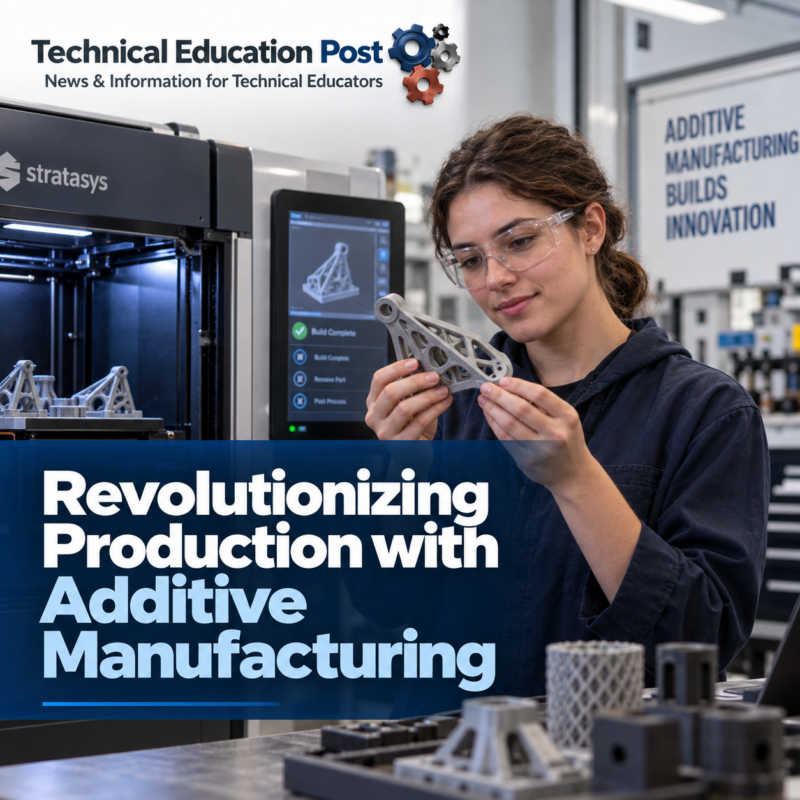
The landscape of modern manufacturing is in constant flux, driven by relentless innovation and the pursuit of greater efficiency, customization, and agility. Among the most transformative forces reshaping this landscape is additive manufacturing, often referred to as 3D printing. While the term “3D printing” might conjure images of hobbyist gadgets, its industrial applications are far more profound, revolutionizing how we design, produce, and distribute everything from intricate aerospace components to life-saving medical devices. This article delves into the core principles of additive manufacturing, its widespread impact on U.S. industries, and the opportunities it presents for professionals across various sectors.
Understanding the Fundamentals of Additive Manufacturing
Additive manufacturing is a process of creating three-dimensional objects by building them layer by layer from a digital design. This stands in stark contrast to traditional “subtractive” manufacturing methods, such as machining, where material is removed from a larger block to achieve the desired shape. Think of it like sculpting: subtractive manufacturing starts with a large block of stone and carves away material until the statue emerges. Additive manufacturing, on the other hand, is akin to building a sculpture brick by brick, or in this case, layer by microscopic layer.
The Core Principle: Layer by Layer Construction
At its heart, additive manufacturing relies on a digital model, typically created using Computer-Aided Design (CAD) software. This digital blueprint is then sliced into hundreds or thousands of thin, two-dimensional cross-sections. The additive manufacturing machine, guided by this sliced data, deposits or fuses material precisely according to each cross-section, one layer at a time, on top of the preceding one. As each layer solidifies, it fuses with the layer below, eventually forming a complete, solid three-dimensional object. This iterative process allows for unparalleled geometric complexity that is often impossible or prohibitively expensive with traditional methods.
Material Versatility: From Polymers to Metals
A key enabler of additive manufacturing’s broad applicability is the diverse range of materials it can process. Initially, the technology was largely confined to plastics and polymers, suitable for rapid prototyping. However, significant advancements have expanded its capabilities to include a wide array of industrial-grade materials.
- Polymers: These are the most common materials, ranging from basic thermoplastics like acrylonitrile butadiene styrene (ABS) and polylactic acid (PLA) used in desktop printers, to high-performance engineering plastics such as ULTEM™ and PEEK, which offer excellent mechanical properties, thermal resistance, and chemical inertness for demanding applications.
- Metals: The development of metal additive manufacturing has been a game-changer for industries like aerospace, automotive, and medical. Powders of metals like titanium, stainless steel, aluminum alloys, and Inconel are fused together using high-power lasers or electron beams.
- Ceramics: Specialized additive techniques are also being developed for technical ceramics, enabling the creation of components with high heat resistance, wear resistance, and electrical insulation properties.
- Composites: Increasingly, additive manufacturing is incorporating composite materials, such as carbon fiber-reinforced polymers, to achieve exceptional strength-to-weight ratios.
The choice of material is dictated by the specific performance requirements of the final part, including its strength, flexibility, temperature resistance, and biocompatibility.
The Digital Thread: Design to Production
Additive manufacturing is intrinsically linked to digital technologies, forming what is often called the “digital thread.” This begins with the design phase in CAD software, where engineers can leverage the freedom of additive manufacturing to create organic shapes, internal lattice structures, and complex geometries that optimize performance, reduce weight, and consolidate multiple parts into a single printed component.
Once the design is finalized, it’s processed by “slicer” software. This software interprets the 3D model and generates the machine code, defining the path of the print head or laser and the precise amount of material to be deposited at each layer. This digital workflow streamlines the entire production process, from concept to finished product, and facilitates easier iteration and customization.
Additive manufacturing continues to revolutionize the manufacturing landscape, and a related article that delves into the importance of education in this field is available at TechEd Magazine. The article discusses how a machine tool course is addressing the skills gap in the industry, which is crucial for the advancement of technologies like additive manufacturing. To learn more about this initiative and its implications for the future of manufacturing, you can read the full article here: Machine Tool Course Fills Gap.
The Impact and Advantages of Additive Manufacturing in U.S. Industries

The adoption of additive manufacturing in the United States is not merely an incremental improvement; it represents a fundamental shift in production paradigms, offering significant advantages across various sectors. Its ability to foster innovation, enhance supply chain resilience, and enable mass customization is driving its rapid growth.
Driving Innovation and Product Development
One of the most profound impacts of additive manufacturing is its acceleration of the innovation cycle. Traditional manufacturing processes often involve long lead times and high tooling costs, making rapid iteration and experimentation expensive. With additive manufacturing, designers and engineers can quickly print prototypes, test their designs, and make modifications in a matter of hours or days, rather than weeks or months.
Additive manufacturing continues to revolutionize various industries, and recent developments in educational funding are helping to advance this technology further. For instance, a significant donation to the GameAbove College of Engineering and Technology at Eastern Michigan University is aimed at enhancing engineering education and research, which includes a focus on innovative manufacturing techniques. This initiative highlights the importance of integrating advanced manufacturing practices into academic programs, as detailed in a related article that discusses the impact of such contributions on engineering education. You can read more about it in the article here: related article.
Enabling Mass Customization and Personalization
The “one-size-fits-all” approach is increasingly being challenged by the demand for personalized products. Additive manufacturing is perfectly suited for this, as each part can be unique without incurring significant additional costs. This is particularly relevant in fields like:
- Healthcare: Custom-fit prosthetics, orthopedic implants (e.g., hip and knee replacements), and dental aligners are prime examples where patient-specific geometries lead to better outcomes and comfort.
- Consumer Goods: Personalized footwear, eyewear, and even custom-designed jewelry are becoming more accessible.
- Automotive: Bespoke interior components or specialized performance parts can be manufactured on demand.
Enhancing Supply Chain Agility and Resilience
Recent global disruptions have highlighted the vulnerabilities of complex, geographically dispersed supply chains. Additive manufacturing offers a compelling solution by enabling localized, on-demand production.
- Reduced Lead Times: Instead of waiting weeks for parts to be shipped, components can be printed near the point of need, drastically reducing delivery times.
- Inventory Reduction: Companies can move away from large inventories of spare parts, printing them only when required, thereby reducing storage costs and obsolescence.
- Distributed Manufacturing: Factories can deploy additive manufacturing capabilities to produce critical components locally, lessening reliance on distant suppliers and mitigating risks associated with transportation delays or geopolitical instability.
- On-Demand Production: This is particularly valuable for legacy aircraft or specialized machinery where spare parts might be difficult or impossible to procure through traditional channels.
Reducing Material Waste and Improving Sustainability
Traditional manufacturing processes, especially those involving machining, can generate substantial amounts of scrap material. Additive manufacturing, by its very nature, uses only the material required to build the part, minimizing waste. This “lean manufacturing” approach aligns with growing environmental consciousness and can lead to significant cost savings by reducing raw material consumption and waste disposal fees.
Light-weighting and Performance Optimization
The ability to create complex internal structures, such as lattices and topologically optimized designs, allows engineers to significantly reduce the weight of components without sacrificing strength. This is critical in industries where weight is a primary concern, such as:
- Aerospace: Lighter aircraft consume less fuel, leading to substantial operational cost savings and reduced emissions. Additive manufacturing enables the creation of intricate, lightweight brackets, impellers, and structural components.
- Automotive: Reducing vehicle weight improves fuel efficiency (for internal combustion engines) or extends range (for electric vehicles), while also enhancing performance.
Common Additive Manufacturing Technologies and Processes

The term “additive manufacturing” encompasses a variety of technologies, each with its own strengths, material capabilities, and ideal applications. Understanding these differences is crucial for selecting the right process for a given manufacturing need.
Powder Bed Fusion (PBF)
This category is one of the most prevalent in industrial additive manufacturing, particularly for metals. A thin layer of powdered material is spread across a build platform. A high-energy source, such as a laser or electron beam, selectively melts and fuses the powder particles together according to the digital design. Unfused powder supports the structure, often eliminating the need for extensive support structures.
- Selective Laser Melting (SLM) / Direct Metal Laser Sintering (DMLS): These technologies use lasers to melt and fuse metal powders. SLM fully melts the powder, while DMLS sinters it (heats it to a point where particles bind but don’t fully melt), both achieving dense, strong parts. Common materials include stainless steel, titanium alloys, aluminum alloys, and nickel alloys.
- Electron Beam Melting (EBM): Similar to laser-based PBF but uses an electron beam in