
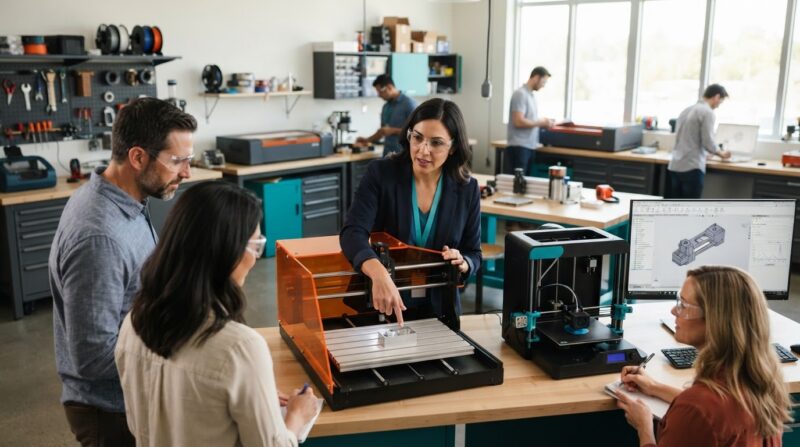
A Don Wood Foundation grant will support professional development for Indiana teachers and expand hands-on instruction in 3D printing, CNC machining, engineering design and advanced manufacturing.
Purdue Polytechnic Institute has received a $417,197 grant from the Don Wood Foundation to expand science, technology, engineering, arts and mathematics (STEAM) education across Indiana.
The award, announced November 20, 2026, will support Purdue’s Teachers and Researchers Advancing Integrated Lessons in STEM (TRAILS) program. Over three years, the initiative aims to reach as many as 5,000 middle and high school students and provide professional development for up to 45 teachers.
The funding emphasizes northeastern Indiana and reflects growing recognition that educators need direct experience with advanced manufacturing tools before introducing those technologies to students.
Teachers Will Learn CNC Machining and Additive Manufacturing
Participating middle and high school teachers will take part in summer professional development at Grace College in Winona Lake, Indiana.
Up to 15 educators each year will receive instruction in computer-aided design (CAD), 3D printing, computer numerical control (CNC) machining, environmental science and engineering design.
Teachers will also gain access to curriculum materials, industry experts and a network of peers to help them apply the training in their classrooms.
The emphasis on instructor preparation addresses a persistent issue in technical education: equipment purchases alone cannot make a program successful if teachers lack confidence in operating machinery or designing lessons around it.
Engineering Design Projects Connect STEAM Disciplines
TRAILS uses a fishing-lure engineering project to introduce biomimicry, the process of studying nature for ideas that can be used to solve design and engineering problems.
Students work in teams to research, design, build and evaluate prototypes. The project also connects to northern Indiana’s manufacturing history, including companies associated with fishing-lure production.
The activity allows teachers to integrate science, mathematics, engineering, design and technology within a single applied challenge.
Alongside technical concepts, students practice collaboration, communication and iterative problem-solving—skills relevant to both technical training and the workplace.
TRAILS Builds on Earlier National Science Foundation Support
Purdue launched TRAILS in 2016 with support from the National Science Foundation. The program has since received more than $3 million in NSF funding and expanded to other states and U.S. territories.
The new Don Wood Foundation award brings an established model back to Indiana classrooms with a targeted emphasis on manufacturing career awareness.
The project is led by Purdue professor Todd Kelley with support from additional Purdue faculty and partners including Grace College and Learning Undefeated. The latter is expected to develop three manufacturing career-profile videos.
Why Teacher Development Is a Workforce Investment
Advanced manufacturing technologies are becoming more visible in middle and high school laboratories, but teachers must be able to connect equipment to age-appropriate academic standards and safe instructional activities.
Professional development can help educators explain why CNC machining and additive manufacturing matter, how design decisions affect production, and what kinds of careers use these technologies.
It can also improve the long-term value of school equipment by reducing dependence on a small number of technically experienced staff members.
For CTE administrators, the Purdue initiative illustrates the value of building grant proposals around curriculum, teacher preparation and student career exploration—not merely the purchase of machines.
The longer-term measure of success will be whether participating educators sustain the lessons and help students identify meaningful pathways into technical education and manufacturing careers.
Source: Purdue Polytechnic Institute, November 20, 2026.