Pennsylvania’s latest workforce investment will support 19 training projects across 16 counties, connecting students and adult learners with advanced manufacturing, automation, CNC technology and industry-recognized credentials.
Pennsylvania is expanding its investment in manufacturing workforce development with more than $2.67 million in newly announced grants designed to help schools, community colleges, apprenticeship providers and workforce organizations prepare workers for technical careers.
Announced November 20, 2026, by the Pennsylvania Department of Community and Economic Development and Department of Labor & Industry, the funding includes 19 awards distributed across 16 counties through the Manufacturing PA Training-to-Career Grant Program.
The initiative supports a range of activities, from career exploration for high school students to hands-on instruction in robotics, manufacturing technology and industrial fabrication. For career and technical education leaders, the investment offers several examples of how states can connect classroom instruction with regional workforce needs.
Robotics and Automation Training Receive Support
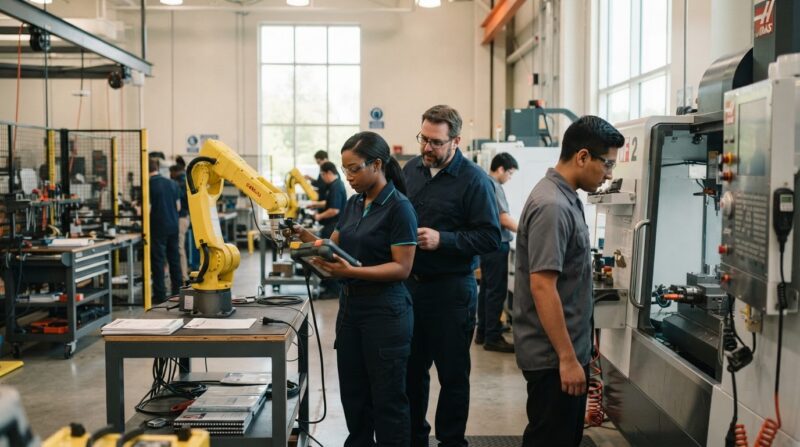
One of the notable awards will support Central Westmoreland Career and Technical School, which received $200,000 to expand its Robotics, Engineering, and Manufacturing program.
The project is designed to prepare 100 students for careers involving robotics, automation, precision manufacturing, technical troubleshooting and applied problem-solving.
The program illustrates the increasing importance of integrated technical education. Modern manufacturing technicians frequently work with interconnected mechanical, electrical and digital systems. Training programs must therefore prepare students to understand how individual technologies function together.
A strong foundation in robotics and manufacturing can support further education and career opportunities in industrial maintenance, automated production, engineering technology and related occupations.
CNC Laser Technology Becomes an Apprenticeship Priority
The Sheet Metal Workers’ Local 19 Joint Apprenticeship and Training Committee received $173,510 to develop a laser-cutting technology training program.
Apprentices and experienced workers will study the operation of advanced CNC laser-cutting equipment, including CAD design, machine programming, production workflows, material utilization and quality control. The curriculum will also address productivity improvement and cost estimating.
These skills matter because advanced manufacturing increasingly requires workers who can do more than operate equipment. Technicians must understand digital production instructions, recognize process errors, use materials efficiently and help maintain consistent production quality.
For technical educators, this reinforces the value of combining practical machine operation with digital design, measurement and manufacturing mathematics.
Community Colleges Expand Short-Term Career Pathways
Northampton Community College received $196,149 to provide an eight-week manufacturing training program.
The 160-hour initiative is intended to serve 30 unemployed or underemployed individuals, introducing foundational manufacturing competencies, stackable credentials and apprenticeship opportunities.
Short-term training can be particularly valuable for adults seeking career changes or opportunities to reenter the workforce. However, the long-term value of these programs depends on whether participants can progress into employment, advanced credentials or additional education.
Programs that combine technical instruction with employer relationships and recognized credentials may offer stronger pathways than isolated training courses.
Thousands of High School Students Will Explore Manufacturing Careers
The Greater Wilkes-Barre Chamber of Commerce received $199,975 for its Luzerne Works Manufacturing Career Pathway initiative.
Over two years, the project is expected to reach more than 8,000 students, with 150 high school juniors and seniors targeted for manufacturing credential opportunities.
Another $200,000 award will help the Community Education Center of Elk and Cameron Counties connect approximately 550 students across five rural school districts with manufacturing employers through site visits, internships, mentoring and career exploration.
These programs address an important challenge: students cannot pursue technical careers they have never had an opportunity to understand. Earlier exposure to manufacturing workplaces may help students identify career options and make better-informed decisions about education and training.
What the Investment Means for Technical Education
Pennsylvania’s latest grants reflect a broader approach to workforce development. Instead of treating career education, apprenticeship and employment as separate stages, the projects emphasize connections among schools, colleges, employers and industry organizations.
The grants also highlight several priorities for successful CTE programs: relevant equipment, practical instruction, employer engagement and credentials that employers recognize.
The state reports that it has invested more than $17 million through the Manufacturing PA Training-to-Career program since 2023 to help train more than 4,000 Pennsylvanians.
The immediate significance of the November funding is the expansion of available programs. The longer-term test will be whether those programs produce measurable improvements in skills, credential attainment, employment and career advancement.
For educators and workforce administrators nationwide, Pennsylvania’s initiative provides practical examples of how targeted investments can strengthen the transition from technical education into skilled employment.
Source: Pennsylvania Department of Community and Economic Development, November 20, 2026.