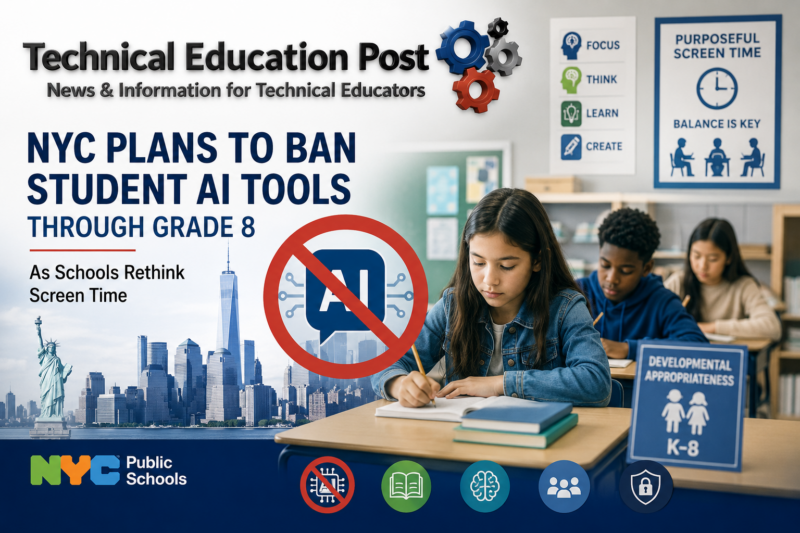
New York City is preparing to draw one of the clearest age-based boundaries yet around artificial intelligence in American public schools.
The nation’s largest school system is expected to prohibit student-facing generative AI tools for children from 2-K through eighth grade, according to reporting by Chalkbeat based on four people briefed on the plans and New York City Public Schools documents. The restrictions would cover tools such as generative-AI chatbots and AI tutors used directly by younger students.
The development represents a significant turn in the national conversation over artificial intelligence in education.
Rather than asking simply whether schools should embrace or prohibit AI, New York City is moving toward a more nuanced question:
At what age—and for what educational purpose—should students interact directly with artificial intelligence?
That distinction matters.
NYC Public Schools has already established that AI should support rather than replace teachers and human judgment. Its existing guidance also says appropriate AI use differs across K–5, grades 6–8 and grades 9–12, and specifically identifies developmental appropriateness, screen time and the balance between AI-supported and independent work as issues requiring different approaches by age.
The expected restrictions would turn that principle into something much more concrete.
For younger students, AI literacy may increasingly mean learning how artificial intelligence works without routinely outsourcing learning to it.
For high school students, the equation could be very different as AI becomes an increasingly important college, career and workforce competency.
Key Takeaways
- New York City is expected to prohibit student-facing generative-AI tools from 2-K through eighth grade, according to Chalkbeat.
- The restrictions would include technologies such as AI chatbots and AI tutors used directly by students.
- NYC Public Schools already uses a risk-based Traffic Light Approach to determine which AI applications are prohibited, restricted or potentially appropriate.
- Existing NYCPS guidance explicitly recognizes that appropriate AI use differs across K–5, grades 6–8 and grades 9–12.
- The district is also examining screen time, cognitive offloading and the balance between AI-supported and independent student work.
- For high school students, NYCPS emphasizes preparation for a world in which AI is already influencing careers and industries.
- The emerging model could establish an important distinction between AI literacy and unrestricted AI access.
Editor’s Note: As of publication, the reported 2-K–8 restrictions had not yet appeared in the publicly accessible NYCPS guidance reviewed by Technical Education Post. Details of the forthcoming policy are therefore attributed to Chalkbeat’s September 2 reporting. NYCPS’s existing official guidance independently confirms that the district is developing differentiated, age-appropriate AI rules across grade bands.
What New York City Is Planning
According to Chalkbeat, New York City Public Schools is expected to release rules prohibiting student-facing AI tools for students in 2-K through eighth grade.
That would encompass early childhood programs, elementary schools and middle schools.
The restrictions are expected to prevent younger students from directly accessing generative-AI applications such as chatbots and AI tutors through the school system.
That does not mean New York City is rejecting artificial intelligence.
Quite the opposite.
NYCPS’s existing policy framework acknowledges that students are growing up in an AI-enabled society and that schools have a responsibility to prepare them for it.
But the district’s philosophy places an important condition on that preparation:
Technology must serve learning rather than define it.
NYCPS says students need strong instruction, meaningful practice and educators capable of determining when AI belongs in learning—and when it does not.
That distinction is likely to become increasingly important nationally.
AI Literacy Does Not Necessarily Mean AI Access
One of the most important ideas emerging from New York City’s approach is that AI literacy and AI access are not the same thing.
A student can learn:
- what artificial intelligence is;
- how algorithms influence information;
- why AI sometimes generates incorrect answers;
- how AI systems can reflect bias;
- how personal information should be protected;
- how AI is changing careers;
- how to critically evaluate AI-generated information;
without necessarily being given unrestricted access to a generative-AI chatbot.
For younger children in particular, those may be very different educational objectives.
NYCPS’s existing guidance makes this distinction implicitly.
The district says younger learners should develop critical-thinking and digital-literacy skills, while high school students need preparation for a world in which AI is already reshaping careers and industries.
That creates the foundation for an age-based AI strategy.
Elementary and Middle School
The priority may be developing foundational skills, independent thinking, digital literacy and understanding what AI does.
High School
The emphasis can increasingly expand toward responsible AI use, research, productivity, technical applications and career preparation.
That distinction could provide a useful model for districts struggling with blanket AI policies.
The Cognitive Offloading Problem
New York City’s existing AI guidance raises another issue that deserves particular attention: cognitive offloading.
The concern is straightforward.
If students use artificial intelligence to perform intellectual tasks they are supposed to be learning to perform themselves, AI may improve the immediate product while undermining the learning process.
Consider a middle school student learning to write an argument.
An AI system can generate a thesis.
It can organize supporting evidence.
It can suggest transitions.
It can rewrite weak sentences.
It can correct grammar.
Those capabilities are useful.
But if the educational objective is for the student to learn how to construct an argument, delegating those steps to AI may eliminate precisely the intellectual work the assignment was designed to develop.
NYCPS says effective AI integration must preserve that intellectual work and is developing guidance intended to ensure AI supports rather than substitutes for student thinking.
That may ultimately prove more important than the question of whether a particular chatbot is allowed.
Screen Time Enters the AI Debate
Artificial intelligence is also becoming intertwined with another education technology debate: screen time.
For years, discussions about classroom technology frequently operated under an assumption that greater digital access represented educational progress.
That assumption is becoming more complicated.
Schools are now asking whether every activity benefits from being digital.
Should students read a physical book or a digital text?
Write notes by hand or type them?
Solve a problem independently or ask an AI tutor?
Work through confusion or immediately request an AI-generated explanation?
Those decisions involve more than screen-time minutes.
They concern what students are doing cognitively while they are using technology.
NYCPS says it is developing differentiated guidance based partly on screen exposure and the balance between AI-assisted and independent work.
That creates a potentially important shift.
The next generation of school technology policy may focus less on maximizing device access and more on determining when technology genuinely improves learning.
Why Age Matters
A single AI policy for every student from preschool through twelfth grade is increasingly difficult to justify.
A four-year-old, a seventh grader and a high school senior have dramatically different educational and developmental needs.
The same AI tool can therefore have very different implications.
A high school engineering student might appropriately use AI to help analyze data from a robotics project.
A career and technical education student might use AI to troubleshoot a manufacturing process.
A high school computer-science student might evaluate an AI model for bias.
Those activities can develop skills relevant to college and careers.
The educational value of giving a young elementary student routine access to a generative-AI chatbot is less clear.
NYCPS explicitly acknowledges that the appropriate role of AI differs among K–5, 6–8 and 9–12 students.
That may seem obvious.
But it represents an important departure from the way educational technology has sometimes been deployed.
Instead of asking whether a product is appropriate for “K–12,” districts may increasingly need to ask:
Appropriate for whom, at what age, performing what task, for what educational objective?
New York City’s AI Traffic Light
The expected age restrictions fit within a broader governance structure NYCPS has already established.
Its Traffic Light Approach for AI Use organizes applications according to risk.
Red: Do Not Proceed
Some AI uses are prohibited entirely.
NYCPS says AI cannot make decisions involving student placement, discipline, eligibility, promotion, graduation or program access.
AI also cannot develop IEPs or Section 504 plans, determine what students know for grading purposes, or perform prohibited behavioral monitoring and student surveillance.
Higher-Scrutiny Uses
Other applications require human judgment and safeguards.
The underlying principle is that the consequences of an AI-assisted action matter when determining how much oversight is necessary.
Lower-Risk Applications
AI can potentially support appropriate instructional and administrative work when it meets district requirements and educators remain responsible for decisions.
The important point is that New York is not treating AI as inherently good or bad.
It is treating different applications as presenting different levels of risk.
Adding age to that framework makes it substantially more sophisticated.
Privacy Is Another Barrier to Unrestricted AI Use
Student-facing AI raises privacy questions as well.
NYCPS requires AI tools that process student data to pass its Enterprise Request Management Application, or ERMA, compliance review.
The process examines data-processing agreements, security, cloud infrastructure, privacy and legal compliance.
NYCPS explicitly states that tools that have not completed the compliance review are not approved for use with student or staff data.
That matters because generative-AI applications can collect significant information through ordinary conversation.
A student might tell an AI tutor:
- their name;
- their school;
- their age;
- academic difficulties;
- disability-related information;
- emotional concerns;
- family circumstances.
Young students may not understand the implications of sharing that information.
Consequently, age-appropriate AI policy is also a student-data policy.
High School Could Be a Different Story
Perhaps the most interesting part of New York City’s emerging framework is what happens after eighth grade.
High schools face a competing responsibility.
They must protect student learning while also preparing students for college and employment environments in which AI is rapidly becoming commonplace.
That is particularly relevant to CTE.
Students entering fields such as:
- advanced manufacturing;
- cybersecurity;
- engineering;
- information technology;
- business;
- healthcare;
- design;
- logistics;
are increasingly likely to encounter AI-supported systems.
A blanket prohibition extending through high school could therefore leave students poorly prepared for the workplace.
NYCPS appears to recognize that tension.
Its family messaging specifically distinguishes younger students developing critical-thinking and digital-literacy skills from high school students preparing for a world where AI is already shaping careers and industries.
That distinction could become a useful national framework:
Protect foundational learning first. Introduce AI progressively. Develop responsible professional use before graduation.
What This Means for CTE
Career and technical education adds another dimension.
A welding student using AI to write an essay is one question.
A manufacturing student using AI to analyze production data is another.
A cybersecurity student investigating AI-generated threats is another.
A health-science student using AI to understand how clinical systems operate is yet another.
The educational objective matters.
For CTE leaders, the challenge will be ensuring that age-appropriate AI restrictions do not prevent students from learning about technologies that are genuinely becoming part of their occupations.
That argues for purpose-specific AI education rather than generic chatbot access.
Students should encounter artificial intelligence because it supports a defined technical competency—not simply because an AI tool is available.
Teachers Remain Central
Another consistent theme throughout NYCPS’s official guidance is the role of the educator.
AI is not considered a replacement for teachers, counselors or school leaders.
Human review is required.
Professional judgment remains central.
That principle becomes particularly important with younger students.
An AI tutor may provide an answer.
A teacher understands why a child is struggling.
An algorithm may identify an error.
A teacher can understand the misconception behind it.
AI can generate another explanation.
An educator can recognize that the student is frustrated, distracted, confused or simply needs more time.
Those are different capabilities.
The strongest educational applications of AI may therefore be those that increase a teacher’s ability to help students rather than attempt to replace the relationship altogether.
Questions to Ask Your District
As districts reconsider student AI policies, administrators and technology leaders should ask:
- Do we have different AI expectations for elementary, middle and high school students?
- Which student-facing AI tools are currently accessible?
- Have those tools undergone privacy and security review?
- What information can students enter into AI systems?
- Do teachers understand tool-specific age restrictions?
- Are we teaching AI literacy or merely providing AI access?
- Which intellectual tasks should students always learn to perform independently?
- When does AI assistance become cognitive substitution?
- How does AI use affect classroom screen time?
- Are students receiving enough opportunities for reading, writing, discussion and problem-solving without digital assistance?
- What AI skills will high school graduates actually need in college and employment?
- How should AI expectations differ in CTE programs?
- Are families informed about student-facing AI?
- Who approves new AI tools?
- How will we evaluate whether AI actually improves student learning?
What Educators Should Watch Next
The Final NYCPS Policy
This is the immediate development to watch.
The specific 2-K–8 restriction is currently supported by reporting from Chalkbeat rather than the publicly accessible NYCPS guidance reviewed for this article. The district’s final published rules will determine precisely how the restriction operates.
High School AI Rules
If younger students are prohibited from using student-facing generative AI, the rules for grades 9–12 become particularly important.
Will high school students have broad access?
Teacher-directed access?
Course-specific access?
Career-oriented access?
The answer could shape how other districts approach age-based AI policy.
AI Tutors
AI tutoring is likely to become a major policy battleground.
The technology offers potentially powerful individualized assistance, but also raises questions about accuracy, dependency, privacy and the role of human educators.
Cognitive Offloading
Expect this phrase to become increasingly important in education policy.
The central issue is whether AI is helping students perform intellectual work or performing that work for them.
Screen Time
AI policy and screen-time policy are likely to converge.
Districts may increasingly evaluate digital tools according to the quality of the learning experience rather than simply the amount of technology available.
Frequently Asked Questions
Is New York City banning AI in schools?
No. The reported policy concerns student-facing generative AI for students through eighth grade, not all uses of artificial intelligence throughout NYC Public Schools. NYCPS already maintains a broader framework for evaluating and governing AI.
Which students would be affected?
According to Chalkbeat’s September 2 reporting, the planned restriction covers students from 2-K through eighth grade.
Would AI chatbots be banned for younger students?
According to the reporting, yes. Student-facing generative-AI applications such as chatbots and AI tutors would be covered by the restriction.
Does the policy ban teachers from using AI?
The reported student restriction should not be interpreted as a blanket prohibition on educator AI use. NYCPS already maintains a broader risk-based framework governing appropriate and prohibited applications.
Why is NYC treating age groups differently?
NYCPS says appropriate AI use differs across K–5, grades 6–8 and grades 9–12 and is developing guidance around developmental appropriateness, screen time and the balance between AI-supported and independent work.
What is cognitive offloading?
In this context, cognitive offloading occurs when technology performs intellectual work that a learner would otherwise need to perform. NYCPS says its developing guidance is intended to ensure AI supports rather than substitutes for student thinking.
Can AI make decisions about NYC students?
Certain applications are expressly prohibited. NYCPS says AI cannot make decisions about placement, discipline, eligibility, promotion, graduation or program access.
Can AI grade students?
NYCPS states that the educator of record determines what a student knows and AI-generated information is advisory rather than determinative.
Does NYC review AI tools for student privacy?
Yes. AI tools involving student data must go through NYCPS’s compliance-review process, which includes privacy and security requirements.
Will high school students still be able to use AI?
The reported 2-K–8 restriction does not establish a comparable blanket prohibition for grades 9–12. The precise rules for high-school student use should be confirmed from NYCPS’s final grade-band guidance once published.
TechEd Magazine Perspective
New York City’s approach could help resolve a false choice that has dominated much of the AI-in-education debate.
Schools do not have to choose between embracing AI everywhere and banning AI everywhere.
Age matters.
Purpose matters.
The intellectual task matters.
A second grader learning to write a paragraph and a high school manufacturing student analyzing machine data are not performing the same educational activity.
They should not necessarily operate under the same AI rules.
That is why New York City’s emerging approach deserves attention well beyond the five boroughs.
The most important question may no longer be:
Should students use AI?
A better set of questions is:
At what age?
For what purpose?
Under whose supervision?
What should students already know how to do independently?
What educational benefit does AI provide?
And perhaps most importantly:
Is the technology helping the student think—or thinking for the student?
The answer will differ by grade, subject and learning objective.
That is not a weakness in AI policy.
It may be the beginning of a much more mature one.
Recommended Reading
School Screen-Time Policies Move Beyond Cellphone Bans — Technical Education Post’s examination of the shift from simply regulating phones toward evaluating purposeful use of school-issued technology and digital learning.
Using AI in Schools — Additional Technical Education Post coverage of responsible artificial-intelligence integration in education.
AI Tools and Training in the Classroom — How teacher preparation and professional development are becoming essential components of school AI adoption.
Read AI Tools and Training in the Classroom
Sources
NYC Public Schools — Guidance on Artificial Intelligence
NYC Public Schools — Full AI Guidance
Chalkbeat — NYC to Ban Student AI Tools in 2-K Through 8th Grade
NYC Public Schools — March AI Guidance Announcement