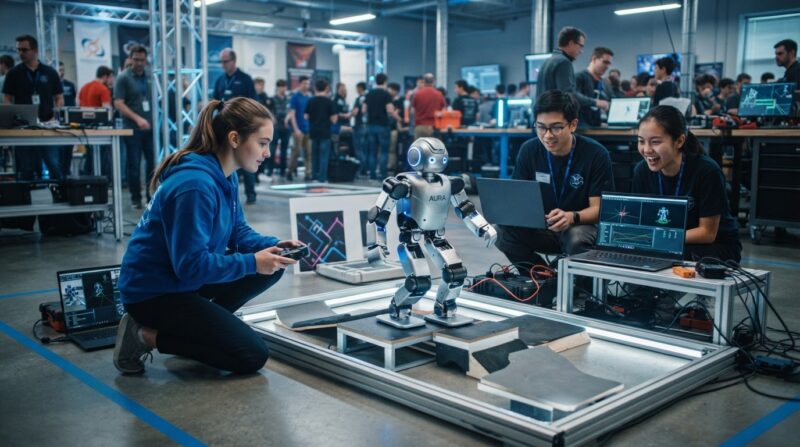
High school teams in South Korea used NVIDIA Isaac Sim and reinforcement learning to train robots for a national competition, demonstrating an emerging approach to teaching artificial intelligence, engineering and robotics.
A recent student robotics competition in South Korea is offering a glimpse of how sophisticated artificial intelligence tools can become part of secondary technical education.
The NAVER Connect Foundation reported November 23, 2026, that it had completed the NAVER Connect Robotics Cup 2026, a high school robotics competition supported by NVIDIA and South Korea’s Ministry of Education.
Finalists used the same broad family of robotics and simulation technologies while developing their own strategies for how robots should move through challenging environments.
For career and technical educators, the event illustrates a shift from simply writing instructions for robots toward training, testing and refining systems that learn from experience.
Students Used NVIDIA Isaac Sim to Train Robot Movement
Four finalist teams met November 22 at NAVER’s Green Factory headquarters after advancing through online qualifying rounds.
Students spent approximately four months using NVIDIA’s Isaac Sim environment to train robot movement through reinforcement learning.
Reinforcement learning is a machine-learning method in which an agent improves its behavior by repeatedly interacting with an environment and receiving feedback about the results.
In a robotics classroom, that can mean testing different approaches to walking, maintaining balance, negotiating obstacles and responding to changes in terrain.
Although competitors worked with comparable robot models, their software strategies produced different performance outcomes, including differences in movement speed, stability and the ability to handle stairs or slopes.
Students therefore had to think like experimental engineers: define a goal, evaluate evidence, change an approach and test again.
Simulation Extends What Students Can Practice
Many high school robotics programs rely on physical kits and programmed behaviors. Those experiences remain valuable, but simulation adds another dimension.
Virtual environments allow students to test strategies and evaluate outcomes before using the same techniques with physical systems or real-world constraints.
The NAVER Connect Foundation also provided cloud-based robotics training resources and educational content to participants, helping reduce the need for every school to own expensive computing equipment.
Simulation is not a substitute for physical testing. Differences between virtual models and actual hardware can create challenges involving friction, sensors, balance and mechanical response.
Teaching students to understand those differences is part of preparing them for sophisticated automation careers.
Winning Teams Receive More Resources
The ODYSSEY team earned the competition’s top award, according to reporting published November 23.
NAVER Connect Foundation said it planned to supply schools associated with the top eight teams with AI research stations that include three high-performance desktop computers each.
The foundation also planned to share student research data as open source, giving participants and educators material that may help support future learning.
These follow-on resources matter because robotics education benefits from sustained experimentation, not only a single competition.
Why It Matters to American CTE Programs
For U.S. technical education programs, the competition offers several curriculum ideas without requiring schools to duplicate the event.
Students could begin by comparing rule-based programming with machine-learning methods, exploring how different training conditions influence performance and documenting what a simulation gets right or wrong.
Robotics lessons can integrate engineering design, mathematics, computer science, digital literacy and communication. They can also introduce concepts increasingly relevant to industrial automation, where machines may use data-driven methods to help adapt to variable conditions.
Educators should ensure that students understand the underlying systems rather than treating AI training as a black box. Technical knowledge, safety, data quality and critical evaluation remain fundamental.
A New Model for Robotics Education
The NAVER Connect Robotics Cup shows that advanced simulation and machine learning are no longer limited to graduate-level laboratories or industrial research teams.
With suitable instruction and access to computing resources, high school students can begin exploring how intelligent machines learn and how engineering choices affect physical outcomes.
The central educational opportunity is not simply producing a faster robot. It is teaching students to ask better technical questions, test their assumptions and improve their designs using evidence.
As robotics and AI become more closely connected, experiences like this may inform future secondary-school robotics and manufacturing programs.
Sources: Aju Press, November 23, 2026; NAVER Connect Robotics Cup 2026, official competition information.