
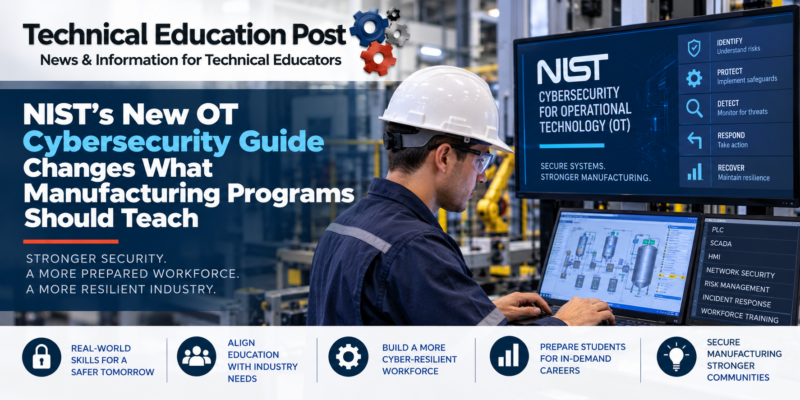
The National Institute of Standards and Technology released the initial public draft of SP 800-82 Revision 4, Guide to Operational Technology Security, on September 21, marking the most significant update to one of industrial cybersecurity’s core reference documents since Revision 3 was finalized in 2023.
The changes are substantial.
NIST has expanded its treatment of operational technology beyond traditional industrial control systems to include building automation, water and wastewater systems, food and agriculture, freight rail, maritime systems, Industrial Internet of Things technologies and cloud-connected OT.
The draft has also been reorganized around the NIST Cybersecurity Framework 2.0, adds greater emphasis on enterprise risk management, expands asset-management and network-monitoring guidance, and incorporates zero-trust concepts into OT architecture.
For colleges teaching mechatronics, automation, industrial maintenance, cybersecurity or advanced manufacturing, this is more than a standards update.
It is a curriculum signal.
Key Takeaways
- NIST published the initial public draft of SP 800-82 Revision 4 on September 21.
- The guide now explicitly addresses IIoT and cloud convergence.
- OT security is reorganized around Cybersecurity Framework 2.0, including its Govern function.
- Asset inventories, network monitoring, detection and zero-trust architecture receive expanded treatment.
- Public comments remain open through November 30, 2026.
What Changed
Operational technology refers to systems that interact with or control physical processes.
In manufacturing education, that includes technologies students already encounter: PLCs, distributed control systems, SCADA platforms, sensors, robotics, drives and industrial networking.
Revision 4 reflects the reality that these systems increasingly do not operate in isolation.
Modern plants may connect production equipment to cloud analytics, remote-maintenance platforms, Industrial Internet of Things devices, enterprise business systems and third-party services.
NIST’s updated draft explicitly adds IIoT and cloud environments to the OT landscape while expanding coverage of sectors outside traditional factory automation.
It also aligns OT risk management more closely with Cybersecurity Framework 2.0 and its Govern, Identify, Protect, Detect, Respond and Recover model.
That matters because cybersecurity is increasingly an organizational responsibility rather than simply an IT function.
Why It Matters for Technical Education
A PLC exercise that teaches only ladder logic is no longer a complete representation of the environment graduates may encounter.
Students also need to understand how the controller is networked, which identities can modify it, what traffic is normal, how an asset is inventoried, which systems depend on it and how cybersecurity controls interact with safety and uptime.
OT security differs from traditional IT security precisely because shutting down or patching equipment indiscriminately can create production or safety problems.
NIST’s guidance repeatedly emphasizes the performance, reliability and safety requirements unique to OT.
That creates an important instructional opportunity.
Cybersecurity students need exposure to physical systems.
Automation students need exposure to cybersecurity.
Industrial maintenance students increasingly need both.
Broader Industry Trend: IT and OT Are Converging
Industry 4.0 has been discussed for years, but the cybersecurity implications are becoming increasingly concrete.
Machine data moves into analytics platforms. Remote users access industrial systems. Vendors support equipment remotely. Sensors send data beyond the production floor.
The old model of an isolated industrial network becomes less realistic with each layer of connectivity.
NIST’s decision to expand the guide toward IIoT, cloud convergence, zero trust and enterprise risk management formalizes that shift.
At the same time, NIST’s NICE program is emphasizing AI’s effect on both the cyber workforce and threat landscape as part of its 2026 Cybersecurity Career Week programming.
For educators, the message is clear: the line between cybersecurity education and industrial-technology education will continue to blur.
Practical Takeaways
Manufacturing and automation programs should map existing labs against the draft.
Can students create an OT asset inventory?
Can they identify network communications between PLCs, HMIs and engineering workstations?
Can they explain why production availability changes the way patches and security controls are deployed?
Can they monitor industrial traffic for anomalies without interfering with a process?
Can they apply least privilege to engineering and maintenance access?
Can they discuss segmentation and zero trust without treating those concepts as purely enterprise-IT topics?
Cybersecurity programs should similarly consider adding physical automation equipment or realistic OT simulation environments.
The goal is not to turn every maintenance technician into a security analyst. It is to ensure graduates recognize when an industrial system creates cyber risk and understand how their technical responsibilities fit into a broader security architecture.
Questions to Ask Your Program
- Does our automation curriculum include OT cybersecurity?
- Do cybersecurity students interact with actual or simulated PLC/SCADA systems?
- Are students learning CSF 2.0?
- Can students build and maintain an OT asset inventory?
- Do labs teach segmentation, monitoring and controlled remote access?
- Are safety and production reliability included in cybersecurity exercises?
Future Outlook
SP 800-82 Revision 4 remains a draft.
NIST is accepting comments through November 30, so programs should not treat every provision as final.
But waiting for final publication before reviewing curriculum would miss the larger point.
The draft shows where federal industrial cybersecurity guidance is heading: connected OT environments, stronger governance, better visibility, closer IT/OT integration and architectures that assume access must be continuously controlled rather than implicitly trusted.
Frequently Asked Questions
What is NIST SP 800-82?
It is NIST’s major guidance document for securing operational technology and industrial control environments.
Is Revision 4 final?
No. The September 21 publication is an initial public draft.
When are comments due?
November 30, 2026.
What technologies does the document cover?
Among others, industrial control systems, SCADA, PLC-related environments, building automation, water systems, IIoT and connected OT.
Why should manufacturing instructors care?
Because cybersecurity is increasingly embedded in the same automation, control and network systems graduates will install, operate and maintain.
TechEd Magazine Perspective
The most important shift in the NIST draft is not a new cybersecurity control. It is the disappearance of a clean boundary between operational technology and the rest of the digital enterprise.
That has consequences for education.
Programs that continue treating automation and cybersecurity as unrelated specialties risk reproducing a separation that modern manufacturing facilities are actively trying to overcome.