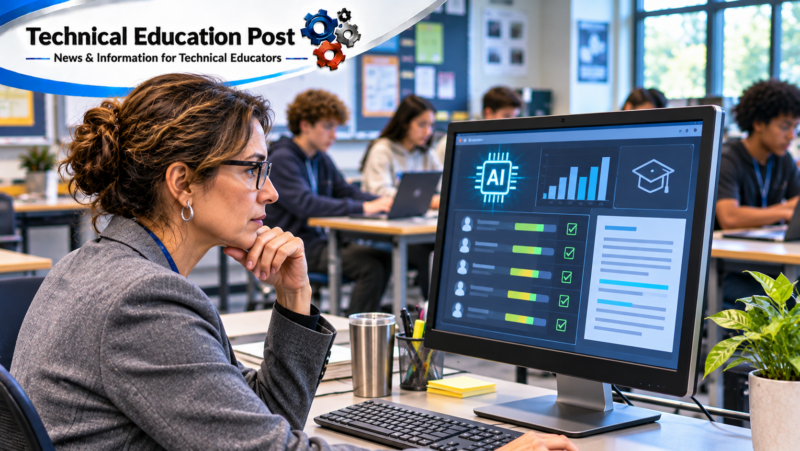
New advocacy positions adopted by the New York State School Boards Association seek stronger safeguards for artificial intelligence in schools, including restrictions on automated grading, student discipline, graduation decisions, and undisclosed AI software updates.
Artificial intelligence is becoming increasingly integrated into K–12 education, but New York school board leaders are calling for clearer boundaries around the decisions schools can delegate to automated systems.
The New York State School Boards Association (NYSSBA) announced on November 9, 2026, that delegates representing member school districts had adopted several new advocacy positions addressing artificial intelligence, student privacy, educational accountability, and technology vendor responsibilities.
Among the most consequential proposals is a call to prohibit AI from serving as the official educator of record or independently determining students’ grades, behavioral evaluations, disciplinary outcomes, placement, promotion, or graduation.
The association also wants technology companies to meet stronger safety and privacy standards when providing student-facing AI products. Another proposal would require vendors to notify school districts before introducing new AI capabilities into existing software and give districts the option to decline those updates.
The positions were adopted during NYSSBA’s October 15 annual business meeting and reported in the association’s November 9 publication.
The resolutions do not themselves change New York law. Instead, they establish policy positions that the association intends to advocate before state and federal policymakers.
For educators and school administrators, the developments highlight a fundamental question: How can schools benefit from artificial intelligence without transferring essential educational decisions away from qualified professionals?
Key Takeaways
- NYSSBA adopted new AI advocacy positions during its October 15 annual business meeting.
- AI should not serve as the educator of record, according to the association’s newly adopted position.
- Official grades and high-stakes student decisions should remain under human responsibility, rather than being determined independently by AI.
- Student-facing AI vendors should meet stronger safety and privacy expectations, including a proposed duty-of-care standard.
- Districts should receive advance notification of AI software changes and have options to decline newly introduced AI functions.
- These are advocacy positions, not enacted regulations, and any binding restrictions would require appropriate governmental action.
What New York School Boards Actually Approved
Nearly 350 NYSSBA member school districts were represented at the association’s 107th Annual Business Meeting.
Delegates adopted 25 position statements covering several issues, including health insurance costs, education funding, artificial intelligence, and state mandates.
The adopted positions generally remain in effect for five years unless circumstances make them obsolete.
Several resolutions specifically addressed the growing use of AI in public education.
Together, they establish an advocacy agenda focused on three areas: human accountability for educational decisions, stronger safeguards for students, and greater district control over software functionality.
1. Prohibiting AI From Serving as the Educator of Record
NYSSBA is calling for legislation, regulation, or guidance that would prevent artificial intelligence from serving as the educator of record.
The position also seeks restrictions on AI independently assigning official grades, conducting student behavioral evaluations, or making high-stakes decisions concerning discipline, promotion, placement, and graduation.
These responsibilities can have lasting consequences for students.
An official grade may influence academic progression, scholarship eligibility, or postsecondary opportunities.
A placement decision can determine access to specialized instruction.
Disciplinary decisions can affect educational records and students’ relationships with their schools.
NYSSBA’s position is that these consequential decisions should not be delegated independently to automated systems.
2. Establishing Stronger Safety and Privacy Standards
The association also supports legislation requiring companies that provide student-facing educational AI products to meet duty-of-care safety and privacy standards.
The proposal reflects concerns about how AI products interact with students, process personal information, and influence learning.
The precise legal obligations would depend on future legislation or regulations.
For districts, the underlying issue is whether existing technology procurement and privacy review processes adequately address AI-specific risks.
3. Giving Districts Control Over AI Software Updates
Another adopted position calls for technology vendors to notify public school districts when updates introduce new AI capabilities into existing software.
NYSSBA also wants districts to have the ability to opt out of those additions.
This concern is particularly relevant because schools frequently use cloud-based educational platforms that receive automatic updates.
A product originally approved for assignments, communication, or document management may later introduce AI-generated summaries, recommendations, or interactive features.
Without sufficient notice, administrators may have limited opportunity to evaluate those changes before students encounter them.
Why AI Grading Is Becoming a Major Policy Question
AI-assisted assessment tools can analyze student work, generate feedback, identify possible errors, and help educators manage repetitive administrative tasks.
These capabilities may offer genuine instructional benefits.
However, automated assessment introduces important questions about accuracy, consistency, fairness, and accountability.
A system may misunderstand an unconventional but correct answer, overlook relevant context, or generate a plausible explanation for an incorrect judgment.
Performance can also vary across subjects and assignment types.
For example, evaluating a straightforward multiple-choice response differs substantially from assessing a complex engineering project, laboratory investigation, or persuasive essay.
In technical education, students may demonstrate competence through practical work that requires observation, safety awareness, troubleshooting, and professional judgment.
These dimensions are not always captured by automated analysis.
TechEd Magazine’s guide to assessing STEM learning explains why strong assessment should evaluate how students apply knowledge, solve problems, and demonstrate technical competence rather than simply reproduce correct answers.
AI Assistance Versus AI Authority
An important distinction exists between AI supporting an educator and AI making a decision independently.
Consider three scenarios.
| Educational activity | Role of AI | Human responsibility |
|---|---|---|
| Generating formative feedback | Suggests improvements to student work | Teacher reviews and contextualizes feedback |
| Evaluating a draft rubric | Identifies possible strengths and weaknesses | Teacher determines the official grade |
| Recommending student placement | Analyzes relevant information | Authorized educators make the final decision |
NYSSBA’s position primarily addresses the third column: decisions that carry formal educational consequences.
The association is not proposing a general prohibition on teachers using AI for every instructional activity.
Instead, it is seeking safeguards against AI independently assuming responsibilities traditionally held by qualified educators.
Why Human Oversight Matters in Technical Education
Career and technical education programs provide particularly useful examples of the limitations of automated assessment.
A welding instructor evaluating a student’s work must consider more than whether the finished weld resembles a reference image.
Assessment may involve equipment setup, material preparation, technique, safety practices, defect identification, and the ability to explain corrective actions.
Similarly, an industrial robotics student may produce functioning code while demonstrating unsafe equipment handling or inadequate troubleshooting practices.
An AI system could assist with documentation or feedback, but practical competence often requires direct observation and professional judgment.
This distinction is also relevant to STEM education more broadly.
A well-designed STEM curriculum integrates technical knowledge, inquiry, experimentation, and evidence-based reasoning.
Assessment should reflect those learning objectives rather than prioritize tasks that are easiest for software to score.
Student Privacy Becomes a Central Concern
Educational AI products may process substantial amounts of student information.
Depending on the system, that information can include written assignments, classroom interactions, academic performance, learning preferences, or behavioral data.
Schools must understand what information a product collects, how it is used, how long it is retained, and whether it is shared with other organizations.
The Family Educational Rights and Privacy Act (FERPA) and applicable state privacy requirements may govern aspects of this activity.
However, not every AI-related privacy question can be resolved through a generic statement that a vendor is FERPA compliant.
Districts should examine actual data flows, contractual terms, security controls, and the specific purposes for which information is processed.
What Should Schools Ask AI Vendors?
Before approving a student-facing AI product, administrators should determine:
- What student information does the system collect?
- Is that information used to train or improve AI models?
- Can the district restrict particular features or data uses?
- How are records retained, accessed, and deleted?
- What security and incident notification commitments does the vendor provide?
- Can the district review significant changes before deployment?
These questions should be addressed through documented procurement and technology governance procedures.
Why Automatic AI Updates Create New Risks
One of the most practical elements of NYSSBA’s position concerns software updates.
Educational technology products are increasingly delivered through cloud services.
Vendors can introduce new features without requiring schools to install an entirely new application.
That model offers operational benefits, but it can also complicate district oversight.
An AI feature introduced through an update might change how student data is processed, how feedback is generated, or how students interact with a platform.
If administrators are unaware of the change, they may be unable to evaluate whether it aligns with district policy.
A Better Approach to AI Change Management
District technology leaders should maintain an inventory of AI-enabled products and establish procedures for reviewing significant functionality changes.
Procurement agreements can specify vendor notification expectations, administrator controls, and procedures for evaluating new capabilities.
Technology departments should also coordinate with curriculum leaders, privacy officers, special education personnel, and classroom educators.
The objective is not to block every software improvement.
It is to ensure that educationally significant changes receive appropriate review before deployment.
New York’s Debate Reflects a Broader National Trend
The NYSSBA resolutions are part of a wider discussion about the role of generative AI in public education.
In September 2026, Education Week reported on efforts in New York City and Los Angeles to establish stronger limits on student AI use.
New York City guidance had already distinguished between certain instructional uses of AI and allowing automated systems to determine official student grades.
The broader debate involves several competing considerations.
Supporters of educational AI emphasize its potential to reduce administrative work, personalize instruction, expand accessibility, and provide students with additional learning support.
Critics emphasize concerns about inaccurate outputs, student privacy, overreliance on automation, and the possibility that technology could weaken meaningful teacher-student relationships.
These perspectives are not necessarily incompatible.
Schools can explore useful applications while maintaining restrictions on high-stakes decisions and requiring evidence that tools actually improve learning.
What School Boards and Administrators Should Do Now
The NYSSBA resolutions offer a useful framework for districts beyond New York.
1. Identify High-Stakes Educational Decisions
Districts should document which decisions require direct responsibility from authorized educators or administrators.
These may include final grades, student placement, disciplinary outcomes, graduation determinations, and formal behavioral evaluations.
2. Establish Human Review Requirements
Policies should specify when AI-generated recommendations may be used and what meaningful human review requires.
Simply approving an automated recommendation without examining its basis may not provide sufficient oversight.
3. Review Student Data Protections
Administrators should work with technology and privacy personnel to evaluate how AI systems collect, process, and retain student information.
4. Update Vendor Agreements
Contracts should address changes to AI functionality, data use, notification procedures, and district administrative controls.
5. Train Teachers and Staff
Educators need practical guidance on acceptable AI assistance, verification of outputs, student privacy, and assessment integrity.
TechEd Magazine’s article on STEM grants for teachers also discusses the growing emphasis on AI literacy and professional development.
6. Create Student and Family Communication Procedures
Districts should explain how AI is used in educational activities and how students or families can raise concerns about automated outputs.
Practical Framework for Responsible AI Assessment
Schools developing AI assessment policies should distinguish among three levels of use.
Low-risk assistance: Generating practice questions, suggesting rubric language, or helping educators organize instructional materials.
Moderate-risk support: Producing formative feedback or identifying patterns in student work, subject to teacher verification and privacy safeguards.
High-stakes decision support: Generating recommendations involving official grades, disciplinary action, placement, or graduation.
The higher the potential impact on a student, the stronger the requirements should be for transparency, validation, and authorized human decision-making.
This framework is an editorial recommendation, not a classification established by the NYSSBA resolutions.
What Happens Next?
NYSSBA’s adopted positions will guide the association’s advocacy activities over the coming years.
The association may seek legislation, regulations, or administrative guidance from New York policymakers and relevant federal authorities.
Whether any of these proposals becomes binding law remains uncertain.
Future developments will depend on legislative priorities, regulatory action, stakeholder input, and the evolution of educational AI technology.
Districts should monitor these developments while independently reviewing their existing practices.
Waiting for new legislation is not necessary to begin evaluating AI-related risks and responsibilities.
Frequently Asked Questions
Has New York banned AI grading in schools?
No. NYSSBA adopted an advocacy position calling for restrictions on AI independently assigning official grades. The resolution itself does not establish a statewide ban.
What is an educator of record?
An educator of record is the officially designated professional responsible for instruction or associated educational accountability under applicable rules.
Can teachers still use AI to help grade assignments?
That depends on applicable district policies and laws. NYSSBA’s position specifically opposes AI independently assigning grades of record, rather than all forms of AI-assisted feedback.
What are high-stakes student decisions?
They include decisions with significant consequences for a student’s education, such as discipline, promotion, placement, and graduation.
Why does NYSSBA want advance notice of AI updates?
The association is concerned that new AI capabilities can be introduced into existing educational products without sufficient opportunity for district review.
Does NYSSBA’s proposal apply to every state?
No. These are advocacy positions adopted by a New York school boards association. They may inform broader policy discussions but do not establish requirements in other states.
Are student-facing AI products prohibited?
No general prohibition was established by the resolutions. NYSSBA is calling for stronger safety and privacy standards.
What should school districts do first?
Review existing AI tools, identify high-stakes uses, establish human accountability, and examine vendor privacy and update policies.
TechEd Magazine Perspective
The New York State School Boards Association’s latest positions reflect an important shift in educational technology governance.
The debate is moving beyond whether artificial intelligence belongs in classrooms.
The more consequential question is how schools should define responsibility when automated systems influence learning and student outcomes.
AI can assist educators with many useful tasks, including drafting instructional materials, providing formative feedback, and organizing information.
However, the ability to generate a recommendation is not the same as possessing the professional authority to make an educational decision.
For schools, the strongest approach is neither unrestricted automation nor blanket rejection of AI.
It is a governance model that connects technological capability with educational purpose, evidence of effectiveness, student protections, and meaningful human accountability.
The principle is especially important in career and technical education, where student competence often depends on practical judgment, safe procedures, and observable performance.
As AI becomes more capable, schools will need to make deliberate choices about which responsibilities technology can support and which must remain firmly in human hands.
Sources and Further Reading
Primary source
Published November 9, 2026.
Additional reporting
Education Week — New York, Los Angeles Restrict Student AI Use. Will Other Districts Follow?
Related TechEd Magazine Coverage
- Assessing STEM Learning: What Evidence Actually Shows Students Are Ready?
- What Is a STEM Curriculum?
- STEM Grants for Teachers: A Practical Guide
- Education as the AI Revolution