A new NC State instructional laboratory combines CNC machining, robotics and 3D printing to prepare future engineers and technology teachers for increasingly sophisticated manufacturing environments.
North Carolina State University is showing how advanced manufacturing equipment can become part of teacher preparation and undergraduate engineering education.
In a November 20, 2026, university report, NC State highlighted the work of doctoral student Sam Munzer, who developed an advanced manufacturing laboratory and course serving students in the College of Education and College of Engineering.
The project combines modern equipment, classroom instruction and curriculum planning to help future technology educators build practical manufacturing skills.
A New Home for Hands-On Manufacturing Instruction
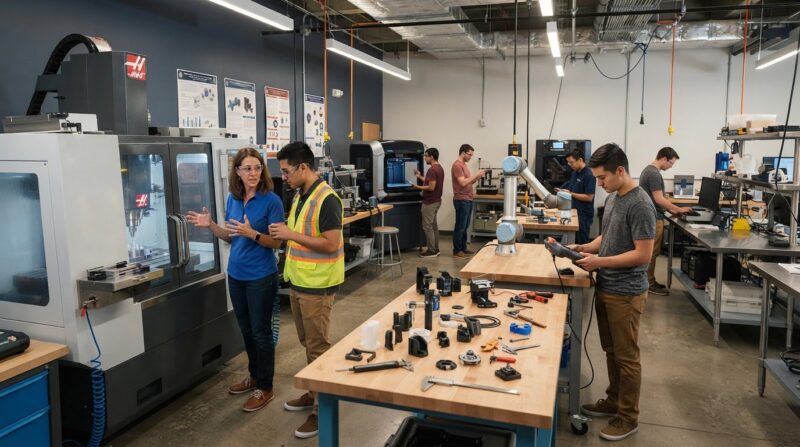
Munzer assembled the laboratory in Lampe Hall, moving furniture and sourcing equipment to create a usable teaching space.
The resulting lab includes computer numerical control (CNC) machinery, robotic arms and 3D printers—technologies frequently encountered in modern manufacturing and engineering programs.
Students can examine how computer-generated designs become physical parts, how manufacturing equipment follows programmed instructions and how robotic systems can support production processes.
Bringing these technologies into one environment helps students see manufacturing as a connected sequence of design, production, measurement and revision.
Industry Relationships Support Equipment and Curriculum
Munzer contacted equipment manufacturers, including Tormach, while planning the laboratory.
The work has expanded beyond obtaining equipment to discussions of curriculum materials and standards for advanced manufacturing education.
Such collaboration can help universities align instruction with the capabilities and constraints of actual manufacturing systems.
However, training material developed for industrial users may need adaptation before it works effectively in a school. Students at different stages need different levels of complexity, guidance and safety supervision.
Future Technology Teachers Are a Central Audience
Among the students using the laboratory are aspiring middle and high school technology educators.
Munzer wants these future teachers to leave with more than the ability to operate equipment. He also wants them to develop teaching resources they can use when introducing manufacturing technologies in their own classrooms.
Instruction emphasizes why products are made in particular ways, how designs influence manufacturing decisions and how processes can be evaluated for sustainability.
For CTE instruction, these topics offer opportunities to integrate engineering, mathematics, science and technology with project-based learning.
Instructor Support Continues After Graduation
One ongoing difficulty in technical education is maintaining the equipment and expertise required for advanced laboratories.
CNC machines, robotic systems and 3D printers may need maintenance, troubleshooting, software updates and specialized instruction.
Munzer’s approach includes a commitment to remain available as a resource to teachers who encounter problems after leaving the university.
Access to knowledgeable peers, manufacturers and former instructors can be essential when a school has a small technical staff.
What CTE Programs Can Learn
The NC State laboratory underscores a distinction that is easy to overlook: the ability to buy modern technology is not the same as the ability to teach with it.
Strong manufacturing education requires instructors who understand the equipment, plan meaningful learning experiences and help students develop problem-solving skills.
For school districts and universities, this project offers a model for investing in educators as well as technology. Future teachers can benefit from practical equipment experience, accessible curriculum and lasting professional connections.
As advanced manufacturing systems continue evolving, teacher preparation may become one of the most important factors in expanding high-quality technical instruction.
Source: NC State College of Education, November 20, 2026.