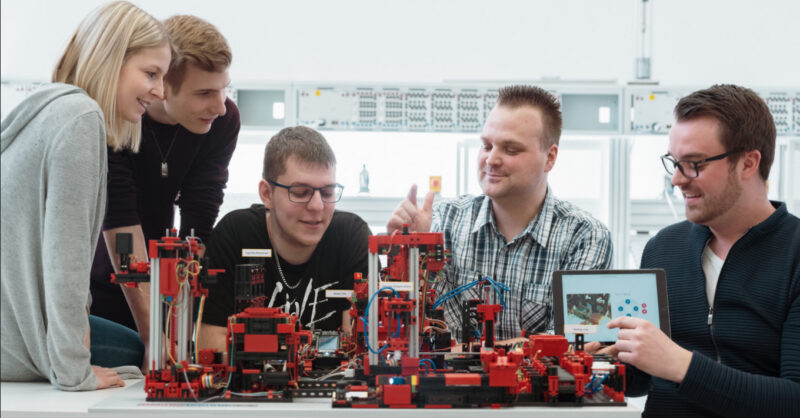
As industries become more connected and data-driven, simulation models are playing a growing role in how people learn and work with complex systems. From classrooms to research labs and innovation centers, they provide a practical way to explore real-world processes without the cost or risk of full-scale implementation. Models Support Education and Industry.
For educators, they offer applied learning experiences that go beyond theory and help students build skills for today’s workforce. For organizations, they support training, experimentation, process improvement, and more informed decision-making. While applications vary, the goal is consistent: to better understand how systems function and improve performance.
From compact training systems to fully connected learning environments, fischertechnik simulation models are designed to replicate real-world automated processes in an interactive format. Used in classrooms, labs, and training facilities, they provide a practical way to explore modern production systems and Industry 4.0 concepts.
What is a Simulation Model?
A simulation model is a scaled-down, educational representation of automated systems commonly used in modern manufacturing environments, designed to replicate how real production processes operate. These models mirror key elements of industrial production systems, including sensors, conveyors, controllers, data flows, and production workflows, helping users understand how processes move through a system and where bottlenecks can occur.
Rather than operating a full-scale factory system, learners use simulation models to explore how automation, control logic, and connected technologies work together in practice. This makes it possible to test ideas, understand system behavior, and build technical skills without the cost or complexity of real production equipment.
Simulation models also allow users to explore “what-if” scenarios by testing system changes, such as workflow adjustments or process variations, in a controlled environment.
Applications in Education
Simulation models are used across education to support applied learning in automation, robotics, and connected systems. The following examples show how institutions integrate them into coursework and research.
Building Practical Engineering Skills
In higher education, simulation models are used to give students real-world challenges in a structured, hands-on learning environment. At Hof University of Applied Sciences (Germany), students work in teams using fischertechnik training models to design and implement assembly line processes based on open-ended tasks.
Instead of following a fixed solution, students analyze systems, program controls, and refine their approach through iteration. This encourages independent thinking while building technical understanding of automation and production systems.
Teaching Industry 4.0 Concepts
At the Technical University of Moldova (Moldova), fischertechnik simulation models are integrated into coursework to help students understand how modern factories operate as connected systems. Students work with communication protocols and control systems that mirror real industrial environments. By interacting directly with these components, they gain a clearer understanding of how data flows across machines, networks, and control layers. This approach supports learning across engineering, automation, and IT disciplines.
Supporting Research in AI and Automation
Industrial simulation models are also used in research settings to explore advanced technologies. At the University of Potsdam/Brandenburg (Germany), fischertechnik Training Factory 4.0 models are part of a broader system for studying neural networks in production control. Researchers simulate global production processes and analyze how data and decisions move across distributed systems. This allows them to identify inefficiencies and test improvements in a replicable simulation environment.
In other environments, fischertechnik models support machine vision and quality assurance applications, where systems are trained to recognize defects and classify materials.
Applications in Industry
In industry, simulation models are used to support training, system development, and process optimization. They help teams test ideas, reduce risk, and improve decision-making before implementing changes in real environments.
Exploring Digital Twins and Virtual Systems
Simulation models are often used as a foundation for digital twins, which are virtual representations of physical systems.
In projects involving virtual factories, fischertechnik simulation models help teams simulate production processes, visualize operations, and test changes before applying them in live operations. This can improve efficiency and reduce the risk of disruption.
Prototyping and Innovation
At facilities like the AWS Builder Studio (global, Amazon Web Services initiative), fischertechnik Industry 4.0 learning factories are used to help teams develop and test new ideas. Engineers and developers can model processes, experiment with workflows, evaluate factory layouts, and test system concepts before committing to physical prototypes.
This lowers the cost of innovation and supports faster decision-making. Workforce Training and Upskilling
Simulation models are widely used for workforce training, helping employees understand automation, control systems, and modern manufacturing processes. A controlled training environment allows teams to learn through practical, hands-on experience without impacting live operations.
This is especially valuable as organizations adopt more complex, connected systems. Simulating Modern Manufacturing Environments
As production environments continue to evolve, newer simulation systems are also being developed to reflect more flexible and adaptive manufacturing approaches. For example, the fischertechnik Agile Production Simulation (APS) model is designed to demonstrate how modern production is shifting from traditional linear assembly lines to modular, automated systems. By incorporating elements such as automated guided vehicles, robotic systems, and AI-supported quality control, models like APS help illustrate how industrial environments are becoming more dynamic and data-driven. These simulation environments are increasingly used to explore current industry challenges and prepare learners for modern manufacturing concepts.
Understanding Cybersecurity in Connected Systems
As industrial environments become more connected, cybersecurity is becoming an important consideration. Modern production systems rely on networked devices, data exchange, and integrated control processes.
Simulation models such as the fischertechnik Training Factory 4.0 are not designed as dedicated cybersecurity training tools. However, they provide a practical way to understand how connected systems operate and where potential risks can exist.
For example, these training systems include:
PLC-controlled production processes
Connected factory modules and sensors
Real-time data visibility through dashboards and monitoring tools 膆 Digital tracking of workpieces and system status
By working with these components, students and professionals can see how information moves across a production system and how different elements depend on one another. This creates a foundation for understanding how disruptions in data, communication, or system behavior could impact operations. It also helps introduce the relationship between IT systems and operational technology, which is an increasingly important consideration in modern industrial environments.
Why Do Organizations Invest in Simulation Models?
Across education and industry, the reasons for using simulation models are consistent. Solutions like fischertechnik industrial simulation models help organizations: 膆 Teach complex systems in a hands-on way
Test and refine processes before implementation
Explore technologies such as AI and connected systems
Train students and employees more effectively
Reduce the cost and risk of experimentation
Even when use cases differ, the value lies in providing a space to safely learn, test, and improve.
Who Uses Simulation Models Like fischertechnik?
Simulation models such as those from fischertechnik are used globally by universities, research institutions, and industry leaders in manufacturing, automation, and engineering to explore Industry 4.0 concepts in a safe, scalable environment.
In higher education and research, institutions such as Hof University of Applied Sciences (Germany), University of Potsdam (Germany), Furtwangen University (Germany), and Luleå University of Technology (Sweden) have used simulation-based factory models in teaching and research contexts. These applications include topics such as production system design,
automation, artificial intelligence, and digital or software-based simulation of industrial processes.
In industry and applied technology contexts, several organizations are shown using simulation or learning factory environments in specific projects related to digital transformation and training. For example, the BMW Group (Germany) is referenced through an application from its light metal foundry at the Landshut plant, where standardization and virtual commissioning are used to support safer and more efficient start-up of production systems.
In other documented examples, technology and software organizations have applied simulation-based factory models in innovation and demonstration settings. MongoDB (United States) is featured in a success story building a virtual factory with MongoDB Atlas to support modernized manufacturing operations. The Builder Studio by Amazon Web Services (AWS) (United States) in Melbourne (Australia) is shown as an innovation environment that includes the use of a fischertechnik Industry 4.0 Learning Factory as part of its tools for developing and demonstrating digital prototypes.
Pilz Education Systems (PES) by Pilz GmbH & Co. KG (Germany) are modular training systems with industrial components used for practical instruction in industrial and electrical engineering contexts.
Frequently Asked Questions
What are simulation models used for in education?
They are used to teach engineering, automation, and Industry 4.0 concepts through practical, hands-on simulation of real-world systems.
How are simulation models used in industry?
Organizations use them to simulate processes, support digital twins, train employees, and test new ideas before applying them in real operations.
Are simulation models only for manufacturing?
No. They are also used in logistics, artificial intelligence research, robotics, and other areas that involve complex systems and data.
What are fischertechnik simulation models used for?
fischertechnik simulation models are used in education, research, and industry training to teach automation, simulate production processes, and demonstrate Industry 4.0 systems in a hands on environment.
Do fischertechnik models require a PLC?
Training Factory Industry 4.0 is available in three configurations: a base model without PLC hardware, a version with wiring and a PLC interface (no PLC included), and a fully equipped version with a PLC and full control components. This allows institutions to select the level of complexity that matches their curriculum and resources. While supporting hands-on learning in automation and Industry 4.0.
What skills can students learn with fischertechnik simulation models?
Students can learn practical skills. PLC programming, system design, automation workflows, data flow understanding, and working with connected production systems.
What is the fischertechnik Training Factory 4.0?
The fischertechnik Training Factory 4.0 is a modular simulation system that replicates a real world production environment. It includes multiple factory modules. A high-bay warehouse, sorting line, and processing stations. allowing users to explore automated workflows and connected systems.
Conclusion
Industrial simulation models continue to play an important role in how organizations teach, learn, and innovate. Solutions such as fischertechnik simulation models bridge the gap between physical systems and digital technologies. Helping users better understand complex environments and prepare for the demands of modern industry.
Classroom, lab, or workplace provide a practical way to explore systems, improve processes, and build relevant skills for the future.
University and industry use cases referenced in this article are drawn from published fischertechnik success stories and application examples.
Source: Models Support Education and Industry
https://www.fischertechnik.de/en/industry-and-universities/success-stories
By Kristie Laettner, Studica Inc.
How Factory Simulation Models Support Education and Industry
Industrial simulation models are used to teach automation, explore Industry 4.0 systems, and test ideas in a controlled environment. Applied across education, research, and industry training in areas such as manufacturing, engineering, and connected systems. Teams understand complex topics such as system design, data flow, and cybersecurity.
https://www.techedmagazine.com/industries/
Models Support Education and Industry