Midland College Plans $77 Million Career and Technical Education Center
The Texas community college’s proposed expansion will strengthen training in automation, welding, diesel technology, heavy equipment, and other high-demand occupations.
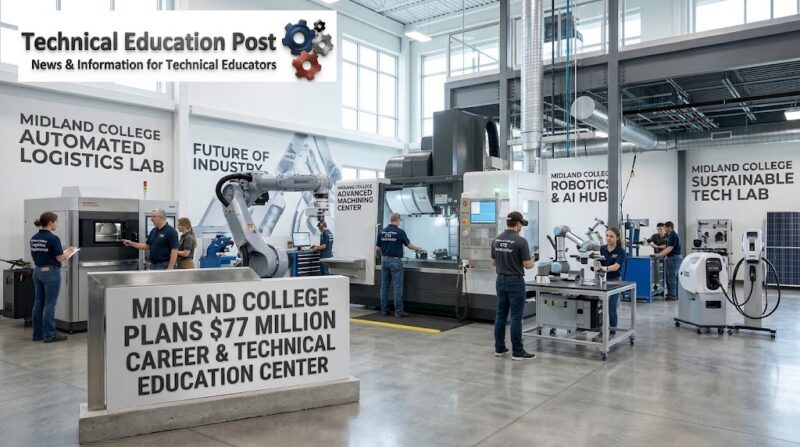
Midland College in Texas is planning a major expansion of its career and technical education facilities through a proposed $77 million Career and Technical Education Center.
The project, reported October 28 by the Midland Reporter-Telegram, includes a 135,000-square-foot development designed to expand the institution’s capacity for hands-on workforce training.
The expansion is expected to accommodate approximately 3,000 additional students and support programs connected to industries throughout the Permian Basin.
A $10 million investment from the Permian Strategic Partnership is helping support the project, alongside other community partners.
For educators and workforce-development leaders, the initiative demonstrates how colleges and industry organizations can collaborate on large-scale technical education infrastructure.
A Major Investment in Technical Education
The proposed Career and Technical Education Center is expected to include three buildings and support 15 courses.
The facility will expand Midland College’s Applied Technology and Health Sciences offerings while increasing access to industry-oriented training environments.
Planned instructional areas include:
- Industrial automation
- Diesel technology
- Heavy equipment
- Welding and fabrication
- Natural gas compression
- Additional applied technology programs
These disciplines support occupations requiring specialized technical skills and practical experience with industrial systems.
The investment reflects the importance of maintaining training facilities that expose students to equipment, processes, and workplace expectations relevant to modern employers.
Responding to Regional Industry Needs
Midland College serves a region with substantial activity in energy production, industrial services, transportation, and related sectors.
Employers in these industries depend on technicians who can operate, maintain, troubleshoot, and repair sophisticated mechanical and electrical equipment.
Training needs extend beyond traditional equipment operation.
Industrial automation programs, for example, may introduce students to programmable logic controllers, sensors, motor controls, electrical troubleshooting, and automated production systems.
Diesel technology programs can provide instruction in engines, diagnostics, mechanical systems, and electronic controls.
Welding and fabrication education supports the development of competencies used in equipment construction, maintenance, repair, and industrial production.
Natural gas compression training can introduce students to the mechanical and operational systems used in energy infrastructure.
By providing appropriate facilities and instructors, community colleges can help develop the specialized workforce required by regional businesses.
Industry Partnerships Help Fund Expansion
One of the project’s most significant features is its connection to the Permian Strategic Partnership.
The organization’s reported $10 million investment demonstrates how regional industry interests can contribute directly to educational infrastructure.
Such partnerships may provide benefits beyond financial support.
Industry organizations can help colleges evaluate equipment requirements, identify workforce competencies, and establish connections with prospective employers.
Advisory partnerships may also support internships, apprenticeships, equipment demonstrations, and continuing education programs.
However, successful collaborations require clear educational objectives.
Programs should prepare students with transferable skills rather than focusing exclusively on the immediate staffing needs of individual companies.
A strong technical education program must also remain adaptable as industries and technologies change.
Expanding Opportunities for High School Students
The proposed facility is expected to create additional dual-credit opportunities through Midland College’s partnership with Midland Independent School District.
According to the local report, the expansion could accommodate approximately 1,000 additional high school students through dual-credit offerings.
Dual-credit programs allow participating students to earn college credit while completing high school coursework.
When connected to career and technical education, these programs can create more direct pathways from secondary education into certificates, associate degrees, and specialized occupational training.
Students may gain earlier exposure to technical fields while reducing the time required to complete certain postsecondary programs.
For schools, partnerships with community colleges can provide access to specialized laboratories and instruction that might otherwise be difficult to offer.
Health Sciences Also Benefit
Although much of the development centers on industrial and technical occupations, the project includes implications for healthcare training.
Midland College plans to repurpose its existing Advanced Technology Center for expanded health sciences instruction.
Programs identified in the reporting include medical assisting and licensed vocational nursing.
This approach illustrates how investments in new technical facilities can create additional instructional capacity elsewhere on campus.
Rather than viewing CTE infrastructure as a collection of unrelated departments, institutions may benefit from coordinating facilities, equipment, and program planning across multiple occupational fields.
Planning for Long-Term Workforce Needs
The project follows approximately three years of planning and remains in the design phase.
According to the October 28 report, college officials expect construction to begin by the end of 2026, with a targeted opening in fall 2028.
As with any major capital project, actual construction schedules and costs may change.
The long planning horizon also illustrates one of the challenges facing technical education institutions.
Facilities developed today must remain relevant as workplace technology continues evolving.
Flexible laboratories, adaptable equipment layouts, and continuing faculty development can help protect the educational value of large infrastructure investments.
What Other Colleges Can Learn
Midland College’s proposed expansion offers several considerations for institutions planning technical education investments.
First, large facility projects should be aligned with documented regional workforce needs.
Second, employers and industry organizations can be important partners in financing and designing programs.
Third, technical education facilities should support practical instruction with contemporary equipment.
Fourth, dual-credit partnerships can broaden access and create earlier entry points into career-focused education.
Finally, long-term operational costs must be considered alongside construction expenses.
Maintaining laboratories, recruiting instructors, updating technology, and replacing equipment all require continuing resources.
Building the Next Generation of Technical Training
The proposed $77 million Midland College center represents a significant commitment to career and technical education.
If completed as planned, the facility would expand access to training in several fields essential to the region’s economy.
For educators nationwide, the broader lesson is that effective workforce development depends on more than adding new courses.
It requires coordinated investment in instructional facilities, qualified educators, employer relationships, and accessible pathways for students.
As industries become increasingly technology-intensive, colleges capable of delivering practical, adaptable training may play an important role in preparing the next generation of skilled workers.
Source: Midland Reporter-Telegram, October 28, 2026.
https://www.mrt.com/news/education/article/midland-tx-college-cte-center-22497358.php