Eaton RESA’s Aviation Careers Institute has earned recognition from the Michigan Aeronautics Commission for connecting high school students with aviation training, flight simulation and industry professionals.
A Michigan career and technical education program has received statewide recognition for introducing high school students to aviation careers.
Eaton Regional Education Service Agency (RESA) announced November 20, 2026, that its Career Preparation Center had received the Michigan Aeronautics Commission’s 2026 Award of Excellence.
The group award recognizes the center’s Aviation Careers Institute, a CTE program designed to help students explore aerospace and aviation occupations while developing technical knowledge and practical skills.
Students Learn in an Aviation Environment
Established in 2023, the Aviation Careers Institute serves high school juniors and seniors from Eaton, Ingham and Clinton counties.
The program is based at Capital Region International Airport, giving students access to an environment where aviation operations and career possibilities are visible beyond a typical classroom.
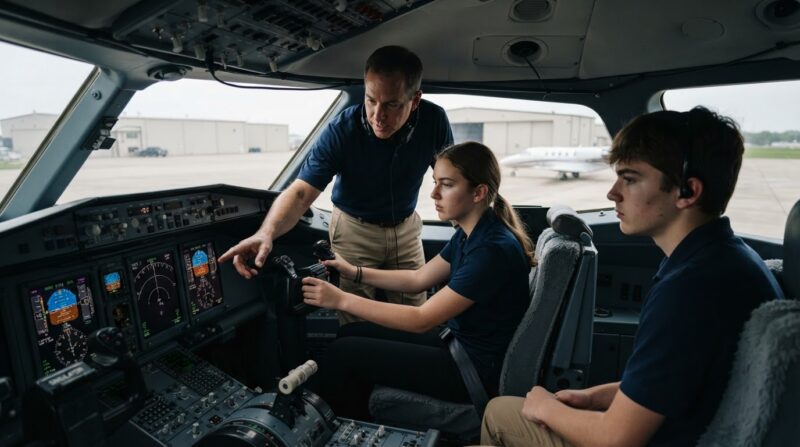
Instruction includes aerodynamics, aircraft systems, aviation instrumentation, flight performance and aviation physiology. Students also use flight simulation to connect classroom concepts with practical decision-making.
These topics require students to apply science and mathematics, interpret technical information and understand how different aircraft systems interact.
Airport and Industry Partnerships Expand Learning
The Aviation Careers Institute was developed through collaboration with Capital Region International Airport, Crosswinds Aviation and other aviation partners.
Industry relationships can give students opportunities to observe aviation operations and speak with people who understand the training requirements and working conditions of different aviation careers.
Students can also pursue high school and college credit, helping them identify possible steps toward postsecondary education.
These connections matter because aviation careers require different education and credential pathways. A student interested in aircraft maintenance may need a very different training plan from a classmate considering a pilot or airport operations career.
Career Awareness Extends Beyond Pilots
Although flight is an engaging introduction to the industry, aviation also depends on maintenance technicians, avionics specialists, airport operations professionals and numerous technical support roles.
High school aviation instruction can expose students to these less familiar career paths before they make college or training decisions.
Students can also discover how skills in electronics, mechanics, mathematics, information systems and communication apply to aviation work.
Training programs must still distinguish classroom practice and simulation from the certifications or supervised experience required for professional aviation occupations.
Why the Recognition Matters for CTE Programs
Program representatives received the award November 18, while the commission had previously identified the program for recognition at a September meeting.
The announcement illustrates how locally developed CTE initiatives can become important regional workforce partnerships.
By placing instruction near an active airport, integrating simulation and connecting students with industry partners, the institute provides an example of learning organized around an occupational environment.
For CTE leaders, the program suggests a practical development strategy: identify regional industries, engage employers early and help students understand the sequence from introductory education to advanced training and employment.
As aviation technology continues to evolve, programs such as the Aviation Careers Institute can help students discover technical pathways that may otherwise remain unfamiliar.
Source: Eaton Regional Education Service Agency, November 20, 2026.