
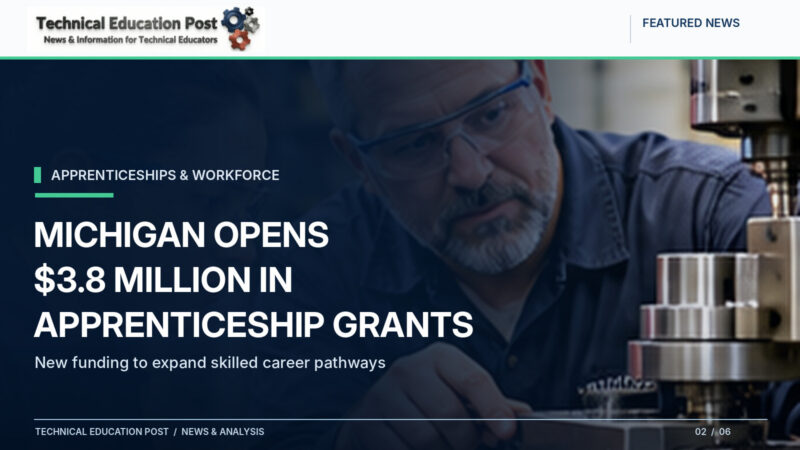
Michigan has opened a new $3.8 million funding opportunity designed to expand Registered Apprenticeship Programs and strengthen the state’s workforce development system.
The Michigan Department of Labor and Economic Opportunity posted its Registered Apprenticeship Michigan Performance Stipends (RAMPS) 2027 Request for Proposals on November 16, 2026.
The program will provide state funding to support the development, implementation, and expansion of Registered Apprenticeships in occupations connected to Michigan’s workforce needs.
Individual awards are anticipated to range from $250,000 to $1 million, with applications due December 11, 2026.
For workforce-development organizations, employers, education providers, and apprenticeship sponsors, the opportunity deserves immediate attention.
Michigan is emphasizing career outcomes and occupational demand, reflecting a broader shift toward evaluating training programs according to their ability to connect participants with meaningful employment.
The announcement also creates an opportunity for technical education providers to strengthen partnerships with employers that need structured, occupation-specific training.
Key Takeaways
- Michigan has made $3.8 million available through its RAMPS 2027 grant opportunity.
- Anticipated awards range from $250,000 to $1 million.
- Funding is organized into two tracks addressing apprenticeship outcomes and strategically important occupations.
- Separate applications are required for organizations seeking funding under both tracks.
- Proposals must be submitted by December 11, 2026, at 11:59 p.m. Eastern.
How the New Funding Works
The RAMPS 2027 program includes two funding tracks.
Track A: High-wage, high-placement occupations
This track supports occupations identified through Michigan apprenticeship outcome data as providing strong wages and employment placement.
Its emphasis reflects the importance of evaluating workforce programs beyond participation alone.
Training providers increasingly need to demonstrate that participants can complete their preparation and progress into sustainable employment.
Track B: Economically important occupations
This track supports Registered Apprenticeships in sectors critical to Michigan’s economic growth and economic health.
The state also identifies opportunities to leverage federal pay-for-performance apprenticeship incentives.
Applicants interested in both tracks must submit separate proposals, and the state limits aggregate awards to any single lead applicant to $1 million.
The full RFP contains the eligibility and program requirements that prospective applicants must review before applying.
Why the Funding Matters
Registered Apprenticeships combine paid employment, structured on-the-job learning, mentoring, and related technical instruction.
Unlike training programs that operate independently from employers, registered apprenticeships establish a direct relationship between learning and occupational responsibilities.
The model can be particularly relevant for advanced manufacturing, industrial maintenance, construction, technical services, and other occupations requiring substantial hands-on experience.
For community colleges and career centers, employer partnerships are a critical component.
Institutions may contribute classroom instruction, technical laboratories, industry knowledge, and assessment capabilities while participating employers provide supervised workplace learning.
The resulting pathway can help workers develop skills without separating technical education from employment.
A Greater Focus on Outcomes
An important feature of Michigan’s approach is its attention to occupational outcomes.
The emphasis on high-wage and high-placement occupations suggests that apprenticeship expansion is not simply a matter of creating additional training seats.
Programs must also address whether participants are preparing for occupations that offer meaningful opportunities.
For educators and workforce administrators, this has practical implications.
Programs should be able to demonstrate that their curriculum aligns with the competencies employers require, that apprentices receive appropriate mentorship, and that participation can lead to measurable advancement.
Completion, retention, wage progression, and employer satisfaction are useful measures to track.
These metrics also help identify where additional instructional support may be needed.
What Education and Workforce Partners Should Do
Organizations considering participation should begin by reviewing the official RAMPS 2027 solicitation.
A useful initial planning process includes identifying appropriate employers, confirming eligible occupations, and determining which organization would serve as the lead applicant.
Partners should also review existing apprenticeship registration arrangements, instructional capacity, participant recruitment methods, and anticipated outcomes.
For institutions already delivering related technical instruction, the opportunity may help support stronger partnerships with Registered Apprenticeship sponsors.
For employers without an established apprenticeship program, consultation with state apprenticeship specialists may be appropriate before developing a proposal.
The funding should not be confused with an automatic payment to every employer or apprentice. Awards are competitive and subject to the state’s published requirements.
Important Dates
| Milestone | Date |
|---|---|
| RFP published | November 16, 2026 |
| Deadline for questions | December 9, 2026 |
| Application deadline | December 11, 2026 |
| Anticipated award notification | January 18, 2027 |
Frequently Asked Questions
How much funding is available?
Michigan has identified $3.8 million in state funding for the RAMPS 2027 opportunity.
What is the maximum award?
The anticipated range is $250,000 to $1 million, with aggregate awards to a single lead applicant capped at $1 million.
Can an organization apply under both tracks?
Yes, but separate applications are required for each track.
Where can applicants find the official requirements?
The Michigan Department of Labor and Economic Opportunity maintains the official RFP, application template, submission instructions, and deadlines on its funding-opportunity website.
TechEd Magazine Perspective
Michigan’s latest apprenticeship investment illustrates an increasingly important principle in workforce development: training capacity and employment outcomes must be considered together.
Expanding access to technical education remains important, but employers and policymakers also need evidence that training leads to occupational competency and career advancement.
For technical education institutions, the opportunity is to become stronger partners in the employment process rather than functioning solely as providers of classroom instruction.
The organizations best positioned to capitalize on funding opportunities like RAMPS will be those that can connect instruction, employer participation, mentorship, and measurable workforce results.