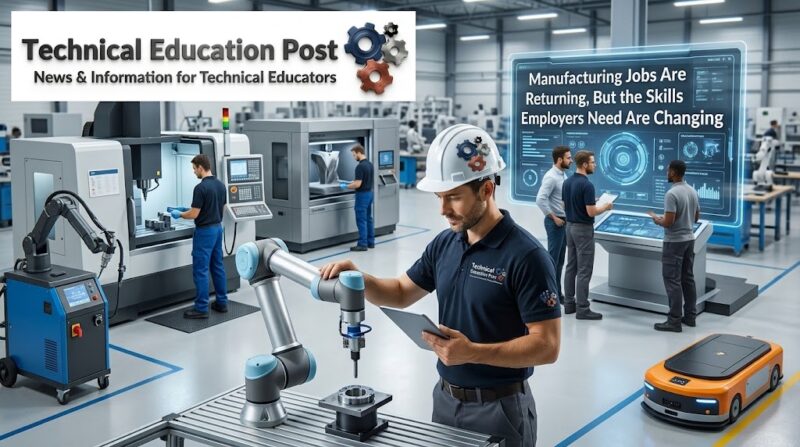
Automation, advanced machinery, and increasingly sophisticated production systems are redefining manufacturing careers—and creating new challenges for technical educators.
American manufacturing is showing signs of renewed hiring, but the jobs emerging across the industry look considerably different from traditional factory positions. Employers increasingly need workers who understand automation, robotics, industrial electronics, equipment maintenance, and advanced manufacturing processes.
According to October 26 reporting by The Wall Street Journal, U.S. manufacturing employment has increased by approximately 72,000 positions since December. However, the growth comes amid a significant transformation in the composition of the manufacturing workforce.
The shift raises an important question for educators, community colleges, and workforce-development organizations: Are today’s training programs preparing students for the manufacturing jobs employers will actually need?
Manufacturing Employment Is Changing
The manufacturing industry has undergone considerable structural change over the past decade.
Labor Department data highlighted in the Journal’s reporting indicate that manufacturers eliminated approximately 244,000 production positions between 2015 and 2025 while adding around 358,000 jobs in management, business, and financial operations.
These changes do not suggest that hands-on manufacturing occupations are disappearing. Instead, they illustrate how technology is reshaping the balance between traditional production labor and positions requiring technical knowledge, analytical capabilities, and specialized training.
Modern manufacturing facilities increasingly depend on automated production lines, computer-controlled machinery, industrial robotics, and connected equipment.
Workers must do more than operate machinery. Many positions require the ability to troubleshoot sophisticated systems, interpret production data, identify mechanical problems, and work with electronic controls.
Automation Is Creating New Workforce Requirements
Advanced manufacturing environments rely on multiple technologies working together.
Industrial robots may handle repetitive production tasks, while technicians oversee equipment performance, maintain automated systems, and respond to operational problems.
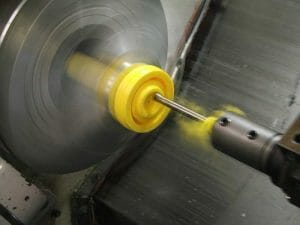
Computer numerical control (CNC) machines require workers who understand machining fundamentals, programming concepts, precision measurement, and quality-control procedures.
Similarly, industrial maintenance increasingly combines mechanical skills with electrical troubleshooting, sensors, programmable logic controllers (PLCs), and automation systems.
The resulting workforce needs are broader than those traditionally associated with factory employment.
Employers need specialists who can understand complete production systems rather than individual pieces of equipment.
The Challenge for Career and Technical Education
For career and technical education programs, the changing manufacturing landscape presents both an opportunity and a responsibility.
Training programs that concentrate exclusively on traditional equipment operation may leave graduates underprepared for highly automated workplaces.
A modern manufacturing curriculum should consider integrating:
- Industrial automation and robotics fundamentals
- CNC machining and programming
- Mechanical and electrical troubleshooting
- PLCs and industrial control systems
- Precision measurement and quality assurance
- Manufacturing data and digital technology
- Workplace safety and preventive maintenance
However, students should not be expected to learn every advanced technology before entering the workforce.
Foundational competencies in mathematics, mechanical systems, electrical principles, and problem-solving remain essential.
These skills provide the groundwork for more specialized training and continuing professional development.
Industry Partnerships Are Becoming More Important
Educational institutions cannot always anticipate technological changes independently.
Partnerships with manufacturers provide opportunities to understand emerging equipment requirements, update instructional programs, and develop practical learning experiences.
Employers can contribute by participating in advisory boards, providing equipment demonstrations, supporting internships, and helping educators identify relevant technical competencies.
Community colleges and technical schools can also develop short-term certificate programs that enable existing workers to upgrade their skills without completing an entirely new degree.
The Journal’s reporting points to semiconductor workforce training involving Arizona State University and Taiwan Semiconductor Manufacturing Company as one example of education responding to specialized industrial demand.
Such partnerships illustrate how training providers can connect instruction to specific workforce needs.
Does Advanced Manufacturing Require a College Degree?
One of the most significant questions surrounding manufacturing’s transformation is whether increasing technological complexity will limit opportunities for workers without four-year degrees.
Certain advanced engineering and research positions require extensive university education.
Many skilled technical occupations, however, can be entered through associate degrees, registered apprenticeships, technical certificates, employer training, and demonstrated competencies.
For employers, distinguishing between positions that genuinely require bachelor’s degrees and those that can be filled through alternative training pathways may help broaden recruitment.
For technical educators, the challenge is to create pathways that allow students to enter manufacturing careers and continue advancing as their skills develop.
Preparing Students for Manufacturing’s Next Generation
The future of manufacturing education will depend on adaptability.
Equipment, software, and production methods will continue changing, making lifelong learning increasingly important.
Schools that emphasize transferable technical knowledge, practical experience, and strong employer partnerships may be better positioned to respond.
Manufacturing’s renewed hiring activity presents an opportunity to strengthen the connection between education and industry.
But creating a sustainable workforce will require more than increasing enrollment in existing programs.
It will require ensuring that the skills students acquire reflect the technology employers are using today—and the systems they are preparing to adopt tomorrow.
Source: The Wall Street Journal, October 26, 2026, “U.S. Manufacturing Is Adding Jobs Again, but the Hiring Rules Have Changed.”