Artificial intelligence is becoming routine in American classrooms faster than many school systems are developing the policies, professional development and leadership capacity needed to manage it.
That is the central finding of new U.S. research commissioned by IBM and conducted by Morning Consult, released September 2, 2026. The survey included 2,048 U.S. adults—1,019 K–12 education professionals and 1,029 parents of K–12 students—and found a striking gap between classroom AI adoption and institutional readiness.
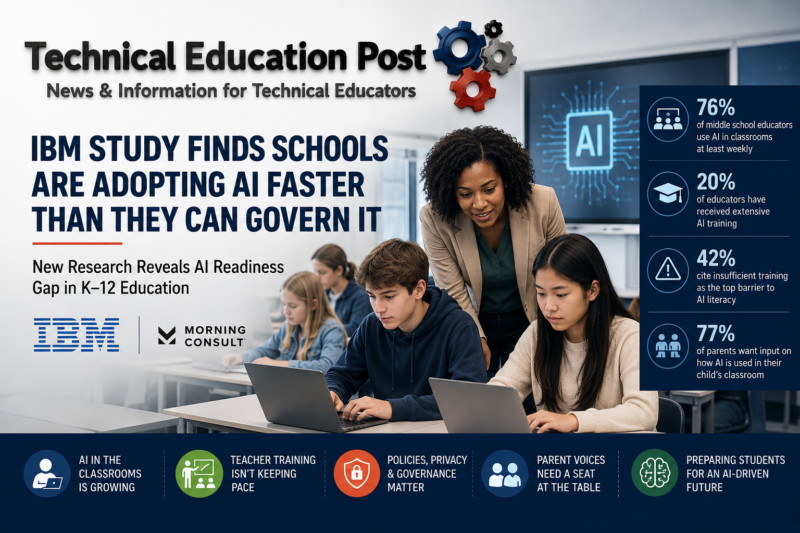
Among classroom educators, 76% of middle school teachers and 73% of high school teachers said AI is being used in their classrooms at least weekly. Nearly half of high school educators—45%—reported daily or almost-daily classroom use.
Yet only 20% of K–12 educators said they have received extensive AI training.
That gap may be one of the most important challenges facing K–12 technology leaders.
Schools are no longer preparing for an AI-enabled future.
In many classrooms, that future has already arrived.
The question now is whether district governance, teacher preparation, curriculum and family communication can catch up.
Key Takeaways
- 76% of surveyed middle school classroom educators and 73% of high school educators said AI is used in their classrooms at least weekly.
- 45% of surveyed high school educators reported AI use daily or almost daily.
- Only 20% of educators said they have received extensive AI training.
- 42% of educators identified inadequate training or professional development as the leading obstacle to supporting AI literacy.
- Only 24% of educators and 16% of parents said the U.S. education system is adapting “very well” to advances in AI.
- 77% of parents want input into how AI is used in their child’s classroom, but only 20% said they clearly understand the AI guidance their child receives.
- Teachers identified student dependence on AI and cheating or plagiarism as leading concerns.
- Educators and parents remain divided over how much AI belongs in K–12 education.
- IBM simultaneously announced a new K–12 AI Leaders Fellowship, beginning with up to 100 education leaders in the greater New York area before expanding to additional states.
AI Is Already Routine in Secondary Classrooms
The speed of adoption is perhaps the survey’s most striking finding.
Among surveyed classroom educators, AI was reportedly being used at least weekly in:
76% of middle school classrooms
73% of high school classrooms
45% of elementary classrooms
At the high school level, 45% of classroom educators said AI was being used daily or almost daily.
Those numbers suggest that the familiar debate over whether schools should “allow AI” may already be outdated in many districts.
AI has moved from novelty to routine.
Students can encounter artificial intelligence through generative chatbots, writing and research tools, tutoring applications, coding platforms and AI features embedded inside software schools already use.
Educators are also using AI to develop lessons, differentiate materials, draft communications, analyze information and support administrative work.
Technical Education Post has previously examined this growing adoption in its coverage of AI tools and teacher training, including the rapidly expanding role technology companies and education organizations are playing in professional development.
The issue is therefore increasingly less about access.
It is about readiness.
Only One in Five Educators Reports Extensive AI Training
The readiness gap becomes much clearer when teacher preparation is considered.
Only 20% of surveyed K–12 educators said they had received extensive AI training.
When educators were asked about barriers to supporting AI literacy, 42% identified insufficient training or professional development, making it the leading barrier.
Another 34% pointed to limited AI curriculum and instructional materials.
That creates a significant institutional problem.
Teachers may be expected simultaneously to:
- use AI effectively;
- teach students how to use it;
- identify inappropriate use;
- protect student information;
- evaluate AI-generated work;
- detect misinformation;
- recognize bias;
- preserve academic integrity;
- determine when AI assists learning and when it replaces it.
Those responsibilities require more than knowing how to type a prompt.
They require AI literacy, instructional judgment and policy awareness.
A district that provides employees with AI tools without providing corresponding professional development may therefore be increasing capability faster than competence.
Schools Are Adopting AI Faster Than Their Systems Are Adapting
IBM framed the results as an AI readiness gap.
The survey provides evidence for that interpretation.
Only 24% of educators and 16% of parents said the U.S. education system is adapting very well to advances in artificial intelligence.
That gap is important because AI adoption involves more than classroom instruction.
A mature district AI strategy may require coordination across:
curriculum
instruction
professional development
technology
cybersecurity
student privacy
procurement
special education
assessment
academic integrity
family communication
career readiness
Installing an AI application addresses almost none of those questions by itself.
This is why the emerging AI challenge is increasingly becoming a leadership challenge rather than merely an education-technology challenge.
Teachers Are Worried About Student Dependency
Classroom educators and administrators also appear to be looking at AI through different lenses.
Among teachers, 52% identified student dependency on AI as a leading concern, while 47% cited cheating or plagiarism.
Those concerns go beyond academic integrity.
Student dependency raises a deeper instructional question:
At what point does AI stop supporting thinking and begin replacing it?
A student can ask AI to:
- brainstorm an idea;
- explain a concept;
- summarize a reading;
- produce an outline;
- write a paragraph;
- solve a math problem;
- generate computer code;
- revise an essay;
- analyze evidence.
Each step can be helpful under some circumstances.
But collectively, those capabilities also make it possible for students to bypass much of the intellectual work schools are designed to develop.
The question is therefore not simply whether AI helps students complete assignments.
Educators have to determine whether students are still developing the underlying competency.
A polished AI-assisted essay is not necessarily evidence that a student learned to write.
A correct AI-generated solution is not necessarily evidence that a student learned to solve the problem.
That distinction will likely become increasingly important as generative AI grows more capable.
Administrators See Different Problems
School administrators placed relatively greater emphasis on infrastructure and implementation issues.
According to IBM’s survey, administrators were more likely than teachers to cite inadequate AI training—26% versus 19%—and the cost of AI tools—22% versus 11%—as concerns.
The difference is understandable.
Teachers encounter the effects of AI directly through student work.
District leaders have to manage the systems around that use.
Those responsibilities include questions such as:
Who approves AI applications?
Which services can process student information?
How are teachers trained?
What does implementation cost?
Which AI services will the district purchase?
How are contracts evaluated?
What happens when an existing software vendor adds AI functionality?
How is student use monitored without creating inappropriate surveillance?
Who decides whether an AI tool actually improves learning?
The district AI problem therefore spans the classroom and the enterprise.
Parents Want a Seat at the Table
Perhaps one of the most consequential survey findings concerns families.
IBM’s survey found that 77% of parents want input into how AI is used in their child’s classroom.
Yet only 20% said they clearly understand the AI guidance their child receives at school.
That is a substantial communication gap.
Parents identified clearer guidelines at 51% and greater transparency about classroom AI use at 48% as the changes most likely to increase their confidence.
This suggests that AI implementation cannot remain an internal technology initiative.
Schools may need to explain:
- which AI systems students use;
- what those systems do;
- what data they collect;
- when students may use them;
- when AI use is prohibited;
- how teachers verify AI output;
- how AI affects grading;
- what families can opt into or out of;
- how student privacy is protected.
Silence can create distrust even when the technology itself is being used appropriately.
Educators and Parents Don’t Fully Agree on AI’s Role
The survey also found a notable difference between educators and parents over whether AI literacy belongs in the curriculum.
59% of educators said AI literacy should either be required or offered as an elective.
Among parents, that number was 40%.
Meanwhile, 28% of parents said AI does not belong in K–12 education at this time, compared with only 12% of educators.
That disagreement could become increasingly significant.
Schools face pressure from one direction to prepare students for an AI-enabled economy.
They face pressure from another to protect foundational learning, privacy and childhood development.
Both concerns are legitimate.
The challenge is building policies that do not treat AI as either universally beneficial or universally harmful.
Middle School Emerges as an Important Boundary
There was one notable area of agreement.
Among educators and parents who believe AI has a place in education, 41% of both groups identified middle school—grades 6 through 8—as the stage when students should first begin learning about AI.
That result is particularly interesting given the emerging national debate around age-appropriate AI use.
The distinction between learning about AI and using generative AI independently is important.
Middle school students can learn:
- how AI works;
- why AI generates errors;
- what bias means;
- how algorithms affect information;
- why personal data matters;
- how AI is changing employment;
- how to verify AI-generated information.
That does not necessarily mean they require unrestricted access to every AI tool.
AI literacy can begin before AI dependence.
AI Readiness Increases in Later Grades
Educators working with older students were generally more confident about students’ readiness for an AI-influenced future.
Overall, 42% of K–12 educators believed students were prepared for future jobs in an AI-driven economy.
Among middle and high school educators, however, that figure rose to 56%.
Likewise, 56% of middle school educators and 59% of high school educators believed students were prepared to think critically before accepting AI-generated outputs.
That suggests age and experience matter.
It may also point toward a progressive AI-literacy model:
Elementary School
Build foundational literacy, numeracy, critical thinking and digital citizenship.
Middle School
Introduce AI concepts, limitations, verification, ethics and responsible use.
High School
Develop increasingly sophisticated AI literacy tied to academic work, college preparation and careers.
CTE
Apply AI within occupational contexts such as manufacturing, cybersecurity, healthcare, engineering, business and information technology.
Such a progression may prove more useful than a single K–12 policy applied equally to every age group.
The Workforce Question Is Becoming Harder to Ignore
Schools also face a long-term workforce obligation.
Students graduating in the late 2020s and early 2030s are likely to enter workplaces where artificial intelligence is embedded into software, operations and decision-support systems.
Technical Education Post has already documented AI becoming part of manufacturing workforce training and technical education, while higher education institutions are expanding AI and machine-learning curricula.
That means simply shielding students from AI cannot be a complete strategy.
But neither can unrestricted adoption.
Workforce readiness increasingly means knowing both how to use AI and when not to trust it.
Future workers may need to:
- verify AI-generated information;
- identify hallucinations;
- protect confidential data;
- understand automated recommendations;
- recognize inappropriate automation;
- work alongside AI systems;
- retain domain expertise sufficient to detect AI errors.
Those skills are not produced automatically by giving students access to chatbots.
They have to be taught.
IBM Launches K–12 AI Leaders Fellowship
IBM is responding to the readiness gap with a new K–12 AI Leaders Fellowship.
The inaugural cohort is scheduled to launch this fall with up to 100 superintendents, education leaders and educators from the greater New York area.
Participants will receive AI learning and credentials through IBM SkillsBuild, curriculum support, capstone projects focused on responsible AI implementation and access to expert facilitators.
IBM says it plans to expand the program to additional U.S. states during its first year, eventually reaching hundreds of education leaders through a cohort model.
The emphasis on leadership is notable.
Much of the first wave of education AI professional development focused on teachers learning to use individual tools.
District leaders now have a different challenge.
They must design the systems within which those tools are used.
The Technology Industry Is Becoming a Major Provider of AI Training
IBM is not alone.
Major technology companies increasingly are helping build the professional-development infrastructure around school AI.
Technical Education Post previously reported that Microsoft, OpenAI and Anthropic have supported teacher-AI training efforts connected with the American Federation of Teachers, while Microsoft has also supported AI training through the National Education Association.
That creates opportunity—but also an important independence question.
Technology companies possess expertise and resources school systems often lack.
They also have commercial interests in the expansion of artificial intelligence.
Schools therefore need to distinguish between:
AI education
and
AI product adoption.
Professional development should teach transferable concepts such as verification, privacy, bias, responsible use and instructional design rather than functioning primarily as training for one company’s product ecosystem.
A Survey Is Evidence, Not a National Census
The IBM findings should also be interpreted carefully.
The research was commissioned by IBM and conducted online by Morning Consult in July 2026.
The sample included:
- 1,019 K–12 education professionals
- 1,029 parents of K–12 students
Results were weighted to reflect the target populations, and the reported margin of error is ±3 percentage points for each sample.
The findings therefore represent what surveyed educators and parents reported.
They should not be interpreted as a direct national measurement of every school district’s AI deployment, classroom software or student outcomes.
That distinction is especially important because IBM is both the study sponsor and the organization launching an AI education initiative alongside the results.
The research is nevertheless useful because the differences it identifies—between adoption and training, schools and parents, teachers and administrators—point toward questions districts can independently examine.
What School Districts Should Do Now
District leaders do not need another general statement saying AI is important.
They need an implementation framework.
The first step should be understanding what is already happening.
Ask teachers what they are using.
Ask students what they are using.
Inventory AI functionality inside existing software.
Review procurement and privacy requirements.
Then determine where policy and training have failed to keep pace.
A district where AI is already used weekly by large numbers of students cannot treat AI professional development as optional enrichment.
It has become part of basic instructional governance.
Questions to Ask Your District
- How frequently are students currently using AI?
- Do we actually know which AI tools teachers and students use?
- What percentage of our educators have received formal AI training?
- Is AI professional development optional or expected?
- Do teachers know how to identify hallucinated information?
- Are students taught how to verify AI outputs?
- Do we have different AI expectations by grade level?
- Which student-facing AI tools are officially approved?
- What information may never be entered into generative AI?
- Does our cybersecurity team review AI applications?
- Do parents understand our AI policy?
- Have families been given meaningful opportunities for input?
- How do we distinguish AI assistance from academic substitution?
- Are teachers expected to disclose their own AI use?
- How are AI-assisted assignments evaluated?
- Which AI skills actually matter to employers and colleges?
- How are CTE programs incorporating occupational AI applications?
- Who is ultimately accountable for district AI governance?
What Educators Should Watch Next
AI Professional Development
The gap between classroom use and educator preparation may put substantial pressure on districts to expand formal training.
State AI Standards
As states define AI literacy, schools will need clarity about what students should know at different grade levels.
Parent Involvement
The IBM survey suggests schools could face increasing expectations for transparency and family participation in AI-policy decisions.
AI and Assessment
As AI becomes routine, schools will need better ways to determine what students can actually do independently.
Teacher Dependency
Student reliance receives considerable attention, but educator dependence on AI could become another issue. Teachers still need enough subject expertise to identify incorrect generated material.
CTE and Workforce Readiness
Career programs may move fastest toward task-specific AI because employers are already integrating AI into technical occupations.
Frequently Asked Questions
What did IBM’s K–12 AI study find?
IBM’s survey found that classroom AI use is already widespread, particularly in middle and high school, while extensive educator training remains comparatively uncommon.
How many people participated?
Morning Consult surveyed 2,048 U.S. adults, including 1,019 K–12 education professionals and 1,029 parents of K–12 students.
How many educators have received extensive AI training?
Only 20% of surveyed K–12 educators said they had received extensive AI training.
How common is classroom AI use?
Among classroom educators surveyed, 76% at the middle school level and 73% at the high school level reported AI use at least weekly. Forty-five percent of high school educators said AI was used daily or almost daily.
What is the biggest barrier to AI literacy?
The most frequently cited barrier among educators was insufficient training or professional development, identified by 42%. Limited curriculum and instructional materials followed at 34%.
What concerns teachers most?
Teachers most frequently cited student dependency on AI, at 52%, followed by cheating or plagiarism, at 47%.
Do parents support AI in schools?
Parent opinions are mixed. Seventy-seven percent said they want input into classroom AI use, but 28% said AI does not belong in K–12 education at this time.
When should students begin learning about AI?
Among respondents who believe AI belongs in education, 41% of both educators and parents identified middle school—grades 6 through 8—as the appropriate starting point.
What is IBM’s K–12 AI Leaders Fellowship?
It is a professional-learning initiative for superintendents, education leaders and educators focused on responsible AI adoption. IBM plans to begin with up to 100 participants in the greater New York area before expanding to additional states.
Is the IBM research independent?
Morning Consult conducted the survey, but IBM commissioned it. That sponsorship should be disclosed when reporting the findings, and the data should be treated as survey evidence rather than an independent national audit of classroom AI usage.
TechEd Magazine Perspective
The most revealing number in IBM’s research may not be the percentage of classrooms using AI.
It is the 20% of educators who say they have received extensive AI training.
Technology adoption can happen remarkably quickly.
Institutional competence usually cannot.
A teacher can create an account in minutes.
A student can begin using AI immediately.
A software vendor can add generative AI in an update.
But developing thoughtful curriculum, professional development, privacy procedures, assessment practices and family communication takes time.
That mismatch is now becoming visible.
The emerging divide in American education may therefore not be between schools that adopt artificial intelligence and schools that resist it.
It may be between schools that govern AI intentionally and schools that simply discover it has already arrived.
The distinction will matter.
AI literacy requires more than prompting.
Responsible AI requires more than a policy document.
Workforce preparation requires more than giving students access to technology.
Schools have to build enough human expertise around artificial intelligence to decide when it improves education—and when it gets in the way.
The technology is advancing rapidly.
The institutional work now has to catch up.
Recommended Reading
Technical Education Post has previously examined how educators and school systems are adapting to AI, including the growing need for professional development.
AI Tools and Training in the Classroom
For the broader workforce side of AI education:
AI Learning and Training Opportunities
Primary Source
IBM released the research on September 2, 2026. The announcement contains the survey findings, methodology and details of the K–12 AI Leaders Fellowship.
IBM — New Study Finds AI Adoption Is Outpacing K–12 Readiness