
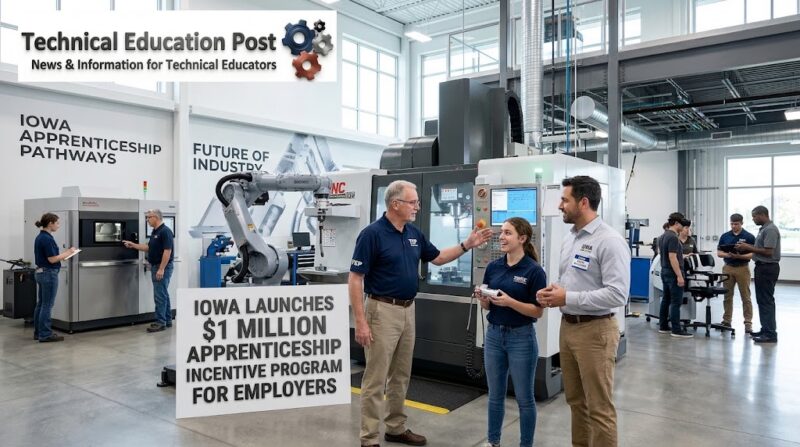
The new LaunchRA initiative offers up to $3,000 per eligible apprentice to encourage new registered apprenticeship programs in high-demand industries.
Iowa has introduced a new financial incentive program designed to encourage employers and workforce organizations to establish registered apprenticeships.
Announced October 27 by Iowa Workforce Development, the LaunchRA initiative provides more than $1 million in funding for eligible new apprenticeship programs.
Qualifying sponsors may receive $2,000 for each apprentice who meets program requirements, with an additional $1,000 available for eligible occupations in high-demand industries.
The program is intended to support apprenticeship development while placing particular emphasis on apprentice retention.
For employers, educators, and workforce-development professionals, LaunchRA provides an example of how public funding can encourage structured, work-based training.
How the LaunchRA Program Works
LaunchRA is administered through the Iowa Office of Apprenticeship.
The program provides incentives to eligible sponsors of newly registered apprenticeship programs that enroll and retain apprentices.
According to Iowa Workforce Development, registered apprenticeship programs established on or after July 1, 2026, may qualify for payments.
Eligible apprentices must have been registered on or after October 1, 2026, and completed at least six months, or 180 days, of participation.
Qualifying sponsors can receive:
- $2,000 for each eligible apprentice retained for the required period.
- An additional $1,000 for apprentices in designated high-demand occupations.
- Up to $30,000 in total funding per sponsor.
The state has allocated approximately $1.027 million to the initiative.
Payments are subject to available funding and program eligibility requirements.
High-Demand Industries Receive Additional Support
LaunchRA provides an additional incentive for programs connected to specific workforce needs.
Eligible high-demand industries include advanced manufacturing, education, healthcare, and information technology.
These sectors often require employees with specialized technical competencies and opportunities to apply classroom knowledge in practical environments.
In advanced manufacturing, apprenticeships may support occupations involving industrial maintenance, equipment operation, electrical systems, and other technical disciplines.
Information technology apprenticeships can provide structured pathways for developing technical abilities through supervised workplace experience.
Healthcare and education employers may also use registered apprenticeships to develop workers for approved occupations.
The additional incentive is intended to encourage new programs in areas that Iowa has identified as priorities.
Why Apprentice Retention Matters
A distinctive feature of LaunchRA is its six-month participation requirement.
Employers cannot simply register an apprentice and immediately collect the incentive.
Instead, they must retain an eligible apprentice for at least 180 days before requesting payment.
This structure connects financial assistance to continued program participation.
It also creates an incentive for sponsors to provide meaningful training, supervision, and support during the early stages of an apprenticeship.
Successful programs often depend on experienced mentors, clearly defined competencies, progressive skill development, and regular feedback.
Apprentices who understand their training objectives and receive consistent support may be better positioned to complete their programs.
However, six-month retention should not be confused with apprenticeship completion.
Long-term program effectiveness also depends on completion rates, credential attainment, career advancement, and employment outcomes.
Registered Apprenticeships Combine Work and Education
Registered apprenticeships provide a structured approach to workforce training.
Programs generally combine paid on-the-job learning with related technical instruction and documented occupational competencies.
Unlike informal workplace training, registered programs operate within established standards and requirements.
Apprentices gain experience performing actual job tasks while receiving guidance from qualified workers.
Related instruction may be delivered through community colleges, technical schools, training centers, or other approved educational providers.
This model can benefit employers seeking to develop workers with skills tailored to operational requirements.
It can also provide participants with an employment-based alternative to traditional education pathways.
Opportunities for Technical Colleges and Employers
The LaunchRA initiative may create opportunities for partnerships between businesses and educational institutions.
Employers often possess the equipment, facilities, and workplace environments necessary for practical training.
Community colleges and technical schools can contribute classroom instruction, laboratory training, assessments, and curriculum development.
By coordinating these resources, partners can help apprentices acquire both theoretical knowledge and occupational experience.
Smaller employers may find such partnerships especially valuable because developing training programs independently can require substantial administrative resources.
Intermediary sponsors can also help coordinate apprenticeship programs when eligible.
Funding and Application Requirements
The LaunchRA program operates from October 1, 2026, through June 30, 2029.
Iowa Workforce Development indicates that incentive requests will be accepted beginning April 1, 2027, after qualifying apprentices have reached the required participation milestone.
Sponsors must satisfy applicable registration, documentation, and eligibility requirements.
The state has also scheduled an informational webinar for November 18, 2026.
Employers interested in participating should review the official program terms before establishing funding expectations.
A Model for Workforce Development
Iowa’s LaunchRA program demonstrates an approach to apprenticeship expansion that rewards both program creation and early apprentice retention.
The initiative cannot guarantee that every participating employer will develop a successful long-term program.
Nevertheless, financial assistance may help reduce some of the costs associated with establishing training pathways.
For technical educators and industry leaders, the program highlights the growing importance of connecting workplace experience, structured instruction, and measurable training outcomes.
As demand for specialized skills evolves, registered apprenticeships remain one option for developing talent while providing workers with practical routes into technical careers.
Official sources:
Iowa Workforce Development announcement, October 27, 2026:
https://workforce.iowa.gov/announcement/2026-10-27/iowa-launches-incentive-program-jumpstart-new-registered-apprenticeships-across-state
LaunchRA eligibility and program details:
https://workforce.iowa.gov/apprenticeship/launch-ra