Intel and PLTW Bring Semiconductor Manufacturing Into High School Classrooms
The semiconductor workforce pipeline is moving downstream into high school.
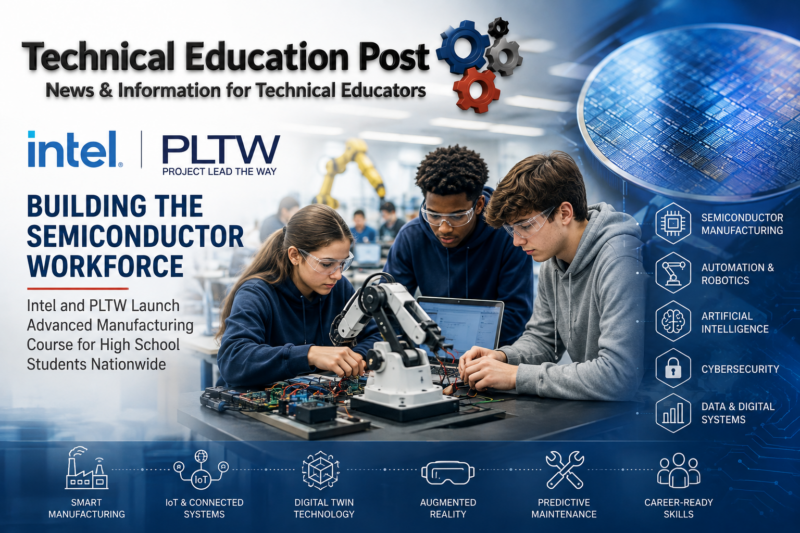
On September 1, 2026, the Intel Foundation and Project Lead The Way (PLTW) announced a three-year collaboration designed to expand access to semiconductor and advanced manufacturing education for students across the United States. At the center of the partnership is PLTW’s new Advanced Manufacturing course, a year-long high school experience built around technologies increasingly associated with Industry 4.0, including automation, robotics, semiconductor manufacturing, artificial intelligence, cybersecurity, connected systems, digital twins and smart-factory operations.
The announcement is important because it reflects a broader change in how schools may need to think about manufacturing education.
Semiconductors are no longer only the domain of university engineering programs, community-college cleanrooms or specialized technical institutes. Students may increasingly encounter semiconductor concepts alongside robotics, AI, industrial cybersecurity and data systems while they are still in grades 10–12.
That creates a more direct pathway from secondary STEM and CTE programs into advanced manufacturing careers, technical education, apprenticeships and postsecondary engineering programs.
For educators and district leaders, the larger question is not simply whether to add a semiconductor lesson.
It is whether the modern high school manufacturing curriculum is keeping pace with what modern manufacturing has become.
Key Takeaways
- Intel Foundation and Project Lead The Way announced a three-year collaboration focused on semiconductor and advanced manufacturing education.
- Intel Foundation says it has awarded PLTW a $3 million grant supporting the effort.
- PLTW’s new Advanced Manufacturing course is designed for students in grades 10–12 and launches during the 2026–27 school year.
- The curriculum includes semiconductor processing, automation, robotics, AI, machine learning, cybersecurity, IoT, data analytics and digital twins.
- Students can work toward a Lean Six Sigma White Belt credential as part of the course.
- Intel Foundation says the collaboration is intended to support training for 1,100 teachers over three years while PLTW’s broader network serves roughly 1.5 million students annually.
- The partnership represents a broader shift toward introducing semiconductor and smart-manufacturing careers earlier in the education pipeline.
What Intel and PLTW Are Building
Project Lead The Way describes its Advanced Manufacturing course as a year-long engineering course for high school students in grades 10–12.
Rather than organizing the course around traditional stand-alone manufacturing processes, the curriculum brings together technologies that now operate as interconnected systems inside modern facilities.
Students encounter:
- automation and robotics;
- semiconductor processing;
- artificial intelligence and machine learning;
- smart manufacturing;
- industrial data systems;
- cybersecurity;
- Internet of Things technologies;
- digital simulation;
- digital twins;
- augmented reality;
- predictive maintenance;
- data-driven optimization.
The distinction matters.
A modern production facility may combine programmable automation, networked sensors, robotic systems, industrial software, AI-supported analytics and cybersecurity controls within a single production environment.
Teaching those subjects separately can make it difficult for students to understand how they interact.
PLTW’s approach places them inside a common manufacturing context.
That gives students an opportunity to see advanced manufacturing as a systems discipline, rather than simply a collection of machines.
Semiconductor Education Is Moving Into Secondary CTE
The semiconductor component may be the most consequential part of the partnership.
Traditionally, semiconductor education has been concentrated in higher education and specialized workforce-training programs.
That is changing.
The expansion of domestic semiconductor manufacturing has created pressure to build a much larger pipeline of technicians, engineers, maintenance specialists, equipment professionals and production workers.
Technical Education Post examined this shift recently in Semiconductor Education Is Becoming National Infrastructure, which looked at efforts to connect semiconductor education across regions and institutions.
The Intel-PLTW collaboration moves another piece of that system into secondary education.
High school students do not need to emerge as semiconductor process engineers.
But earlier exposure can help them understand:
- what semiconductor manufacturing is;
- how chips are produced;
- what careers exist inside semiconductor facilities;
- which skills those careers require;
- what postsecondary programs can lead to those careers.
That type of career awareness can matter considerably when students begin choosing electives, technical programs, dual-enrollment courses or postsecondary pathways.
Manufacturing Curriculum Is Becoming More Digital
The course also illustrates how the definition of manufacturing education continues to expand.
Traditional programs often emphasize skills such as machining, fabrication, welding, measurement and mechanical systems.
Those remain important.
But advanced manufacturing increasingly adds another layer.
Machines generate data.
Sensors monitor operations.
Robots coordinate production.
Software models systems.
AI assists with optimization.
Cybersecurity protects connected industrial infrastructure.
Digital twins replicate physical processes virtually.
As a result, future manufacturing workers may need both mechanical understanding and digital literacy.
PLTW describes the difference between traditional and advanced manufacturing in similar terms. Its course materials emphasize that advanced manufacturing integrates robotics, AI, IoT connectivity, real-time analytics, cybersecurity and digital-twin simulation into networked production environments.
That creates an instructional challenge for schools.
A manufacturing program built entirely around equipment operation may no longer be enough.
A computer-science program disconnected from physical systems may not be enough either.
The emerging workforce sits between those domains.
AI Becomes a Manufacturing Skill
Artificial intelligence is especially significant in this curriculum because it is presented as an industrial technology rather than simply a generative-AI application.
Students use AI in connection with data analysis, system performance and manufacturing optimization.
PLTW’s course outline describes students working with large data sets, developing predictive models for maintenance and production optimization, and using AI tools to interpret industrial data and improve system performance.
That is a different educational use of AI than asking a chatbot to generate an essay.
It introduces students to AI as part of an operational system.
That distinction will matter increasingly for CTE.
Technical Education Post previously examined this trend in AI Training for Manufacturing Workers, where workforce programs were beginning to teach AI specifically for shop-floor and technician roles.
The Intel-PLTW initiative brings similar concepts earlier in the pipeline.
Students may begin learning not only how to use AI, but how AI interacts with production systems, data, automation and maintenance.
Cybersecurity Is Becoming a Manufacturing Competency
Cybersecurity is another telling inclusion.
Historically, cybersecurity education was often treated as part of information technology.
Modern factories make that separation increasingly difficult.
A connected manufacturing environment may include:
- programmable logic controllers;
- industrial networks;
- robotic systems;
- smart sensors;
- cloud-connected equipment;
- production databases;
- remote monitoring systems.
Those assets create cybersecurity responsibilities.
A technician working around networked machinery may therefore need at least a basic understanding of industrial cyber risk even if cybersecurity is not the employee’s primary job.
PLTW explicitly includes cybersecurity fundamentals within the Advanced Manufacturing course.
That signals an important curriculum trend:
Cybersecurity is becoming embedded knowledge across technical occupations rather than remaining a stand-alone IT specialty.
Digital Twins Move Into the High School Curriculum
Digital twins may be one of the most advanced concepts included in the course.
A digital twin is a virtual representation of a physical system that can be used to model, monitor and optimize real-world operations.
PLTW’s course outline introduces students to digital twins of robotic systems and asks them to compare physical equipment with its virtual counterpart.
Students examine simulation, robotic motion, collision risks and process optimization before integrating digital twins with augmented reality to solve smart-manufacturing challenges.
This type of experience can be valuable because many advanced industrial technologies are expensive or impractical to reproduce fully in a school lab.
Simulation gives students access to concepts that might otherwise require specialized facilities.
It also reflects the changing nature of technical work.
Technicians increasingly interact with both physical equipment and software models of that equipment.
The Course Connects Classroom Skills With Industry Credentials
PLTW also includes an industry-recognized credential opportunity.
Students taking Advanced Manufacturing can work toward a Lean Six Sigma White Belt credential.
That gives districts another way to connect classroom learning with industry terminology and process-improvement concepts.
But credentials should still be evaluated carefully.
A credential is most valuable when employers recognize it and when the underlying skills have genuine labor-market relevance.
The larger value of this course may therefore lie less in the credential itself and more in the combination of technical exposure, project-based learning and career awareness.
Teacher Preparation Will Be Critical
Curriculum cannot scale without instructors.
Intel Foundation says the collaboration aims to help train 1,100 teachers over the next three years.
That may prove just as important as student enrollment.
Advanced manufacturing instructors are increasingly expected to understand technologies spanning multiple disciplines.
A single course may now require familiarity with:
- robotics;
- programming;
- industrial data;
- automation;
- cybersecurity;
- AI;
- semiconductor concepts;
- digital simulation.
Schools cannot assume that every existing engineering or manufacturing teacher already has that expertise.
PLTW requires structured professional development for Advanced Manufacturing. Current training listings show an 80-hour format, with some sessions combining in-person and online work.
That reinforces a larger workforce issue within CTE itself:
The country cannot expand advanced technical education faster than it can prepare instructors to teach it.
What This Means for School Districts
District leaders considering advanced manufacturing programs should look beyond the course title.
The real question is what type of manufacturing environment students are being prepared to understand.
A modern program should increasingly expose students to the interaction between:
physical systems + digital systems + data + automation + cybersecurity.
That does not mean every school needs a semiconductor cleanroom.
It does mean students should understand what modern manufacturing looks like before they graduate.
Technical Education Post’s broader Technical and STEM Education 2026 analysis identified workforce alignment as one of the major challenges facing technical education.
The Intel-PLTW collaboration offers one example of what stronger alignment can look like.
Industry identifies emerging technical requirements.
Curriculum developers translate them into instructional experiences.
Teachers receive training.
Students encounter the technology before entering postsecondary education or employment.
That cycle can help schools update programs more quickly as industry evolves.
What Employers Should Watch
Manufacturers also have a role.
Industry partnerships are most useful when employers do more than sponsor equipment.
Companies can help schools understand:
- which occupations are growing;
- which technologies are actually used locally;
- which technical competencies entry-level workers need;
- which credentials have real value;
- what equipment students should encounter;
- what workplace experiences can be offered.
PLTW’s Advanced Manufacturing advisory board includes representatives from Intel, Toyota Motor North America, the Association for Advancing Automation, MIT-related education initiatives and other manufacturing and technology organizations.
That industry participation can help keep the curriculum connected to real workforce changes.
Local employers should consider doing the same at the regional level.
A national curriculum becomes more valuable when districts can connect it to nearby manufacturers, community colleges and apprenticeship programs.
The Semiconductor Pipeline Cannot Begin at College
The broader workforce lesson may be the most important.
Semiconductor workforce discussions often focus on university engineering programs or community-college technician training.
Those institutions are essential.
But students first need to know these careers exist.
A high school student who has never encountered semiconductor manufacturing may never search for a semiconductor technician program.
A student who has never seen automation may not consider mechatronics.
A student who believes manufacturing means repetitive manual labor may overlook an industry built increasingly around robotics, data systems, controls, precision production and advanced materials.
That is why early exposure matters.
High school CTE does not replace postsecondary training.
It makes the postsecondary pipeline visible.
Questions to Ask Your Program
District leaders, CTE directors and manufacturing educators evaluating their own programs should ask:
- Does our manufacturing curriculum reflect current Industry 4.0 technologies?
- Are students exposed to automation and robotics?
- Do they learn how industrial data is collected and analyzed?
- Does the curriculum include AI applications in manufacturing?
- Are students introduced to semiconductor careers?
- Do they understand industrial cybersecurity?
- Are digital twins or simulation tools part of instruction?
- Can students connect classroom projects to local manufacturing careers?
- Are instructors receiving enough professional development to teach emerging technologies?
- Which industry-recognized credentials actually matter to employers in our region?
- Are local manufacturers helping shape curriculum?
- Do community colleges know what our high school students are learning?
- Can students move from high school coursework into dual enrollment, apprenticeships or technical degrees?
- Are our labs preparing students for current equipment—or equipment industry stopped using years ago?
What Educators Should Watch Next
How Many Schools Adopt the Course
The most important measure will be implementation.
A strong curriculum has limited impact if only a small number of districts can afford equipment, professional development or staffing.
Teacher Capacity
The stated goal of training 1,100 teachers deserves close attention.
Instructor availability may become one of the biggest constraints on advanced-manufacturing program growth.
Semiconductor-Specific Pathways
The course introduces semiconductor concepts, but educators should watch for deeper secondary-to-postsecondary articulation agreements focused specifically on microelectronics.
Industry Credentials
Schools should monitor whether credentials connected to advanced manufacturing translate into measurable value for students.
Local Employer Partnerships
The strongest programs are likely to connect national curriculum with regional employers, community colleges and apprenticeship systems.
The Convergence of CTE Disciplines
Manufacturing, computer science, cybersecurity, electronics and engineering may become increasingly difficult to teach as separate silos.
Courses such as this one point toward a more integrated technical-education model.
Frequently Asked Questions
What did Intel and Project Lead The Way announce?
The Intel Foundation and Project Lead The Way announced a three-year collaboration to expand semiconductor and advanced manufacturing education for U.S. students. The partnership centers on PLTW’s new Advanced Manufacturing course.
How much funding is Intel Foundation providing?
Intel Foundation states that it awarded Project Lead The Way a $3 million grant supporting semiconductor science and advanced manufacturing education.
Who can take the PLTW Advanced Manufacturing course?
The year-long course is designed for students in grades 10–12.
What do students learn?
Topics include automation, robotics, semiconductor processing, AI, machine learning, cybersecurity, IoT, data analytics, smart manufacturing and digital twins.
Is semiconductor manufacturing really taught in high school?
Yes. Semiconductor processing and production concepts are explicitly included in PLTW’s Advanced Manufacturing curriculum.
Does the course include AI?
Yes. Students encounter AI and machine-learning concepts in manufacturing contexts, including data analysis and system optimization.
Does the course include cybersecurity?
Yes. Cybersecurity fundamentals are included among the technical areas covered by the course.
Does the course offer an industry credential?
Students can work toward a Lean Six Sigma White Belt credential.
When is the course available?
PLTW lists Advanced Manufacturing as a new offering for the 2026–27 school year.
Will teachers receive training?
Yes. PLTW requires professional development, and Intel Foundation says the collaboration aims to support training for approximately 1,100 teachers over three years.
TechEd Magazine Perspective
The significance of this partnership is not that Intel has helped create another STEM course.
It is what the course says about where technical education is heading.
Manufacturing education once could be divided relatively cleanly into mechanical, electrical and production skills.
That world is disappearing.
The modern technician may encounter a robot connected to an industrial network, controlled by software, monitored through sensors, represented by a digital twin, optimized through AI and protected by cybersecurity systems.
The semiconductor industry makes this convergence especially visible.
It depends on precision manufacturing, electronics, automation, process control, data, maintenance, engineering and sophisticated production technology operating together.
If high schools want to prepare students for that environment, their programs must increasingly reflect the same convergence.
Intel and PLTW are bringing that model into grades 10–12.
The next challenge is implementation.
Districts will need trained teachers.
Teachers will need appropriate equipment and software.
Programs will need employer partners.
Community colleges will need articulation pathways.
Students will need opportunities to move from classroom exposure into credentials, apprenticeships, technical degrees and careers.
That is the real opportunity.
The semiconductor workforce pipeline does not begin when a student enrolls in college.
It begins when a student first realizes that the industry exists—and can imagine a place within it.
Recommended Reading
Semiconductor Education Is Becoming National Infrastructure
How regional education networks are attempting to build a coordinated U.S. semiconductor workforce pipeline.
America’s Advanced Manufacturing Workforce
A broader examination of the skilled workforce required as advanced manufacturing investment expands.
AI Training for Manufacturing Workers
How AI skills are increasingly becoming part of technician and shop-floor workforce preparation.
Technical and STEM Education 2026
Technical Education Post’s broader look at STEM, CTE and workforce alignment.
Primary Sources
Intel Foundation and PLTW Expand Pathways to Semiconductor Careers
PLTW Advanced Manufacturing Course
PLTW Advanced Manufacturing Course Outline