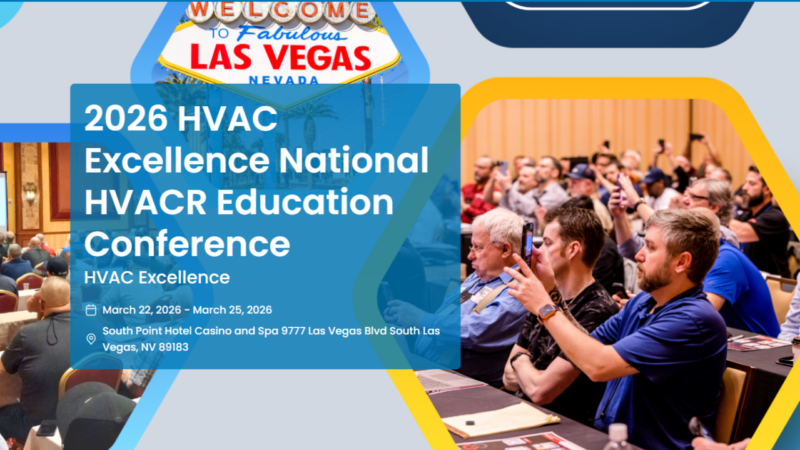
The HVACR industry is changing faster than ever before. Refrigerants are shifting, controls are becoming smarter, equipment designs look different, and expectations for system performance are higher. What once changed over years is now changing seemingly overnight. The changes in equipment are not coming, it is already here! These were some of the things discussed at the HVAC Excellence National HVACR Education Conference. HVAC Industry Message for Education.
MANUFACTURERS MESSAGE FOR INSTRUCTORS
During the Manufacturers Summit, leaders from Bosch Home Comfort Group, Daikin Comfort Technologies, General HVAC Solutions America, Lennox Industries, LG Electronics, Midea, Mitsubishi Electric Trane HVAC US, and Rheem Manufacturing stood together on one stage.
In a highly competitive industry, that kind of unity matters. Their message was clear. This is not about selling equipment, this is about closing the skills gap between what is being manufactured and what is being taught.
Manufacturers are willing to provide training. They are willing to open equipment and explain why it was designed the way it was. Willing to share service data and technical knowledge. They are willing to support programs. But partnership must go both ways. Support cannot be a one-way request for donations.
If instructors do not attend training, if programs do not update curriculum, and if schools refuse to move beyond legacy technologies, support will fade. Manufacturers are ready to meet educators halfway. Educators must step forward as well.
A MESSAGE FOR SCHOOL ADMINISTRATORS
If we want strong programs, we must invest in strong teachers and integrate the latest equipment.
Across the country, students are sometimes trained on systems that are no longer common in the field. At the same time, manufacturers are designing and building highly sophisticated systems which may not be in a legacy classroom of 10 years ago. The equipment contains inverter driven systems, low GWP refrigerant equipment (mandated by regulations), smart connected diagnostics, and high-performance heat pumps.
Heat pumps now outsell gas furnaces by nearly thirty five percent. They are being installed in cold climates every day (capable of operating to -21°F). Yet some programs still question whether they even work, and this gap continues to grow.
If instructors are not trained on modern systems, students graduate unprepared. If students graduate unprepared, contractors struggle and don’t hire the students from the programs, and the workforce shortage becomes worse.
Investment in professional development is no longer optional, it is necessary. Other industries understand this. Automotive instructors learn about new models each year. Medical educators stay current with new procedures. As technologies change, our programs must adapt, incorporate these changes and invest in the latest systems.
When directors invest in sending teachers to national training events, they invest in student success, workforce readiness, and the long-term strength of their programs.
Ask yourself, would you attend a computer science program taught on Windows 3.1, or an automotive program taught on 1994 cars? It is highly unlikely. Then why should manufacturers support a program that only teaches legacy technologies?
THE REALITY OF MODERN HVACR
Low GWP refrigerants are now standard. Inverter and variable speed systems are standard. Connected diagnostics are standard. High performance heat pumps are standard. These are not emerging technologies. They are today’s equipment. Students must be ready to work on these systems on their first day in the field.
Codes are evolving. Standards for R-290 monobloc heat pumps already exist. A3 refrigerants require an understanding of the safety standards associated in working flammable refrigerants. Intelligent controls require new troubleshooting skills. Technology is moving faster than training. That must change.
THE WORKFORCE OPPORTUNITY
Nearly 400,000 skilled trade jobs are currently unfilled in the United States, according to the Bureau of Labor Statistics. By 2033, that number could approach 2 million, according to Deloitte and The Manufacturing Institute.
At the same time, K–12 systems continue steering most students toward four-year degrees, even though the Bureau of Labor Statistics reports that 70% of jobs do not require a bachelor’s degree. We are pushing students in one direction while the jobs are in another.
Concerns that artificial intelligence could drive unemployment above 10% by 2028 have intensified fears about job displacement. Yet the same technologies fueling automation are driving one of the largest infrastructure expansions in modern history.
Artificial intelligence, streaming, online banking, and cloud computing all rely on data centers, massive facilities filled with servers that generate extraordinary heat. That heat must be managed, controlled, and transferred without compromising performance. Behind every technological breakthrough is a rapidly expanding mechanical backbone powered by highly skilled HVACR professionals.
Technology is not replacing the skilled trades, it is increasing their value. The more advanced the systems, the greater the need for highly trained technicians. The real question is simple: Are our programs aligned with these jobs? And will our students be ready?
RAISING THE STANDARD
In many trades, education standards are required. Medical gas instructors require 10+ years of plumbing/mechanical experience, 2+ years of teaching, and a current 6010 installer certification. Their programs must meet industry standards, and students must pass various exams. Yet in HVACR, formal education, standards, and accreditation are mostly voluntary.
It may be time for our industry to evolve! Programs should meet standards, and cover the competencies needed for entry level success. Students should follow structured learning paths. Apprenticeships and continuing education should be expected. If we want professional respect, we must embrace professional standards.
Source: HVAC Industry Message for Education
https://www.escogroup.org/hvac/
Dedicated to improving education in the HVACR industry. Our mission is to raise the level of instruction and workforce readiness by setting benchmarks, validating program quality, and supporting educators throughout their careers.
https://www.techedmagazine.com/industries/
HVAC Industry Message for Education