Schools are placing greater emphasis on professional skills, career portfolios, technical credentials and hands-on experience as they reconsider what graduates should be able to demonstrate.
High schools across the United States are reevaluating how they prepare students for employment and higher education, increasingly recognizing that a diploma alone may not demonstrate the capabilities employers expect.
Reporting published November 23, 2026, by Education Week examines school systems combining academic instruction, career and technical education (CTE), industry credentials and workplace experience to help students prepare for changing workforce expectations.
The movement reflects a broader shift toward evaluating readiness through demonstrated competencies as well as completed coursework.
Career Preparation Becomes a Schoolwide Priority
Bristol-Plymouth Regional Technical School in Taunton, Massachusetts, offers 19 technical programs spanning fields from culinary arts to construction. Students also take college-preparatory academic courses, keeping additional education and technical employment pathways open.
The school introduced an initiative called the Bristol-Plymouth Promise on November 18, 2026. It emphasizes what graduates can demonstrate rather than simply the number of courses they finish.
Under the initiative, students are expected to build professional portfolios, earn an industry credential, participate in work-based learning and complete a civic contribution. The school intends to fully implement the Promise by 2030.
Its Portrait of a Graduate focuses on competencies including professionalism, critical thinking, emotional intelligence, communication and civic-mindedness. These abilities are emphasized across academic and technical courses.
Employers Want Evidence of Workplace Skills
Industry surveys help explain why schools are paying closer attention to these competencies.
The National Association of Colleges and Employers’ Job Outlook 2026 Spring Update identifies teamwork, problem-solving and verbal communication among employers’ most sought-after attributes in entry-level candidates.
Technical competence remains essential. An industrial automation student, however, must also communicate troubleshooting steps, work safely with colleagues and explain decisions to supervisors and customers.
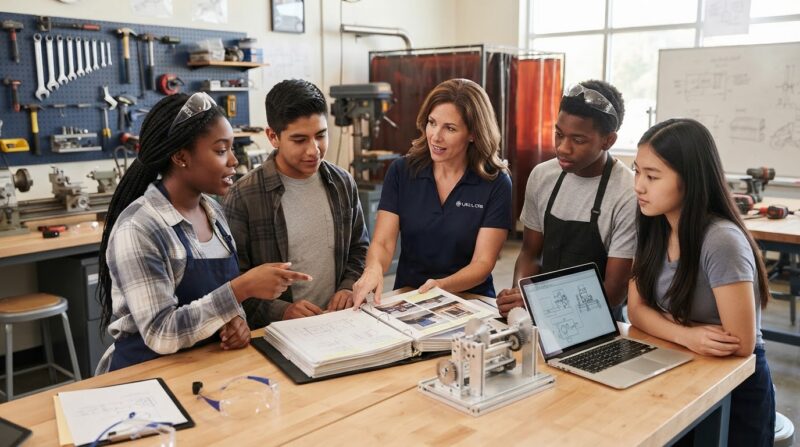
CTE laboratories offer a natural setting for developing these skills, since students can collaborate on authentic projects that require planning, testing and revising solutions.
Career Portfolios Offer a More Complete Picture
Wayzata High School in Minnesota provides another example of expanded career pathways. According to the report, approximately 85% of students take classes in one of the school’s 12 CTE pathways, including aviation, aerospace technology, graphic design and digital production.
Wayzata encourages students to develop portfolios showing what they can do. Unlike a transcript, a portfolio may contain examples of technical work, designs, credentials, projects and evidence of practical learning.
The portfolios are encouraged, rather than universally required at Wayzata. That distinction matters: schools can use them as an additional demonstration of learning without assuming every student follows the same educational route.
Portfolios may be especially helpful for students pursuing manufacturing, engineering technology, digital media and information technology, where work products can show capabilities more clearly than a course title.
Work-Based Learning Makes Skills Visible
Practical experience also gives students opportunities to practice professional behavior. At Bristol-Plymouth, cooperative work, internships and community projects connect technical assignments with real users and workplace standards.
Public-facing school programs, including culinary and cosmetology services, provide settings where students must deliver technical results while meeting customer expectations.
Those experiences can strengthen communication, dependability and problem-solving in ways that are difficult to replicate through written examinations alone.
What CTE Leaders Can Take From the Shift
For administrators, the emerging question is not whether academic knowledge still matters. It is how schools can make their students’ knowledge and capabilities visible.
Technical programs can combine rigorous coursework with authentic projects, employer input, credentials and structured reflection. Schools also need practical systems for evaluating the quality of portfolios and ensuring students have equitable access to work-based opportunities.
The goal is a stronger connection between classroom learning and the demands students will encounter after graduation—whether they enter employment, apprenticeships, community colleges or four-year institutions.
Career readiness is becoming less about a single graduation milestone and more about helping students demonstrate that they can learn, contribute and adapt.
Source: Education Week, November 23, 2026.