
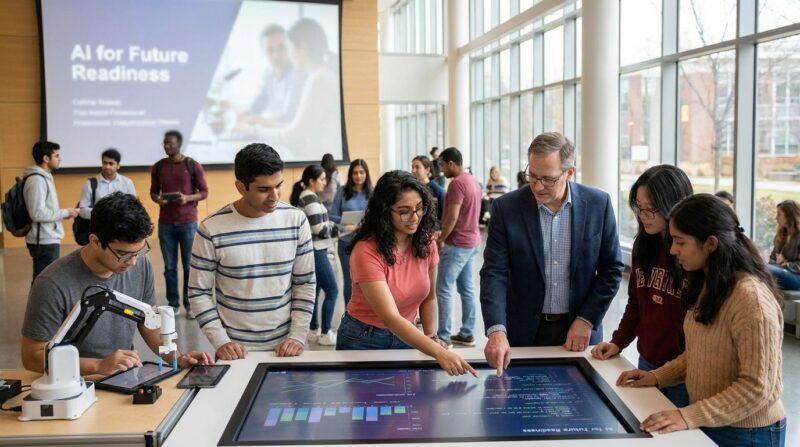
Google.org Backs Three Higher Education Initiatives to Advance AI Readiness
Introduction
In a significant move to bolster artificial intelligence (AI) education and workforce development across the United States, Google.org announced a substantial investment of $5 million distributed among three distinct higher education initiatives. This funding aims to address the growing demand for AI-skilled professionals, enhance curriculum development, and promote equitable access to AI education. The selected projects, each with a unique focus, represent a strategic effort to build a more robust AI-ready workforce capable of meeting the evolving needs of industries increasingly reliant on AI technologies. This article delves into the specifics of these initiatives, their implications for technical education, and the broader context of AI’s impact on the future of work.
In light of Google.org’s recent support for three higher education initiatives aimed at enhancing AI readiness, it is essential to consider the broader implications of technology education at all levels. An article that complements this discussion is titled “Automotive Education Needed in High School,” which emphasizes the importance of integrating technology-focused curricula in secondary education to prepare students for future careers in various tech-driven fields. You can read more about this vital topic in the article here: Automotive Education Needed in High School.
Strategic Investment in AI Skill Development
Google.org’s commitment of $5 million is directed towards three specific higher education institutions, each tackling different facets of AI readiness. The goal is to create scalable and impactful programs that can serve as models for other institutions and directly contribute to the pipeline of AI talent. This investment underscores the critical role of higher education in preparing individuals for the AI-driven economy.
Initiative 1: Expanding AI Curriculum and Instructor Training
One of the primary beneficiaries is focused on developing and disseminating accessible AI curriculum frameworks and providing comprehensive training for educators. This approach recognizes that a widespread shortage of qualified instructors and standardized, high-quality curriculum are significant barriers to broad AI education. By empowering educators, these initiatives aim to equip them with the knowledge and resources to teach AI concepts effectively, from foundational principles to advanced applications. The funding will likely support the creation of open educational resources (OERs), online modules, and in-person workshops designed to bring educators up to speed on the latest AI developments and pedagogical best practices.
Initiative 2: Fostering AI Talent from Underrepresented Communities
Another key initiative targets the expansion of AI educational opportunities for individuals from underrepresented and underserved communities. This component of the funding is crucial for promoting diversity and inclusion within the AI field, ensuring that the benefits of AI technology are shared broadly and that the workforce reflects the diverse population it serves. Programs will likely include scholarships, mentorship opportunities, dedicated outreach efforts to high schools and community colleges, and the development of AI bootcamps or certificate programs tailored to the needs of these populations. The aim is to dismantle systemic barriers and create pathways for individuals who might otherwise be excluded from AI education and careers.
Initiative 3: Bridging the Gap Between Academia and Industry
The third initiative focuses on strengthening the connection between academic AI programs and the needs of the industry. This involves developing collaborative projects, internships, and research opportunities that expose students to real-world AI challenges and equip them with the practical skills that employers are actively seeking. Partnerships with companies will be essential, providing students with hands-on experience with industry-standard tools and methodologies. This initiative seeks to ensure that graduates are not only theoretically sound but also possess the practical competencies to contribute immediately to AI-driven workplaces.
Why This Investment Matters for Technical Education
The Google.org investment arrives at a critical juncture for technical education. As AI permeates virtually every sector, from manufacturing and healthcare to finance and education itself, the demand for individuals with AI-related skills is surging. The Bureau of Labor Statistics (BLS) consistently highlights the strong growth in occupations related to computer and information technology, many of which are directly or indirectly influenced by AI. For example, the BLS projects that employment for software developers, a field increasingly incorporating AI expertise, is projected to grow 25 percent from 2022 to 2032, much faster than the average for all occupations. Similarly, data scientists and AI specialists are in high demand, with the BLS noting rapid growth in this area.
Technical education institutions, including community colleges and career and technical high schools, are uniquely positioned to play a vital role in this AI readiness effort. They can provide accessible, hands-on training that prepares students for roles that do not necessarily require a four-year degree but are essential for the AI ecosystem. This funding can help these institutions:
- Develop New AI-Focused Programs: Create or enhance programs in areas like AI ethics, machine learning operations (MLOps), data analytics for AI, AI-assisted design, and AI system maintenance.
- Upgrade Existing Facilities and Equipment: Invest in the necessary hardware, software, and cloud computing resources to offer practical AI training.
- Recruit and Retrain Faculty: Attract instructors with industry experience in AI and provide professional development for existing faculty to incorporate AI concepts into their current disciplines.
- Build Industry Partnerships: Establish stronger collaborations with local businesses to ensure curriculum relevance and provide student internship and job placement opportunities.
The emphasis on underrepresented communities is particularly relevant for technical education, which often serves as a crucial entry point for individuals from diverse socioeconomic backgrounds. By making AI education more accessible and inclusive, these initiatives can help address existing workforce disparities and create new economic opportunities.
Industry Context: The Pervasive Influence of AI
Artificial intelligence is no longer a futuristic concept; it is a present-day reality shaping industries and economies worldwide. From algorithmic trading in finance to predictive maintenance in manufacturing, AI is driving efficiency, innovation, and new business models. The U.S. Department of Commerce, in its various reports on AI, consistently emphasizes the national imperative to maintain a leading edge in AI development and deployment. This includes fostering a skilled workforce capable of developing, implementing, and managing AI systems.
The skills gap in AI is a significant concern for industry leaders. Companies are struggling to find qualified personnel to fill roles such as AI engineers, machine learning specialists, data scientists, AI ethicists, and AI trainers. This talent shortage can hinder innovation and slow down the adoption of AI technologies, impacting competitiveness. The initiatives funded by Google.org directly address this gap by investing in the educational infrastructure and human capital development necessary to meet industry demands.
The BLS projects that AI and machine learning specialists will be among the fastest-growing occupations. For instance, while specific data for “AI specialists” might be aggregated, the growth in related fields like “Data Scientists” (projected 35% growth from 2022 to 2032) and “Computer and Information Research Scientists” (projected 10% growth from 2022 to 2032) points to a broader trend. This demand necessitates a proactive approach from educational institutions to equip students with the requisite skills.
In a recent move to enhance AI readiness in higher education, Google.org has announced its support for three innovative initiatives aimed at equipping students with essential skills for the future. This initiative aligns with broader efforts to strengthen educational infrastructure, as highlighted in an article discussing the Infrastructure Investment and Jobs Act, which emphasizes the importance of modernizing educational facilities to support advanced technologies. For more insights on this topic, you can read the article here.
Impact on Technical Education: A Transformative Opportunity
This infusion of resources presents a transformative opportunity for technical education. It signals a recognition from major technology players like Google.org that the frontline of AI workforce development lies within institutions that provide practical, career-focused training.
Curriculum Modernization and Specialization
The funding will undoubtedly spur the modernization of existing technical programs and the creation of new, specialized AI-related courses and certifications. This could include:
- AI Fundamentals for Technicians: Courses that introduce core AI concepts, such as machine learning algorithms, neural networks, and data preprocessing, tailored for students in fields like automotive technology, advanced manufacturing, or cybersecurity.
- AI Application in Specific Trades: Modules within existing trade programs that demonstrate how AI is being used to enhance efficiency, improve diagnostics, or enable new functionalities. For example, AI-powered diagnostic tools in automotive repair or AI-driven quality control in advanced manufacturing.
- AI Ethics and Responsible AI: Courses that address the ethical considerations, bias, and societal implications of AI, crucial for responsible deployment and management of AI systems.
- MLOps and AI System Management: Training focused on the operational aspects of AI, including deployment, monitoring, maintenance, and scaling of machine learning models, bridging the gap between development and practical application.
Faculty Development and Retention
A significant portion of the funding is expected to be allocated to faculty development. This is critical, as many technical instructors may not have direct experience with AI. Initiatives could include:
- Industry Externships: Opportunities for faculty to spend time in industry settings, gaining hands-on experience with AI technologies and applications.
- Certification Programs: Support for faculty to obtain certifications in AI-related fields.
- Collaborative Curriculum Development Workshops: Bringing together faculty and industry experts to co-create relevant and